
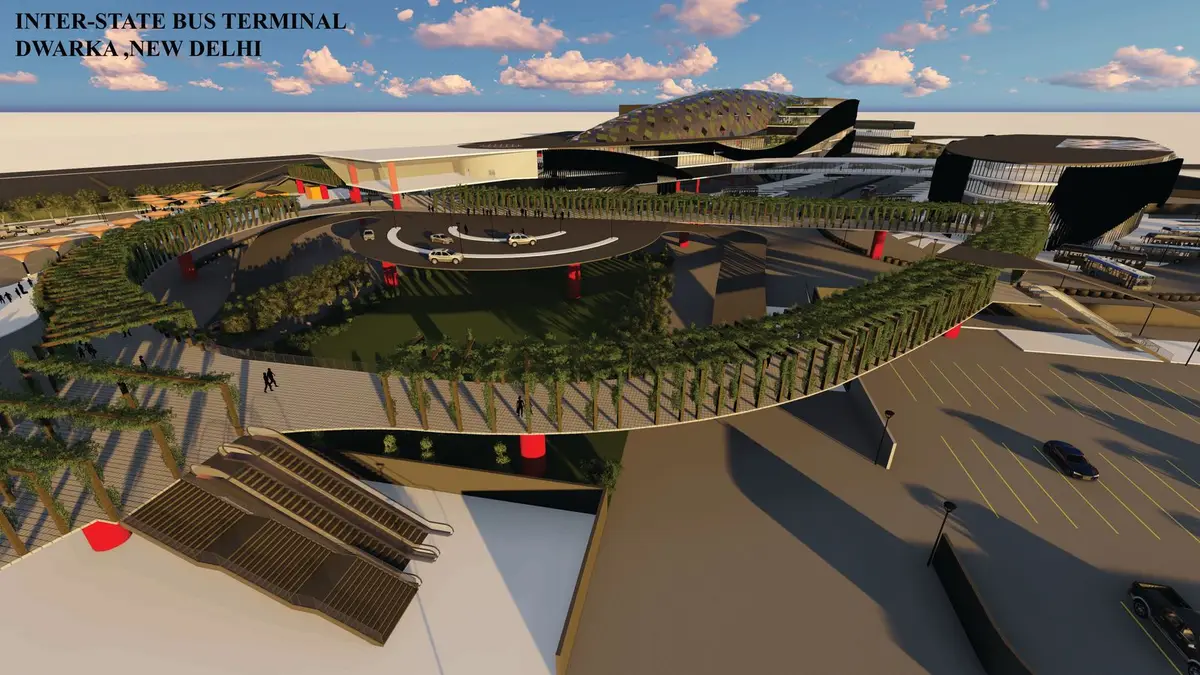
Interstate Bus Terminal, Dwarka: A No-Conflict Circulation System for New Delhi's Intercity Travel
An 11-hectare greenfield terminal in Sector 23 separates buses, cars, autos and pedestrians into dedicated loops under a solar-clad shell roof.


Most bus terminals fail at the same moment: when an intercity coach, a taxi, an e-rickshaw and a passenger dragging luggage all try to occupy the same few metres of asphalt. The Interstate Bus Terminal at Dwarka begins from that failure and designs against it. Its central proposition is a no-conflict circulation system, a site where every mode of movement gets its own path and none of them cross.
Developed by Shubham Solanki, the project imagines a new intercity hub on a greenfield site at Sector 23, Dwarka, in New Delhi. The site covers 11 hectares and is planned for an estimated 20,000 users per day. Alongside intercity and local bus operations, the brief folds in commercial space, offices and hotel accommodation, positioning the terminal as a piece of the city rather than a holding pen at its edge.
Five Movement Streams, Zero Intersections
The circulation diagram is the project's engine. Solanki assigns distinct loops to intercity buses, local buses, private cars and taxis, auto-rickshaws and e-rickshaws, and finally pedestrians, a category that covers passengers, staff and tourists. Each stream follows a dedicated route, so a coach pulling into its bay never has to negotiate with a cab dropping off a family.
What lifts this beyond traffic engineering is the use of vertical segregation. Rather than spreading every flow across a single ground plane, the scheme stacks user groups so that platforms, waiting areas, offices and amenities are reached without overlap. At 20,000 daily users, that decision is the difference between a terminal that feels crowded and one that feels organised.
Elongated Volumes Tuned to a Linear Site
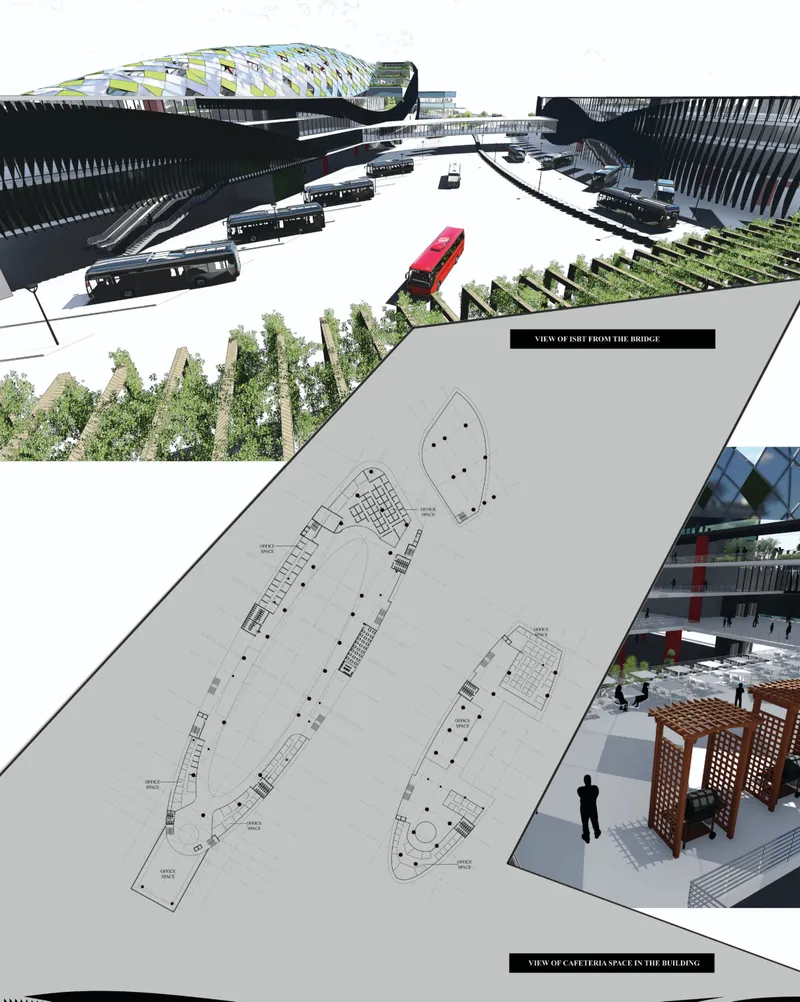
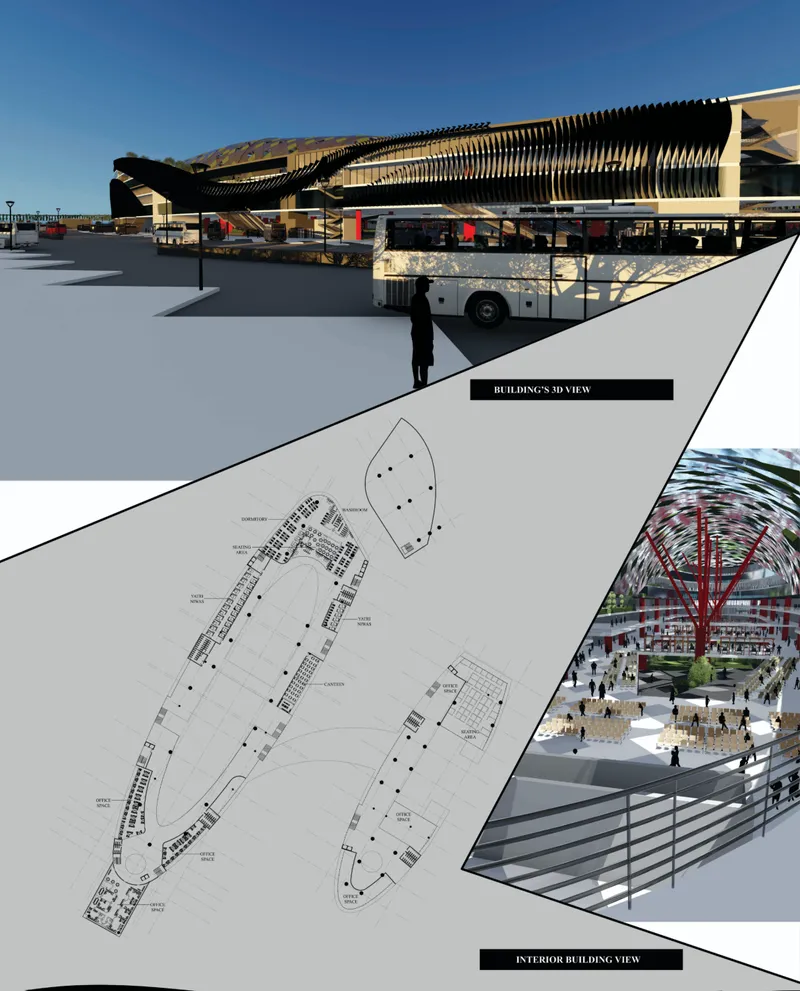
The master plan reads as a set of long built forms laid along the site's linear geometry. Bus bays, boarding zones and parking sit where they can be reached directly from the arterial roads, which trims the internal driving that typically clogs large terminals. Multilevel bus parking and idle bus zones, taxi and prepaid vehicle areas, and the maintenance, refuelling and service yards each claim a defined territory instead of spilling into one another.
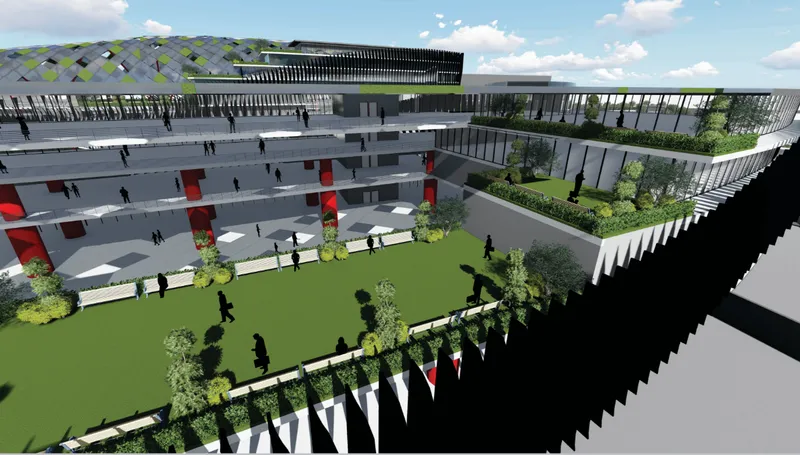
Bridges and elevated connections tie the parking areas to the terminals and upper-level facilities. This lifts a portion of the pedestrian load off the ground, keeping the lower level legible for vehicles. Landscaped green buffers and lawns stitch between the programme blocks, giving the plan breathing room and a softer edge toward the surrounding city.
A Central Atrium as the Orientation Spine
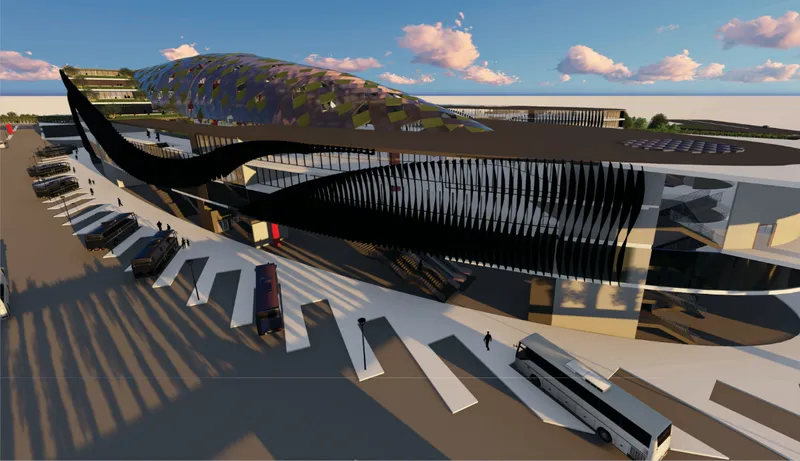
Inside, the terminal organises itself around a large central atrium. Ticketing, waiting zones, retail, food courts and services all open onto this shared volume, so a first-time traveller can see where they need to go before they have to ask. Wayfinding here is spatial before it is graphic, with clear signage reinforcing what the section already communicates.
Administrative offices, commercial programme and hospitality occupy the upper floors, keeping passenger-facing functions close to the platforms. Shaded walkways, generous waiting areas and an emphasis on universal accessibility suggest a designer thinking about the elderly traveller or the parent with a stroller, not only about peak-hour throughput.
A Shell Roof That Shades, Filters and Generates
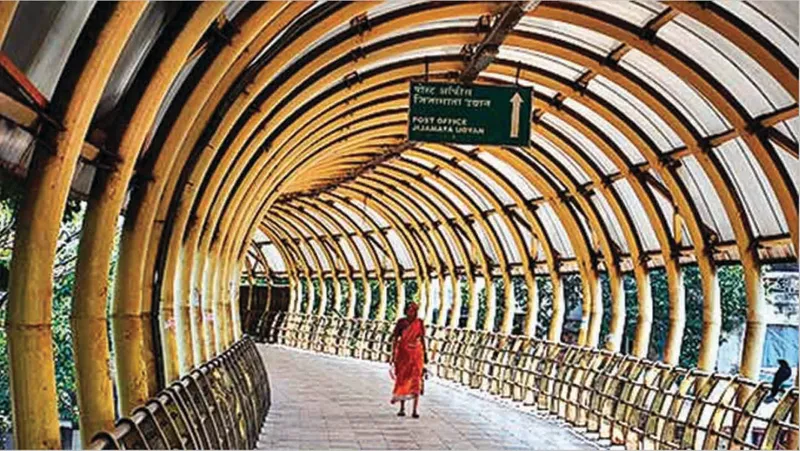
The expressive shell roof carries both the building's identity and much of its environmental strategy. It shades the interior and moderates daylight, filtering light and heat before they reach the public spaces below. Extensive roof-mounted solar panels are intended to let the building generate its own energy, while the atriums and open edges draw air through the terminal for natural ventilation, a sensible response to Delhi's heat.
The sustainability argument also loops back to circulation. By shortening internal travel distances, the plan lowers operational energy demand, and the green buffers help limit heat gain across the site. The point is that efficiency is not an add-on here; it is a consequence of the layout itself.
Why This Project Matters
Indian bus terminals are often treated as infrastructure first and architecture last, resulting in sprawling yards where pedestrians are an afterthought. The Dwarka ISBT reverses that hierarchy. By resolving conflicts between buses, cars, autos and people at the planning stage, it makes safety and clarity the foundation on which everything else is built.
Equally important is the decision to treat the terminal as an urban public building. Folding in commerce, offices and accommodation gives the site life beyond departure times and turns a transit point into an active node in the city. For a capital region facing growing demand for intercity mobility, the project offers a useful template: separate the flows, shorten the distances, and let the roof work as hard as the plan.
View the Full Project
About the Designers
Designer: Shubham Solanki
Enter a Design Competition on uni.xyz
uni.xyz runs architecture and design competitions year-round that reward proposals with spatial conviction and real site intelligence.
Project credits: Interstate Bus Terminal (ISBT) by Shubham Solanki.


Popular Articles
Popular articles from the community


Cube Design Draws an Ecological Corridor Between Two Shenzhen Hills with the Nankai Building
Beside Shenzhen's container docks, the Nankai Building pairs stacked balconies with a climbing green screen to connect two hillsides across its height.

U.GA Architects Wraps an Oval Rooftop Pool in Curved Board-Formed Concrete on Busan's Jeollidan-gil
In Busan's Jeonpo-dong, a 454 m² mixed-use block stacks a neighborhood facility, guest rooms and an oval rooftop pool inside spiraling concrete walls.

Juan García Correa, John González and Claudia Rueda Sink a Circular Amphitheater into a Manizales Engineering Building
On the La Nubia campus in Manizales, Colombia, the S1 Building folds labs and offices into a hillside of ramped lawns that double as a campus route.

Architekt Andreas Gruber Scatters 23 Dark Timber Chalets Across a South Tyrolean Forest Edge
In Molini di Tures, Amonti Chalets breaks a resort into a hamlet of gabled timber houses, with parking, storage and services pushed into the slope.

Similar Reads
You might also enjoy these articles

Maya Harvest: A Cacao Resort Village Rooted in Mayan Tradition and Local Craft
Situated within a Tabasco cacao plantation, this shortlisted resort proposal merges vernacular materials with hands-on cultural immersion.
Harmonia: A River-Shaped Community That Grows Over Decades in Boa Vista
Curved pathways and modular grid structures along the Branco River create a phased settlement designed to evolve from 2030 to 2050.
The Architecture of Bathing: A Mughal Hammam Reimagined Across the Yamuna
Charlotte May's honorable mention entry for The Black Taj reinterprets Agra's bathing rituals through red sandstone, water, and framed views of the Taj Mah
Om-1: A Wall-Hung System That Moves Your Workspace Off the Desk
Modular plywood boards, magnetic pegs, and utility elements migrate clutter from the horizontal surface to the vertical plane.

Explore Transit Hub Competitions
Discover active competitions in this discipline

Challenge to reimagine the Iron Throne

Photograph architecture without architects

Illustrate the lost glory of Angkor Wat - Render Challenge

Design challenge to reuse E-waste
Comments (0)
Please login or sign up to add comments
No comments yet. Be the first to comment!