

XY Contemporary Turns a Quebec Strip Mall into an Adult Candyland for Jack Le Coq
A 2,600 m² fast food restaurant in Laval, Canada, channels 1950s diner nostalgia through neon arches, checkered floors, and candy-colored furniture.


Strip malls are where restaurant interiors go to die. The formula is familiar: drop ceilings, neutral palettes, franchise-grade furniture bolted to the floor. XY Contemporary Interior Design Office, led by René Tringali, took that premise and detonated it for Jack Le Coq, a Quebec fast food chain whose Laval location occupies 2,600 square meters of what could have been forgettable retail space. Instead, the 2022 project reads like a fever dream where a 1950s diner collided with a candy store, and neither side lost.
What makes the project genuinely interesting is not just the color, which is easy, but the spatial intelligence hiding underneath it. Restaurant owner Jack Gaspo wanted an environment that would lift people's spirits after the pandemic, and XY Contemporary responded with a design that is operationally rigorous beneath its playful surface. Handmade mirrors are positioned to eliminate blind spots for staff. Custom fixtures change from location to location so no two restaurants feel like copies. The result is a chain restaurant that refuses to behave like one.
Neon Arches as Spatial Punctuation
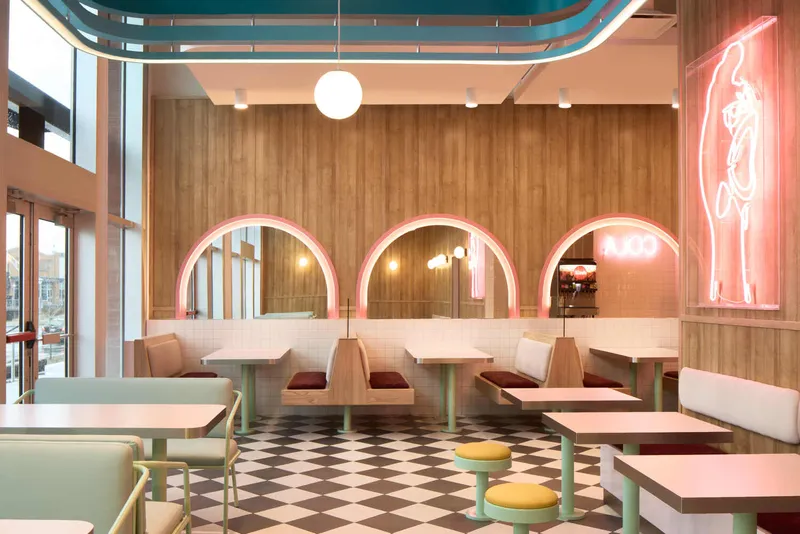
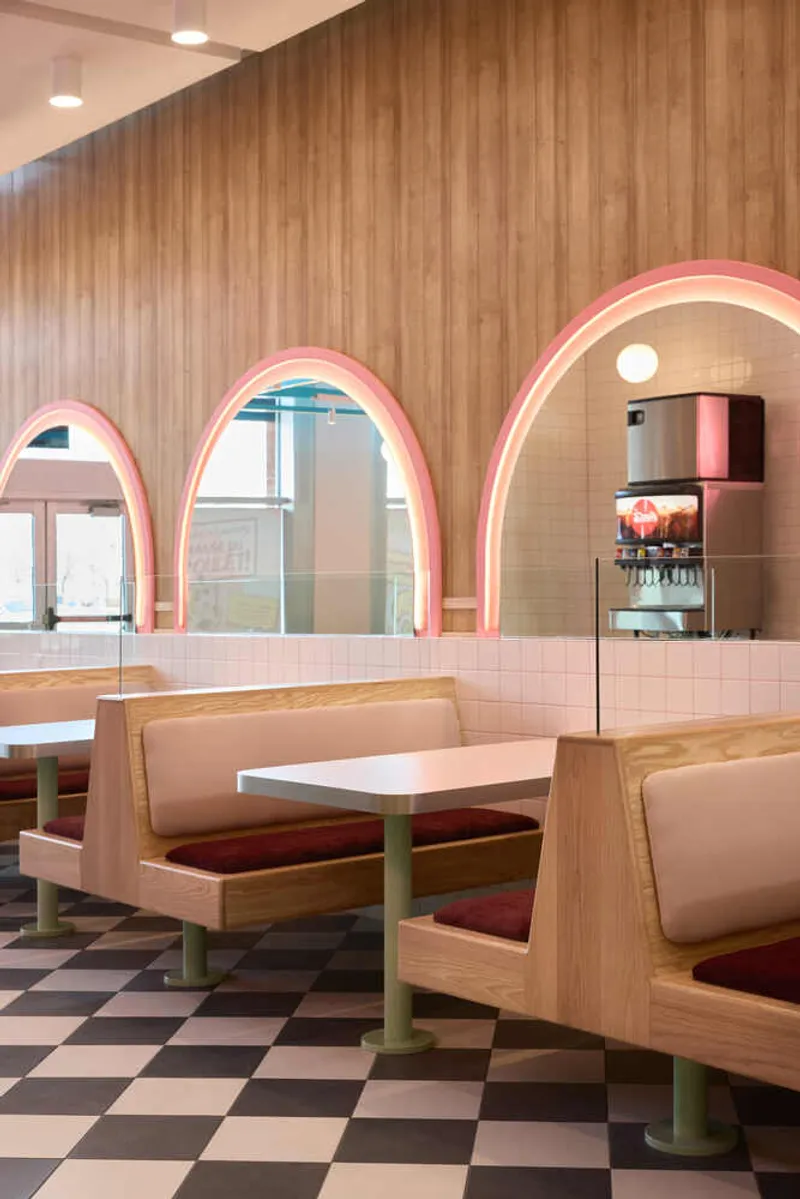
The most immediately recognizable motif is the pink neon arch, repeated across partitions, reflected in glass, and set into half-walls of white tile. These arches do more than glow. They subdivide a large floor plate into zones that feel intimate without closing off sightlines across the room. The triple-arched openings framed by white tile and wood paneling create a threshold effect, marking transitions between seating areas the way a doorway might, but without the wall.
Booth seating framed in blonde wood picks up the arch geometry, and the neon reflections in the glass behind double the effect. It is a trick that makes a fast food restaurant feel layered and considered, which is exactly the point. The neon is not decoration applied to a finished room. It is the room's organizing principle.
The Checkered Floor Anchors Everything
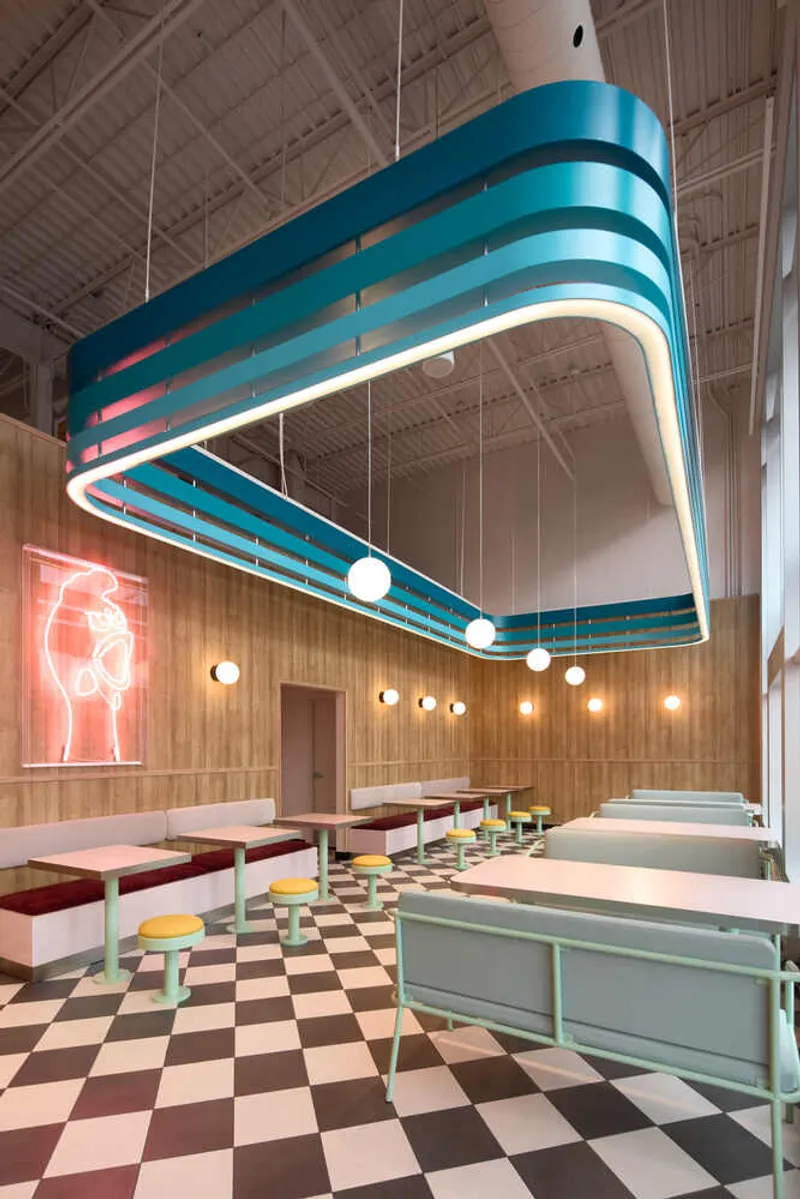
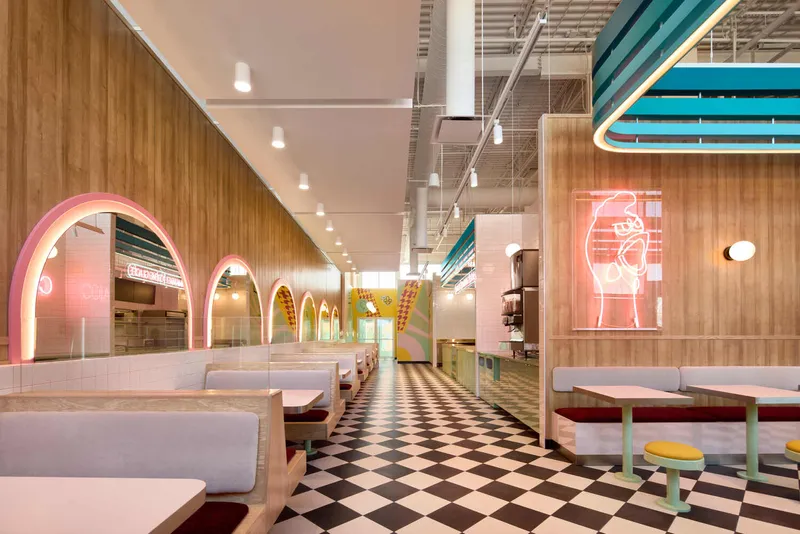
A black and white checkered floor is the oldest diner cliché in the book, and XY Contemporary leans into it without apology. The floor runs the full length of the dining room, providing a visual constant beneath a ceiling that is anything but constant. Suspended blue banded canopies, exposed structure, and hanging fixtures all compete for attention overhead, and the checkered plane below keeps the whole composition from tipping into chaos.
The long view through the dining room in image 3 reveals the strategy most clearly. Pink arched partitions march into the distance, the floor tiles pull the eye forward, and the exposed ceiling stays raw and industrial above it all. The contrast between the polished surface at foot level and the unfinished one overhead gives the space a productive tension: half finished restaurant, half stage set.
Color as Identity, Not Afterthought
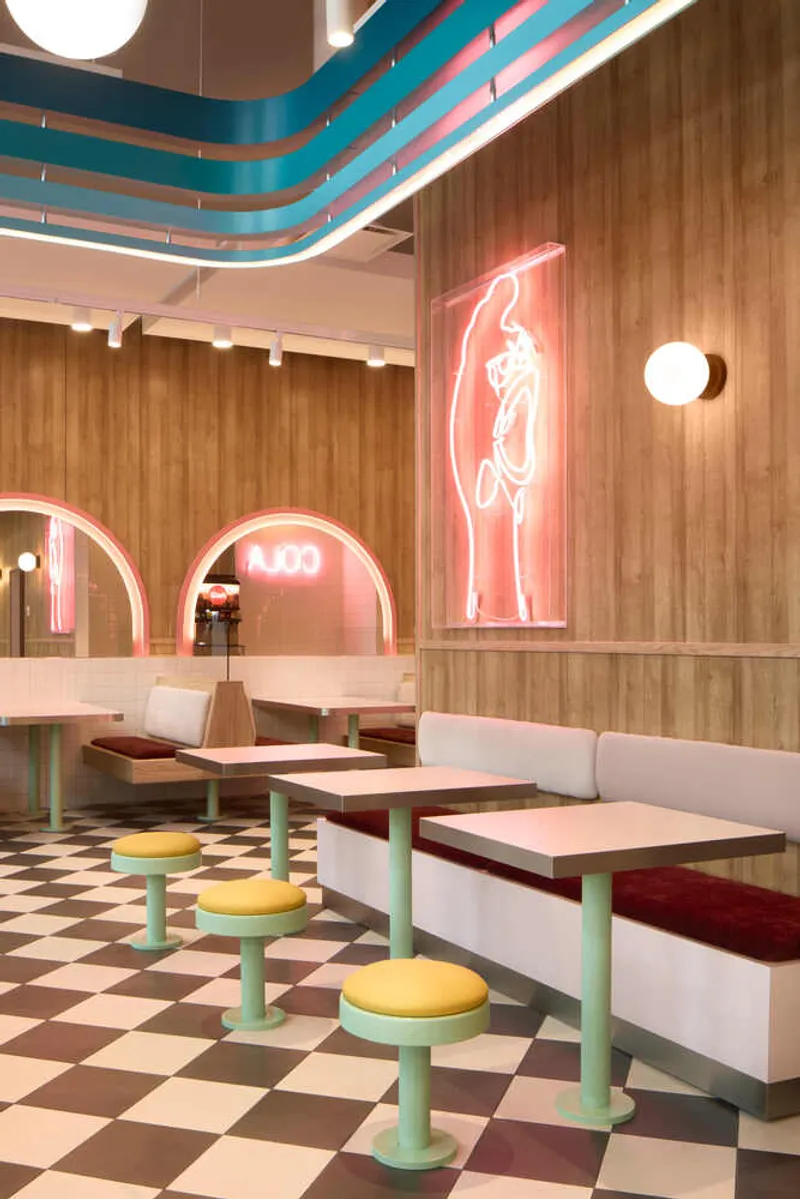
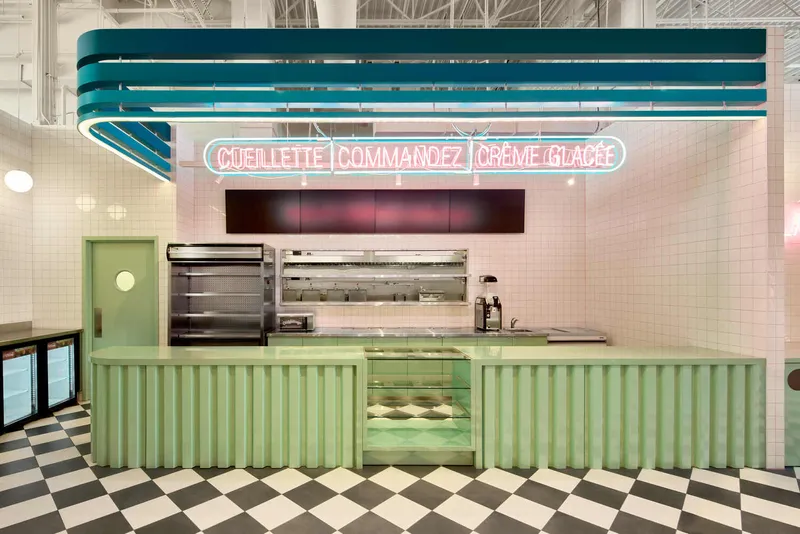
The palette here is unapologetically saturated. Mint green ribbed panels wrap the service counter. Yellow stools pop against vertical wood paneling. A pink neon figure, part signage, part art installation, glows on the wall above a banquette. XY Contemporary sourced materials from Benjamin Moore, Formica, and Daltile to achieve surfaces that could hold these colors without looking cheap under fluorescent light. The material choices matter because saturated color on a flimsy substrate reads as a children's party, while saturated color on solid laminate and tile reads as intentional.
The service counter is a standout moment. The ribbed mint base gives it a physical texture that photographs well but also creates a visual weight that grounds the counter against the busier wall behind it. Pink neon signage above and white tile below frame the transaction zone, making the act of ordering food feel like approaching a stage.
Sculptural Volumes and the Exposed Ceiling
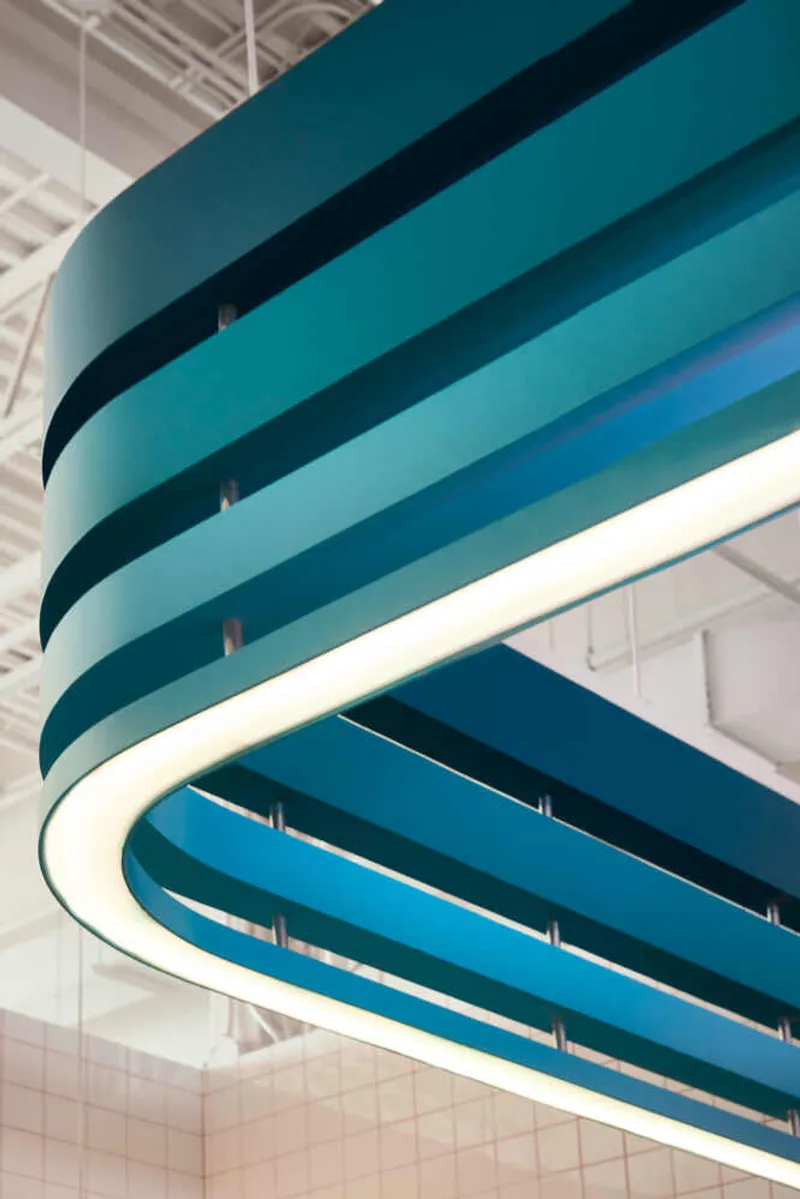
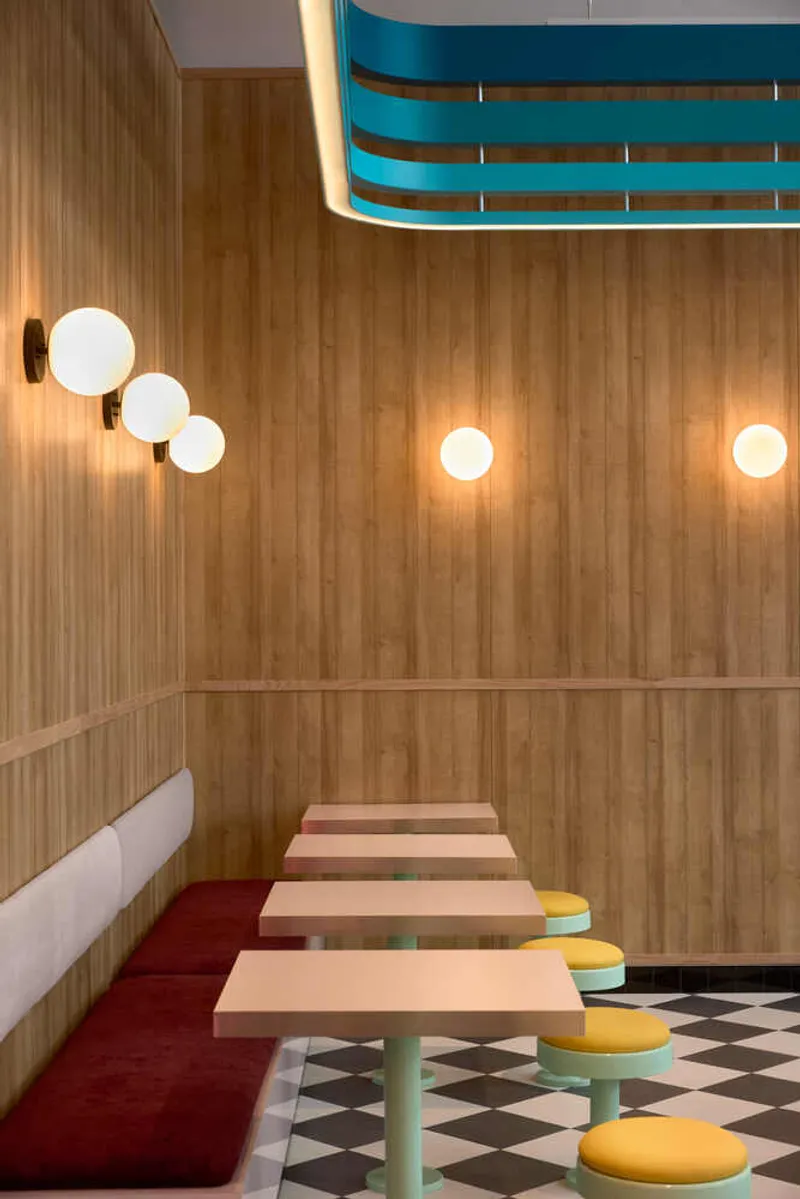
The turquoise balcony edges curving against the raw ceiling structure reveal the project's most ambitious spatial move. Rather than concealing the mechanical infrastructure above, the design team introduced sculptural volumes that interact with it. These layered, curving forms in turquoise read as fragments of a larger geometry, as if a more complete interior has been partially peeled away to reveal the building's bones.
Leaving the ceiling exposed is a cost-saving measure in strip mall construction, but here it becomes a design asset. The contrast between the curated surfaces below and the utilitarian reality above keeps the space from feeling hermetically sealed. It breathes. It also signals honesty about what the building actually is: a commercial box in a parking lot, dressed up brilliantly on the inside.
Why This Project Matters
Chain restaurants rarely get discussed as serious interior design. The economics push toward replication, the timelines push toward speed, and the result is usually a space that looks fine in a brand manual and dead in person. XY Contemporary's work for Jack Le Coq pushes back against every one of those tendencies. Each location gets custom fixtures and distinct spatial character, which means the brand identity lives in attitude and palette rather than in a photocopied layout. That is a more resilient form of branding, and a far more interesting one.
The project also demonstrates that post-pandemic hospitality design does not need to be cautious. The instinct after 2020 was to make restaurants feel safe, clean, clinical. Jack Le Coq goes the other direction: loud, warm, unapologetically joyful. The mirrors that solve sightline problems for staff, the neon arches that divide the floor plate, the checkered floor that holds the chaos together: these are all disciplined design decisions dressed in playful clothing. The lesson is that rigor and delight are not opposites. They are collaborators.
Jack Le Coq Restaurant Interior Design by XY Contemporary Interior Design Office. Location: Laval, Canada. Area: 2,600 m². Year: 2022. Lead Architect: René Tringali. Designers: Genevieve Ghaleb, Bella Astor. Project Manager: Katherine Martin. General Contractor: Groupe Manovra. Photography by Phil Bernard.
About the Studio
Share Your Own Work on uni.xyz
If projects like this are the kind of work you want to make, uni.xyz is a place to publish your own, find collaborators, and enter design competitions.


Popular Articles
Popular articles from the community


The Amber Palace Opera: A Geological Fiction Surfaces on Tallinn's Baltic Waterfront
Pierre Brillard reimagines a Baltic legend as a public landscape, opera house, and waterfront promenade rooted in Tallinn's coastal identity.


graciastudio Turns a Viewless Tijuana Lot Inward Around a Courtyard of Concrete, Timber and Trees
In Tijuana, Jorge Gracia's GA2 House stacks a timber-clad private floor over exposed concrete and replaces a missing view with a planted interior patio.

David Ortega Stacks a Two-Story Mexico City Penthouse Around a Steel Stair and a Pergola-Shaded Roof Terrace
In Colonia Roma, a 300 m² penthouse uses oak joinery, a planted steel stair and a slatted roof pergola to make a new-build apartment feel like a house.

Aquadapt: An Underwater Habitat That Rewrites Its Rooms by the Hour
Curved modules ring the seabed while one shell shifts from breakfast room to cinema, farm and football pitch as residents' needs change.

Similar Reads
You might also enjoy these articles


Hodi-Mandai Geram
Project Function: Preservation and revitalization of the Intangible heritage and socio-spatial identity of the Hodi by Housing, Cultural Memory Center, Sacred Grove, landscape, local tourism economy


Olio Towers: A Mid-Rise for Performers That Fuses Housing, Rehearsal, and Stage
Located blocks from Houston's Theater District, this modular tower stacks living units around a central performance atrium.

Oasis: Modular Green Housing Carved into Dhaka's Urban Fabric
A shortlisted Plugin Housing entry reclaims unauthorized settlements in Dhaka with stepped concrete volumes, green roofs, and ventilation-driven design.

Black Hole: A Floating Megastructure for the Post-Physical Era
Emiliano Mazzarotto envisions a spherical, self-scaling arena where e-sports, digital hotels, and holographic stadiums replace traditional public space.

Explore Interior Design Competitions
Discover active competitions in this discipline

Challenge to design luxury tourism on rails

Challenge to reimagine the Iron Throne

Photograph architecture without architects

VR headsets Storefront design competition
Comments (0)
Please login or sign up to add comments
No comments yet. Be the first to comment!