
Landscape Infrastructure for Eco-Tourism in Mostardas, Brazil
Designing human-scale landscape infrastructure that connects ecology, culture, and eco-tourism along Brazil’s coastal lagoons.


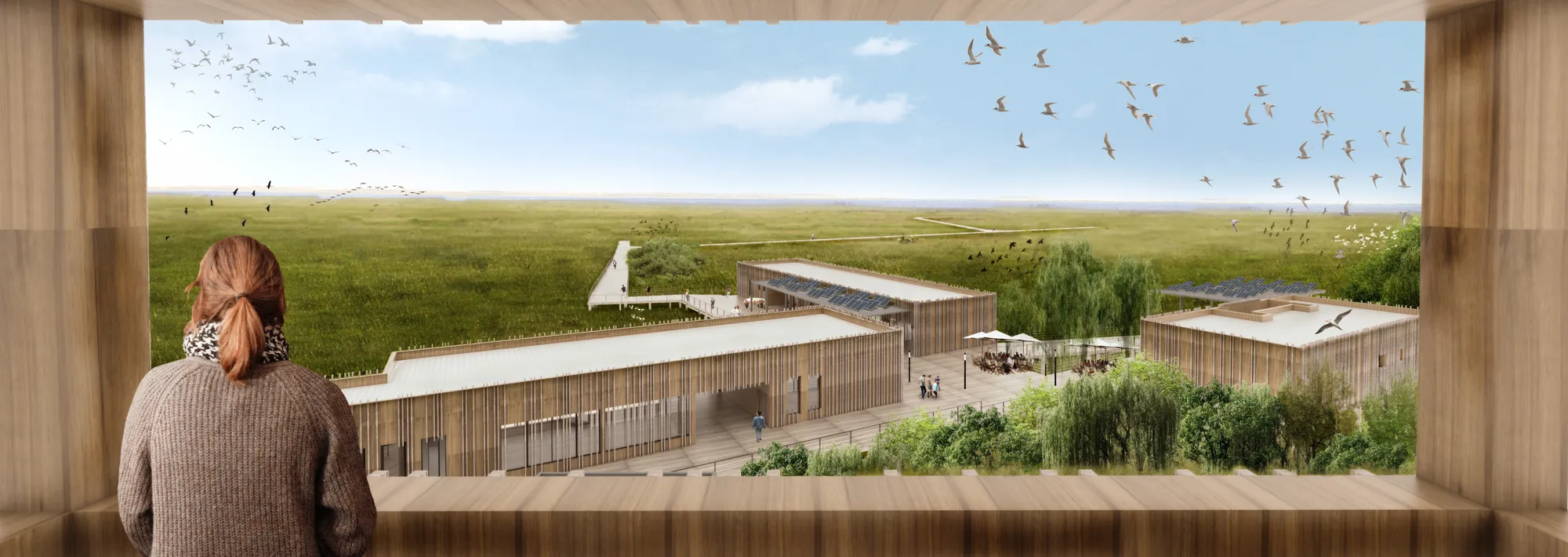
The project Landscape Infrastructure: Cultural and Tourism Improvements for Mostardas City, by Pedro Terra Oliveira, explores how landscape infrastructure architecture can act as a subtle yet powerful framework to connect urban life, fragile ecosystems, and emerging eco-tourism economies. Located in Mostardas, Rio Grande do Sul, Brazil, the proposal carefully navigates the relationship between built form and nature, positioning architecture not as an object, but as a system embedded within the territory.
Set between the Lagoa dos Patos and the Lagoa do Peixe National Park, the project responds to a landscape defined by water, migratory birds, wetlands, and long horizontal horizons. Rather than imposing iconic structures, the intervention introduces a sequence of minimal, modular elements that enhance accessibility, environmental awareness, and cultural identity without compromising ecological balance.
Territorial Reading and Environmental Context
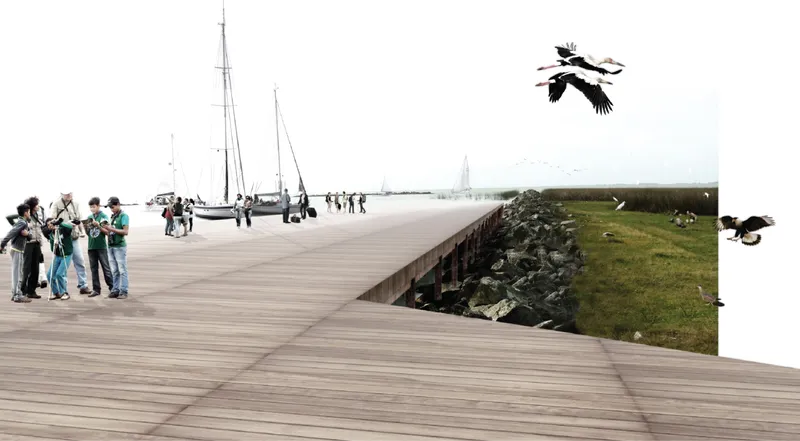
A comprehensive territorial analysis underpins the proposal. Mapping waterways, urban centers, lighthouses, harbors, beaches, and protected zones reveals Mostardas as a strategic hinge between ecological systems and human occupation. The Lagoa do Peixe National Park, an internationally protected RAMSAR site, plays a central role, hosting migratory bird routes that span continents.
This ecological sensitivity demands an architectural response rooted in restraint. The project adopts landscape infrastructure architecture as a methodology: where pathways, observation decks, housing modules, and research facilities are woven into the land with minimal disturbance. Architecture becomes an extension of natural systems rather than a competing force.
Connecting, Activating, Integrating
The spatial strategy unfolds through three interrelated actions: connect, activate, and integrate.
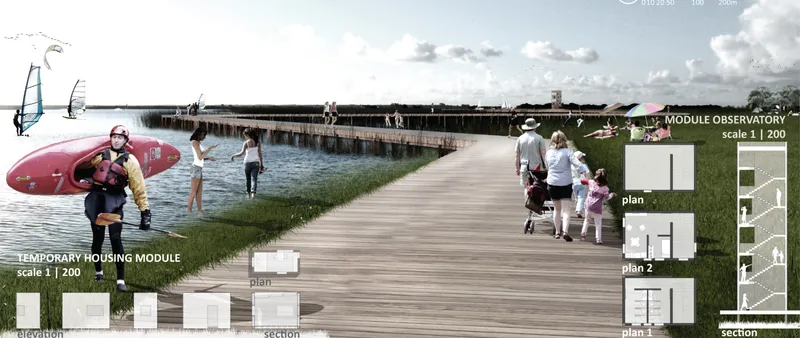
- Connect: Walkways, bridges, and navigation points establish a continuous network linking lagoons, urban areas, and ecological landmarks. These connections reinforce cultural heritage while improving access for residents, researchers, and visitors.
- Activate: Strategic architectural insertions—such as observation towers, docks, and temporary housing—activate previously underused areas. These interventions introduce new rhythms of occupation without overwhelming the landscape.
- Integrate: Architecture operates as landscape. Built forms follow natural contours, respond to wind and water, and adapt to varying levels of environmental sensitivity.
Together, these actions demonstrate how landscape infrastructure architecture can support tourism, research, and education simultaneously.
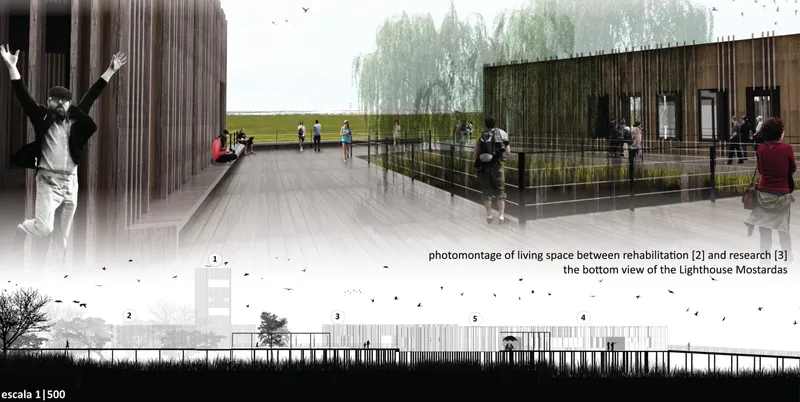
Architecture for Research, Education, and Tourism
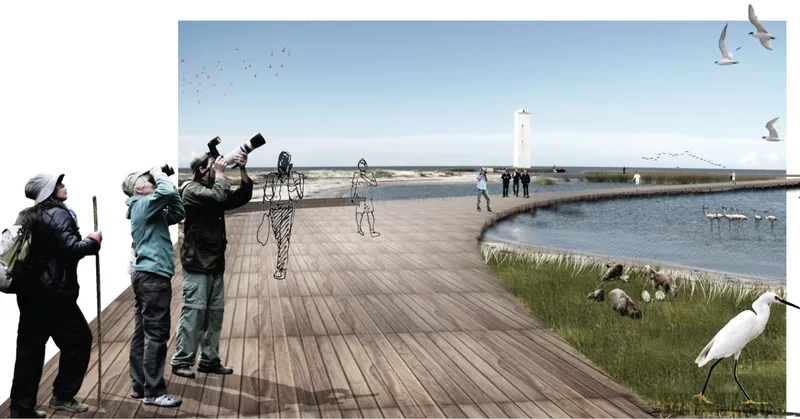
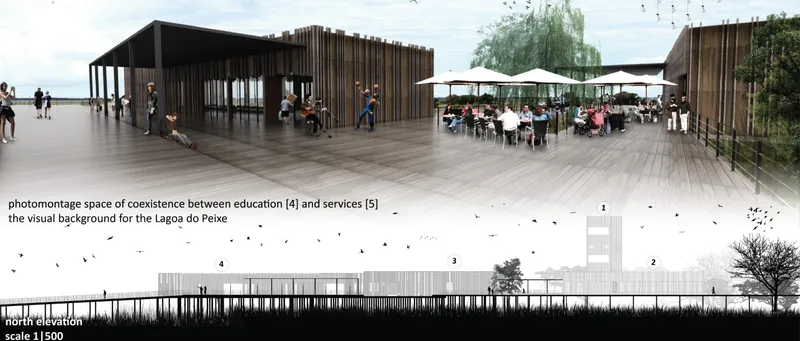
The programmatic framework balances environmental protection with human engagement. Key components include observatories, rehabilitation and research laboratories, lodging for researchers, educational spaces, and visitor services. These elements support field studies, ecological monitoring, and environmental education, transforming the site into a living laboratory.
Importantly, tourism here is not extractive. Visitors are guided through curated paths that encourage observation, learning, and respect for nature. Architecture becomes a mediator, structuring experiences while preserving ecological integrity.
Material Strategy and Constructive Logic
Material choices reinforce the project’s environmental ethos. Locally sourced eucalyptus wood, treated pine, and regionally manufactured components ensure low cost, ease of assembly, and reduced carbon impact. Modular construction allows buildings to adapt, expand, or be removed as environmental conditions change.
Thermo-acoustic insulation derived from regional by-products, such as rice husk and cementitious mortars, further anchors the architecture in local material culture. The result is a construction system that is lightweight, reversible, and deeply contextual.
Cultural and Environmental Value
Beyond physical infrastructure, the project strengthens Mostardas’ cultural identity. Lighthouses, harbors, and traditional navigation routes are reinterpreted as focal points within the landscape network. These landmarks anchor collective memory while opening new narratives around sustainability and coexistence.
By aligning ecological preservation with economic opportunity, the proposal demonstrates how landscape infrastructure architecture can generate long-term value. Eco-tourism becomes a tool for education, conservation, and community engagement rather than mere consumption.
Landscape Infrastructure, Cultural and Tourism Improvements for Mostardas City presents a compelling model for contemporary architectural practice. Through minimal intervention, territorial intelligence, and ecological sensitivity, the project shows how architecture can operate as infrastructure, landscape, and cultural mediator at once.
In an era of environmental urgency, this approach to landscape infrastructure architecture offers a scalable, responsible framework: one that respects nature, empowers communities, and redefines the role of architecture in fragile territories.




Popular Articles
Popular articles from the community

AL-JANNAH: Sustainable Architecture and Permaculture for Afghan Widows
AL-JANNAH uses sustainable architecture and permaculture to create resilient oasis of housing, learning, work and renewal for Afghan widows.

Hill & Cross Opera: Sculptural Opera House Architecture Shaped by Tallinn’s Landscape and Identity
Hill & Cross Opera reimagines opera house architecture in Tallinn through its sculptural hill, civic plaza, glass wave and a luminous cross.

Riyadh For All: Intergenerational Urban Design for Active Aging in Rabat
Riyadh For All reimagines urban design in Rabat with intergenerational co-living, adaptive courtyards, and Moroccan cultural exchange today.

Conexión: Biophilic Design Reimagines High-Rise Living in Hong Kong
Conexión reimagines high-rise living in Hong Kong through biophilic design, green facades, shared spaces, daylight, water and nature within.


Similar Reads
You might also enjoy these articles

Maya Harvest: A Cacao Resort Village Rooted in Mayan Tradition and Local Craft
Situated within a Tabasco cacao plantation, this shortlisted resort proposal merges vernacular materials with hands-on cultural immersion.
Harmonia: A River-Shaped Community That Grows Over Decades in Boa Vista
Curved pathways and modular grid structures along the Branco River create a phased settlement designed to evolve from 2030 to 2050.
The Architecture of Bathing: A Mughal Hammam Reimagined Across the Yamuna
Charlotte May's honorable mention entry for The Black Taj reinterprets Agra's bathing rituals through red sandstone, water, and framed views of the Taj Mah
Om-1: A Wall-Hung System That Moves Your Workspace Off the Desk
Modular plywood boards, magnetic pegs, and utility elements migrate clutter from the horizontal surface to the vertical plane.

Explore Landscape Urbanism Competitions
Discover active competitions in this discipline



Challenge to reimagine the Iron Throne


Photograph architecture without architects


Illustrate the lost glory of Angkor Wat - Render Challenge


Design challenge to reuse E-waste
Comments (0)
Please login or sign up to add comments
No comments yet. Be the first to comment!