

Las Rocas House Complex by Ignacio Urquiza Arquitectos and Ana Paula de Alba
Las Rocas is a modular, nature-integrated housing complex in Valle de Bravo, blending architecture with rocky terrain, vegetation, light, and landscape.


A Regenerative Residential Sanctuary Integrated into the Landscape of Valle de Bravo
Las Rocas is a thoughtfully designed residential complex located in the northern region of Valle de Bravo, Mexico, within the elevated terrain of La Peña. Conceived by Ignacio Urquiza Arquitectos and Ana Paula de Alba, the project transforms a 6,400-square-meter site into a regenerative living environment deeply rooted in natural topography, endemic vegetation, and rocky outcrops. With four homes totaling 3,200 square meters, the development redefines rural retreat living through minimal impact, modular flexibility, and a sensitive relationship between architecture and the surrounding nature.


Respecting the Landscape Through Careful Site Placement
The design began with an extensive site analysis to understand the terrain’s existing conditions—runoff paths, rock formations, and local vegetation. Each house was strategically positioned to minimize disruption to these natural elements. The land was approached as an extension of the adjacent nature reserve, reinforcing the architects’ commitment to environmental regeneration.
A narrow cobblestone path leads residents to a centralized service core containing parking, storage, cisterns, machine rooms, and treatment systems. Vehicles are left behind, allowing residents to approach their homes on foot through a network of steps and pathways. This transitional experience reinforces the shift from urban life to immersive nature.


A Modular System Adapted to Each Micro-Context
The project emerged from a modular design strategy. Each house uses the same architectural components, but their configuration responds uniquely to the specific topographic and environmental conditions of its location. Volumes are arranged freely along six orientations—front, back, above, below, left, and right—allowing the architecture to settle gently into its surroundings.
Separation between volumes creates voids, courtyards, light wells, and ventilation channels. Nature becomes an active participant in the design: a bathroom may be shaped around a boulder, a tree may become part of a roofline, and the uneven terrain becomes a pathway or staircase. The site guides the architecture—not the other way around.


Circulation as a Spatial and Climatic Connector
Circulation corridors serve as linear spines that link volumes horizontally and vertically. Their openness contrasts the enclosed sleeping and private areas, creating a rhythmic sequence between sheltered and exposed spaces. These corridors capture southern light and local warmth, improving passive climate regulation while allowing views toward vegetation and rocky formations.

Living Spaces That Frame the Landscape
The living and dining areas feature dramatic corner windows supported by a 5 × 10-meter cantilever. This structural gesture dissolves boundaries between interior and exterior, ensuring these communal spaces become central gathering points rather than underused secondary rooms—a common issue in the rural homes around Valle de Bravo.
The kitchen integrates seamlessly with the social spaces and can be opened or closed through sliding partitions. Terraces were crafted last in the design process, carefully mapped on-site to ensure they blend into the landscape and expand each home’s connection to the outdoors.


Material Simplicity That Enhances Natural Presence
Las Rocas is defined by its subtle palette: light-gray stucco walls that echo the color of local stone, textured stone flooring, and glass flush with the façade, creating a smooth, reflective surface that visually merges with the environment. The restrained materiality highlights the landscape rather than competing with it. The homes feel both grounded and light, allowing surrounding vegetation and geological features to dominate the experience.


Bespoke Interior Design Tailored to Each Family
Ana Paula de Alba designed custom interiors for all four residences, tailoring each home to the lifestyle and preferences of the family inhabiting it. This personalized approach gives every house its own identity while maintaining coherence with the overall architectural language. The result is a harmonious balance between user needs, architectural clarity, and natural context.


All photographs are works of Onnis Luque


Popular Articles
Popular articles from the community


Singing Woman: An Opera House That Performs Before the Curtain Rises
Ovidiu Cristian Pavel's conceptual opera house translates Estonia's choral identity into a sculpted waterfront landmark facing the Baltic Sea.

Aquadapt: An Underwater Habitat That Rewrites Its Rooms by the Hour
Curved modules ring the seabed while one shell shifts from breakfast room to cinema, farm and football pitch as residents' needs change.


graciastudio Turns a Viewless Tijuana Lot Inward Around a Courtyard of Concrete, Timber and Trees
In Tijuana, Jorge Gracia's GA2 House stacks a timber-clad private floor over exposed concrete and replaces a missing view with a planted interior patio.
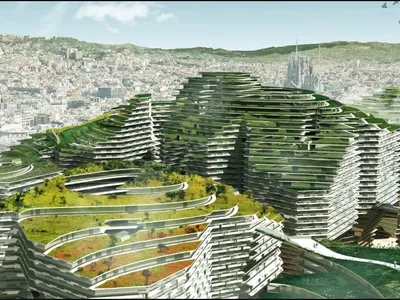
Manzana Morphosis: Stretching Barcelona's Grid into a Living Landscape for 2050
A radical reworking of the Eixample manzana turns density into a tool for generous public space, vertical ecology, and environmental performance.

Similar Reads
You might also enjoy these articles


Hodi-Mandai Geram
Project Function: Preservation and revitalization of the Intangible heritage and socio-spatial identity of the Hodi by Housing, Cultural Memory Center, Sacred Grove, landscape, local tourism economy


Olio Towers: A Mid-Rise for Performers That Fuses Housing, Rehearsal, and Stage
Located blocks from Houston's Theater District, this modular tower stacks living units around a central performance atrium.

Oasis: Modular Green Housing Carved into Dhaka's Urban Fabric
A shortlisted Plugin Housing entry reclaims unauthorized settlements in Dhaka with stepped concrete volumes, green roofs, and ventilation-driven design.

Black Hole: A Floating Megastructure for the Post-Physical Era
Emiliano Mazzarotto envisions a spherical, self-scaling arena where e-sports, digital hotels, and holographic stadiums replace traditional public space.

Explore Architecture Competitions
Discover active competitions in this discipline

Challenge to reimagine the Iron Throne

Photograph architecture without architects

Illustrate the lost glory of Angkor Wat - Render Challenge

Design challenge to reuse E-waste
Comments (0)
Please login or sign up to add comments
No comments yet. Be the first to comment!