

Lautenbag Architectuur Tucks a Modern Barn House Behind an 18th-Century Monument in Friesland
Villa Oranjewoud draws on the Frisian landscape of forests and meadows to craft a restrained 200 m² timber home that barely registers from the street.


Oranjewoud sits in the kind of Frisian landscape that resists spectacle: wide meadows, slow ditches, stands of trees that filter light more than they frame views. Building here demands a certain reticence. Lautenbag Architectuur, led by Diana Lautenbag, understood the assignment. Villa Oranjewoud, completed in 2021, is positioned diagonally behind an eighteenth-century gardener's house that serves as a national monument. From the public street, you would barely know the new house is there at all.
What makes the project worth studying is not a single dramatic gesture but a series of disciplined choices that add up to a house of real quality. The front facade is almost entirely closed. Living spaces open to the side and rear, where farmland views and garden light pour in through generous glazing. The typology is a barn house, recognizable in its gabled silhouette and vertical timber cladding, yet the proportions, details, and material restraint mark it as unmistakably contemporary. It is a house that looks as though it has always occupied its site, which is precisely the point.
A Closed Front, an Open Back
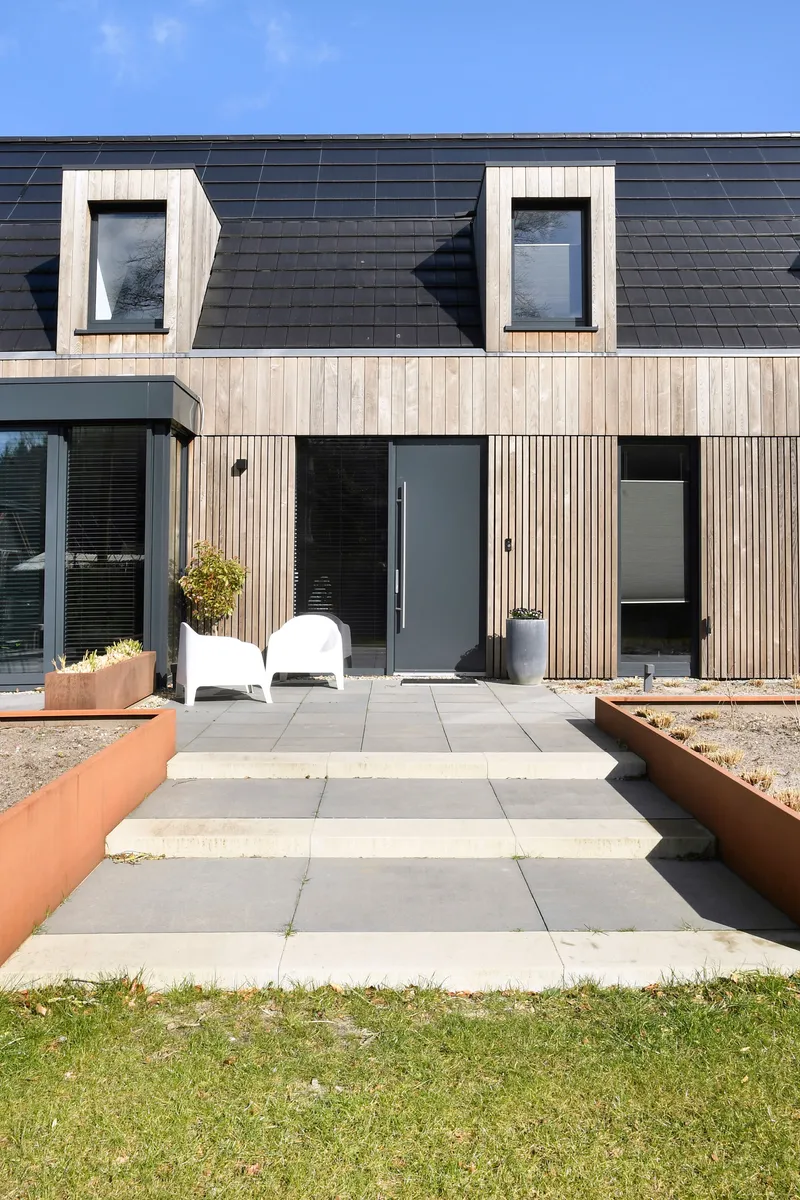


The entrance facade presents a taut composition of vertical timber cladding and a dark tile roof, interrupted only by the minimum openings needed for arrival. Concrete stepping stones lead to a narrow entry along the elongated side wall. Walk through the house and the character reverses completely: the rear garden elevation is largely glazed, with a steel-framed pavilion extension that dissolves the boundary between interior and landscape. A concrete terrace extends the living space outward toward the lawn.
Privacy and openness are calibrated by orientation rather than by curtains or mechanical screens, though solar screens are embedded behind the facade for climate control. The result is a house that turns its back on passersby and its face toward the sky and the fields. It is a legible strategy executed without fuss.
Timber Cladding and the Barn Silhouette
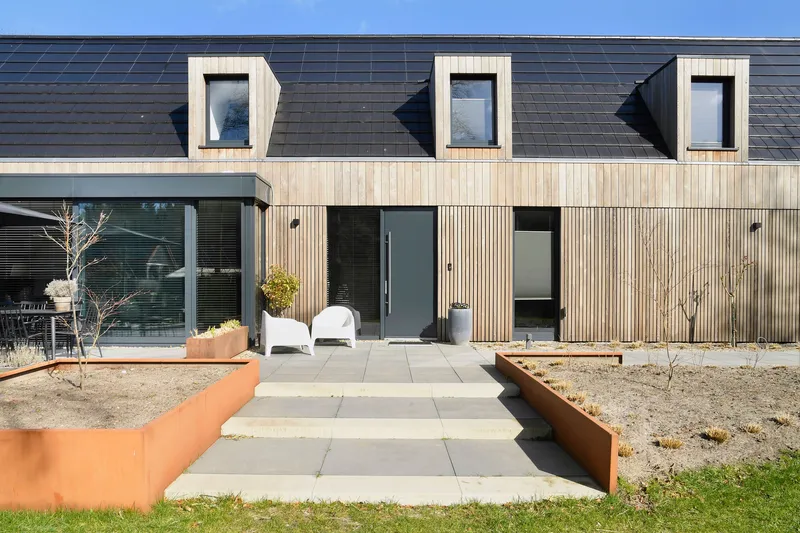
The gabled volume reads as a barn, but the proportions have been stretched and refined. Vertical timber boards run unbroken from ground to eave, giving the walls a rhythmic grain that catches raking light. Projecting dormer windows puncture the roof plane at the upper level, creating individual bedroom identities without disrupting the overall form. The cladding color, somewhere between weathered silver and warm grey, helps the house recede against the surrounding tree canopy.
Steel planters along the path and the dark tile roofing introduce a tonal counterpoint that keeps the composition from reading as pastoral pastiche. These are deliberate, restrained material contrasts, not decoration.
Light, Space, and a Grand Piano
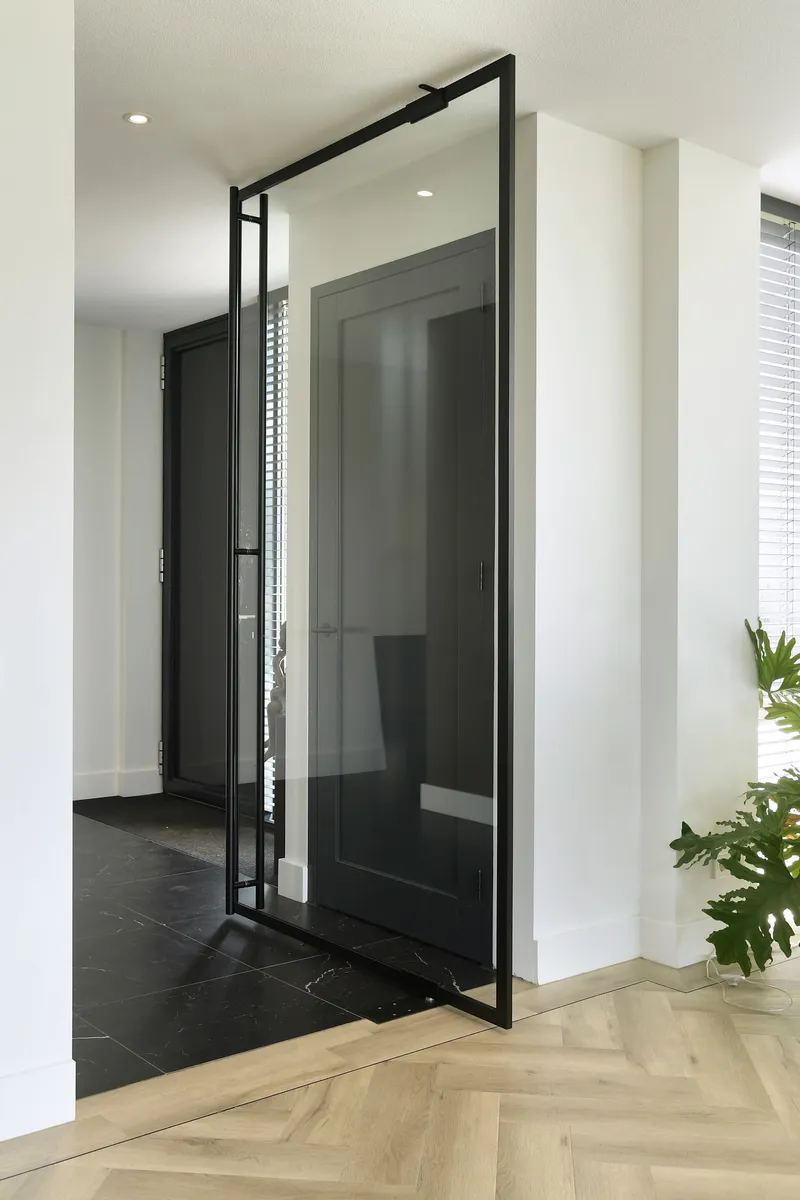

Inside, the palette is stripped to essentials: herringbone oak floors, white stucco walls, and a steel pivot door at the entrance that operates as both threshold and statement. The living room, dining area, and kitchen flow into one another in open plan, and a double-height connection to the upper floor floods the core of the house with overhead light. A mezzanine hosts a grand piano, which feels less like an interior design flourish and more like a room given over to the acoustics the volume naturally provides.
Guest rooms occupy the upper floor, accessed via a staircase near the entrance. The bedroom window, centered in a white gabled wall, frames sky and treetops in a composition that is almost monastic in its simplicity. Gold-colored tiles appear in the toilet as the single moment of material exuberance, an accent that proves the restraint elsewhere is a conscious decision, not a budget constraint.
Sitting Quietly Beside History
The site strategy deserves its own paragraph. The eighteenth-century gardener's house, now used as an office, is a national monument. Building behind it required careful positioning: the new villa sits on a diagonal, deferring to the monument's street presence while claiming the rear of the plot and its views over farmland. The separation between old and new is generous enough that each building breathes independently, yet the two share an implicit dialogue through scale and material warmth.
Solar panels integrated into the roof via Exasun X-Roof in-roof modules keep the fifth facade clean, and the passive orientation strategy, open to the south and west, closed to the north, reduces energy demand without resorting to the gadgetry that often clutters low-energy houses. The technology is present but invisible, which is consistent with the project's broader temperament.
Plans and Drawings


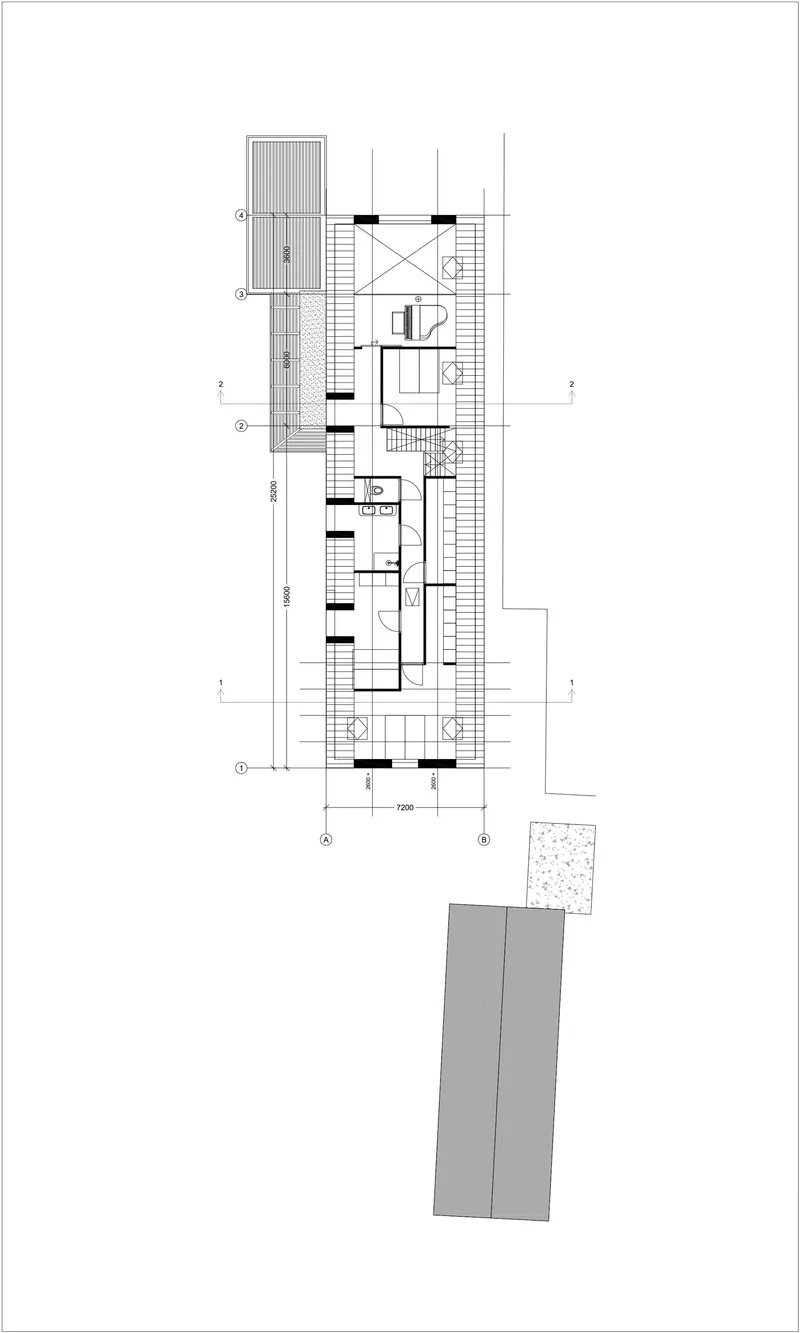

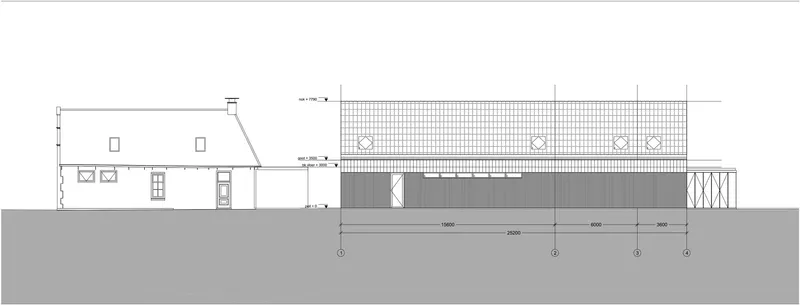

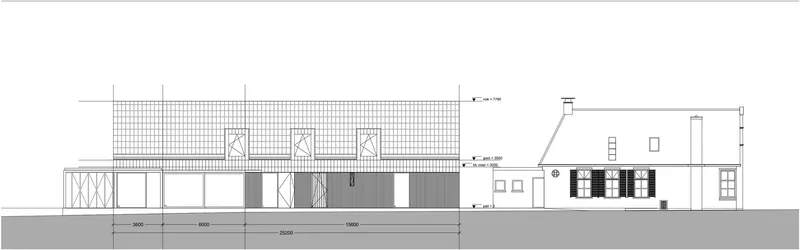
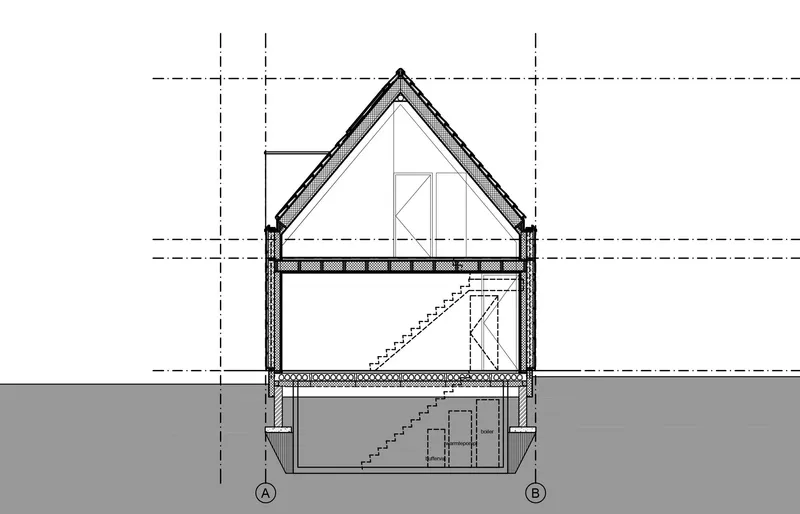

The site plan confirms the diagonal placement behind the monument, while the ground floor plan reveals how the elongated volume channels circulation along one side and stacks living functions in a single open room facing the garden. The upper floor plan shows bedrooms organized around a central staircase, with small terraces carved into the roofline. Section drawings expose a basement level, not immediately obvious from the exterior, that adds programmatic depth beneath the simple barn profile. The elevations document the shift from closed front to open rear with a clarity that reads almost like a diagram of the privacy gradient.
Why This Project Matters
Villa Oranjewoud is not trying to reinvent the house. It is trying to build one well, in a specific place, with specific constraints, and to make every decision legible without making any of them loud. In a residential market saturated with barn-house references that tip into kitsch or minimalist boxes that ignore their context entirely, this project threads the needle. The barn form is sincere, not ironic; the modernism is embedded in the proportions and details, not applied as a veneer.
For architects working on sensitive historical sites, the project offers a useful case study in deference without timidity. Lautenbag did not try to match the monument or compete with it. She simply built a good house behind it and let the landscape do the rest. That takes more confidence than it looks like.
Villa Oranjewoud, designed by Lautenbag Architectuur (Diana Lautenbag). Oranjewoud, The Netherlands. 200 m². Completed 2021. Photography by Jaro van Meerten.
About the Studio
Share Your Own Work on uni.xyz
If projects like this are the kind of work you want to make, uni.xyz is a place to publish your own, find collaborators, and enter design competitions.


Popular Articles
Popular articles from the community


Faces of the Soviet Avant-Garde: Turning Moscow's Street Names into an Open-Air Museum
A network of sculptural installations across a Moscow residential district transforms forgotten architect names into spatial encounters with cultural memor

The Amber Palace Opera: A Geological Fiction Surfaces on Tallinn's Baltic Waterfront
Pierre Brillard reimagines a Baltic legend as a public landscape, opera house, and waterfront promenade rooted in Tallinn's coastal identity.

Singing Woman: Contemporary Architecture Inspired by Estonia’s Voice and the Sea
Singing Woman turns Estonia’s song culture into flowing opera house architecture, blending public life, landscape, sea, and national memory.

Cloaked Colonization: A Mobile Underwater Habitat That Moves Like a Fish
Micah Abaya's shortlisted EHC Pacific entry reimagines ocean settlement as a dispersed network of self-sustaining architectural organisms.

Similar Reads
You might also enjoy these articles

Bao Huynh Watercolor Atelier: A Serene Art Retreat in Hội An
Bao Huynh Watercolor Atelier in Hội An blends multifunctional art spaces, sustainable design, local materials, and family-friendly living in a serene environment.

Atelier Macri Concept Store Interior Design by CASE-REAL
Atelier Macri store features a "ko" counter, walnut wood details, cork displays, blending retail, gallery, and seamless customer experiences.

Manuel Vargas Izquierdo Stadium and High-Performance Sports Center: Architectural Excellence in Jalpa de Méndez
The Manuel Vargas Izquierdo Stadium blends sustainable design, inclusive sports facilities, and cultural-inspired architecture, revitalizing Jalpa de Méndez’s public spaces.

KAKR Buluh Awar Hall: Revitalizing Community and Ecology Through Bamboo Architecture
Community built bamboo hall revitalizes Buluh Awar village, empowering youth, restoring ecology, celebrating vernacular craftsmanship through sustainable architecture and culture.

Explore Geurst & Schulze Architecten Competitions
Discover active competitions in this discipline

Challenge to design a portable theatre

Challenge to design a portable music platform

Challenge to design an open learning module for the elderly
Comments (0)
Please login or sign up to add comments
No comments yet. Be the first to comment!