
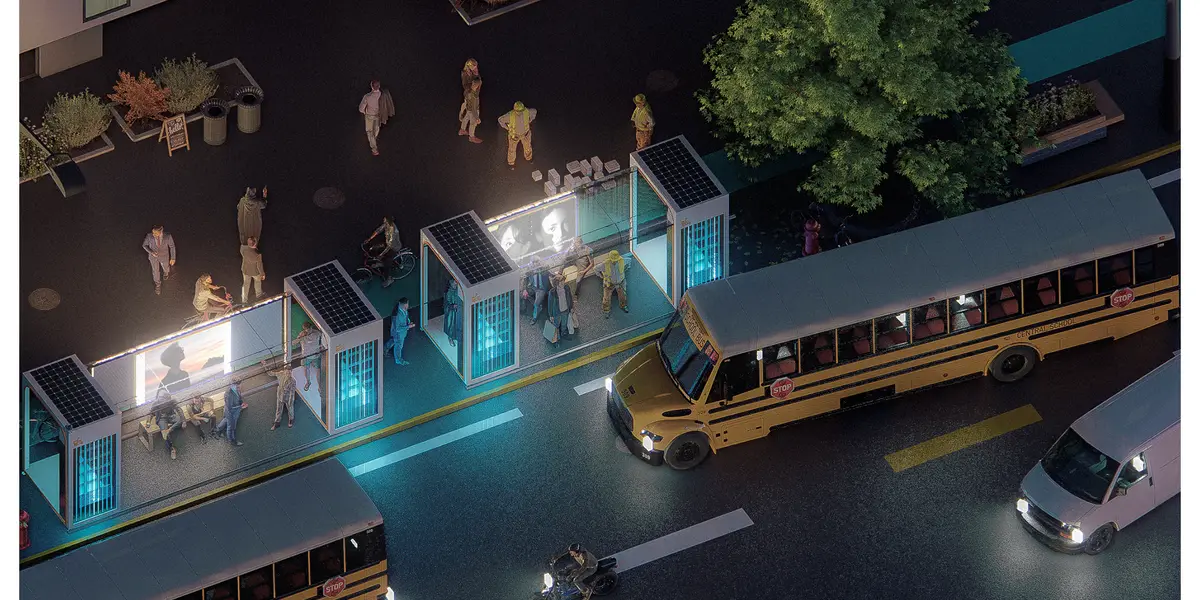
Logistics bus stop
Construction of logistics bus station and station network in post epidemic Era

Background: Logistics City + Post epidemic Era
The service radius of public transportation network in high density population cities in China is about 500m, and the intra city distribution industry in high density population cities is highly developed. And promote the rapid development of logistics, especially the city logistics distribution service. The rise of e-commerce has effectively driven the rapid development of the express industry, directly creating China's developed express network. In recent years, the rise of o2o business model, especially the development of take away, fresh food and other home scenes, has promoted the rapid development of instant delivery in the same city.
The application of AI and big data is becoming more and more popular. Based on artificial intelligence, we can accurately evaluate the difficulty of distribution, ETA and rider ability. With the rapid development of GPS and the continuous opening of GIS manufacturers' capabilities, we have a complete technical system, including big data, artificial intelligence, infrastructure, complex business system platform based on mainstream open source technology and self research, and relatively complete operation and maintenance, security and risk control systems. In terms of infrastructure, the quality of mobile network in China is constantly improving, and the cost is decreasing year by year, which indirectly promotes the almost universal coverage of smart phones.
Due to the characteristics of China's super large population and the high degree of crowd aggregation, the demand for take out and home scenes in major cities, especially the first tier cities, continues to increase. In 2018, the unmanned distribution open platform has completed the test operation in xiong'an new area, capital iron and steel Park, Shenzhen Lenovo building and other places, which proves the feasibility of the unmanned distribution open platform for regional scale operation.
However, the "space difference" and "time difference" effects of intra city logistics distribution always exist, and the terminal distribution network of the last 100 meters is often limited by many factors. For example, the decline of user experience caused by the decline of labor force in the city's service industry; customer privacy issues; terminal delivery efficiency, accounting for 30% - 60% of each delivery time; rider safety and work efficiency. Moreover, in the post epidemic era, the problems caused by space control and people flow restriction are more sensitive. The potential value of dense urban public transit network is not given full play. It is our thinking and design direction to think about how to integrate the bus station system and terminal logistics distribution in a high-density population city.
Through the effective measures of epidemic prevention and control in China, the society recovers steadily and people's life is on the right track. Because there are certain management regulations in public areas, the developed takeout industry in China and the spatial management mechanism in the post epidemic era aggravate the "space-time difference" of terminal distribution. To alleviate the last "100m" problem of the local distribution industry, we can take "the last 100m of small logistics transportation" as the system operation and incorporate it into the bus stop system design.
First of all, we improve the quality of bus station infrastructure, design night lighting system and update materials. Taking the terminal distribution mechanism of small and micro businesses in the same city as the network construction point, the cooperation mechanism of logistics and government is combined to produce small cargo terminals and prefabricated bus stops. Set up face recognition distribution receiving system, unmanned distribution charging station. Solar panels are used as self generating system. The whole device and bus stop are modular, factory assembled and prefabricated, which are directly sent to the city by trucks for track embedding and component installation.
In the later operation of the system, the public, enterprises and the government can cooperate with each other to build a beautiful blueprint for the city with win-win orientation.

Popular Articles
Popular articles from the community


David Ortega Stacks a Two-Story Mexico City Penthouse Around a Steel Stair and a Pergola-Shaded Roof Terrace
In Colonia Roma, a 300 m² penthouse uses oak joinery, a planted steel stair and a slatted roof pergola to make a new-build apartment feel like a house.

GROUP A Strips a 1969 Rotterdam Harbor Headquarters to Its Frame and Wraps It in Timber Louvers
In Rotterdam's M4H harbor district, Ferro Offices reuses a 1969 frame, adds one timber storey and reaches BREEAM-NL Outstanding.

David Macias Steps a Doorless Stone and Plaster House Down a Tropical Colombian Hillside
In the humid hills of Colombia, Threshold House replaces the front door with an open void and terraces its 850 m² down the slope instead of fighting it.

Jaramillo Van Sluys Arquitectura and Urbanismo Turn a Demolished Registry Lot in Quito into an Orchard Plaza
In Quito's Centro Histórico, a 2,800 m² plaza exposes the San Agustín convent wall and redraws its lost Augustinian orchard in volcanic stone.

Similar Reads
You might also enjoy these articles


Vereda Arquitetos Renovates a 40-Square-Meter Apartment Inside Niemeyer's Copan Building
A compact unit in São Paulo's most iconic residential tower gets a material overhaul that pairs exposed concrete with bold blue Formica.

Shakur's House: Exposed Brick as an Interior Organiser in a 168 m² Mashhad Residence
Brick moves indoors in this Mashhad residence, where masonry walls, glass partitions and teal planes sequence a compact home without closing it off.

Day and Night Park: A Time-Based Urban Newsstand in Beijing
A temporary urban newsstand in Beijing blending travel, light, and reading through poetic colors, compact form, and community-focused design.

Modernist Patio Renovation in El Masnou, Barcelona by Oliver Segura Arquitectura + Cebrià Arquitectura
Modernist patio renovation blending tradition and innovation with a movable pool, leveled floors, and Catalan materials in El Masnou.


Comments (0)
Please login or sign up to add comments
No comments yet. Be the first to comment!