

Manuel Bouzas Scales a Mediterranean Blind to Cover an Entire Plaza in València
A temporary timber pavilion in the historic El Carmen neighborhood reclaims a neglected square with vernacular shading and local materials.


The Mediterranean blind is one of those building elements so common across southern Europe that it has become invisible. Slatted, operable, usually green or brown, it hangs off millions of balconies from Alicante to Naples, doing the quiet work of keeping interiors cool without a single watt of electricity. For the second edition of València's TAC! Urban Architecture Festival, Manuel Bouzas took that humble domestic artifact and blew it up to the scale of an entire public square, suspending a catenary-shaped canopy of traditional wooden blinds between two triangular timber porticos to shade 280 square meters of neglected plaza.
The site, Plaza Músico López Chavarri in the historic El Carmen neighborhood, is not really a plaza at all. It is a gap left behind after a residential building was demolished, an accidental void with no shade, no seating, and no reason for anyone to linger. Bouzas's proposal, selected from 125 competition entries by young architects, treats that emptiness as an opportunity rather than a problem. By draping a giant blind overhead, placing quarried stones below as counterweights and informal seats, and planting a small garden at the center, the pavilion gave the square everything it lacked: shelter, furniture, vegetation, and a reason to stay.
A Domestic Element at Urban Scale
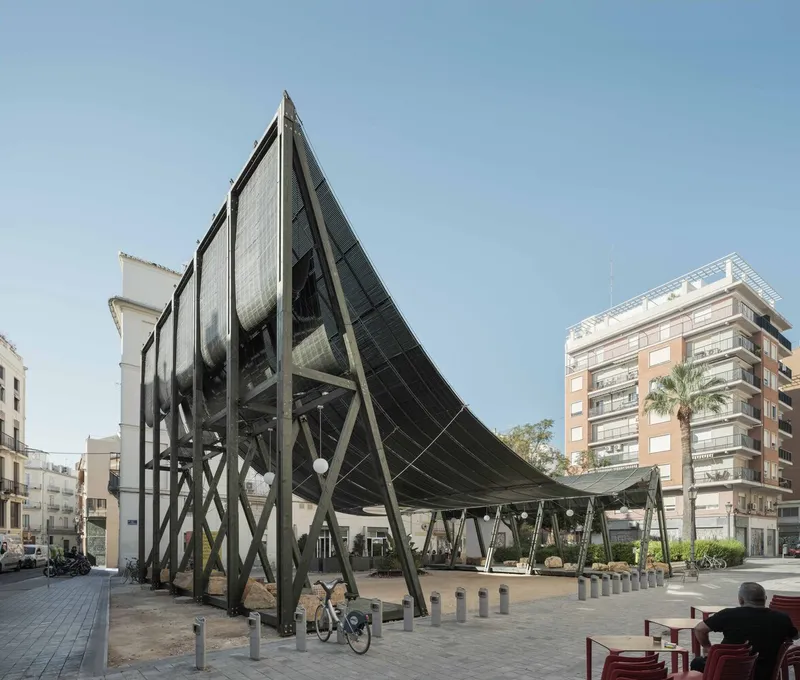

What makes this project compelling is the directness of the analogy. A blind protects a window; this blind protects a neighborhood. The structural logic follows from the same principle: two triangular timber frames act as the brackets that would normally flank a window opening, while the slatted canopy hangs between them in a catenary curve that is both structurally efficient and visually generous. The dark green color is not arbitrary. It references one of the five traditional hues manufactured in the blind factories of Sax, Alicante, rooting the pavilion in a specific regional craft tradition.
The "alicantina" blind, as it is known locally, was once standard climate equipment across the Mediterranean. Air conditioning rendered it almost obsolete. Bouzas's pavilion argues, persuasively, that the original technology still works, and that its logic can scale far beyond the domestic threshold.
Timber Porticos and Catenary Geometry
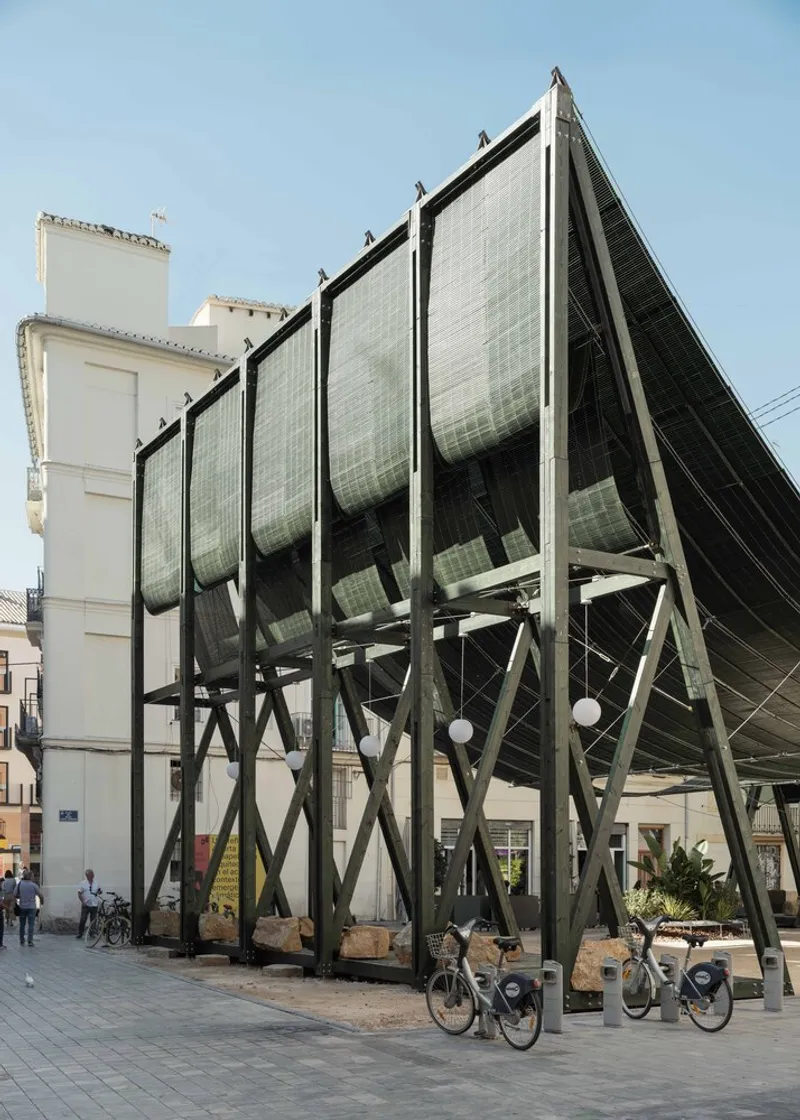

The structural system is deliberately legible. Two triangular porticos, built from pine timber sourced from plantation forests in Soria (within a 300-kilometer radius of the site), frame the space and carry the loads. Between them, the wooden blind drapes into a catenary curve, the same shape a chain assumes under its own weight. It is one of the most efficient forms for a suspended surface, minimizing bending forces and allowing the canopy to span with minimal material. The bolted connections at the beam junctions are exposed and honest, reflecting a construction philosophy that prioritizes assembly, disassembly, and reuse over permanent fixity.
Rocks quarried in Teruel sit at the base of the porticos, serving a dual purpose: they act as counterweights to stabilize the structure against wind uplift, and they double as informal seating. The decision to let raw stone perform both structural and social roles is the kind of economy that distinguishes good temporary architecture from disposable scenography.
Light, Air, and an Interior Garden

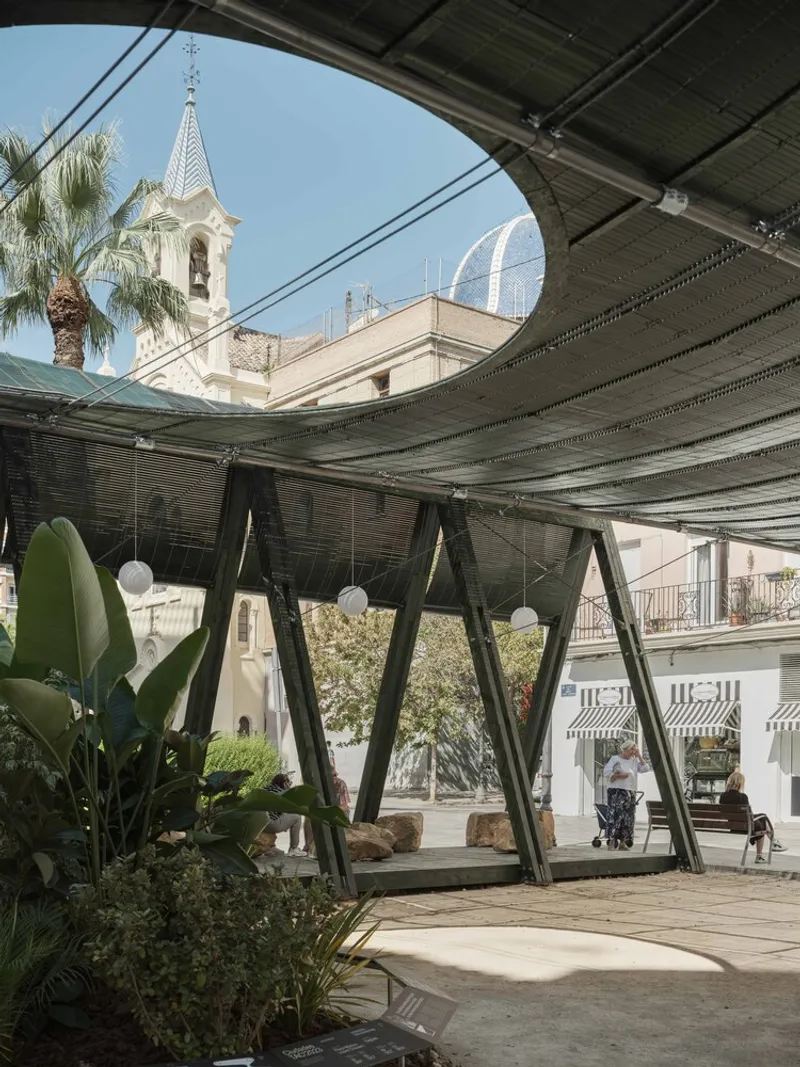
The canopy is not a sealed surface. A circular opening at its center punches through the blind, admitting a controlled shaft of sunlight that illuminates a small garden planted directly below. The vegetation and soil were sourced from the site itself, a quiet gesture that reinforces the project's commitment to zero-kilometer materials. During the late summer weeks of the installation's life, from September 25 to October 16, 2023, this pocket of greenery contributed to a measurable microclimate effect, lowering temperatures beneath the canopy through evapotranspiration while the slatted blind above filtered the worst of the sun's heat.
Through the circular oculus, you catch framed views of the surrounding neighborhood: a church bell tower, the distant silhouettes of modern towers, the facades of apartment buildings whose balconies still carry placards from residents calling for a better future for the space. The framing is intentional. The pavilion does not turn its back on its context; it selectively reveals it.
Underneath the Canopy

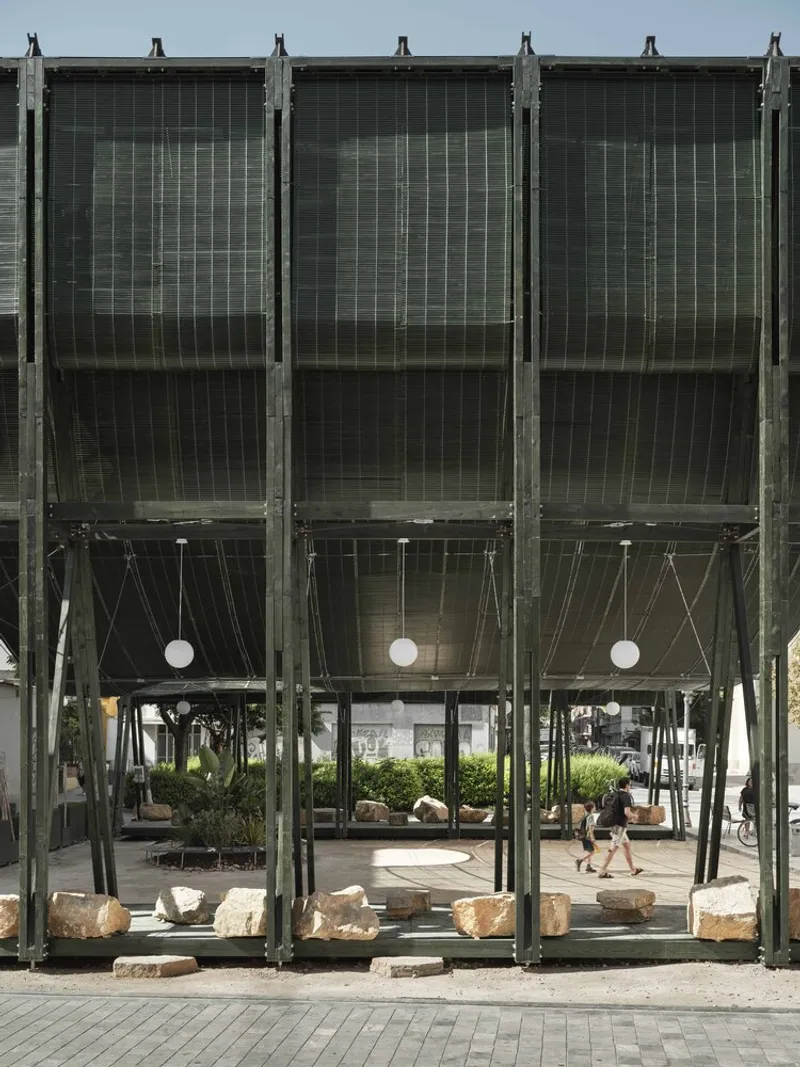
Beneath the blind, the space operates as an open-air room. Globe lights hang from the structure, providing evening illumination for the twenty free public events hosted during the pavilion's three-week run. The program, curated by the Ajuntament de València and Las Naves, ranged across architecture, social innovation, and creative practice, turning the shaded square into a genuine civic venue. The limestone boulders scattered across the ground plane invite informal occupation: sitting, leaning, gathering in loose clusters rather than filing into fixed rows.
There is a lesson here about the difference between furniture and infrastructure. The pavilion provides shade and enclosure at the infrastructure scale, then trusts people to furnish the space themselves through how they choose to occupy it. The rocks are generous enough to sit on but ambiguous enough to avoid prescribing behavior.
Circular Construction, Local Economy
Every material in this pavilion was sourced within 300 kilometers and built by local labor. The pine came from Soria. The blinds were manufactured in Sax, Alicante. The stones were quarried in Teruel. The contractor, SIDO Madera, pre-assembled the modular components in a workshop to reduce on-site construction time, cost, and risk. This is not a token sustainability gesture; it is a genuinely circular construction model. After dismantling, the timber was returned to the industry for reuse, the stones went back to their quarry, and the blinds were donated to neighbors in El Carmen.
For a temporary installation, the deconstruction plan matters as much as the construction plan. Too many festival pavilions end up in landfill once the cameras leave. Bouzas designed the afterlife of every component from the start, which elevates this project from a clever installation into a credible prototype for low-impact temporary architecture.
Why This Project Matters
The Mediterranean Pavilion is not a complex building. Its power lies in the precision of its argument: that a pre-industrial shading technology, deployed at urban scale with locally sourced materials and a clear disassembly plan, can transform a neglected gap site into a functioning public room. In a moment when cities across southern Europe are scrambling for heat mitigation strategies, Bouzas offers an answer that requires no mechanical systems, no imported materials, and no permanent foundations. The solution was hanging on every balcony in the neighborhood the whole time.
As a competition-winning project by a young architect, built for under three weeks of public life, it also demonstrates something important about the TAC! Festival model. Giving emerging designers the budget to actually construct their ideas, rather than just render them, produces work that is tested by weather, bodies, and public scrutiny. That feedback loop between drawing and building is where real architectural intelligence develops. Bouzas's pavilion passed the test.
Mediterranean Pavilion by Manuel Bouzas, located in Plaza Músico López Chavarri, València, Spain. 280 square meters. Completed in 2023. Structural engineer: Juan F. De la Torre. Contractor: SIDO Madera. Photography by Luis Diaz.
About the Studio
Share Your Own Work on uni.xyz
If projects like this are the kind of work you want to make, uni.xyz is a place to publish your own, find collaborators, and enter design competitions.


Popular Articles
Popular articles from the community


Opera on the Sea: Driftwood Logic Shapes a Timber Opera House on Estonia's Coast
Trevor Orgill's opera house translates the entangled drift of floating timber into a civic building where wood, water, and music converge.


FCC Arquitectura Expands a Portuguese Granite House with a Board-Marked Concrete Wing
In Portugal, JV House pairs a cleaned-up whitewashed and granite dwelling with a timber-shuttered concrete extension, courtyards and a garden pool.

Aquadapt: An Underwater Habitat That Rewrites Its Rooms by the Hour
Curved modules ring the seabed while one shell shifts from breakfast room to cinema, farm and football pitch as residents' needs change.

Cube Design Draws an Ecological Corridor Between Two Shenzhen Hills with the Nankai Building
Beside Shenzhen's container docks, the Nankai Building pairs stacked balconies with a climbing green screen to connect two hillsides across its height.

Similar Reads
You might also enjoy these articles


Hodi-Mandai Geram
Project Function: Preservation and revitalization of the Intangible heritage and socio-spatial identity of the Hodi by Housing, Cultural Memory Center, Sacred Grove, landscape, local tourism economy


Olio Towers: A Mid-Rise for Performers That Fuses Housing, Rehearsal, and Stage
Located blocks from Houston's Theater District, this modular tower stacks living units around a central performance atrium.

Oasis: Modular Green Housing Carved into Dhaka's Urban Fabric
A shortlisted Plugin Housing entry reclaims unauthorized settlements in Dhaka with stepped concrete volumes, green roofs, and ventilation-driven design.

Black Hole: A Floating Megastructure for the Post-Physical Era
Emiliano Mazzarotto envisions a spherical, self-scaling arena where e-sports, digital hotels, and holographic stadiums replace traditional public space.

Explore Architecture Competitions
Discover active competitions in this discipline

Challenge to design a portable theatre

Challenge to design a portable music platform

Challenge to design an open learning module for the elderly

Challenge to reimagine the Iron Throne
Comments (0)
Please login or sign up to add comments
No comments yet. Be the first to comment!