

Mirai: A Floating Architecture School on Tokyo Bay Built for Rising Seas
An algae-plastic platform supports modular studios, holographic labs, and green roofs on the waters of Tokyo Bay.


What if a school of architecture could physically demonstrate the climate future it asks students to design for? Mirai, meaning "future" in Japanese, is a floating campus proposed for Tokyo Bay that treats rising sea levels not as a threat to resist but as a condition to inhabit. Sitting on an algae-based Spirulina plastic platform and supported by steel hulls and reinforced tie beams, the structure houses programs in architecture, object design, and 3D animation within a building that rises and falls with the water level. It is pedagogy made structural: the medium is the message.
Designed by Hatem Bouassida and Liana Tremblay, Mirai was shortlisted in the Bauhaus Neue competition. The project selects its site deliberately: Tokyo Bay sits within a student-rich urban ecosystem, adjacent to the University of Marine Technologies, and within a city recognized globally for technological innovation. It also faces a very real climate future of rapidly rising sea levels, making it the ideal proving ground for floating architecture at an institutional scale.
Angular Volumes Stacked Over Water


The dusk waterfront rendering reveals the project's most immediate architectural gesture: cantilevered volumes stacked and rotated to create a dynamic silhouette against the Tokyo Bay skyline. The angular massing reads as both assertive and buoyant, its illuminated interiors visible through generous glazing that frames water views from every programmatic level. A sailboat in the foreground reinforces the maritime context, quietly reminding viewers that this building does not touch the ground.
The composite site analysis diagram grounds this vision in data. Water level maps chart the projected rise that motivates the entire project, while street-level photographs and satellite imagery of the surrounding bay establish the urban density and infrastructural adjacencies that justify placing a design school here. The choice of Tokyo is not merely symbolic. It is strategic, leveraging both the city's technological culture and the bay's environmental urgency.
Layered Interiors from Workshop to Green Roof
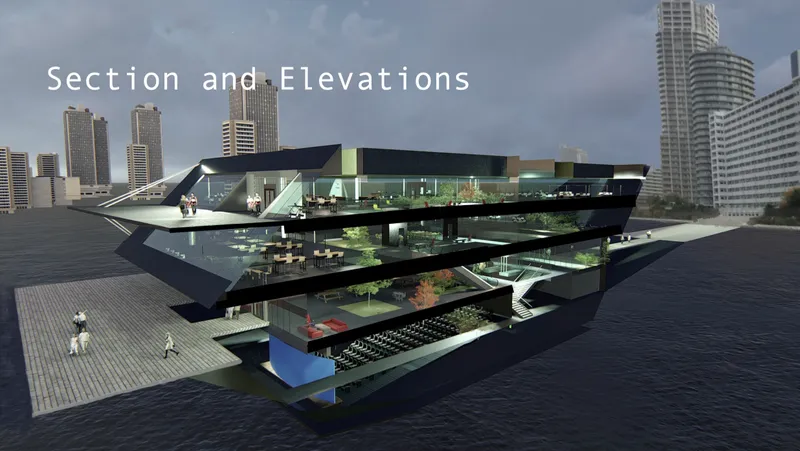
The section drawing slices through the stacked volumes to expose how each cantilevered level accommodates a distinct programmatic zone. Architecture workshops, 3D animation labs, common areas, and hologram-equipped auditoriums are organized as modular zones, vertically separated yet connected by circulation that encourages cross-pollination between disciplines. The section also reveals the structural logic: steel hulls below the waterline transition into the inhabited volumes above, with the Spirulina plastic platform acting as the critical interface between building and bay.
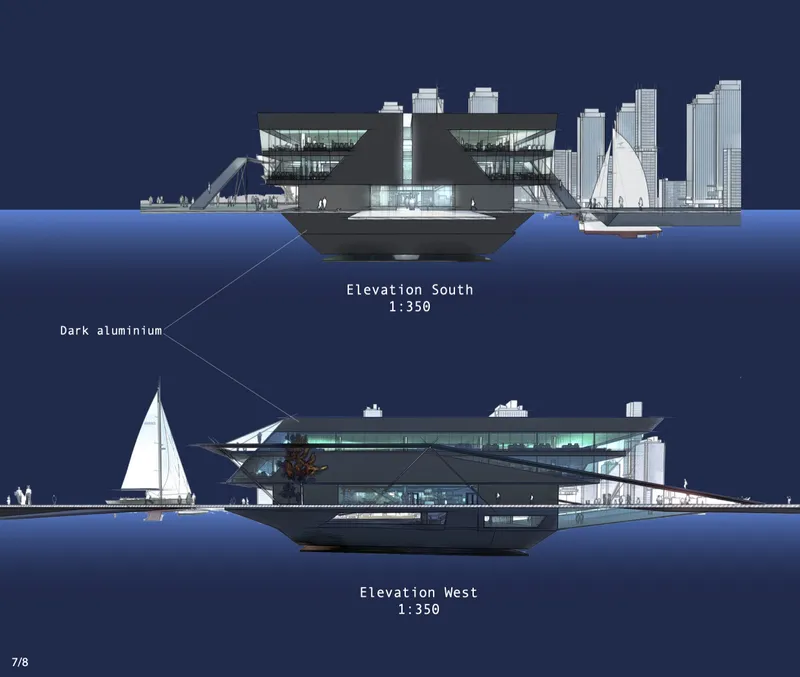
The south and west elevations provide a more precise reading of materiality. Notations indicate dark aluminum cladding wrapping the exterior, lending the building a taut, metallic skin that contrasts with the reflective water surface below. The elevations also clarify the proportional relationships between solid and void: opaque cladding panels alternate with glazed openings in a rhythm that controls solar gain while maintaining visual connection to the surrounding seascape.
Programmatic Modules Stacked on an Algae Platform

The exploded axonometric is the most informative drawing in the set, peeling apart each programmatic layer from entrance level to green roof. It makes visible what the section only suggests: the degree to which each floor operates as a semi-autonomous module with its own spatial character. Interior perspective vignettes embedded in the diagram show digital tables, transparent presentation walls, and immersive holographic environments that blur the boundary between physical studio and virtual workspace. These are not speculative add-ons; they are integrated into the building's pedagogical core.
Movable partitions and adaptable layouts allow spaces to shift between exhibition, lecture, and digital showcase modes. The green roof, shown at the top of the exploded view, introduces indoor gardens and planted surfaces that provide ecological balance and sensory contrast to the tech-forward interiors below. The building does not merely float on the bay; it coexists with its water ecosystems, with the bioplastic platform designed to avoid displacing marine habitats.
Holographic Pedagogy Inside a Climate-Adaptive Shell
What sets Mirai apart from other floating architecture proposals is the specificity of its interior program. The holographic technology is not decorative futurism; it serves a direct educational function in a school that teaches 3D animation alongside architecture. Immersive learning environments, transparent presentation walls, and digital fabrication tools are embedded in studio spaces that can be reconfigured through movable partitions. The building teaches adaptability by being adaptable.
The structural system reinforces this flexibility. Steel hulls provide the rigid base that absorbs tidal and wave forces, while reinforced tie beams distribute loads across the Spirulina plastic platform. This material choice is significant: an algae-derived bioplastic offers a sustainable alternative to conventional marine construction materials while maintaining the structural resilience required for a permanently occupied campus. The platform adapts to water level fluctuations without transferring instability to the inhabited volumes above.
Why This Project Matters
Mirai makes a compelling argument that floating architecture can be more than crisis response. By housing a design school on an adaptive marine platform, Bouassida and Tremblay collapse the distance between what students learn and how they experience learning. The building itself becomes a case study in climate-adaptive design, sustainable material innovation, and the integration of digital technology into physical space. Every lecture on resilience takes place inside a resilient structure.
As coastal cities worldwide confront the reality of rising sea levels and diminishing buildable land, projects like Mirai reframe floating architecture as a legitimate typology rather than an emergency measure. The proposal demonstrates that a campus can be functionally complex, environmentally conscious, and spatially ambitious while resting on water instead of soil. It is a prototype for institutional buildings that move with their environment rather than fortifying against it.
View the Full Project
About the Designers
Designers: Hatem Bouassida, Liana Tremblay
Enter a Design Competition on uni.xyz
uni.xyz runs architecture and design competitions year-round that reward proposals with spatial conviction and real site intelligence.
Project credits: Mirai, by Hatem Bouassida, Liana Tremblay Bauhaus Neue (uni.xyz).


Popular Articles
Popular articles from the community


Cube Design Draws an Ecological Corridor Between Two Shenzhen Hills with the Nankai Building
Beside Shenzhen's container docks, the Nankai Building pairs stacked balconies with a climbing green screen to connect two hillsides across its height.


Manzana Morphosis: Stretching Barcelona's Grid into a Living Landscape for 2050
A radical reworking of the Eixample manzana turns density into a tool for generous public space, vertical ecology, and environmental performance.

FCC Arquitectura Expands a Portuguese Granite House with a Board-Marked Concrete Wing
In Portugal, JV House pairs a cleaned-up whitewashed and granite dwelling with a timber-shuttered concrete extension, courtyards and a garden pool.

ETEH Reworks the Shared Spaces of São Domingos School in Brazil Around Timber, Color and Hanging Plants
At São Domingos School in Brazil, 436 m² of hall, refectory and library are recast with timber joinery, a yellow and blue code and trailing greenery.

Similar Reads
You might also enjoy these articles

Vereda Arquitetos Renovates a 40-Square-Meter Apartment Inside Niemeyer's Copan Building
A compact unit in São Paulo's most iconic residential tower gets a material overhaul that pairs exposed concrete with bold blue Formica.

Shakur's House: Exposed Brick as an Interior Organiser in a 168 m² Mashhad Residence
Brick moves indoors in this Mashhad residence, where masonry walls, glass partitions and teal planes sequence a compact home without closing it off.

Day and Night Park: A Time-Based Urban Newsstand in Beijing
A temporary urban newsstand in Beijing blending travel, light, and reading through poetic colors, compact form, and community-focused design.

Modernist Patio Renovation in El Masnou, Barcelona by Oliver Segura Arquitectura + Cebrià Arquitectura
Modernist patio renovation blending tradition and innovation with a movable pool, leveled floors, and Catalan materials in El Masnou.


Comments (0)
Please login or sign up to add comments
No comments yet. Be the first to comment!