

Steimle Architekten Breaks a Mixed-Use Block into Gabled Volumes in Ludwigsburg
A pale brick ensemble of residential and office space slots into a small German city's roofscape with quiet discipline.


Ludwigsburg is not a city that invites loud architecture. Its baroque grid and low-rise fabric demand a certain decorum, and any new mixed-use insertion has to prove it can hold a corner without shouting. Steimle Architekten BDA understood the assignment with HLC Ludwigsburg, breaking what could have been a single monolithic development into a cluster of gabled brick volumes that read more as a family of houses than as a commercial block.
What makes the project worth studying is its refusal to treat density as an excuse for anonymity. The individual volumes are compact and specific, each one oriented to create courtyards, passages, and rooftop views that give residents a genuine sense of address. Office and retail uses are absorbed into a concrete base that keeps the street edge active, while the residential floors above wear a pale brick skin punctured by carefully irregular windows. It is a fundamentally urban project that borrows the scale and silhouette of its neighbors without copying them.
Brick Volumes and the Gabled Silhouette
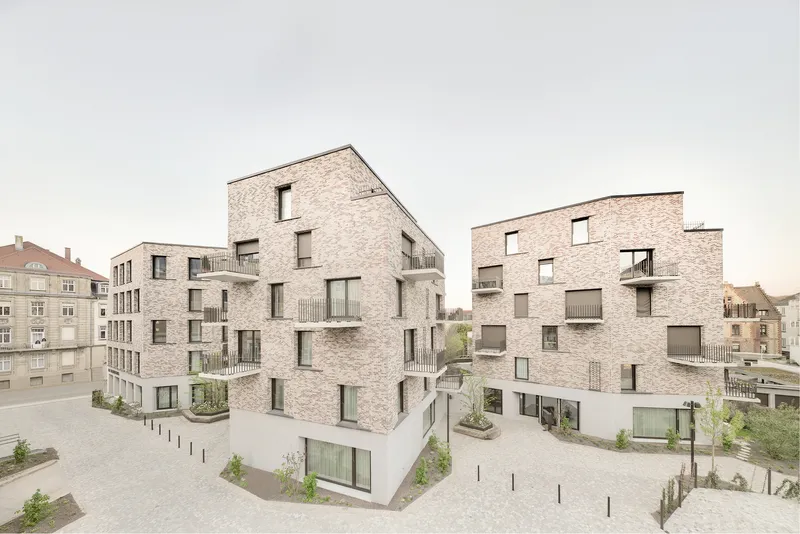
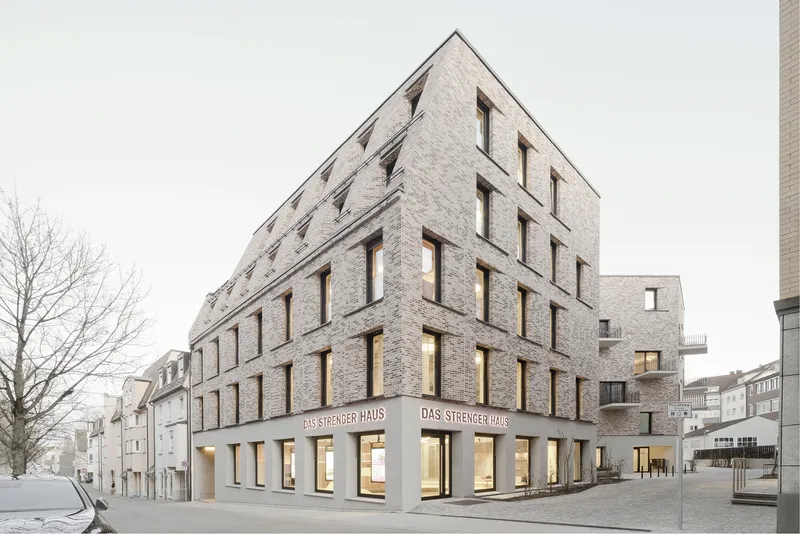

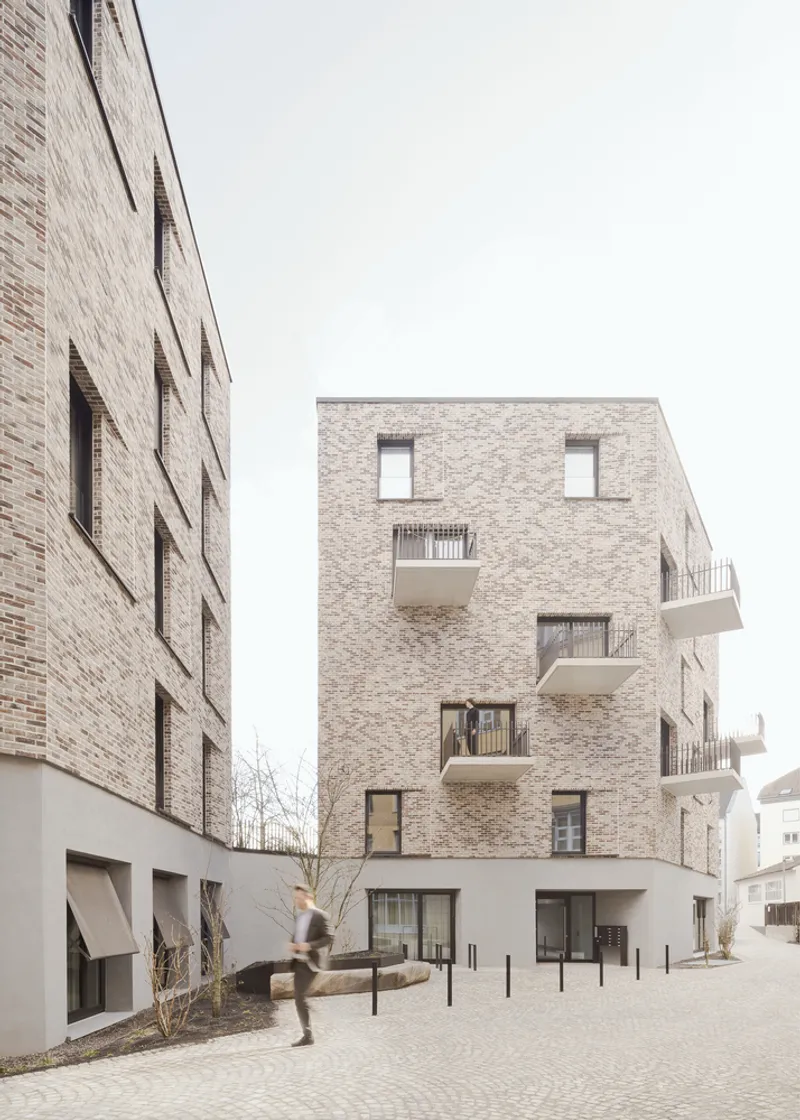
The pale brick wrapping each volume does double duty: it unifies the ensemble while letting each building hold its own identity through subtle differences in window placement and gable proportion. At the street corner, a gabled form rises above a recessed concrete base whose illuminated storefronts signal commercial ground-floor life. The punched windows are arranged in patterns that look almost random at a glance but follow a logic tied to interior room layouts, avoiding the monotonous grid that plagues so many housing projects.
From the street, the facades have a solidity that recalls postwar German housing without nostalgia. The brick is light enough to catch the overcast Swabian sky and reflect it back, keeping the volumes from feeling heavy despite their mass. Steimle's decision to use gabled roofs rather than flat ones is the single most consequential move in the project: it stitches HLC into the surrounding roofscape of pitched red tiles so convincingly that the building reads as though it has always been part of the block.
Courtyards as the Real Living Rooms
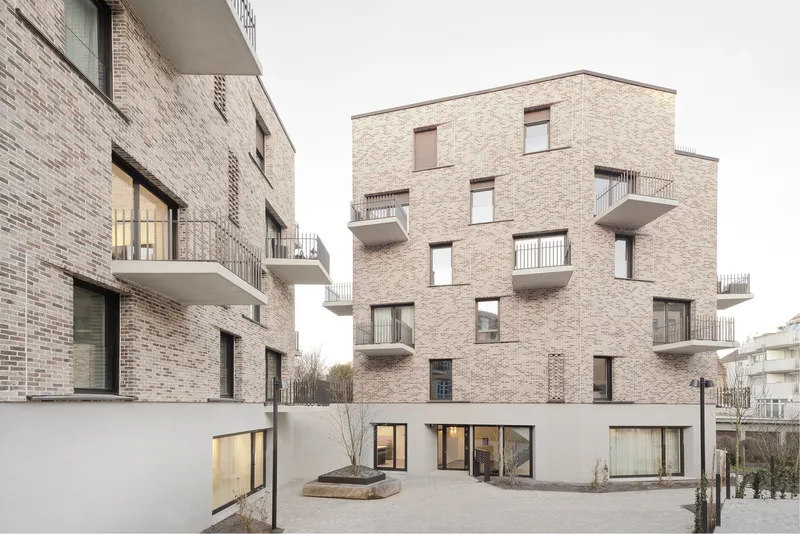
The spaces between the volumes are where HLC earns its keep. Winter or summer, the courtyards create a sheltered interior world defined by cantilevered balconies and a single tree that acts as a calendar, marking the seasons against the neutral brick. These are not decorative leftover spaces; they are the primary outdoor rooms for residents, scaled tightly enough to feel intimate but open enough to let daylight reach the lower floors.
A narrow passage between two of the blocks, just wide enough for a pedestrian, introduces a cinematic compression that breaks the courtyard sequence into distinct moments. The protruding balconies overhead intensify the sense of enclosure, and the view terminates against another brick wall, forcing the eye upward toward the sky. It is a trick borrowed from medieval town planning, and it works precisely because the rest of the project is so restrained.
The Passage and Pedestrian Scale
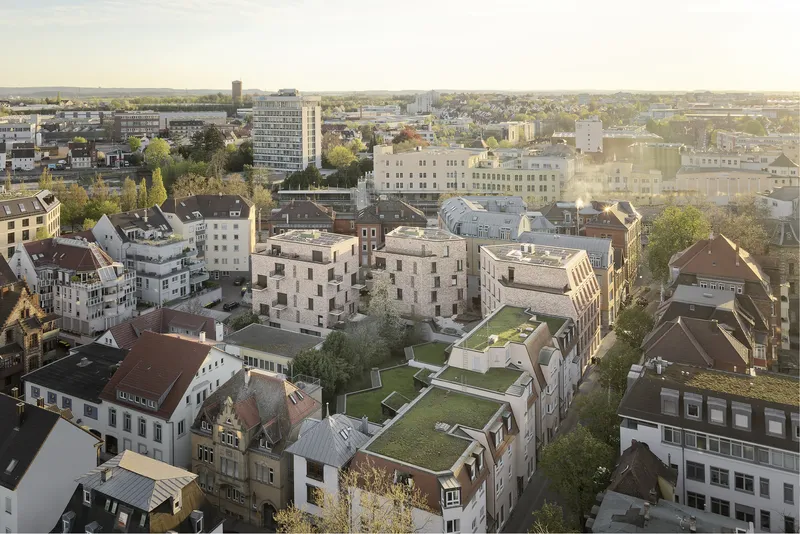
Seen from above at dusk, the complex reveals its strategy most clearly: three compact volumes packed tightly together within a block of low-rise neighbors, their pale brick glowing against the darker context. The aerial view confirms that HLC is denser than anything around it, yet the broken massing keeps the perceived scale in check. No single elevation stretches long enough to dominate its street frontage.
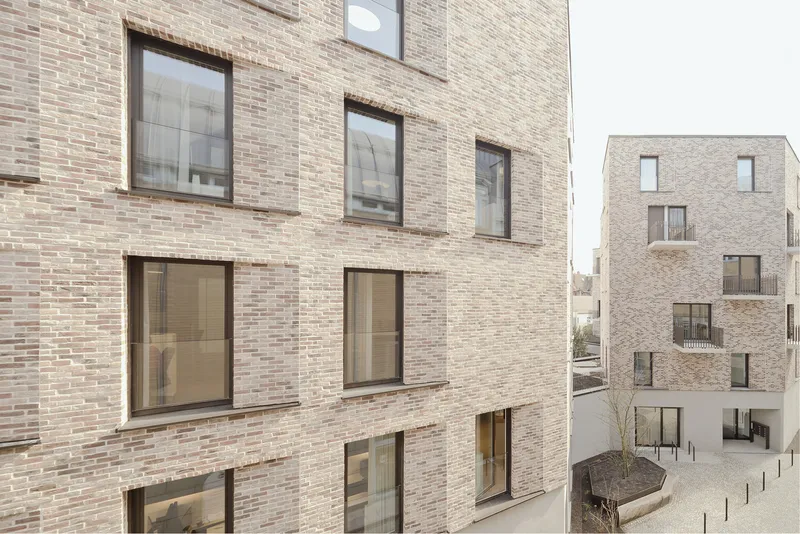
At ground level, the narrow pedestrian passage between the blocks is a generous gesture disguised as a constraint. It invites movement through the site rather than around it, linking the courtyard to the street and creating a shortcut that residents and passersby share. The brick walls on either side are close enough to touch, and the balconies above form a rhythmic overhead canopy that turns a utilitarian gap into an experience.
Thresholds Between Inside and Out
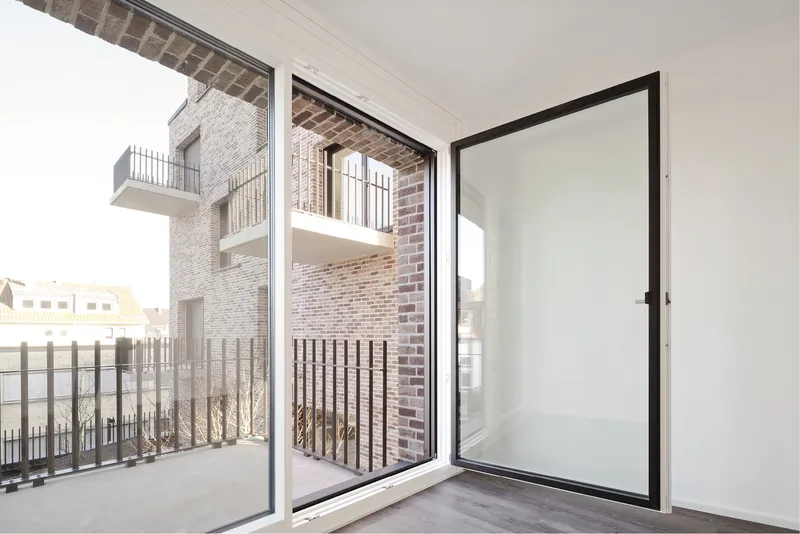
From within the apartments, the relationship to the exterior is mediated by deep balconies framed in metal railings that sit flush with the brick facade. The view from inside, through full-height glass doors, layers interior floor, balcony slab, railing, and the opposing brick wall into a telescoping sequence that gives each unit a strong sense of depth. It is a simple detail, but it transforms a standard balcony into a room-scale threshold.
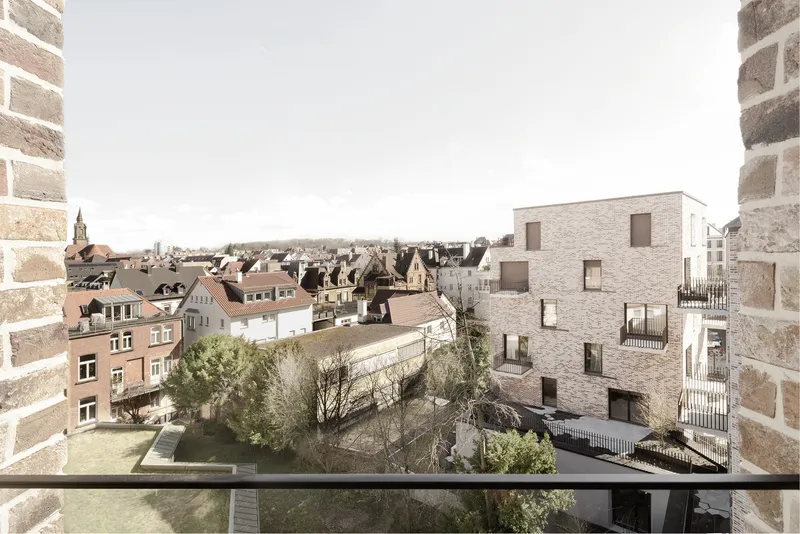
The rooftop terraces offer a different kind of threshold: a horizon line of neighboring gardens, red-tiled roofs, and the gabled peaks of the HLC volumes themselves. Residents at this level step out of private space directly into the broader urban landscape, and the framing is generous enough to make that transition feel earned. Steimle treats every edge of the building as a potential vantage point, not just the balconies but the roofs, the passages, even the storefronts.
Plans and Drawings
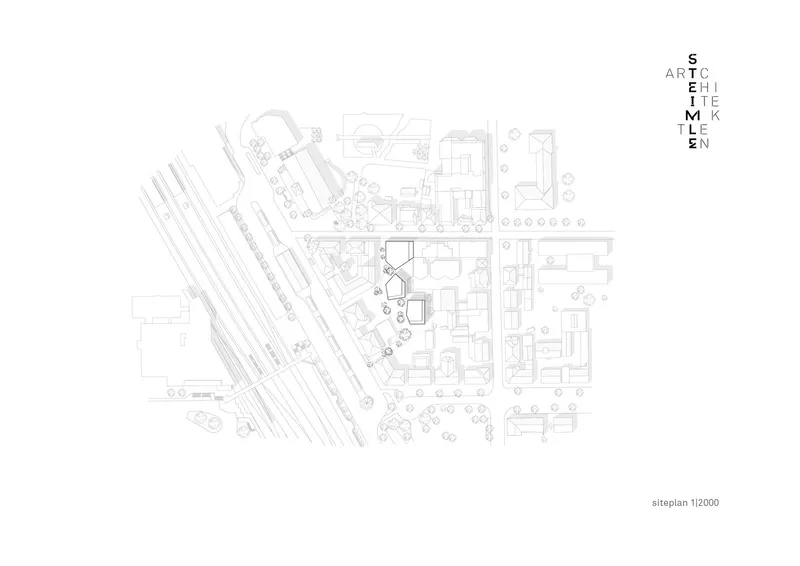
The site plan confirms what the photographs suggest: HLC occupies nearly the full depth of its block, with three distinct volumes oriented to maximize courtyard space and minimize blank party walls. The surrounding streets wrap the complex on three sides, ensuring that every facade is a public face. Landscaping is concentrated in the courtyards and along the eastern edge, where existing garden plots form a green buffer to the neighbors.
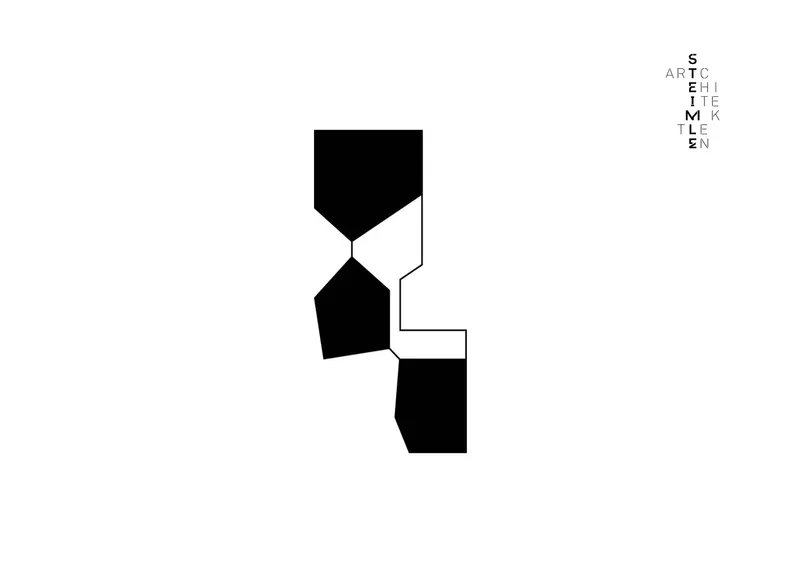
A massing diagram strips the project to its essentials: three dark volumes connected by lighter circulation spines. The white linking elements are where corridors, stairwells, and shared services live, and their slenderness explains why the volumes read as independent buildings rather than wings of a single structure. It is a diagram that could be handed to a planning committee as proof of concept, cleanly separating served from servant space.
Why This Project Matters
HLC Ludwigsburg is not a landmark building, and that is entirely the point. It demonstrates that density, mixed use, and architectural quality can coexist without spectacle. By fragmenting a sizable program into domestic-scale volumes with pitched roofs and brick skins, Steimle Architekten sidestep the usual tension between developer ambition and neighborhood resistance. The result is a project that feels inevitable rather than imposed.
For architects working on infill housing in European towns, the lesson here is one of calibration. Every decision, from the brick tone to the balcony depth to the width of the pedestrian passage, serves the same goal: making a dense mixed-use block behave like a collection of houses. It is a strategy that requires discipline rather than invention, and it produces the kind of architecture that improves a street without demanding attention for doing so.
HLC Ludwigsburg, a mixed-use residential and office development by Steimle Architekten BDA, Ludwigsburg, Germany. Photography by Brigida González.
About the Studio
Share Your Own Work on uni.xyz
If projects like this are the kind of work you want to make, uni.xyz is a place to publish your own, find collaborators, and enter design competitions.


Popular Articles
Popular articles from the community


Aquadapt: An Underwater Habitat That Rewrites Its Rooms by the Hour
Curved modules ring the seabed while one shell shifts from breakfast room to cinema, farm and football pitch as residents' needs change.

The Amber Palace Opera: A Geological Fiction Surfaces on Tallinn's Baltic Waterfront
Pierre Brillard reimagines a Baltic legend as a public landscape, opera house, and waterfront promenade rooted in Tallinn's coastal identity.


FCC Arquitectura Expands a Portuguese Granite House with a Board-Marked Concrete Wing
In Portugal, JV House pairs a cleaned-up whitewashed and granite dwelling with a timber-shuttered concrete extension, courtyards and a garden pool.

Opera on the Sea: Driftwood Logic Shapes a Timber Opera House on Estonia's Coast
Trevor Orgill's opera house translates the entangled drift of floating timber into a civic building where wood, water, and music converge.

Similar Reads
You might also enjoy these articles


Hodi-Mandai Geram
Project Function: Preservation and revitalization of the Intangible heritage and socio-spatial identity of the Hodi by Housing, Cultural Memory Center, Sacred Grove, landscape, local tourism economy


Olio Towers: A Mid-Rise for Performers That Fuses Housing, Rehearsal, and Stage
Located blocks from Houston's Theater District, this modular tower stacks living units around a central performance atrium.

Oasis: Modular Green Housing Carved into Dhaka's Urban Fabric
A shortlisted Plugin Housing entry reclaims unauthorized settlements in Dhaka with stepped concrete volumes, green roofs, and ventilation-driven design.

Black Hole: A Floating Megastructure for the Post-Physical Era
Emiliano Mazzarotto envisions a spherical, self-scaling arena where e-sports, digital hotels, and holographic stadiums replace traditional public space.

Explore Mixed-Use Competitions
Discover active competitions in this discipline

Challenge to reimagine the Iron Throne

Photograph architecture without architects

Illustrate the lost glory of Angkor Wat - Render Challenge

Design challenge to reuse E-waste
Comments (0)
Please login or sign up to add comments
No comments yet. Be the first to comment!