
Ignacio Urquiza and Ana Paula de Alba Wrap a Mexico City Restaurant in Stainless Steel and Timber
NINYAS turns an industrial material palette into a warm, communal dining room anchored by a central island and double-height shelving.


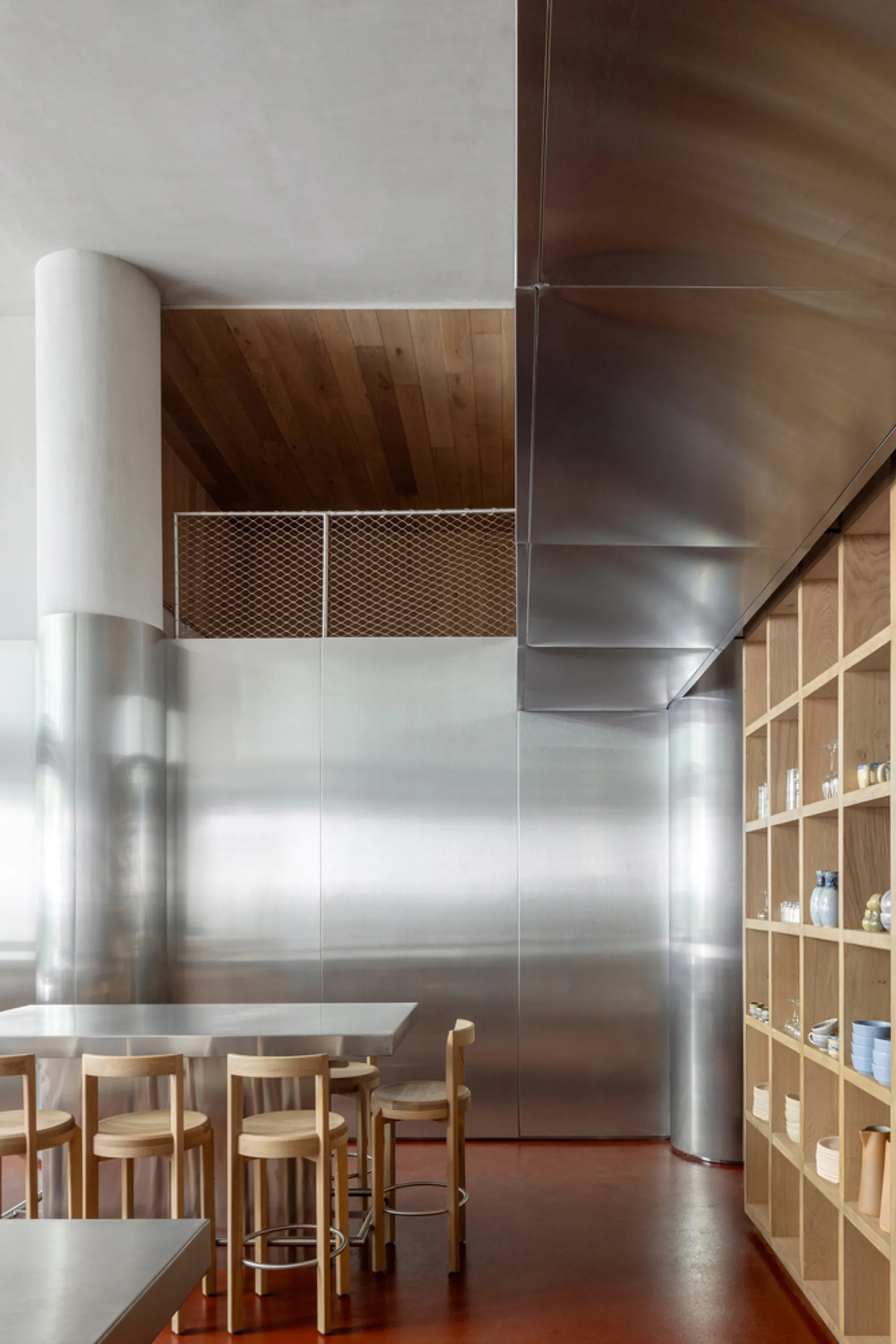
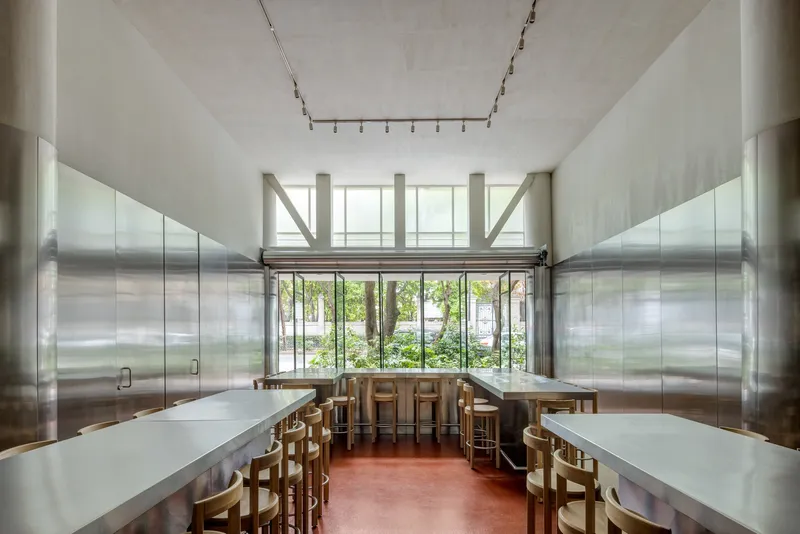
A restaurant interior built almost entirely from stainless steel should feel clinical. NINYAS, designed by Ignacio Urquiza Arquitectos and Ana Paula de Alba in Mexico City, does not. The project takes the vocabulary of a professional kitchen, the sheet metal, the mesh grilles, the track lighting, and extends it across every surface of the dining room, then softens the whole thing with light timber stools, open wood shelving, and a terracotta resin floor that gives the space a grounded warmth no polished slab could.
What makes NINYAS genuinely interesting is the refusal to separate front of house from back of house. The central island functions as both a communal dining table and a working counter, placing guests directly in the current of food preparation. A double-height volume lifts the ceiling away from the action and fills the upper register with bottle displays and mesh-guarded mezzanine space. The result is a restaurant that reads as one continuous room rather than a series of staged experiences.
The Central Island as Social Anchor
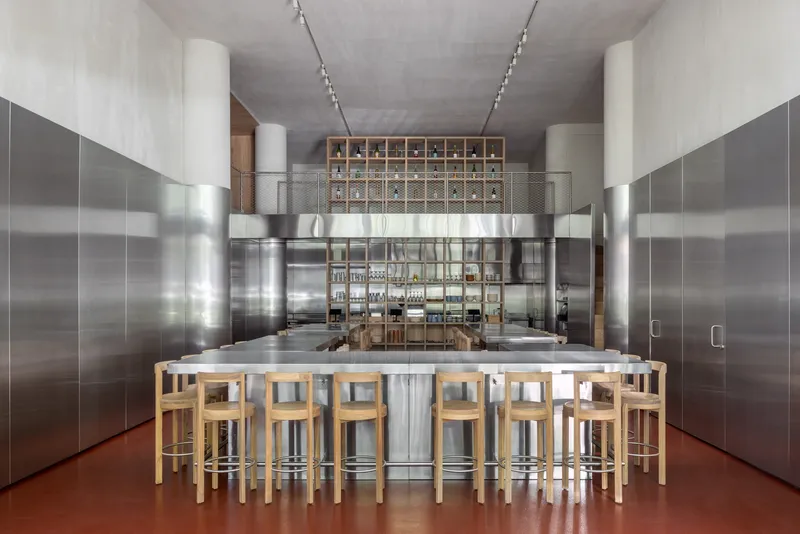
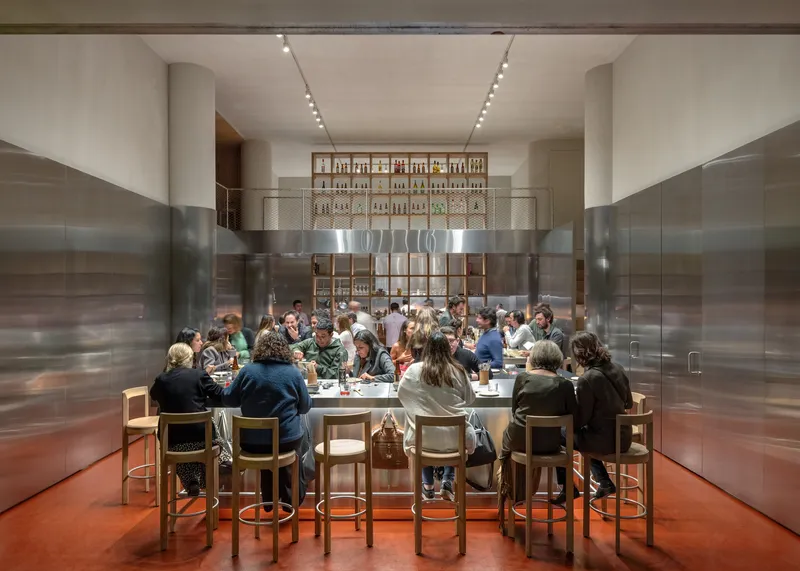

The plan revolves around a shared metal-topped island that seats diners on all sides. Timber bar stools pull up tight to the counter, establishing an intimacy closer to an izakaya than a conventional sit-down restaurant. When the room fills, the island becomes a communal table where strangers face each other across plates, a social arrangement that few Western restaurant typologies attempt at this scale.
A curved stainless steel column punctuates one end of the island, rising through the double-height volume and doubling as a structural element. It is both honest and theatrical: you can trace the load path from the mezzanine grille down through the column to the floor, yet the cylinder catches light in a way that makes it feel sculptural rather than merely functional.
Stainless Steel as a Total Surface

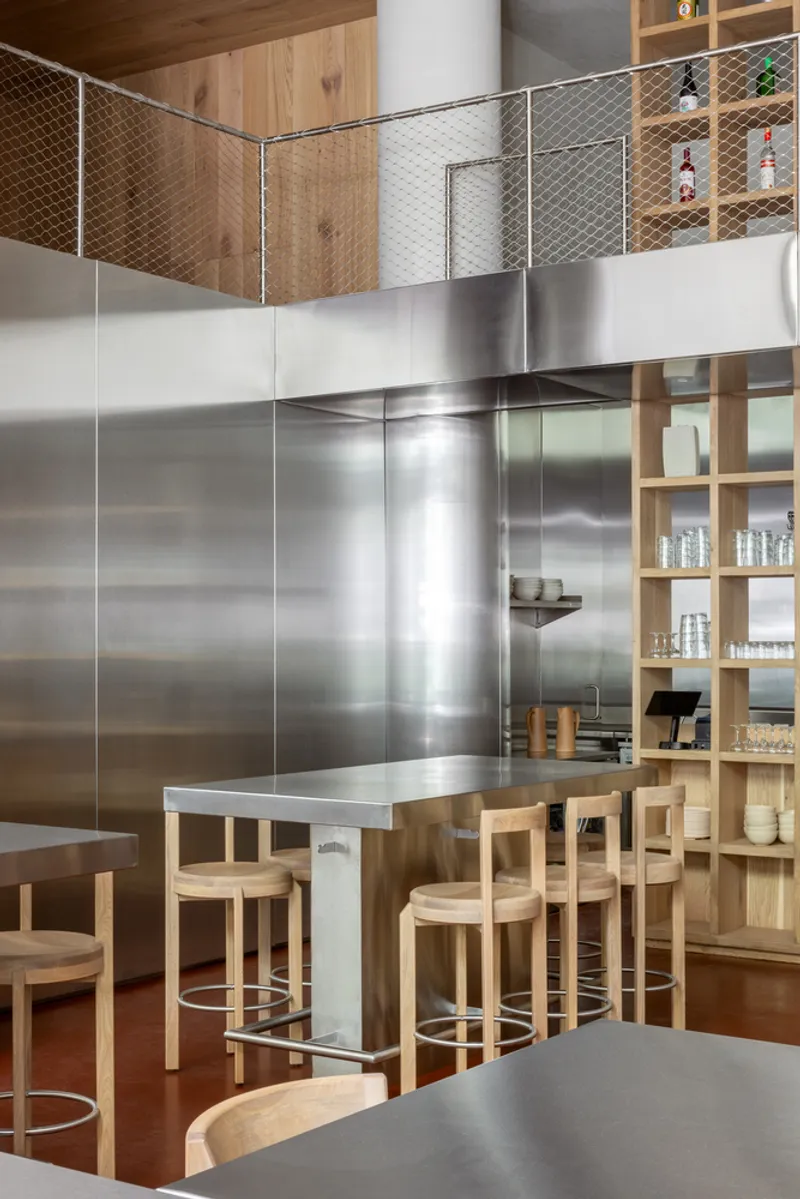
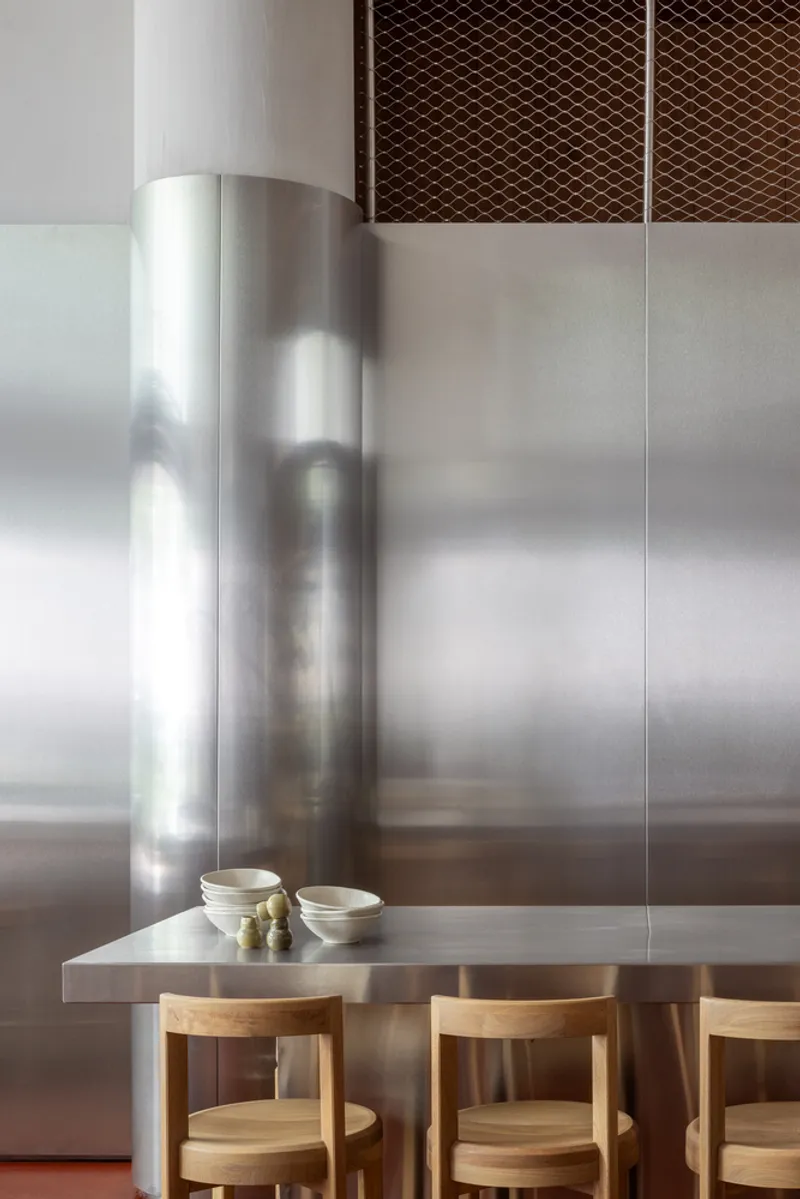
Urquiza and de Alba commit fully to the stainless steel palette. Wall panels, cabinetry, counters, and the cylindrical column are all finished in the same brushed metal, creating a visual continuity that eliminates the usual hierarchy between furniture and enclosure. The effect is closer to a piece of industrial design than a conventional architectural interior: every element belongs to the same system.
That commitment could easily tip into coldness, but the designers manage the temperature through two counterweights. The terracotta resin floor introduces a matte, earthy base tone that absorbs light rather than bouncing it. And the timber elements, stools, shelving, subtle counter details, add grain and texture at exactly the points where human hands make contact. It is a studied calibration, not an accident.
Double-Height Volume and the Mezzanine Edge
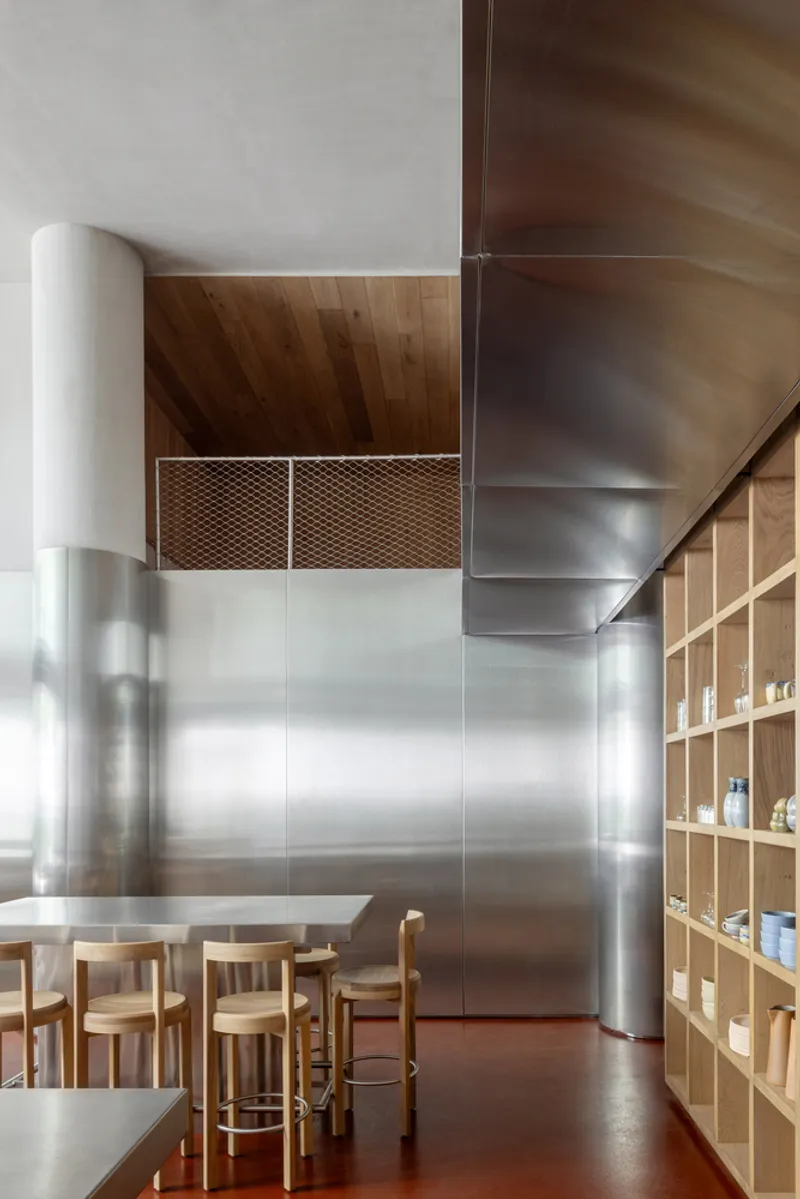
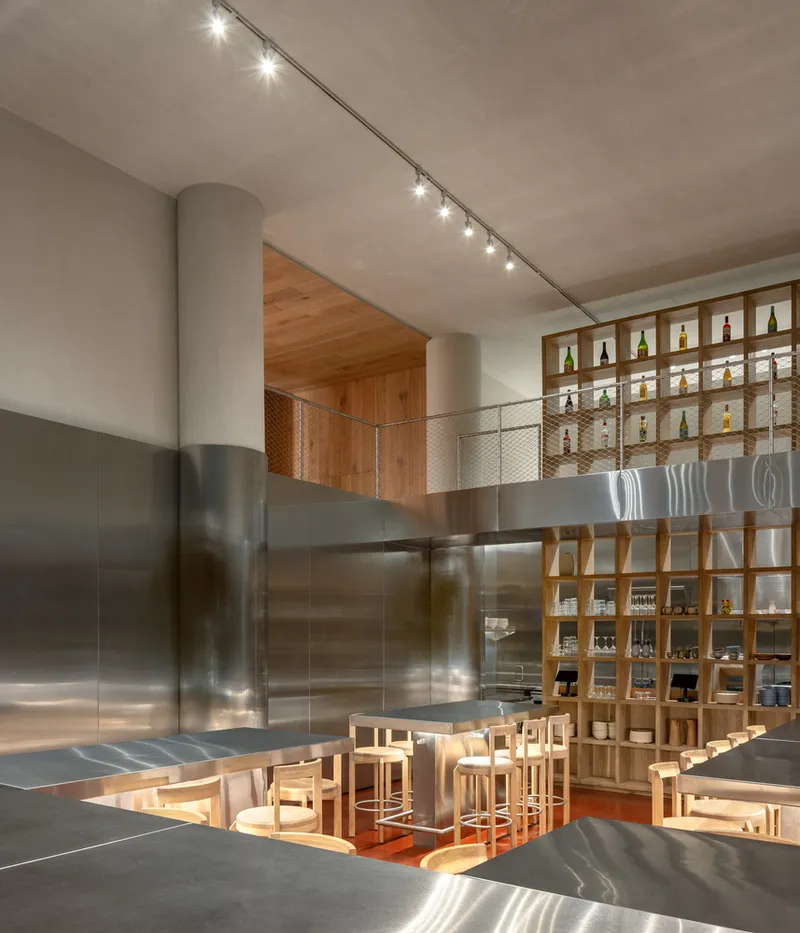
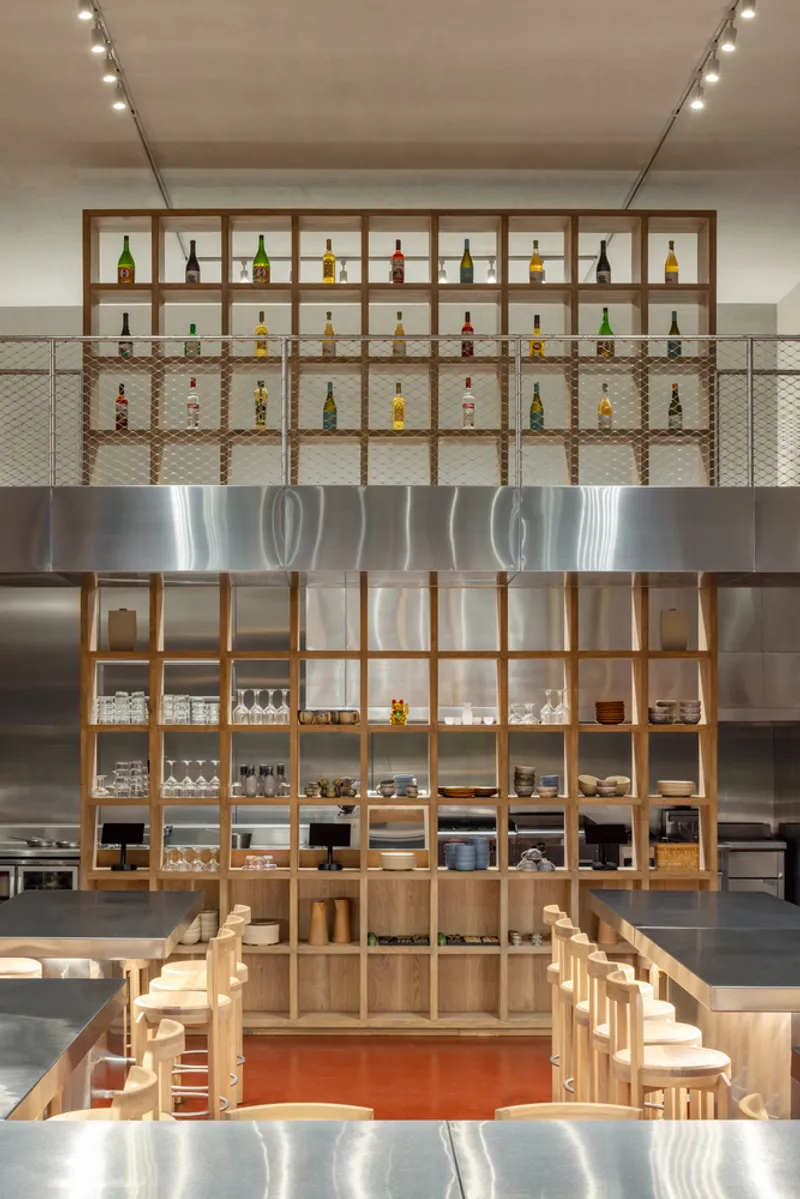
The most generous spatial move is the double-height void above the dining area. Open wood shelving climbs the full height of the wall, turning bottle storage into an architectural feature that gives the room vertical ambition. Mesh grilles at the mezzanine level allow light and air to pass between floors while keeping the upper workspace visually connected to the dining room below.
Track lighting runs along the ceiling plane and washes the shelving evenly, avoiding the spotlit drama that many hospitality projects default to. The lighting strategy reinforces the egalitarian logic of the plan: no single table gets the best light because the entire room is treated as one zone.
Kitchen as Display, Not Backstage


The galley kitchen sits in plain view, its stainless steel cabinetry and espresso machine forming a wall of equipment that reads as part of the dining room's materiality rather than a separate service zone. Open wood shelving above the work surfaces stores tools and ingredients at arm's reach, reinforcing the idea that everything in NINYAS is accessible, visible, and part of the experience.
White tabletops adjacent to the kitchen provide a tonal break, their clean surfaces contrasting with the warm terracotta floor and the metallic walls. The palette here is deliberately limited: three materials, three tones, no decorative additions. The food, presumably, provides the color.
Threshold and Transparency

Black steel folding doors define the primary entrance, swinging open at dusk to dissolve the boundary between street and interior. The view through the doors frames the central island as the first thing a visitor sees, anchoring orientation before one even steps inside. It is a simple and effective piece of spatial choreography.
On the opposite side, floor-to-ceiling windows open the dining hall to an adjacent garden, introducing greenery as the only organic element in an otherwise mineral interior. Exposed steel bracing visible above the glazing makes the structural logic legible from the dining seat, a transparency that echoes the kitchen's open-plan ethos.
Physical Models


Three physical models reveal the design process in material terms. Gridded timber screens, perforated metal railings, and a vivid red floor plane appear in miniature, confirming that the material decisions were tested at model scale before being executed at full size. The section model is particularly telling: it shows the double-height bar area flanked by cylindrical white columns and the mezzanine hovering above, a spatial relationship that is harder to grasp from photographs alone.
These models are worth studying because they expose the layering strategy. Screens sit in front of structure, which sits in front of shelving, which sits in front of the enclosure wall. Each layer operates at a different degree of transparency, and the models make that sequence legible in a way the finished photographs compress.
Plans and Drawings

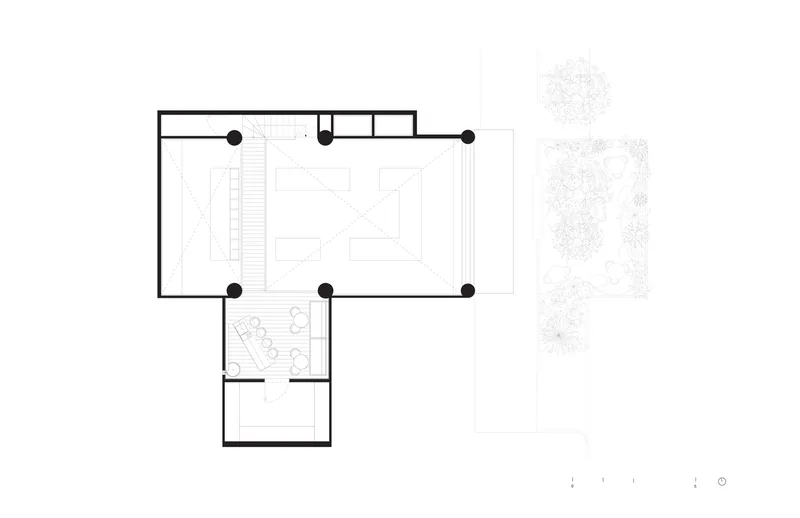
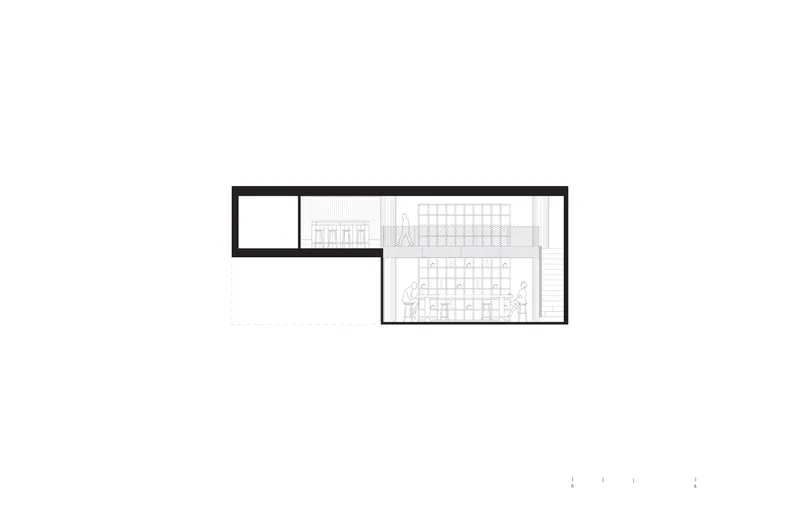
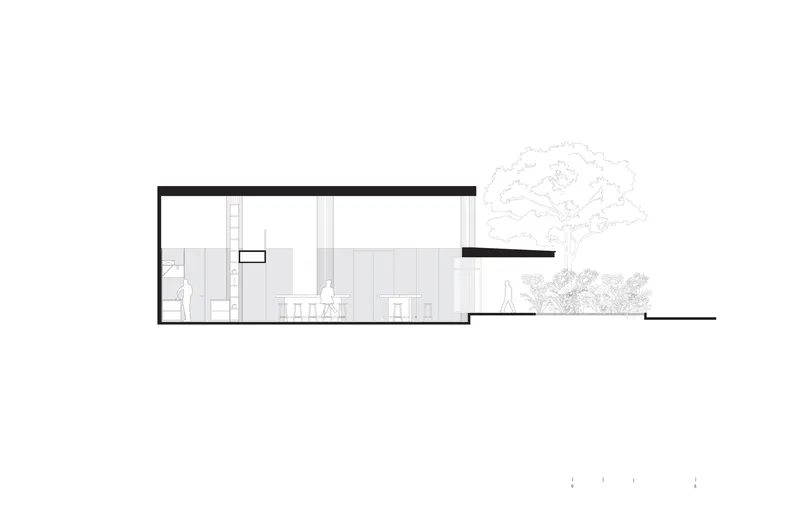
The floor plans confirm an L-shaped layout with a circular seating arrangement at its heart and an adjacent garden courtyard that provides natural light and ventilation. The upper level plan shows the kitchen workspace organized around a central island and connected to an entry vestibule, reinforcing the vertical relationship between preparation and dining. A section drawing cuts through the double-height volumes and reveals how the mezzanine slots between existing trees, a detail invisible from inside.
Why This Project Matters
NINYAS matters because it treats restaurant design as architecture, not decoration. The material palette is rigorous enough to hold an entire interior together without pattern, color, or ornament doing the work. The spatial strategy, a single communal room with no backstage, proposes a social model as much as an aesthetic one. In a hospitality landscape saturated with themed environments and Instagram backdrops, the directness here is quietly radical.
Ignacio Urquiza and Ana Paula de Alba demonstrate that industrial materials can produce warmth when deployed with precision. The terracotta floor, the timber grain, the garden glimpse through glass: these are not afterthoughts softening a harsh concept, they are integral moves that make the steel sing rather than clang. NINYAS is a small project with a clear argument, and that clarity is exactly what makes it stick.
NINYAS, designed by Ignacio Urquiza Arquitectos and Ana Paula de Alba, Mexico City, Mexico. Photography by Rafael Gamo and IUA Ignacio Urquiza Arquitectos.
About the Studio
Share Your Own Work on uni.xyz
If projects like this are the kind of work you want to make, uni.xyz is a place to publish your own, find collaborators, and enter design competitions.




Popular Articles
Popular articles from the community


The Earth Pod: 3D Printed Homes for Resilient Refugee Communities
The Earth Pod reimagines refugee housing through 3D printed homes made from clay, combining resilience, self-sufficiency, and rapid shelter.

Play: Fragments of Their World
Familiar architecture becomes modular playground design, creating safe spaces where displaced children can learn, connect, imagine and play.

The Ocean Hive: Sustainable Architecture for a Self-Sufficient Civilization at Sea
The Ocean Hive imagines sustainable architecture at sea, where modular habitats, algae, wave power and ocean waste sustain a growing colony.

The Musturak Paradise: Senior Living Architecture for a Connected Future in Temara, Morocco
The Musturak Paradise reimagines senior living architecture in Temara via private homes, social spaces, culture, community, and shared care.


Similar Reads
You might also enjoy these articles


Hodi-Mandai Geram
Project Function: Preservation and revitalization of the Intangible heritage and socio-spatial identity of the Hodi by Housing, Cultural Memory Center, Sacred Grove, landscape, local tourism economy


Olio Towers: A Mid-Rise for Performers That Fuses Housing, Rehearsal, and Stage
Located blocks from Houston's Theater District, this modular tower stacks living units around a central performance atrium.

Oasis: Modular Green Housing Carved into Dhaka's Urban Fabric
A shortlisted Plugin Housing entry reclaims unauthorized settlements in Dhaka with stepped concrete volumes, green roofs, and ventilation-driven design.

Black Hole: A Floating Megastructure for the Post-Physical Era
Emiliano Mazzarotto envisions a spherical, self-scaling arena where e-sports, digital hotels, and holographic stadiums replace traditional public space.


Explore Nio Architects Competitions
Discover active competitions in this discipline



Challenge to reimagine the Iron Throne


Photograph architecture without architects


Illustrate the lost glory of Angkor Wat - Render Challenge


Design challenge to reuse E-waste
Comments (0)
Please login or sign up to add comments
No comments yet. Be the first to comment!