
Studio gamp! Scatters a Village of Gabled Volumes Across an Italian Hillside
The Blue House in rural Italy reinterprets vernacular farmstead typology through brick, stone, and a deference to existing oaks.


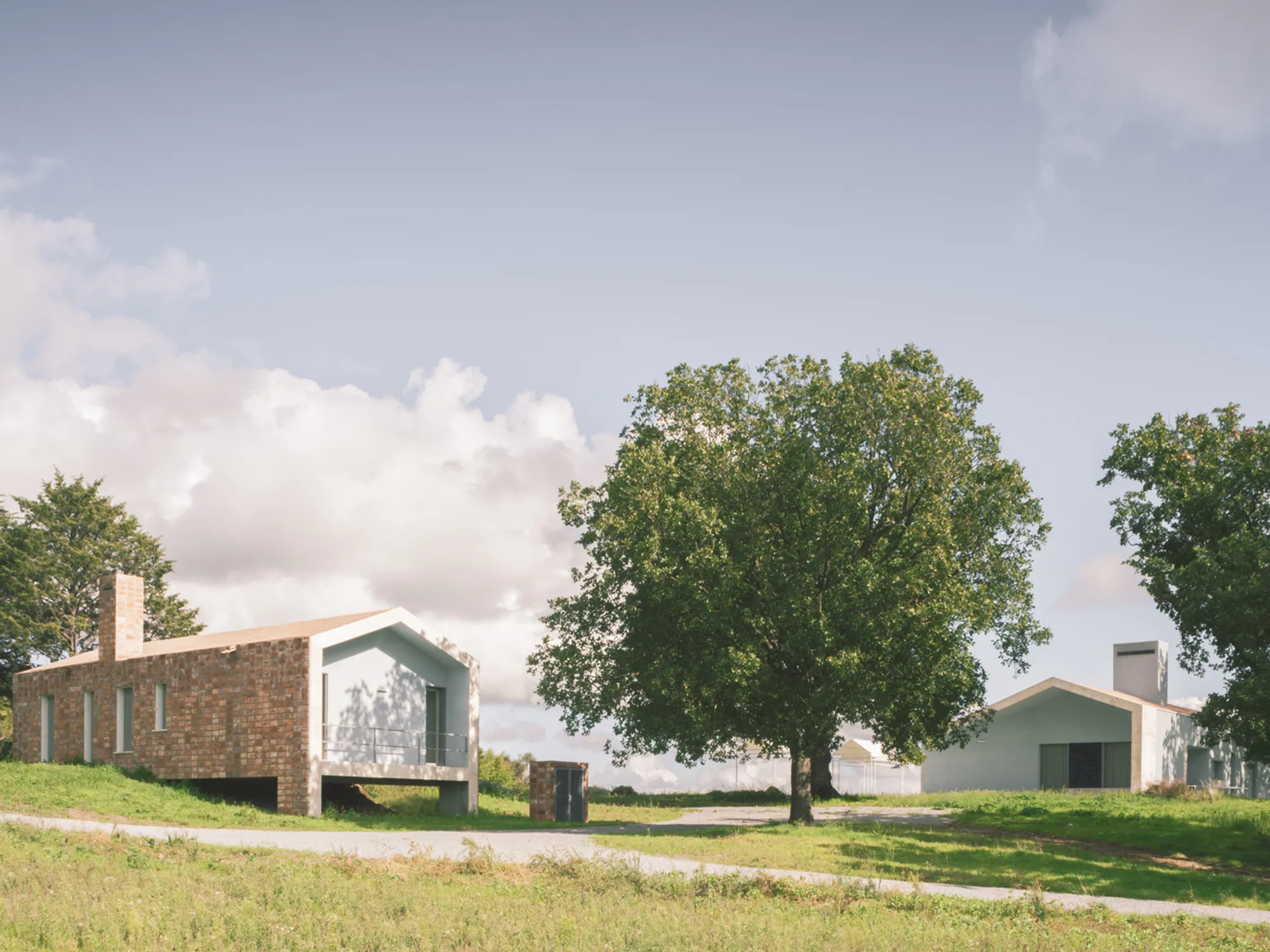
The idea of building in the countryside carries a persistent tension: how to place something new in a landscape that already has a strong identity. Studio gamp! addresses this with the Blue House, a residential project in rural Italy that fragments the typical single-family villa into a cluster of small gabled volumes. Rather than dropping one monolithic object onto the hillside, the architects organized the program as a loose constellation of buildings, each scaled to the surrounding oak trees and the gentle topography of the site.
What makes the project genuinely interesting is its refusal to choose between nostalgia and abstraction. The material palette, red brick, pale stone, white render, terracotta roof tiles, is drawn directly from the local building tradition, but the formal moves are sharp and deliberate. Narrow vertical slit windows replace the conventional openings of a farmhouse. Volumes are rotated off axis to respond to specific trees and contour lines. The result reads less like a house than like a small hamlet that could have accumulated over decades.
A Fragmented Footprint
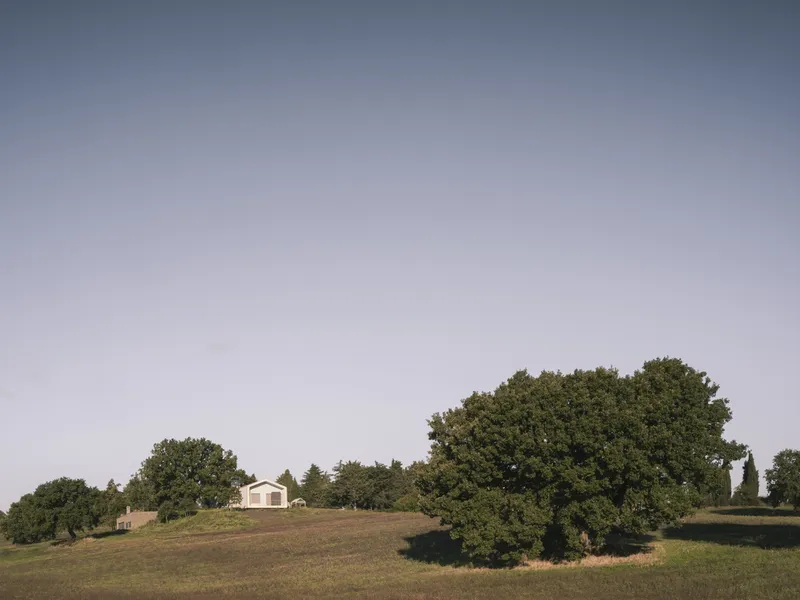
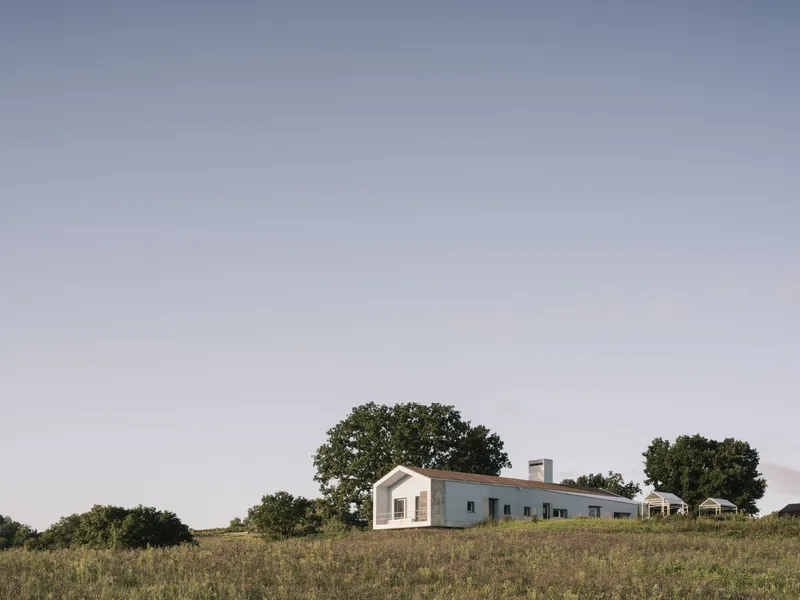
Seen from a distance, the Blue House almost disappears into the landscape. The white gabled form sits beneath a canopy of mature oaks, its pitched roofline echoing the silhouette of traditional agricultural buildings across the region. The decision to break the program into separate wings, a main living volume, a horizontal service bar, and smaller ancillary structures, means no single element competes with the scale of the trees. The architecture defers to what was already there.
The low horizontal wing stretches across the meadow in a gesture that emphasizes the site's lateral dimension. Afternoon light catches the white render and terracotta, producing exactly the kind of warm, grounded composition that a single rectangular box never could. Each volume is sized to contain a discrete function, and the gaps between them create sheltered outdoor rooms.
Brick, Stone, and the Logic of the Ground
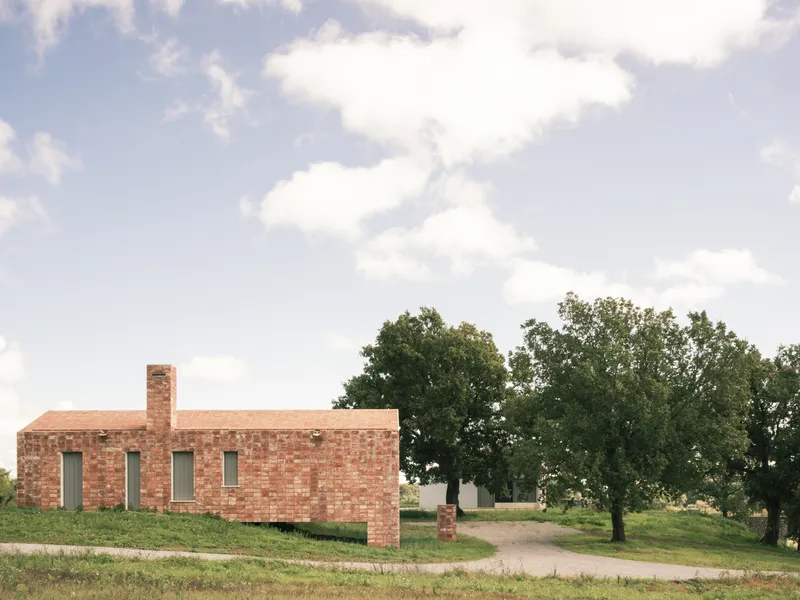
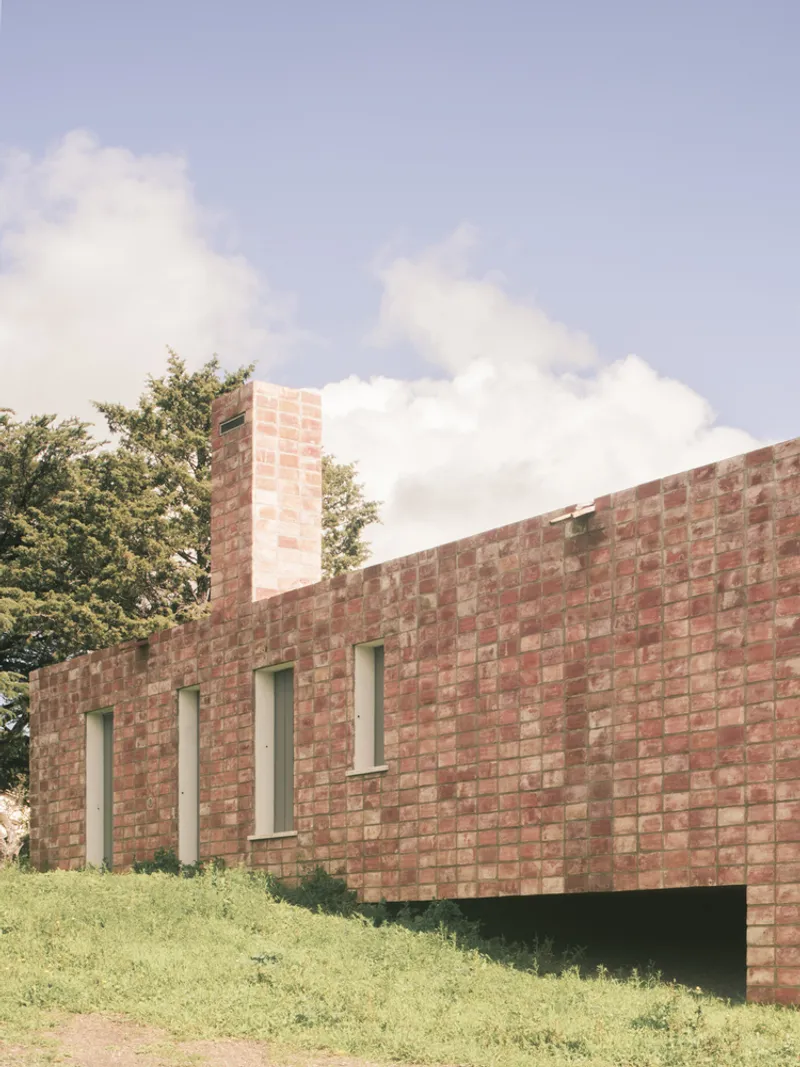
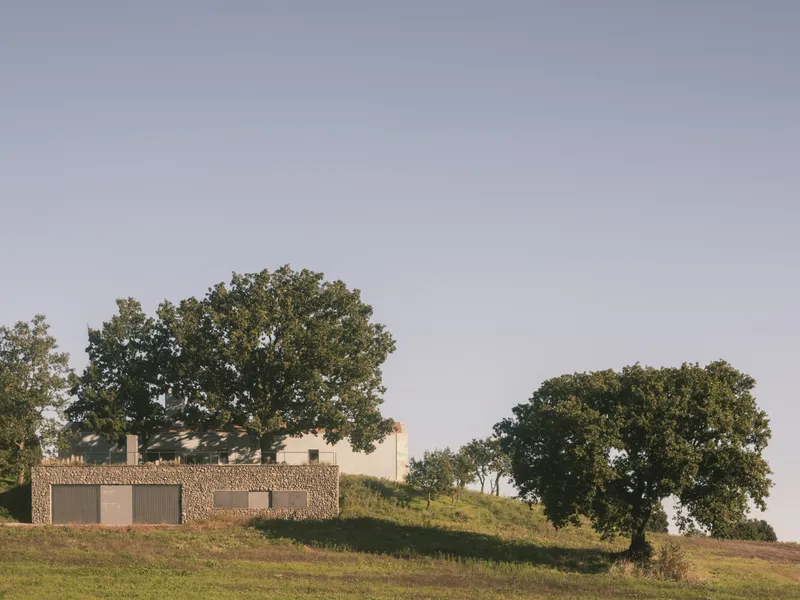
The material strategy is layered. Where the building meets the slope, stone cladding provides a heavy, grounded base that anchors the structure visually and physically to the hillside. Above this, red brick takes over, its vertical slit windows punched with a precision that keeps the walls feeling solid. The chimney stack rising from the brick facade reads as an honest functional element, not a decorative appendage.
Studio gamp! has clearly thought about how materials weather. The stone base will darken and green over time, gradually merging with the terrain. The brick will mellow. These are not materials chosen from a mood board; they are materials chosen to age into their surroundings. The horizontal openings cut into the stone wall along the slope operate like observational slits, framing specific views of the landscape while keeping the facade closed and protective.
The Skeletal Frame and the Oak
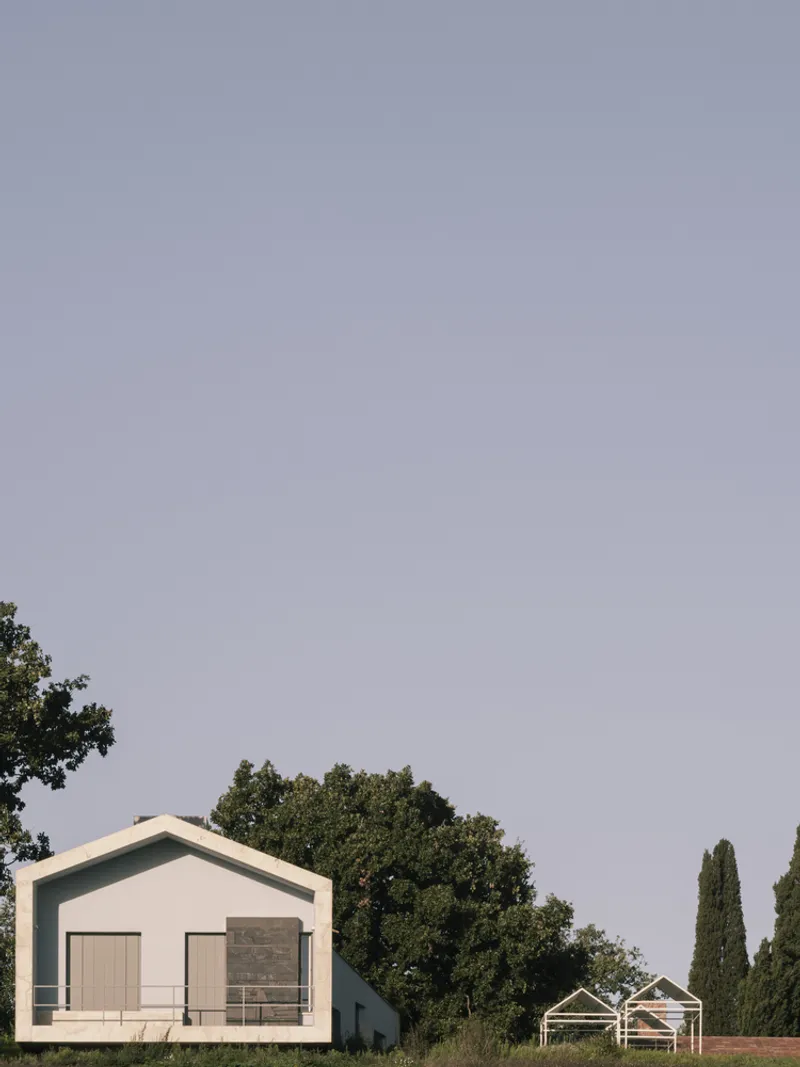
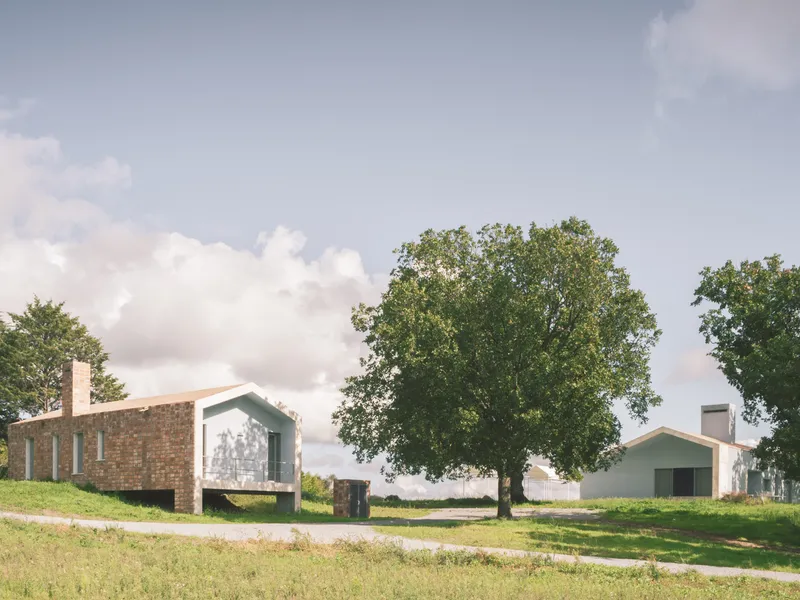
One of the most striking moments in the project is the skeletal frame structure that appears alongside a white gabled volume. Whether intended as a pergola, a future enclosure, or simply a spatial marker, it introduces an almost archaeological quality, as if the building is simultaneously being constructed and uncovered. The bare structure frames the sky and the surrounding trees without enclosing them.
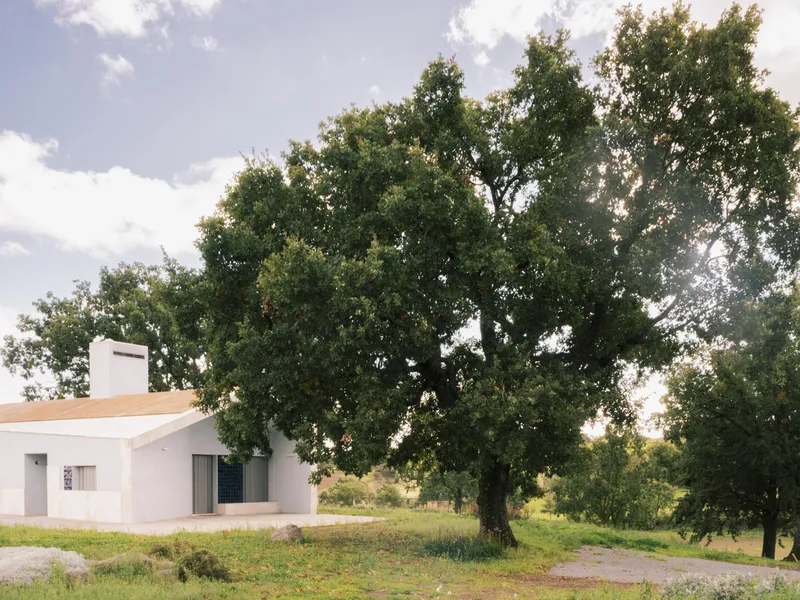
The cluster composition around the large oak tree is where the project's organizing principle becomes clearest. The tree is not centered in a courtyard or framed symmetrically. Instead, the volumes wrap loosely around it, maintaining respectful distances, allowing the canopy to define the spatial hierarchy. The architecture concedes the central role to nature.
Interior Character: Craft Without Preciousness
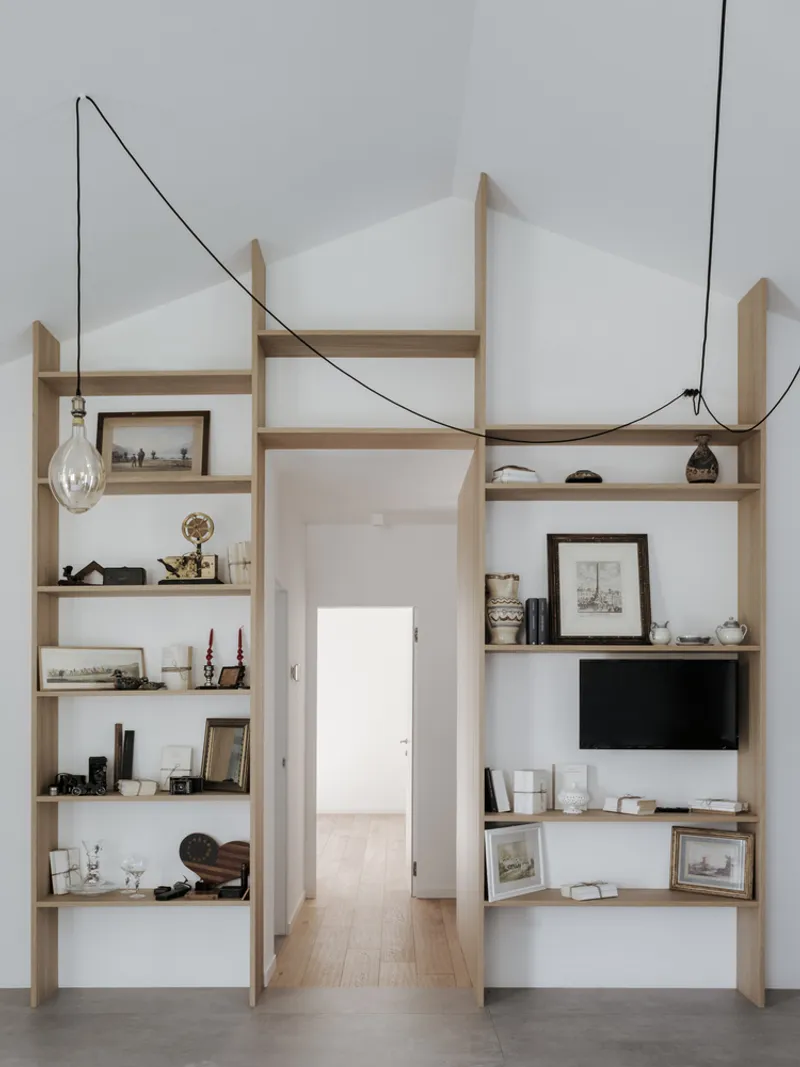
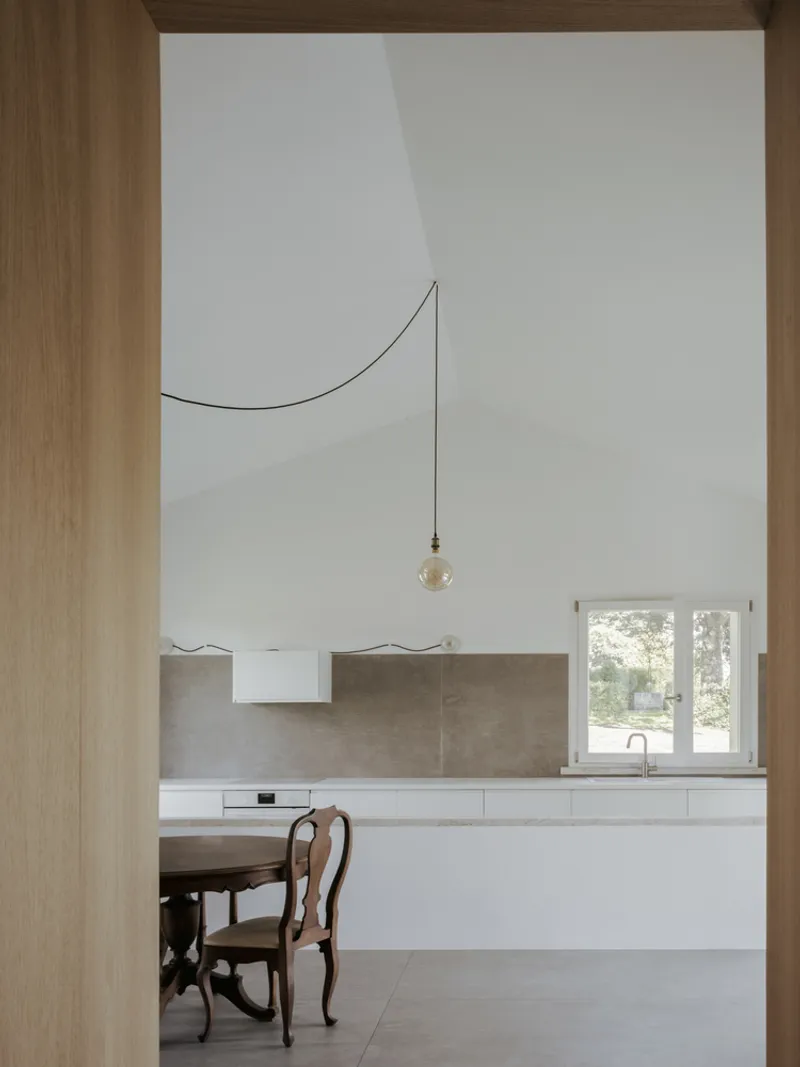
Inside, the gabled ceiling forms create rooms that feel tall without being cavernous. Built-in shelving flanks doorways, turning structural bays into functional furniture. Exposed cable pendant lights hang at deliberate heights, providing warmth without the need for recessed fixtures. The kitchens are framed by timber openings that create a sense of threshold between living and service zones, with stone backsplashes and simple white cabinetry maintaining the project's commitment to material honesty.
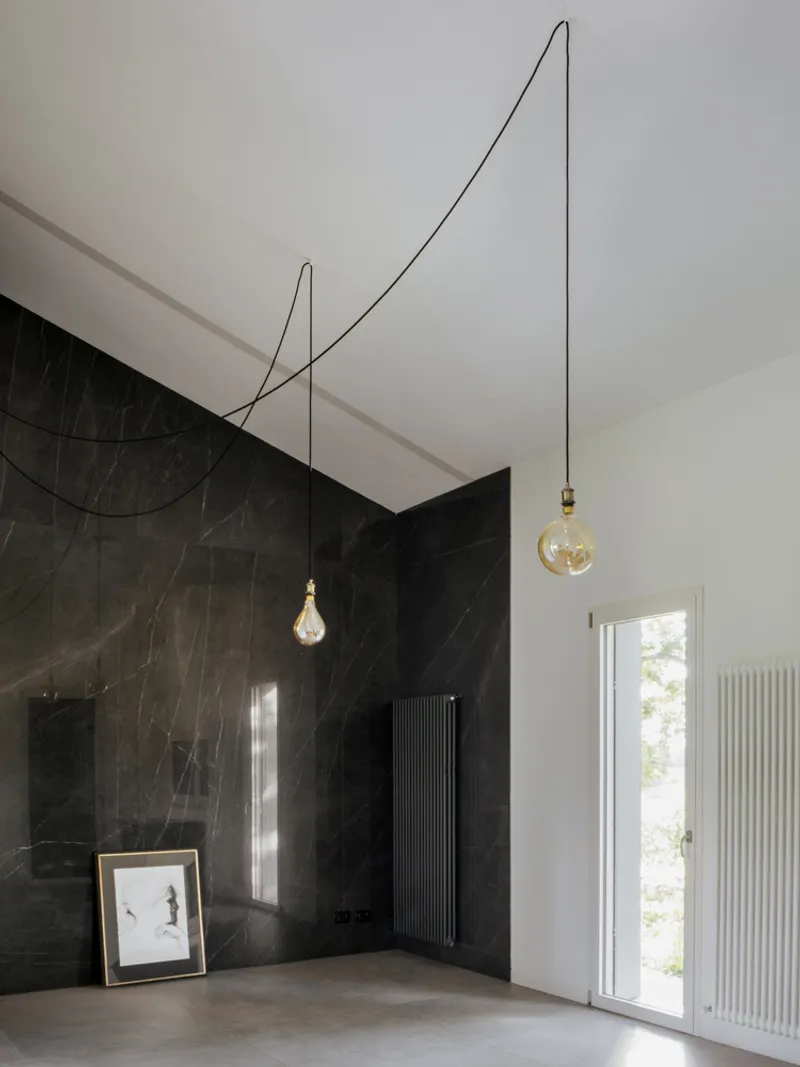
The black marble wall in the main living space is the interior's boldest gesture: a tall, dark plane that absorbs light on one side while a floor-to-ceiling window floods the concrete floor with it on the other. The contrast is controlled and purposeful. There is no attempt to make every surface uniformly bright or neutral. Each room has a distinct material personality.
Detail and Texture
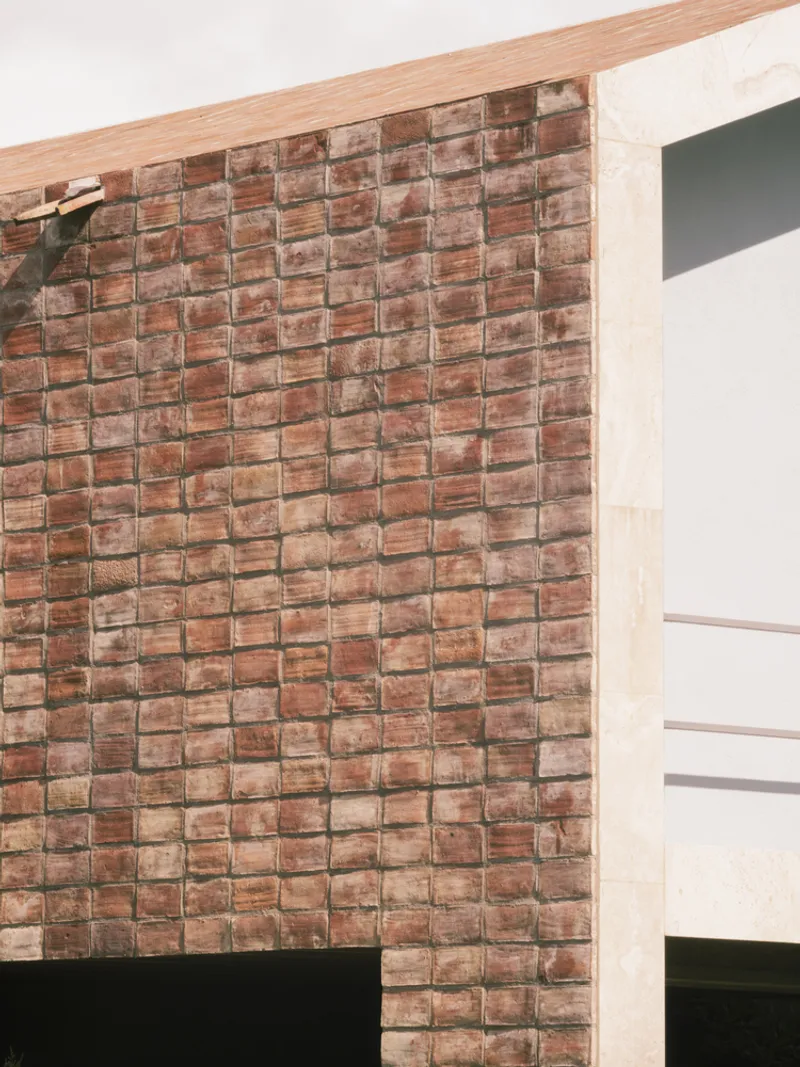
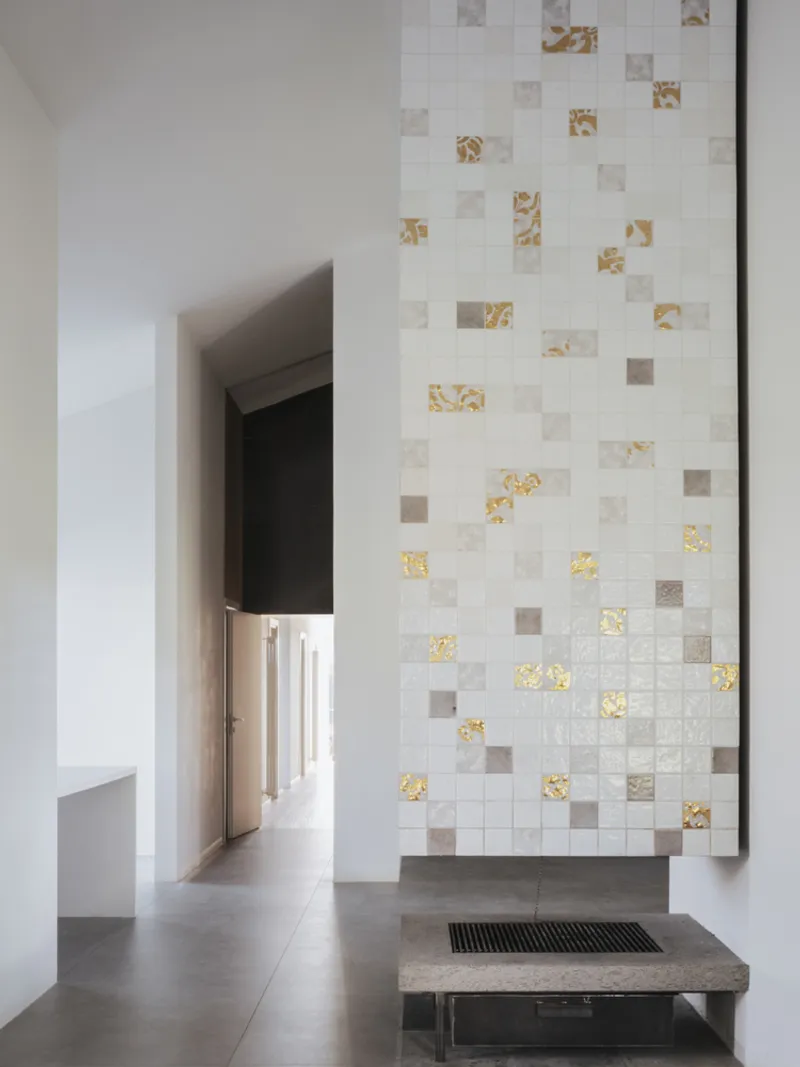
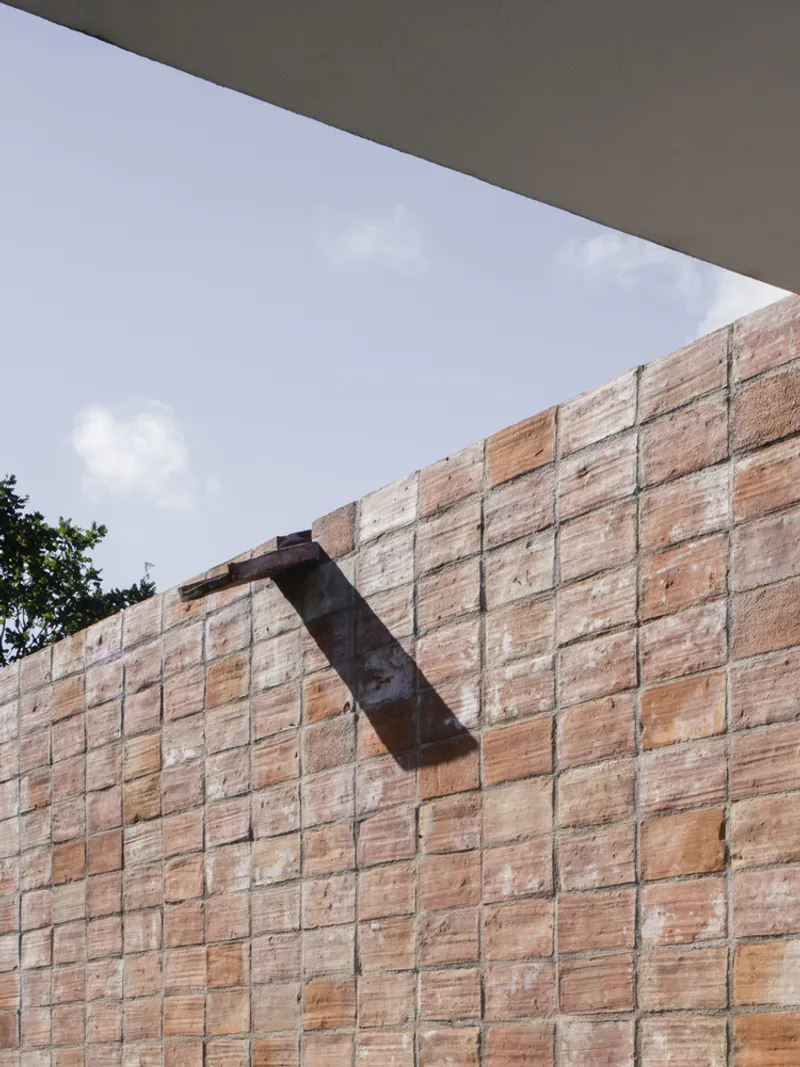
The details reward close attention. A basket-weave terracotta tile wall meets a timber ceiling beam and white plaster with a clarity that reveals how carefully each junction was resolved. A mosaic wall with gold-leaf accents lifts a simple corridor into something unexpected, a moment of decorative generosity in an otherwise restrained project. Reclaimed timber formwork walls, still bearing the imprint of concrete casting, are left exposed as finished surfaces. The metal bracket details and visible construction joints are celebrated rather than concealed.
These are not luxury finishes. They are working materials assembled with skill. The difference matters. The Blue House communicates quality through the precision of its joints and the consistency of its material logic, not through expensive surface treatments.
Threshold Details
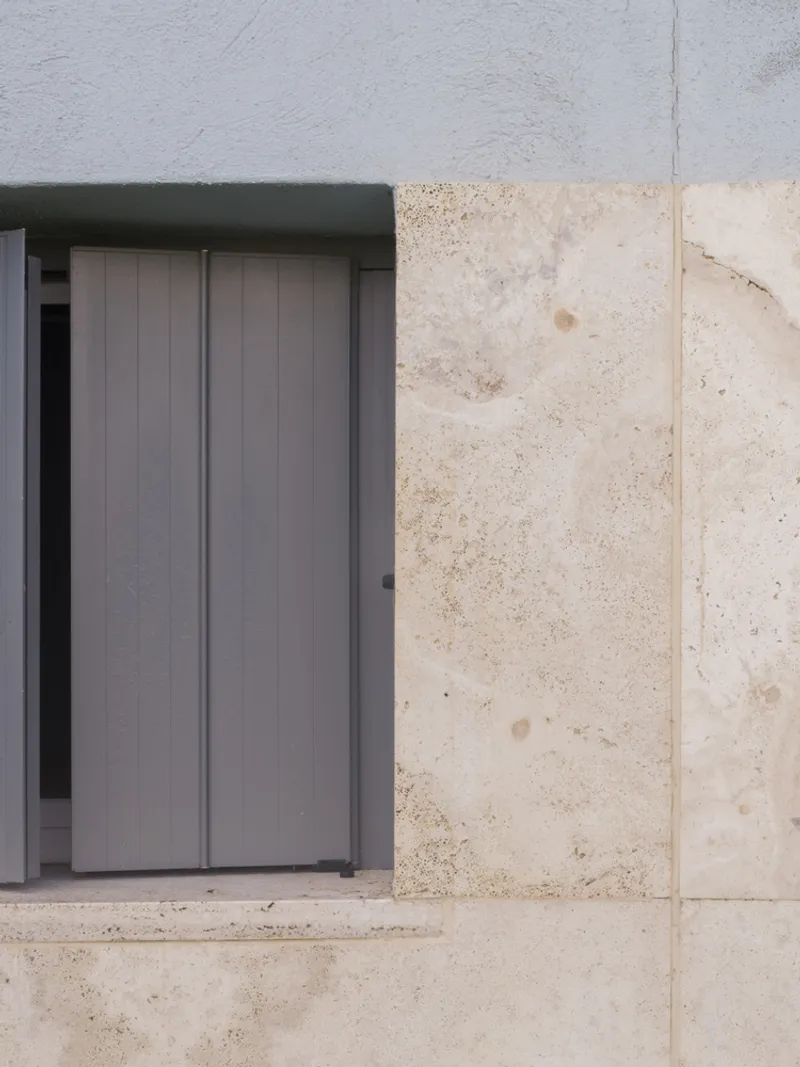
The close-up of a grey metal door frame set into pale stone captures the project's tectonic ambition in miniature. The visible construction joints around the frame are left unpatched, showing where stone blocks were cut and fitted around the opening. It is the kind of detail that separates buildings designed at 1:100 from those designed at 1:1. Studio gamp! clearly worked through the thresholds at full scale, ensuring that each transition between materials is legible and considered.
Plans and Drawings
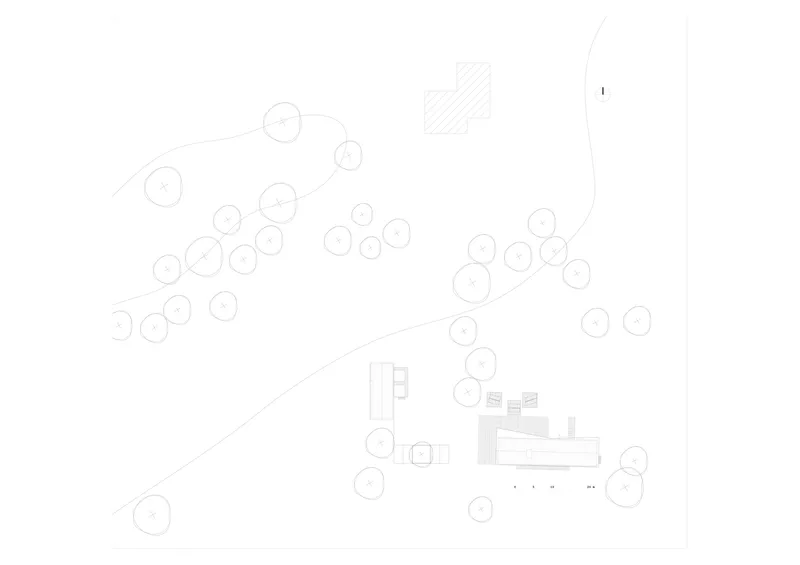
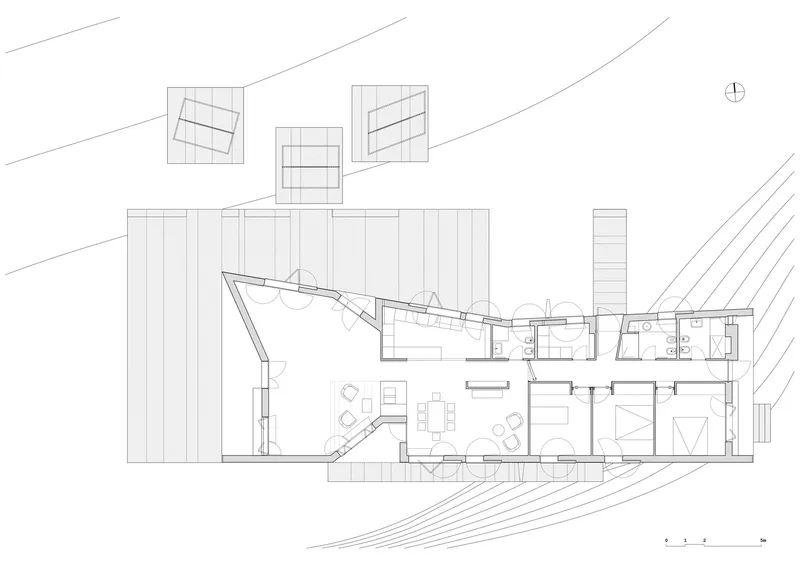
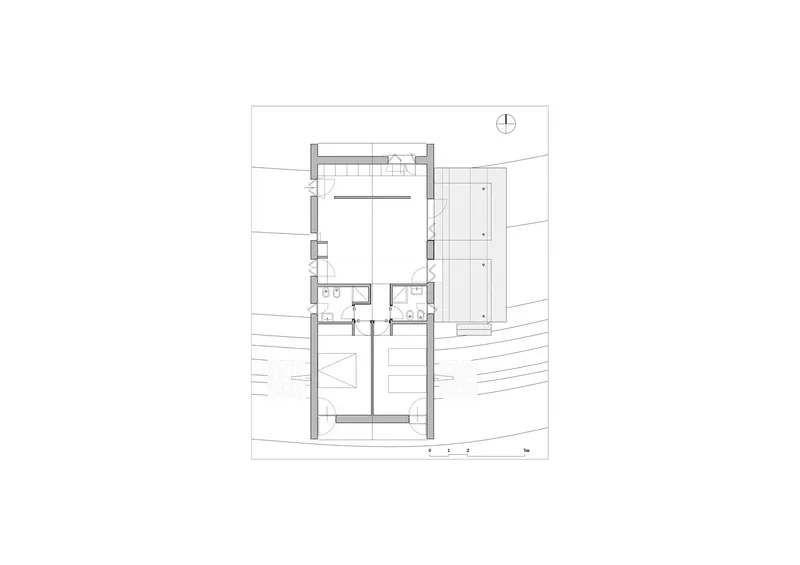
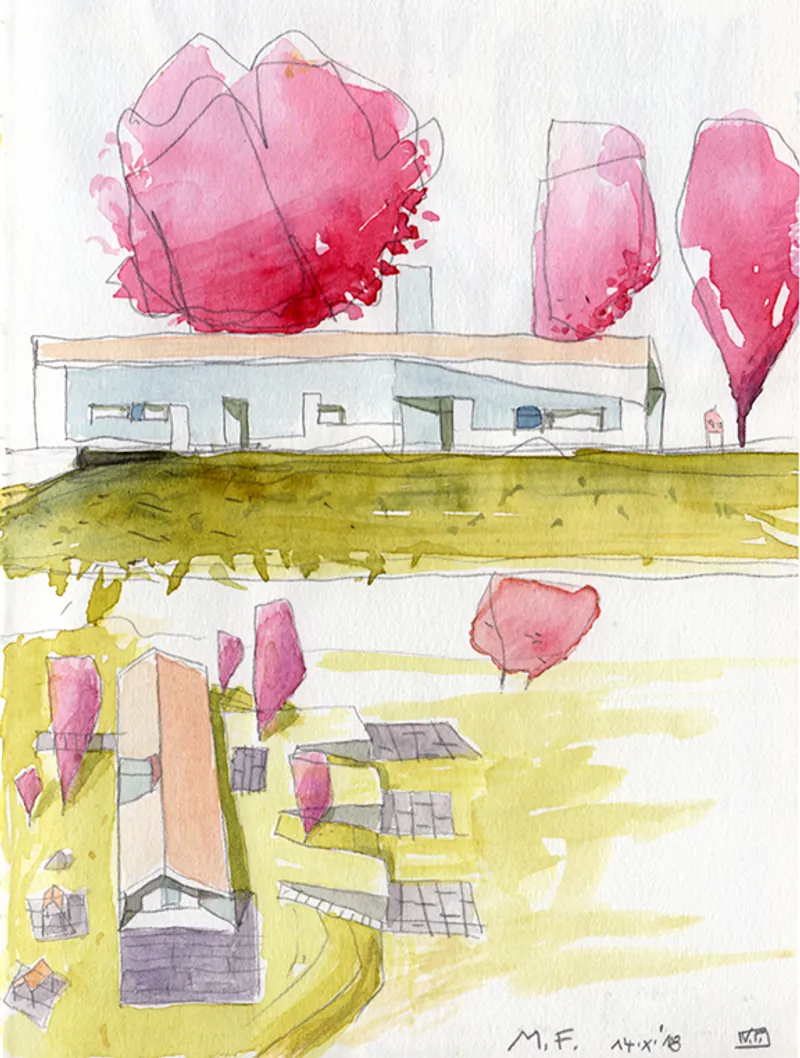
The site plan confirms what the photographs suggest: the building footprint is not a single rectangle but a loosely arranged set of volumes threaded among existing tree canopies. Topographic contours indicate the slope that the stone base absorbs. The floor plans reveal compact, efficiently organized interiors. One plan shows an angular living area with angled glazing oriented toward landscape views, flanked by bedrooms and bathrooms. Another depicts a tighter dwelling with a central bathroom core and peripheral service spaces, the kind of disciplined plan organization that makes small rooms feel generous.
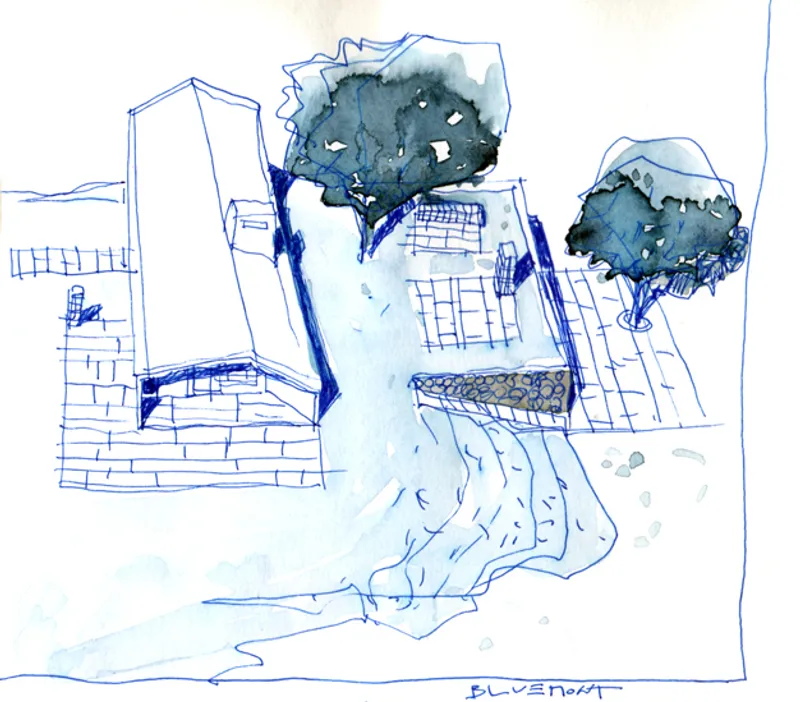
The watercolor sketches are a welcome inclusion. They show the project in its earliest conceptual phase: a stone-based building nestled beside mature trees, with clerestory windows and a horizontal profile. The pink flowering trees and golden ground plane in the studies suggest the architects were thinking about seasonal color from the very beginning. These are not presentation renderings; they are thinking tools, and they reveal a studio that designs by hand before it designs by computer.
Why This Project Matters
Rural residential architecture in Italy too often falls into one of two traps: the pseudo-farmhouse that cosplays as heritage, or the white-box interloper that ignores context entirely. The Blue House does neither. By fragmenting the program, grounding the base in local stone, and letting existing trees dictate the site plan, Studio gamp! arrives at a third position that is both contemporary and embedded. The project demonstrates that you can use traditional materials and pitched roofs without being conservative, and you can make sharp formal decisions without being indifferent to place.
At a moment when rural land across southern Europe is attracting new investment and new construction, the Blue House offers a model for how to build with ambition and restraint simultaneously. The lesson is spatial, not stylistic: break the volume, respect the trees, let the materials age. It sounds simple. Very few projects actually pull it off.
Blue House by Studio gamp!, Italy. Photographs by Lorenzo Zandri.
About the Studio
Share Your Own Work on uni.xyz
If projects like this are the kind of work you want to make, uni.xyz is a place to publish your own, find collaborators, and enter design competitions.




Popular Articles
Popular articles from the community


The Earth Pod: 3D Printed Homes for Resilient Refugee Communities
The Earth Pod reimagines refugee housing through 3D printed homes made from clay, combining resilience, self-sufficiency, and rapid shelter.

Play: Fragments of Their World
Familiar architecture becomes modular playground design, creating safe spaces where displaced children can learn, connect, imagine and play.

Lunar Spiral: Space Architecture Shaped by the Mathematics of the Universe
Lunar Spiral reimagines space architecture through Fibonacci geometry, lunar regolith, levitating habitats, and self-sustaining Moon living.

Conexión: Biophilic Design Reimagines High-Rise Living in Hong Kong
Conexión reimagines high-rise living in Hong Kong through biophilic design, green facades, shared spaces, daylight, water and nature within.

Similar Reads
You might also enjoy these articles


Hodi-Mandai Geram
Project Function: Preservation and revitalization of the Intangible heritage and socio-spatial identity of the Hodi by Housing, Cultural Memory Center, Sacred Grove, landscape, local tourism economy


Olio Towers: A Mid-Rise for Performers That Fuses Housing, Rehearsal, and Stage
Located blocks from Houston's Theater District, this modular tower stacks living units around a central performance atrium.

Oasis: Modular Green Housing Carved into Dhaka's Urban Fabric
A shortlisted Plugin Housing entry reclaims unauthorized settlements in Dhaka with stepped concrete volumes, green roofs, and ventilation-driven design.

Black Hole: A Floating Megastructure for the Post-Physical Era
Emiliano Mazzarotto envisions a spherical, self-scaling arena where e-sports, digital hotels, and holographic stadiums replace traditional public space.

Explore Architecture Competitions
Discover active competitions in this discipline



Challenge to reimagine the Iron Throne


Photograph architecture without architects


Illustrate the lost glory of Angkor Wat - Render Challenge


Design challenge to reuse E-waste
Comments (0)
Please login or sign up to add comments
No comments yet. Be the first to comment!