

Hexagonal Affordable Housing: Sliding Trapezoidal Cells That Reconfigure a City Block
Eighty-four kinetic modules slot into a structural grid, harvesting solar energy as they slide to reshape a San Francisco housing block.


What if a building could rearrange itself the way you rearrange furniture? Hexagonal Affordable Housing (HAH) takes that premise literally: 84 trapezoidal housing cells slide in and out of a structural grid like drawers in a dresser, cantilevering over a central plaza, chasing sunlight, and reconfiguring the social geometry of an entire urban block. The result is a mid-rise residential system that refuses to sit still, drawing on Japanese Metabolist thinking and smart energy tech to propose a genuinely kinetic answer to the affordability crisis.
Designed by Andrea Wan, Anurag Jadhav, Katelyn Anderson, and William Ingram, the project received an Honorable Mention in the Plugin Housing Challenge 2020. Sited within a typical San Francisco urban block, HAH confronts the dense metropolitan realities of limited solar access, steep topography, and constrained lot dimensions with a scalable modular grid that can adapt to varying urban densities and community demographics.
A Structural Grid That Breathes
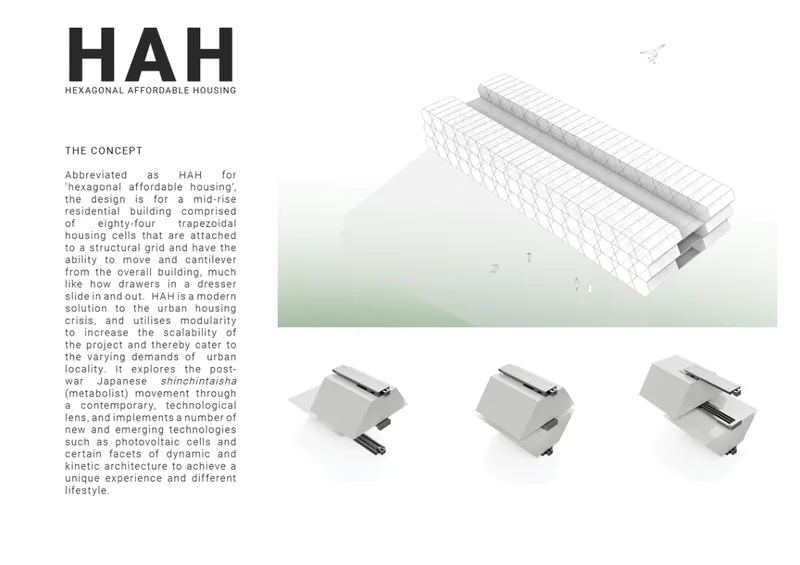
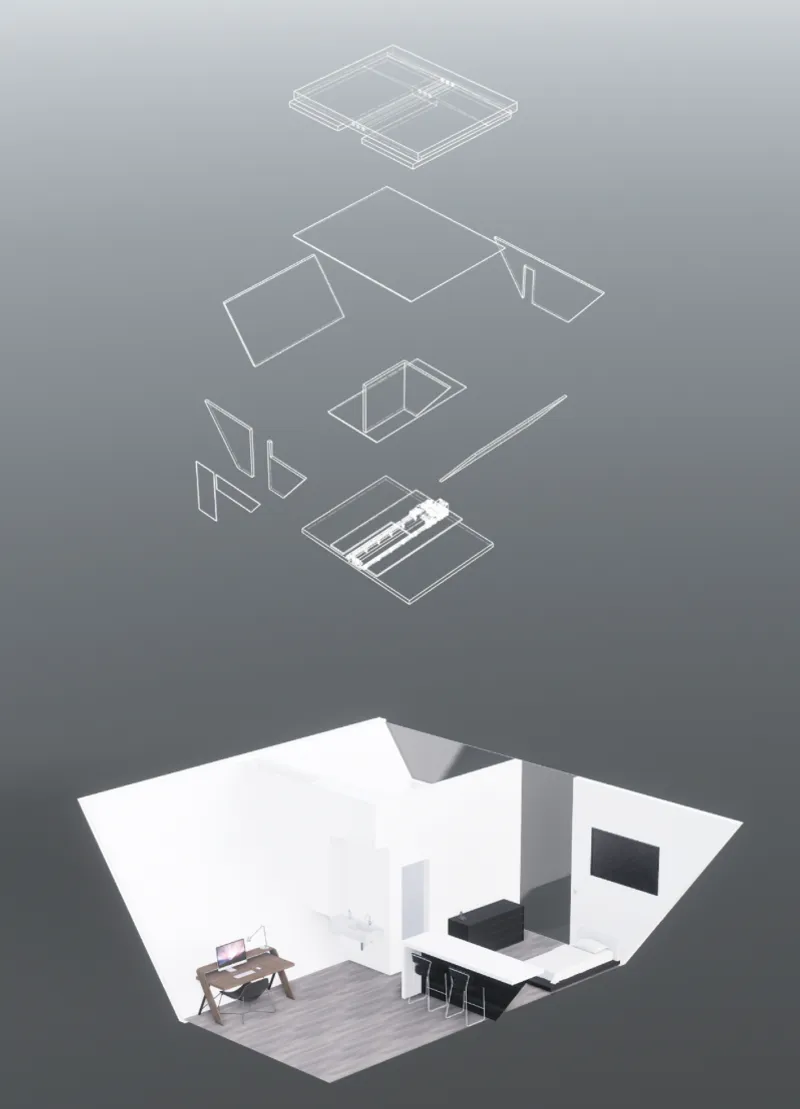
The axonometric drawings reveal the core logic: a rigid structural frame accepts trapezoidal modules that can be pushed, pulled, and cantilevered to reshape the building envelope in real time. Each cell attaches to the grid and slides along tracks, enabling dynamic spatial reconfigurations that maximize daylight exposure for every unit. The exploded diagram peels apart the layered assembly, showing how building components stack above a fully furnished interior, making the relationship between structure and habitation immediately legible.
Rooted in the philosophies of shinchintaisha, the Metabolist movement's vision of architecture as a living organism, HAH updates that mid-century ambition with contemporary fabrication and energy technology. The scalable grid means the system is not locked to one site or one density; it can stretch to meet the demands of different neighborhoods, lot sizes, and community profiles.
Seventy Square Meters of Adaptable Living
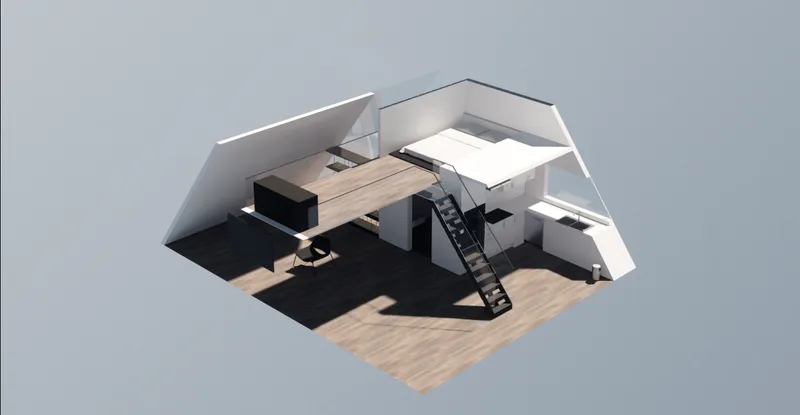
The cutaway axonometric slices into a single trapezoidal module, exposing the timber furniture, metal staircase, and loft bed that define each 70-square-meter double-occupancy unit. Designed for young professionals, students, and first-time cohabiting couples, the interior minimizes partition walls in favor of fluid, open configurations. A home office, fully equipped kitchen, and lounge occupy the lower level, while the loft maximizes the high ceilings created by the trapezoidal geometry. Large window panels flood the space with light, and the absence of rigid room divisions means residents can reshape their unit as their lives change.
Borrowed Light and Cultural Memory
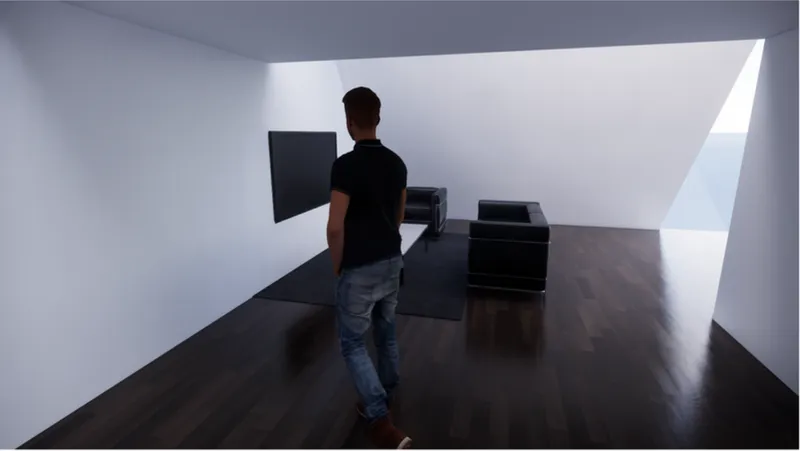
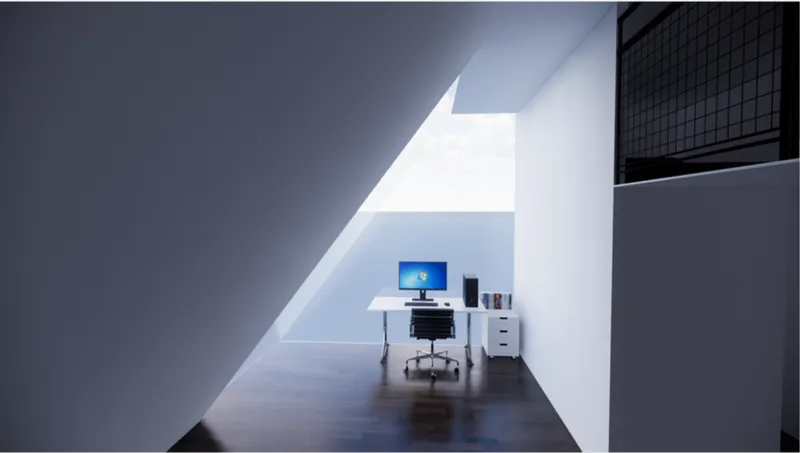
HAH's lighting strategy carries a narrative charge. The Chinese idiom zuo bi tou guang tells of a scholar who carved a hole in a wall to study by a neighbor's light. That story becomes a design feature: shared triangular lightboxes, powered by rooftop solar panels, sit between adjacent units. Translucent panels resembling Japanese washi paper diffuse natural light through angular openings into interior spaces, reducing electricity consumption while giving the architecture a warm, paper-lantern glow. The interior view captures a figure standing in precisely this condition, bathed in angular daylight that enters from above and to the side.
Smart sensors regulate both interior and exterior lighting in response to daylight levels and occupancy, while photovoltaic cells integrated across the façade generate the renewable energy that powers the kinetic sliding mechanism itself. Each module's ability to reposition exposes its photovoltaic surfaces to optimal sunlight throughout the day, creating a feedback loop where the building's movement directly improves its energy harvest. The workspace nook beneath the angled skylight, with a rooftop solar panel visible just above, makes this loop tangible at the scale of a single desk.
A Plaza Without Lawns
At ground level, the project organizes itself around a central plaza paved in concrete with tree-lined seating areas. The deliberate absence of lawns is a water conservation strategy consistent with the building's broader environmental ethos. In a city where every drop counts, replacing turf with hardscape and canopy shade is both a practical and political gesture, signaling that affordable housing and ecological responsibility are not competing priorities.
Why This Project Matters
HAH operates at an intersection that most modular housing proposals avoid: kinetic building systems, net-zero energy ambitions, and cultural storytelling. The sliding mechanism is not a gimmick; it directly improves solar performance, spatial variety, and daylight quality. And by grounding the design in literary and architectural traditions from East Asia, the team gives the project a depth of reference that elevates it beyond a purely technical exercise.
As a prototype for affordable mid-rise living, Hexagonal Affordable Housing suggests that adaptability does not have to come at the expense of identity. Each 70-square-meter unit is small enough to be genuinely affordable and large enough to feel generous, while the building's constant physical reconfiguration ensures that no two days on the block look exactly the same. For a housing crisis defined by rigidity, sameness, and scarcity, that kind of dynamism is exactly what is needed.
View the Full Project
About the Designers
Designers: Andrea Wan, Anurag Jadhav, Katelyn Anderson, William Ingram
Enter a Design Competition on uni.xyz
uni.xyz runs architecture and design competitions year-round that reward proposals with spatial conviction and real site intelligence.
Project credits: Hexagonal Affordable Housing (HAH) by Andrea Wan, Anurag Jadhav, Katelyn Anderson, William Ingram Plugin Housing Challenge 2020 (uni.xyz).


Popular Articles
Popular articles from the community


Cloaked Colonization: A Mobile Underwater Habitat That Moves Like a Fish
Micah Abaya's shortlisted EHC Pacific entry reimagines ocean settlement as a dispersed network of self-sustaining architectural organisms.

Opera by the Sea Estonia: Three Shells Dissolving Architecture into Tallinn's Coastline
A winning opera house proposal replaces monumental form with interconnected shells that blur the boundary between building, park and Baltic Sea.

Opera on the Sea: Driftwood Logic Shapes a Timber Opera House on Estonia's Coast
Trevor Orgill's opera house translates the entangled drift of floating timber into a civic building where wood, water, and music converge.

The Amber Palace Opera: A Geological Fiction Surfaces on Tallinn's Baltic Waterfront
Pierre Brillard reimagines a Baltic legend as a public landscape, opera house, and waterfront promenade rooted in Tallinn's coastal identity.

Similar Reads
You might also enjoy these articles

Day and Night Park: A Time-Based Urban Newsstand in Beijing
A temporary urban newsstand in Beijing blending travel, light, and reading through poetic colors, compact form, and community-focused design.

Modernist Patio Renovation in El Masnou, Barcelona by Oliver Segura Arquitectura + Cebrià Arquitectura
Modernist patio renovation blending tradition and innovation with a movable pool, leveled floors, and Catalan materials in El Masnou.

Alto Residencial Coop: Cooperative Housing Development in Santiago de Compostela by Carbajo Barrios Arquitectos
A linear cooperative housing complex blending white volumes and perforated metal façades, enhancing community living, natural light, privacy, and urban integration.
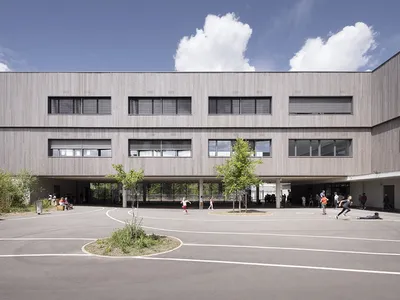
Vil Genis School by BPA ARCHITECTURE – Massy, France
Vil Genis School in Massy, France, features sustainable design, south-facing classrooms, community integration, accessible spaces, and modern educational architecture.

Explore Modular Housing Competitions
Discover active competitions in this discipline

Challenge to design luxury tourism on rails

VR headsets Storefront design competition

Designing a staircase for a client
Comments (0)
Please login or sign up to add comments
No comments yet. Be the first to comment!