

Morphism Converts a Midcentury Quito Textile Factory into a Hands-On Children's Science Museum
Awawa transforms an industrial sawtooth-roofed building in Ecuador's capital into a timber-framed playground for interactive learning.


There is a particular kind of building that cities inherit but rarely know what to do with: the midcentury industrial shed, structurally sound but programmatically obsolete. In Quito, the former "La Industrial" textile factory sat with its repeating sawtooth roofline largely intact, a relic of Ecuador's manufacturing ambitions. Morphism saw in that raw shell not just floor area to repurpose but a spatial logic to exploit. The result, Awawa Interactive Science Museum, turns 1500 square meters of factory space into a landscape of climbing walls, rope sculptures, plywood modules, and curved seating, all threaded through the original structural bays.
What makes the project genuinely interesting is how little it fights the existing architecture and how much it amplifies it. The sawtooth roof, designed to flood a weaving floor with even northern light, now illuminates a museum floor where children crawl through portholes, scale pegboard walls, and navigate woven rope nets. The conversion refuses the white-cube museum model entirely. Instead of inserting neutral partitions, Morphism treats the old factory frame as an active participant in the experience, letting timber trusses, exposed brick, and glazed skylights define the spatial rhythm of play.
The Factory Shell as Framework

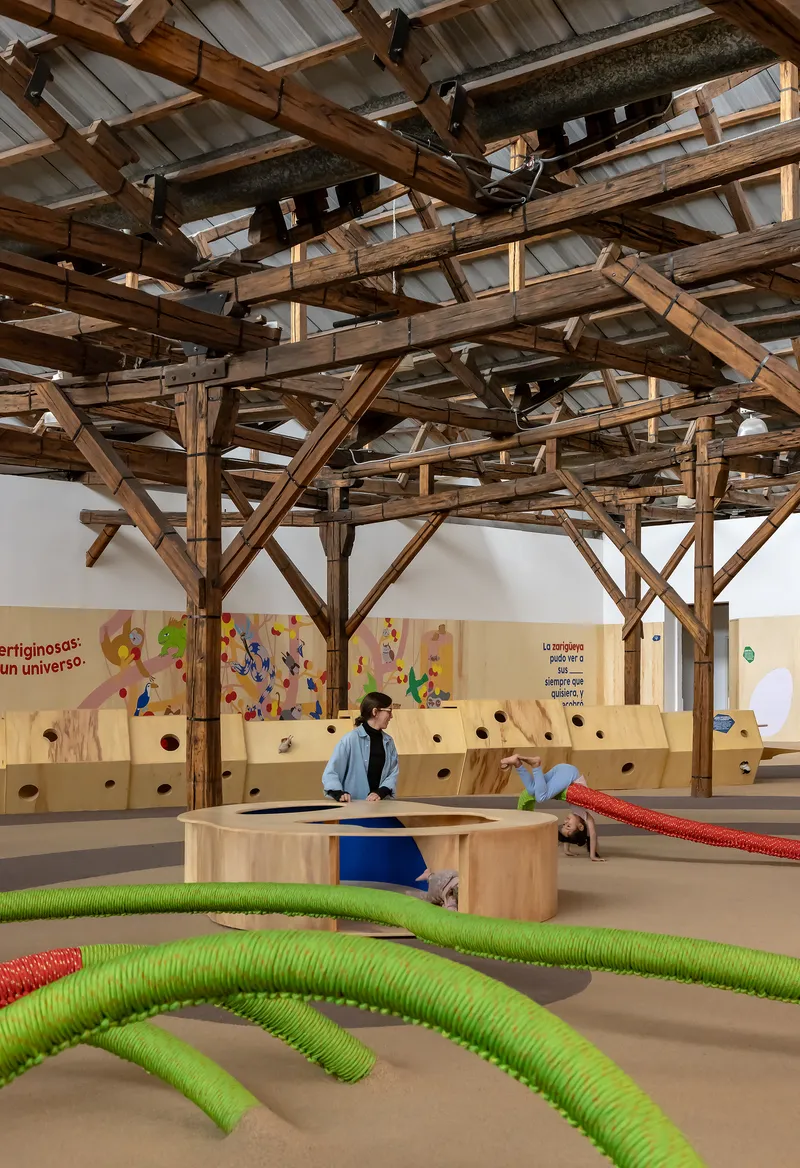
From the street, Awawa reads as what it always was: a low industrial building with a distinctive sawtooth profile and a modest central entrance reached by a set of broad steps leading to a paved plaza. There is no showy new facade grafted onto the old one. The restraint is deliberate. By preserving the factory's exterior identity, Morphism sets up a powerful contrast with the interior, where every surface has been rethought for the scale and energy of children.
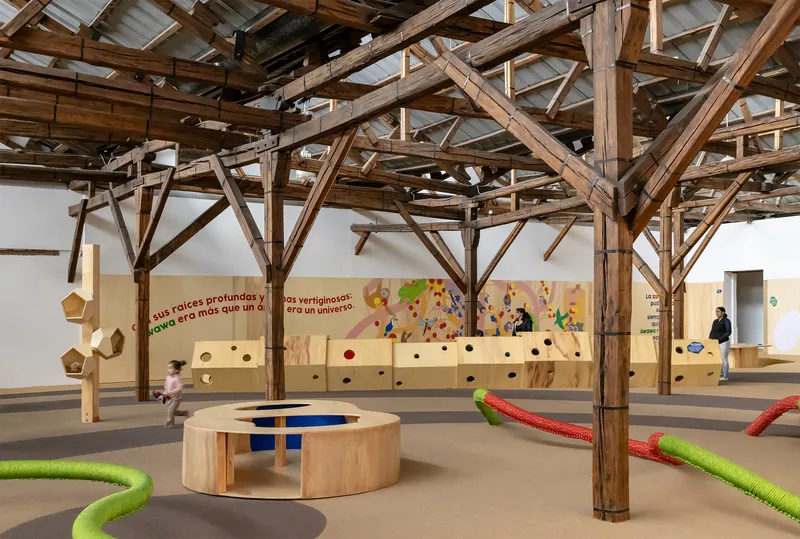
Inside, the exposed timber truss ceiling becomes the project's defining overhead landscape. Translucent panels set into the sawtooth bays wash the space in soft, diffused daylight. The structural columns and diagonal bracing are left visible, establishing a clear grid that organizes the various play zones without walls. It is an honest reading of the building's bones, and it gives the museum a spatial generosity that purpose-built children's facilities rarely achieve.
Plywood as Play Infrastructure

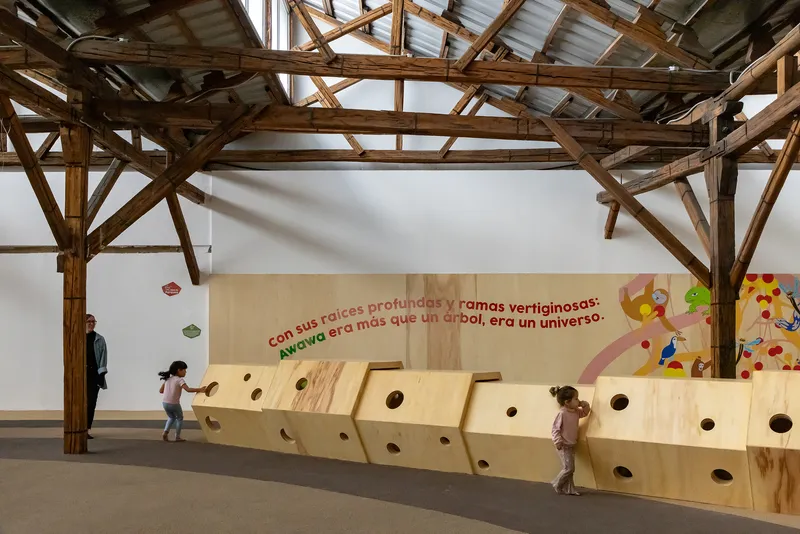

Plywood does most of the heavy lifting here, both literally and conceptually. Morphism uses it to construct climbing walls punctured with circular cutouts, hexagonal play modules that children can crawl into and stack against, and pegboard surfaces that invite rearrangement. The material choice is smart for a children's museum: warm to the touch, visually consistent, and easy to repair or replace as exhibits evolve.
The portholes cut into plywood partitions at various heights are a particularly effective move. They frame the museum as a series of glimpses and discoveries rather than a single open room. A child peering through a low cutout gets a different view than the one looking through a hole at shoulder height. Scale becomes interactive, which is exactly the point of a science museum aimed at young visitors.
Rope, Color, and Vertical Play
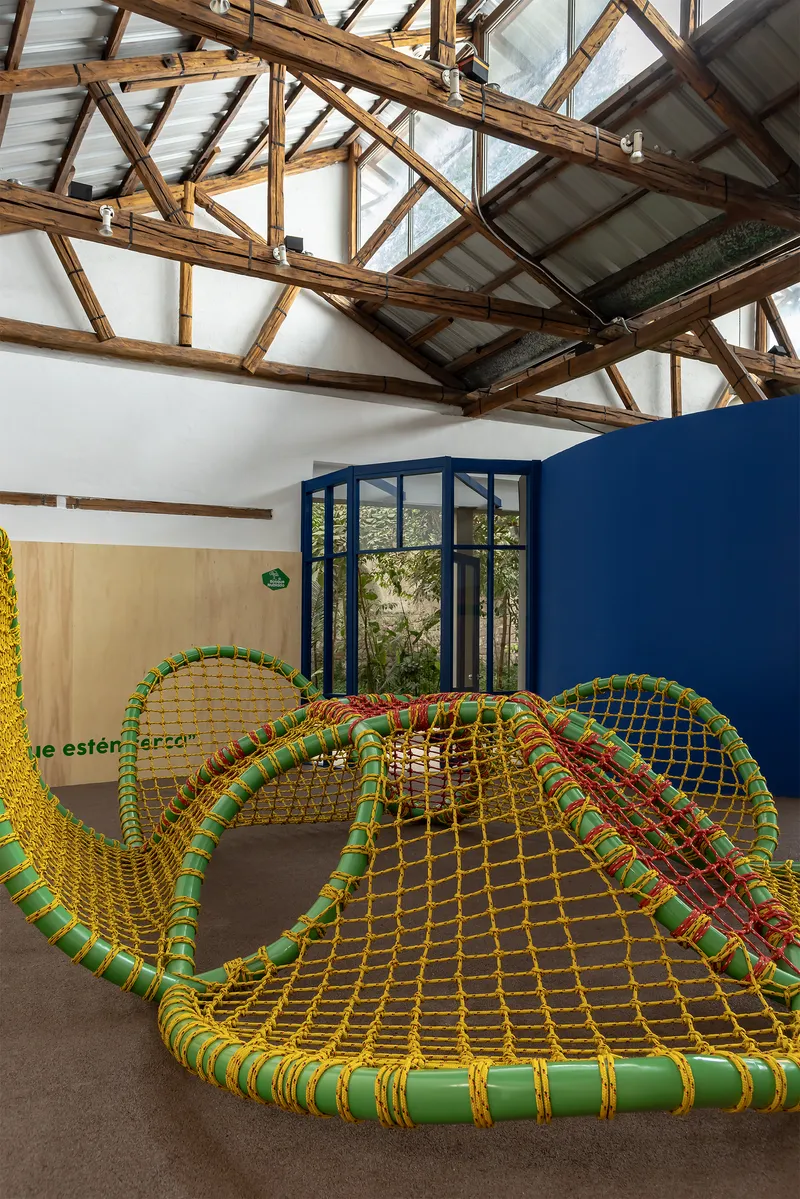

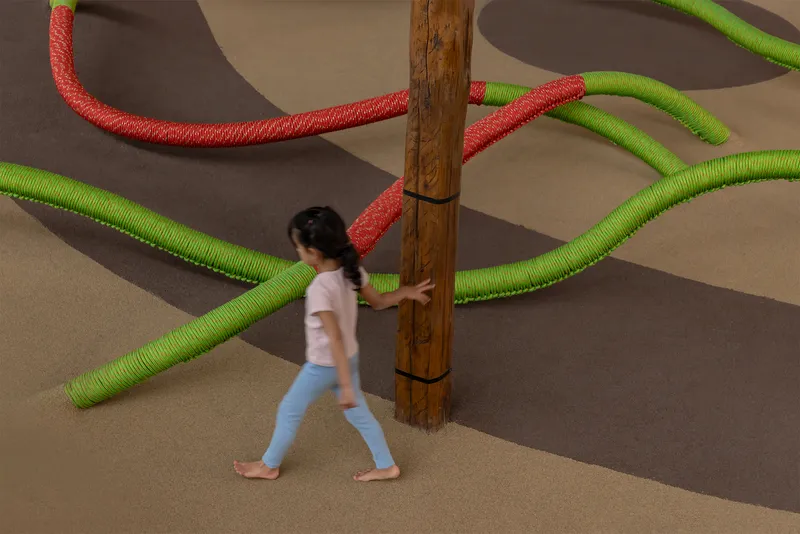
Woven rope installations in green, yellow, red, and blue add an unpredictable softness to the hard geometry of the timber frame. Climbing nets stretch beneath the trusses, and colored rope tubes snake across the polished concrete floor, inviting children to pull, swing, and reach. The ropes inject a tactile dimension that plywood and brick alone cannot deliver, and their saturated colors register instantly in a space that is otherwise dominated by warm neutrals and raw materials.
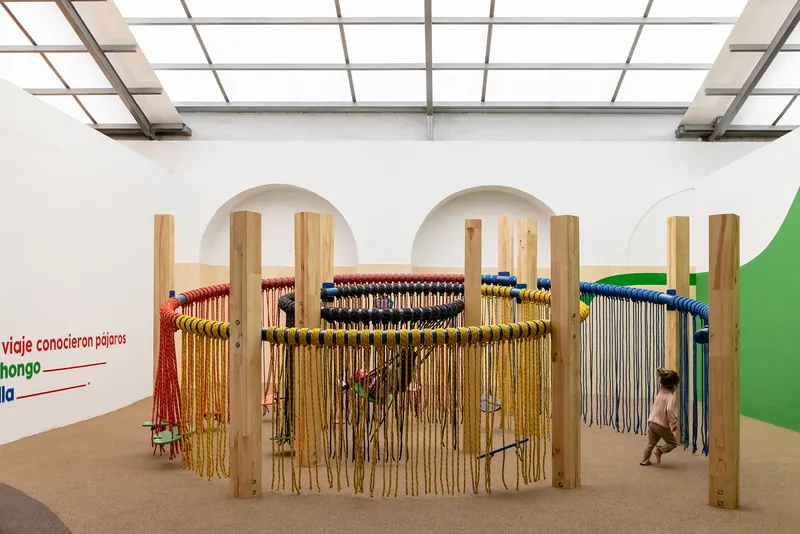
Vertically hung rope curtains in one zone create a semi-transparent threshold that children can push through, turning movement itself into a sensory experience. It is a low-tech solution with a high payoff: no electronics, no screens, just the physics of tension and gravity made legible through play.
Curved Seating and Gathering Zones
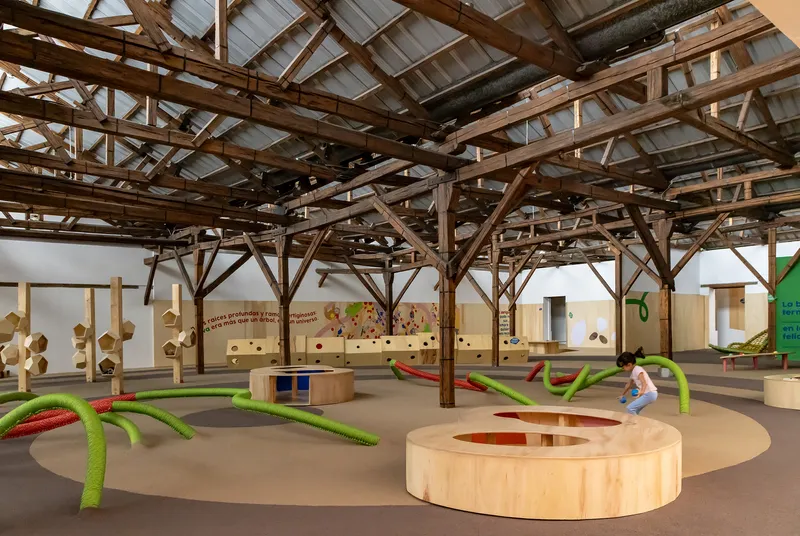


Scattered through the open floor plan are circular and curved plywood seating elements that serve as informal gathering points. These low benches double as observation platforms for parents and resting spots for tired children. Their organic geometry softens the orthogonal grid of the factory structure and creates eddies in the flow of the room, places where the pace naturally slows.
A coral-painted accent wall behind one bench grouping introduces color at an architectural scale, anchoring a zone without enclosing it. The palette stays restrained overall, which lets the rope installations and the occasional painted surface carry disproportionate visual weight. It is a careful calibration: enough color to excite without overwhelming a space that already has a lot happening.
Skylit Circulation and the Planted Staircase


Not every moment in Awawa is about play. A hexagonal concrete block staircase, flooded with light from a glazed skylight and surrounded by potted greenery, offers a quieter interlude. Children climb the steps as though ascending a geological formation. The planting softens the concrete and introduces a living element into a building defined by hard surfaces, creating a micro-courtyard condition within the factory footprint.
Elsewhere, a timber-framed zone beneath a gridded skylight houses climbing walls flanked by exposed brick. The layering of original masonry, new timber framing, and natural light from above gives this area a sectional richness that rewards upward glances, important in a museum designed for visitors whose default sightline is about a meter off the ground.
The Exhibition Hall as Open Landscape
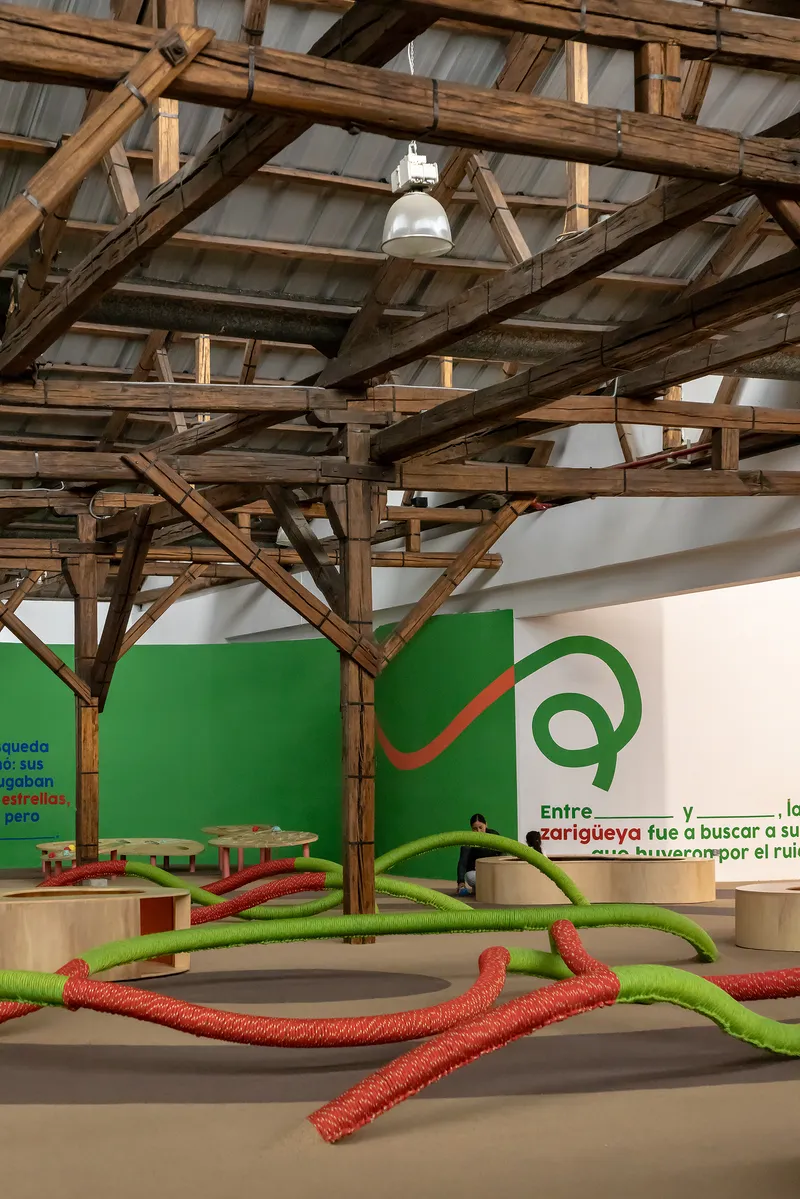

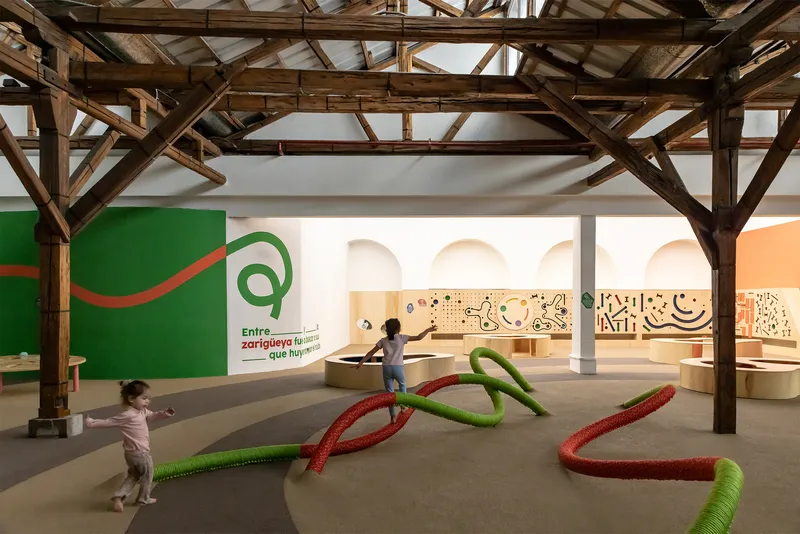
Pulled back to its widest view, the museum reads as a single continuous landscape rather than a series of rooms. Timber columns march down the center, play installations cluster in loose zones, and children move freely between them. The polished floor reflects the trusses above, doubling the perceived height of the space. Bright green rope sculptures punctuate the ground plane like oversized organisms, pulling kids toward them with sheer formal curiosity.
Wall graphics and arched niches along the perimeter provide secondary layers of engagement, while the main floor stays open enough for group activities or simply running. The lack of hard partitions means sightlines are long and supervision is easy, a practical consideration that too many children's museums treat as an afterthought.
Plans and Drawings


The isometric drawing reveals what the photographs only hint at: a planted courtyard punched into the factory floor, providing natural ventilation and daylight to interior zones that would otherwise rely entirely on the sawtooth skylights. The axonometric section makes the parallel bay structure legible, showing how each sawtooth module creates a repeating rhythm of light and shadow across the full width of the building.
The floor plan is where Morphism's strategy becomes most legible. Circular play zones with organic forms occupy the center of the plan, while gridded functional areas, likely storage, restrooms, and administrative spaces, line the perimeter. The layout uses the factory's regular column grid to define edges without building walls, a move that keeps the interior feeling open while still providing spatial variety. It is a plan that could accommodate different exhibits over time without structural modification, which is exactly the kind of long-term thinking adaptive reuse projects need.
Why This Project Matters
Adaptive reuse projects often succeed on atmosphere alone: exposed brick, industrial skylights, the romance of a building's former life. Awawa goes further by making the specific qualities of the factory, its light, its structural rhythm, its spatial generosity, work harder than they ever did when the building produced textiles. The sawtooth roof is not just preserved; it is activated as a lighting instrument for a new program. The column grid is not just tolerated; it organizes play without confining it.
Quito gains something rare with this project: a children's institution that treats its young visitors as spatial thinkers, not passive consumers of screens and signage. Morphism's design trusts materials, light, and physical challenge to do the teaching. In a global context where children's museums are increasingly dominated by digital interactives and branded content, Awawa's commitment to rope, plywood, and open space feels both radical and deeply practical. It is a factory that finally makes something worth keeping: curiosity.
Awawa Interactive Science Museum, Quito, Ecuador. Architects: Morphism. Area: 1500 m². Year: 2025. Photography: JAG Studio.
About the Studio
Share Your Own Work on uni.xyz
If projects like this are the kind of work you want to make, uni.xyz is a place to publish your own, find collaborators, and enter design competitions.


Popular Articles
Popular articles from the community

Opera by the Sea Estonia: Three Shells Dissolving Architecture into Tallinn's Coastline
A winning opera house proposal replaces monumental form with interconnected shells that blur the boundary between building, park and Baltic Sea.

Manzana Morphosis: Stretching Barcelona's Grid into a Living Landscape for 2050
A radical reworking of the Eixample manzana turns density into a tool for generous public space, vertical ecology, and environmental performance.

Cloaked Colonization: A Mobile Underwater Habitat That Moves Like a Fish
Micah Abaya's shortlisted EHC Pacific entry reimagines ocean settlement as a dispersed network of self-sustaining architectural organisms.

Singing Woman: Contemporary Architecture Inspired by Estonia’s Voice and the Sea
Singing Woman turns Estonia’s song culture into flowing opera house architecture, blending public life, landscape, sea, and national memory.

Similar Reads
You might also enjoy these articles

Bao Huynh Watercolor Atelier: A Serene Art Retreat in Hội An
Bao Huynh Watercolor Atelier in Hội An blends multifunctional art spaces, sustainable design, local materials, and family-friendly living in a serene environment.

Atelier Macri Concept Store Interior Design by CASE-REAL
Atelier Macri store features a "ko" counter, walnut wood details, cork displays, blending retail, gallery, and seamless customer experiences.

Manuel Vargas Izquierdo Stadium and High-Performance Sports Center: Architectural Excellence in Jalpa de Méndez
The Manuel Vargas Izquierdo Stadium blends sustainable design, inclusive sports facilities, and cultural-inspired architecture, revitalizing Jalpa de Méndez’s public spaces.

KAKR Buluh Awar Hall: Revitalizing Community and Ecology Through Bamboo Architecture
Community built bamboo hall revitalizes Buluh Awar village, empowering youth, restoring ecology, celebrating vernacular craftsmanship through sustainable architecture and culture.


Comments (0)
Please login or sign up to add comments
No comments yet. Be the first to comment!