
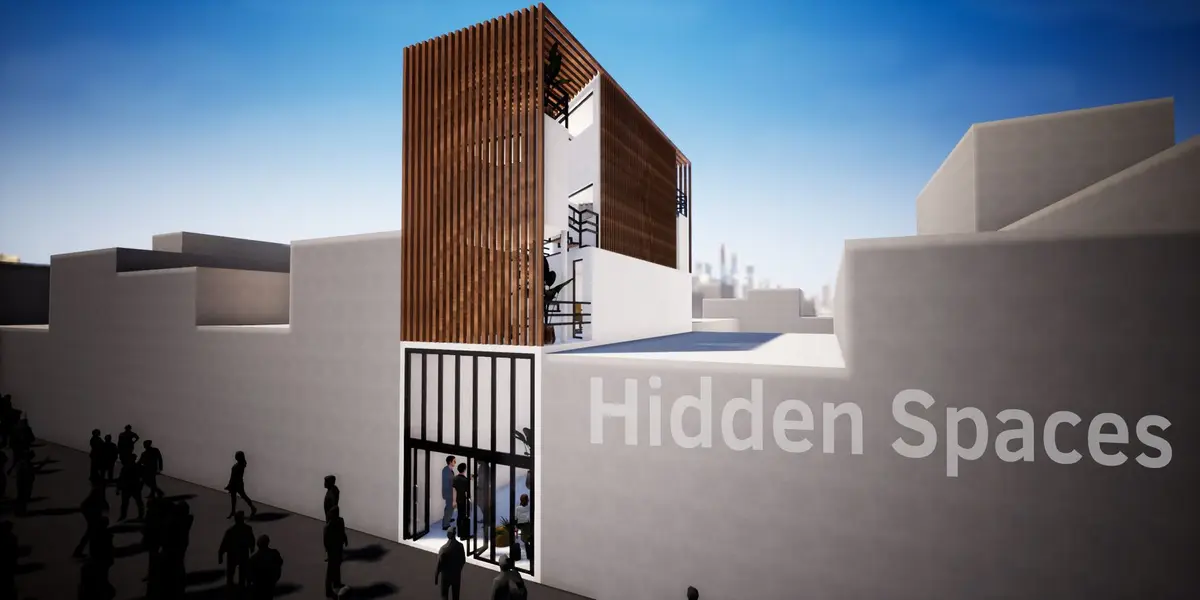
Hidden Spaces: A Timber-Wrapped Nest for Multigenerational Living in Dense Delhi
Three floating bedroom cubes sit inside a wooden scaffolding that filters sun and privacy across five levels of compact urban life.


Take a narrow plot in one of the densest cities on earth, stack three independent bedroom cubes inside a wooden cage, and open the ground floor entirely to the street. That is the provocation at the core of Hidden Spaces, a compact residential project that treats a multigenerational Delhi household not as a problem to be solved but as a social asset to be architecturally amplified. The design nests six family members across five levels while keeping each generation's autonomy intact, all wrapped in a scaffold of timber fins that double as sun shading and a privacy gradient.
Designed by SE YA and presented on UNI, the project responds to Delhi's particular cocktail of extreme density, punishing heat, and deeply communal culture. The family brief itself is telling: a young couple working in hospitality, two children, and retired grandparents who travel frequently and step into caretaking roles when needed. Rather than compartmentalizing these overlapping lives, the architecture builds a vertical ecosystem where shared and private zones are legible, adaptable, and thermally comfortable without heavy mechanical intervention.
A Wooden Cage Hovering Over an Open Street Front
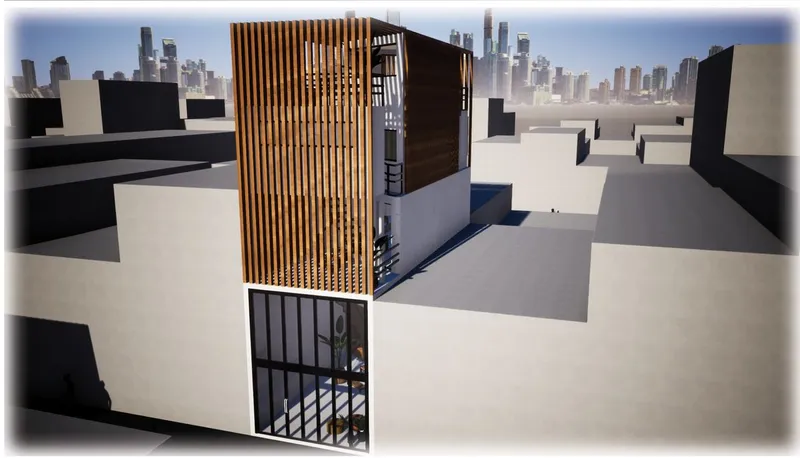
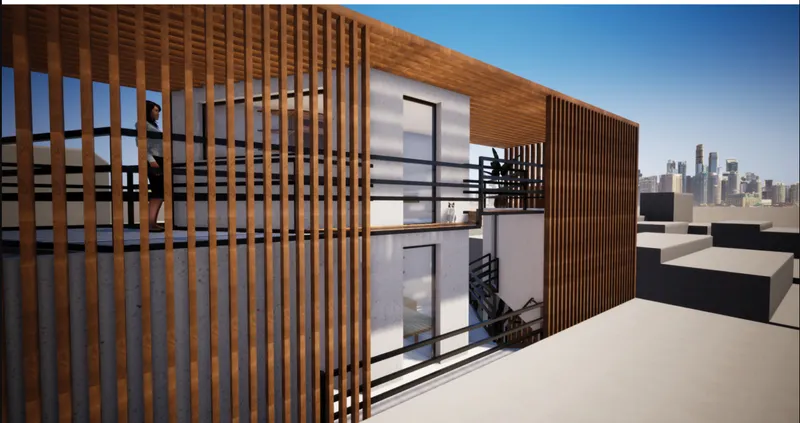
From above, the building reads as a slender timber volume tucked into a tight urban block. Vertical louvres in locally sourced treated teak wrap the upper floors, forming a brise-soleil that filters Delhi's harsh direct sun while preserving outward views for the occupants. The aerial perspective reveals how the residence negotiates its constrained footprint: the timber screen creates a unified envelope, but behind it, three modular cubes containing bedrooms and bathrooms float independently, separated by internal courtyards that drive cross-ventilation through the section.
The facade detail confirms the tectonic logic. The slatted screen is not decorative veneer; it is the building's primary environmental strategy, casting layered shadow patterns that shift throughout the day. Behind the fins, an exposed stairwell connects the levels while allowing glimpses of the distant Delhi skyline. The material palette is restrained but warm: teak fins, powder-coated metal railings, and exposed concrete with natural mineral pebbledash plaster. Bright local textiles in orange, red, and yellow punctuate the interiors, visible through the screen's gaps like color caught inside a lantern.
Five Levels Dissected: How the Section Works
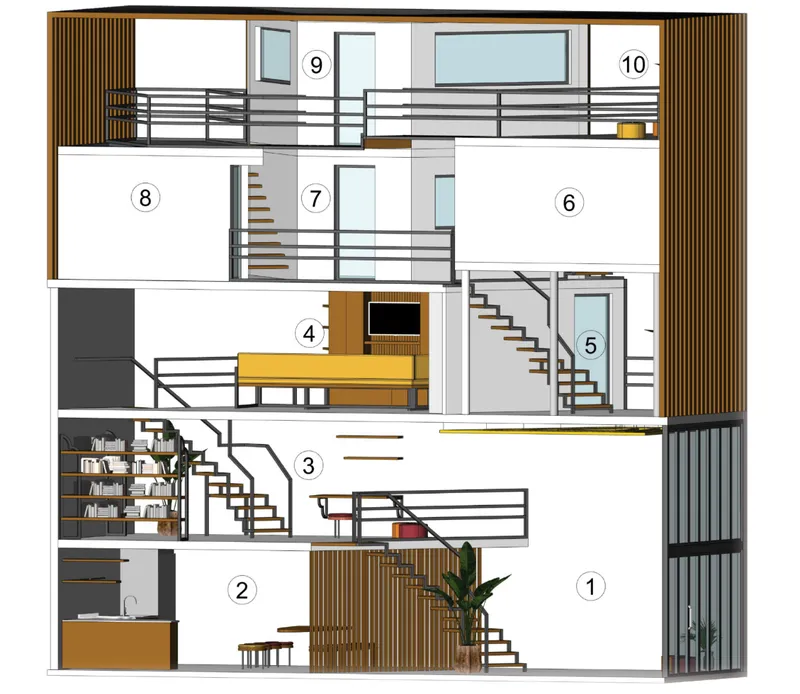
The sectional drawing is the project's clearest argument. Five levels are connected by interconnecting staircases, and each of the three bedroom cubes is individually accessible, complete with a private terrace. This autonomy is key to the design's long-term viability: any cube can be rented out, repurposed, or reconfigured as the family's needs change. The grandparents might occupy one cube during a six-month stay; it could host an Airbnb guest the next season, fitting the couple's hospitality background. The numbered rooms behind timber and metal screens show how privacy is graduated vertically, moving from the fully public ground floor to the most intimate sleeping quarters above.
The courtyards visible between cubes are not leftover space. They are the building's lungs, enabling passive cooling by drawing hot air upward and pulling cooler air through operable glazing at each level. In a city where summer temperatures routinely exceed 40°C, this strategy reduces reliance on air conditioning and keeps energy costs manageable for a middle-income household.
The Ground Floor as Public Threshold
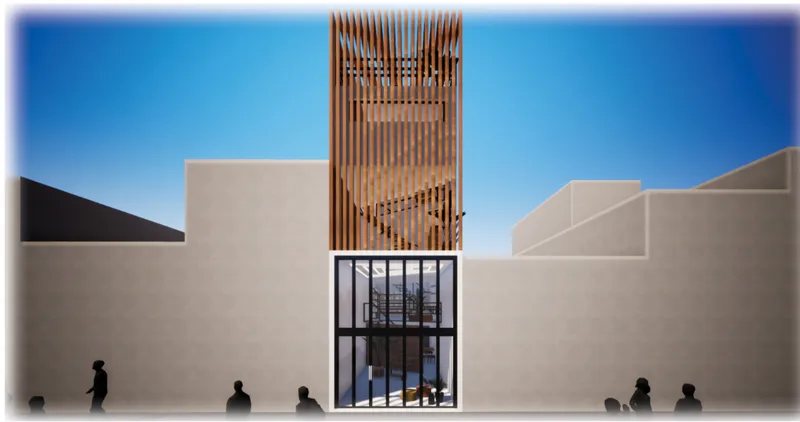
At street level, the timber tower recedes and the facade becomes entirely glazed, operable glass that can slide open to dissolve the boundary between interior and sidewalk. The street elevation drawing captures this moment: figures gather at the threshold as if the house were a neighborhood living room. Inside, a kitchen, dining space, and library occupy this zone, deliberately programmed for social overlap. For a family in hospitality, the ground floor is both domestic space and a stage for cultural exchange, echoing the Indian tradition of welcoming strangers as guests.
The transparency is a bold move in a city where compound walls and security gates are the default. By inverting that expectation, the design argues that community safety comes from visibility and engagement rather than enclosure. The glazing is entirely operable, so residents can calibrate the degree of openness by season, time of day, or mood. It is architecture as a social dial, not a fixed boundary.
Rooftop Pergola: Shadow as Usable Space
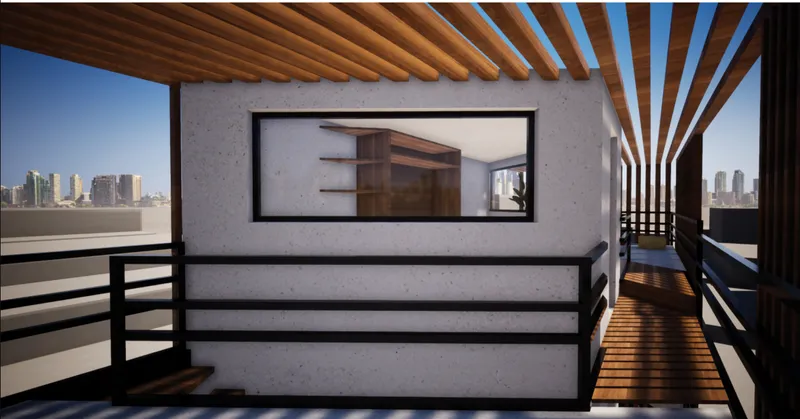
The sequence culminates at the roof, where radiating timber pergola beams cast a precise lattice of shadow across a slatted deck. In a climate where unshaded outdoor space is unusable for much of the year, this pergola converts the rooftop into habitable territory: a place for evening meals, children's play, or the grandparents' morning routine. The clear sky above and the geometric shadow pattern below give the space a meditative quality that contrasts with the density pressing in from every side.
Materially, the roof terrace continues the teak and metal language of the floors below, reinforcing the sense that the entire building is a single coherent organism rather than a stack of unrelated apartments. The pergola also completes the environmental envelope, shielding the top floor from direct solar gain and reducing the cooling load on the rooms immediately beneath.
Flexible Interiors: Folding, Sliding, Transforming
Inside the cubes, custom furniture does the heavy lifting. Foldable beds, sliding storage cubes that double as seating or play areas, and multifunctional wall units allow each room to shift from bedroom to workspace to playroom over the course of a single day. In a footprint this tight, every square meter must earn its keep twice. The children's room and master bedroom both use this strategy, ensuring that the compact plan never feels claustrophobic. The furniture framing is powder-coated metal, consistent with the building's exposed structural aesthetic and tough enough for daily transformation.
Why This Project Matters
Hidden Spaces is not a luxury villa disguised as social housing, nor is it a utopian diagram disconnected from real constraints. It is a pragmatic, buildable proposal for how a six-person multigenerational family can live well on a narrow urban plot in one of the world's most pressurized cities. The design's real intelligence lies in its adaptability: the modular cubes, the rentable rooms, the operable ground floor, and the passive cooling strategy all anticipate change rather than resisting it. As families grow, shrink, age, and diversify their income streams, the architecture flexes with them.
For Delhi and cities like it, where population density will only increase and land parcels will only shrink, the project offers a transferable model. It proves that compact does not have to mean compromised, that multigenerational living can be an architectural asset rather than a spatial liability, and that a simple timber screen, deployed with discipline, can regulate sun, privacy, and urban identity all at once. That is a lot of performance from a cage of teak fins and three floating cubes.
View the Full Project
About the Designers
Enter a Design Competition on uni.xyz
uni.xyz runs architecture and design competitions year-round that reward proposals with spatial conviction and real site intelligence.
Project credits: Hidden Spaces by SE YA, UNI.


Popular Articles
Popular articles from the community


The Amber Palace Opera: A Geological Fiction Surfaces on Tallinn's Baltic Waterfront
Pierre Brillard reimagines a Baltic legend as a public landscape, opera house, and waterfront promenade rooted in Tallinn's coastal identity.

Opera on the Sea: Driftwood Logic Shapes a Timber Opera House on Estonia's Coast
Trevor Orgill's opera house translates the entangled drift of floating timber into a civic building where wood, water, and music converge.

Extended Shell: Retrofitting Kolkata's Balconies as Living Urban Thresholds
A modular retrofit system recovers the social and environmental intelligence of Kolkata's historic verandas for contemporary Park Street residents.
Temporary Home for Dogs: A Reversed Zoo Rethinks Animal Shelter Architecture
In Bucharest, a sinuous corridor and freed landscape flip the logic of containment, designing a shelter that works to make itself unnecessary.

Similar Reads
You might also enjoy these articles

Day and Night Park: A Time-Based Urban Newsstand in Beijing
A temporary urban newsstand in Beijing blending travel, light, and reading through poetic colors, compact form, and community-focused design.

Modernist Patio Renovation in El Masnou, Barcelona by Oliver Segura Arquitectura + Cebrià Arquitectura
Modernist patio renovation blending tradition and innovation with a movable pool, leveled floors, and Catalan materials in El Masnou.

Alto Residencial Coop: Cooperative Housing Development in Santiago de Compostela by Carbajo Barrios Arquitectos
A linear cooperative housing complex blending white volumes and perforated metal façades, enhancing community living, natural light, privacy, and urban integration.

Vil Genis School by BPA ARCHITECTURE – Massy, France
Vil Genis School in Massy, France, features sustainable design, south-facing classrooms, community integration, accessible spaces, and modern educational architecture.

Explore Urban Dweller Competitions
Discover active competitions in this discipline

Design challenge to equip cities with modern furniture

Packaging challenge - Design meets sustainability
Comments (0)
Please login or sign up to add comments
No comments yet. Be the first to comment!