

Museum of the Future, Showcasing the Latest Innovations, Opens Today in Dubai
Explore the Cutting-Edge Technologies and Ideas That Will Shape Our World at Dubai's Newest Cultural Landmark

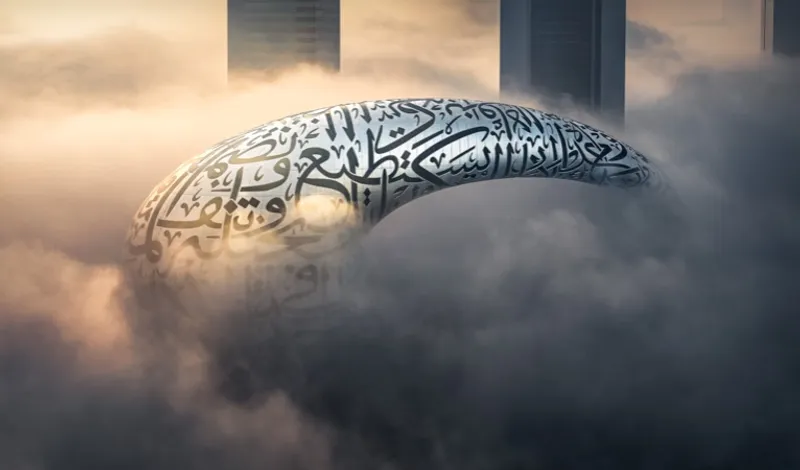
Dubai is set to open the Museum of the Future, a permanent exhibition of inspiring visions for the future of humanity, on March 8, 2023. Designed by architect Shaun Killa of Killa Design, the Museum aims to serve as a global centre for inspiration, innovation, and the development of solutions to challenges and opportunities in human development. The Museum turns the traditional concept of a museum on its head by serving as a testbed for new concepts, ideas, visions, and innovations that will transform our lives, improve society, and benefit the world.

Dubbed ‘The Most Beautiful Building in the World,’ the Museum of the Future reflects the rapidly evolving intellectual environment in topics such as science, artificial intelligence, space exploration, climate adaptation, urban life and mobility, and will incorporate new thinking, the latest research findings, and emerging capabilities in these areas. The Museum will also disseminate knowledge and research and highlight the most important technological changes, new scientific discoveries, and emerging trends.

The Museum of the Future is a ‘living museum,’ constantly adapting and metamorphosing as its very environment drives continual and iterative change to its exhibits and attractions. “The Museum brings together futurists, thinkers, innovators, and the public in a testbed of ideas that define the world of the future and shape the way we interact with our world to come,” said Mohammed Al Gergawi, UAE Minister for Cabinet Affairs and Chairman of the Dubai Future Foundation.
As a global centre for the development of futuristic thinking, the Museum of the Future will connect thinkers, specialists, and experts from all over the world by hosting ongoing forums, research, and knowledge sessions throughout the year. It will contribute to creating a deep and extensive global intellectual movement dedicated to exploring and foreseeing future changes in the fields of innovation, science, and economic and cultural development in the service of humanity.
The building was conceived as an architectural and cultural icon and is a remarkable feat of computer-aided design and engineering. Its parametric design, created through an algorithmic design process that supports complex geometries, and innovative use of Building Information Modelling (Bim), a three-dimensional model-based design technology, have resulted in a 77-meter high toroidal structure that is implemented without using a single column.

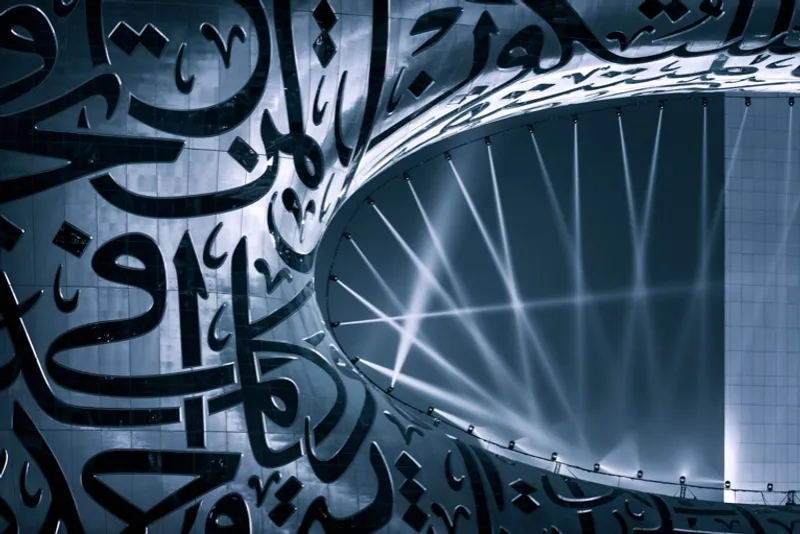
The Museum’s façade, which extends over an area of 17,600 square meters, is made of stainless steel, consisting of 1024 pieces of art manufactured using robots uniquely able to create the demanding shapes. The façade alone was constructed over a period of 18 months and comprises a complex assembly of four-layer composite material panels, each requiring over 16 process steps. It is illuminated by 14,000 meters of light lines, tracing Arabic calligraphy representing three quotes on the future by His Highness Sheikh Mohammed bin Rashid Al Maktoum, Vice President and Prime Minister of the UAE and Ruler of Dubai.
At the core of the Museum is its multi-use hall, which can accommodate more than 1,000 people, as well as a special hall for interactive lectures and workshops that can accommodate more than 345 people. The Museum of the Future is fed with 4,000 megawatt-hours per year of solar power generated by a dedicated solar park and meets the highest global standards of sustainability. The three quotations inscribed on the building in Arabic calligraphy are: “We may not live for hundreds of years, but the products of our creativity can leave a legacy long after we are gone,” “The future belongs to those who can imagine it, design it, and execute it. It isn’t something you await, but rather create,” and “Innovation is not an intellectual luxury. It is the secret behind the evolution and rejuvenation of nations and peoples.”

The Museum of the Future in Dubai is a seven-story building that houses innovation laboratories for health, education, smart cities, energy, and transportation. It also contains a platform for displaying and testing innovations from some of the world's leading technology and innovation leaders and entrepreneurs. The Museum provides a place for partnerships with major universities and international research institutes and offers advanced research courses on the latest findings in human sciences as well as specialized workshops.
The Museum aims to generate and test ideas, especially in developmental areas related to the challenges facing society. It includes a permanent exhibition of future innovations and laboratories to facilitate this goal. The Museum is a unique space that promotes the development of future-oriented ideas, collaborations, and innovations.
The Museum of the Future contains a series of experiential displays for the general public to visit and be inspired by different aspects of future thinking. These displays are situated across five levels of the building, each with a different theme. The top level, OSS Hope, presents an experience of humanity's home in space, where guests join its community and learn about what life could potentially be like aboard a huge space station in 2071.
The Heal Institute is a digital recreation of a real part of the Amazon rainforest in Leticia, Colombia, depicting the ecosystem with unparalleled realism. Guests can explore a luscious tropical rainforest and understand their responsibility towards nature as we face environmental change. Al Waha provides an opportunity for visitors to explore themselves in a world that simulates their senses. It is a space for health and well-being, detached from technology, allowing visitors to meditate, reconnect with themselves, and restore their natural balance.
Tomorrow Today explores the contrasting ways in which technology can shape the future and the wide-ranging responses it can provide to the challenges that the planet and society are facing. The exhibit includes more than 50 prototypes and current products focusing on five areas, waste management, environment, food security, agriculture and irrigation, and city planning. The exhibit aims to inspire visitors to think about the impact of technology on the future and the ways it can help address the challenges facing society.
At the bottom of the public display levels, Future Heroes is a playspace designed for children under the age of 10. The space encourages young minds to make new discoveries about themselves and the world around them. Overall, the Museum of the Future is a unique space that promotes innovation and inspires visitors to think about the possibilities of the future. It is an essential destination for those interested in exploring the potential of emerging technologies and their impact on society.
***
Press release and photos courtesy of UAE Government Media Office

Popular Articles
Popular articles from the community


David Ortega Stacks a Two-Story Mexico City Penthouse Around a Steel Stair and a Pergola-Shaded Roof Terrace
In Colonia Roma, a 300 m² penthouse uses oak joinery, a planted steel stair and a slatted roof pergola to make a new-build apartment feel like a house.

Jaramillo Van Sluys Arquitectura and Urbanismo Turn a Demolished Registry Lot in Quito into an Orchard Plaza
In Quito's Centro Histórico, a 2,800 m² plaza exposes the San Agustín convent wall and redraws its lost Augustinian orchard in volcanic stone.

Juan García Correa, John González and Claudia Rueda Sink a Circular Amphitheater into a Manizales Engineering Building
On the La Nubia campus in Manizales, Colombia, the S1 Building folds labs and offices into a hillside of ramped lawns that double as a campus route.

LT2A and OPEN Architectes Thread a Brick and Glass High School Through a Wooded Belgian Campus
In Braine-l'Alleud, a 3,000 m² wing for Collège Cardinal Mercier pairs pale brick with a glazed colonnade, deferring to a small chapel and a dense wood.

Similar Reads
You might also enjoy these articles


Vereda Arquitetos Renovates a 40-Square-Meter Apartment Inside Niemeyer's Copan Building
A compact unit in São Paulo's most iconic residential tower gets a material overhaul that pairs exposed concrete with bold blue Formica.

Shakur's House: Exposed Brick as an Interior Organiser in a 168 m² Mashhad Residence
Brick moves indoors in this Mashhad residence, where masonry walls, glass partitions and teal planes sequence a compact home without closing it off.

Day and Night Park: A Time-Based Urban Newsstand in Beijing
A temporary urban newsstand in Beijing blending travel, light, and reading through poetic colors, compact form, and community-focused design.

Modernist Patio Renovation in El Masnou, Barcelona by Oliver Segura Arquitectura + Cebrià Arquitectura
Modernist patio renovation blending tradition and innovation with a movable pool, leveled floors, and Catalan materials in El Masnou.

Comments (0)
Please login or sign up to add comments
No comments yet. Be the first to comment!