
RS+ Robert Skitek Sculpts a Topographic Playground into the Heart of a Polish Housing Estate
In Tychy's Jaworek Park, nearly 8,000 square meters of undeveloped land become a landscape of water, wood, and winding concrete ribbons.


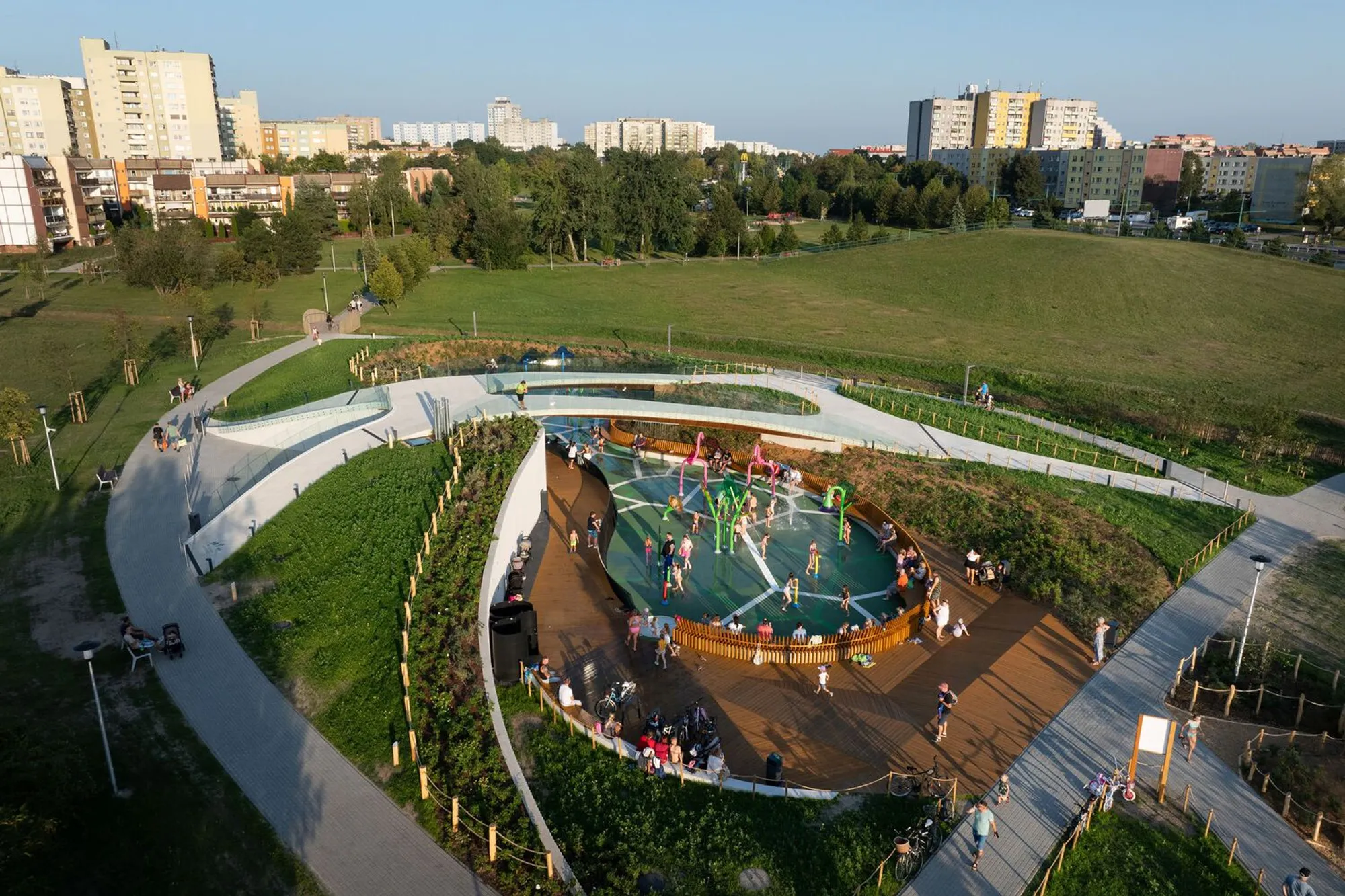
Between the socmodernist housing blocks of Tychy's "Ł" and "K" estates lies Jaworek Park, a green corridor that already held a toboggan hill, a skate park, and a modest watercourse. What it lacked was a reason for younger children and their caregivers to linger. RS+ Robert Skitek found that reason by reshaping the ground itself: piling earth into berms, carving basins, and lacing everything together with sinuous white concrete paths and a reinforced concrete footbridge that doubles as an elevated vantage point. The result, completed in 2024 at a cost of PLN 11.6 million, is a nearly 8,000 square meter playground system that feels less like equipment dropped onto a lawn and more like terrain you discover.
What makes this project worth studying is not the splash pad or the rope bridges in isolation. It is the decision to treat recreation as landscape architecture. The two principal zones, a water playground and a natural playground, are not fenced enclosures but topographic events woven into existing park circulation. Cyclists and pedestrians pass over the play areas on a bridge without breaking stride. Rain gardens collect runoff. A technical building disappears inside a slope. Every functional requirement has been absorbed into the landform, which is the real design move here.
Landform as Architecture
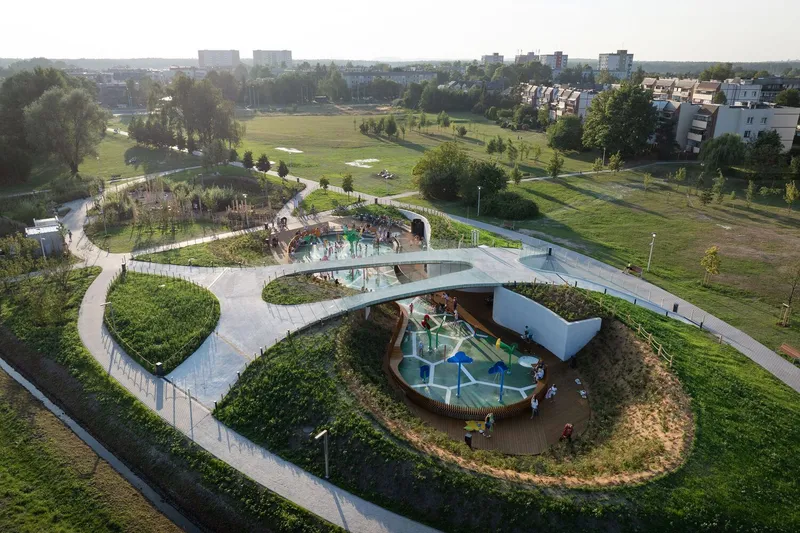
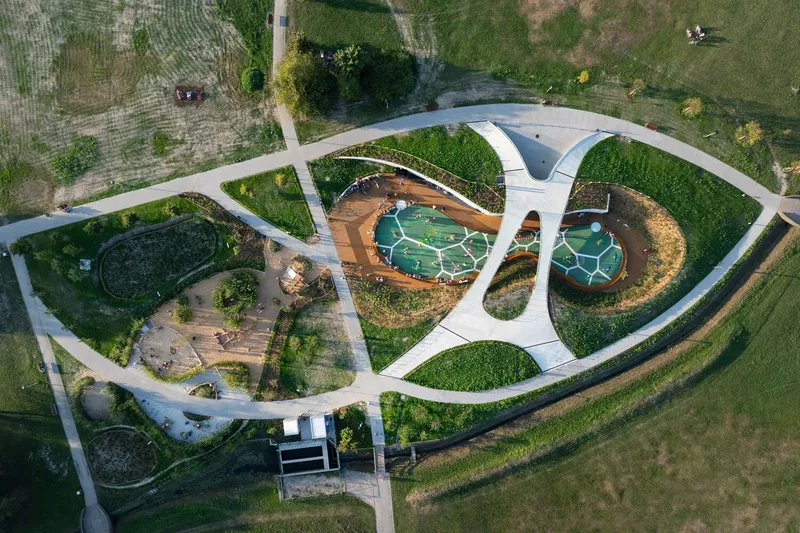
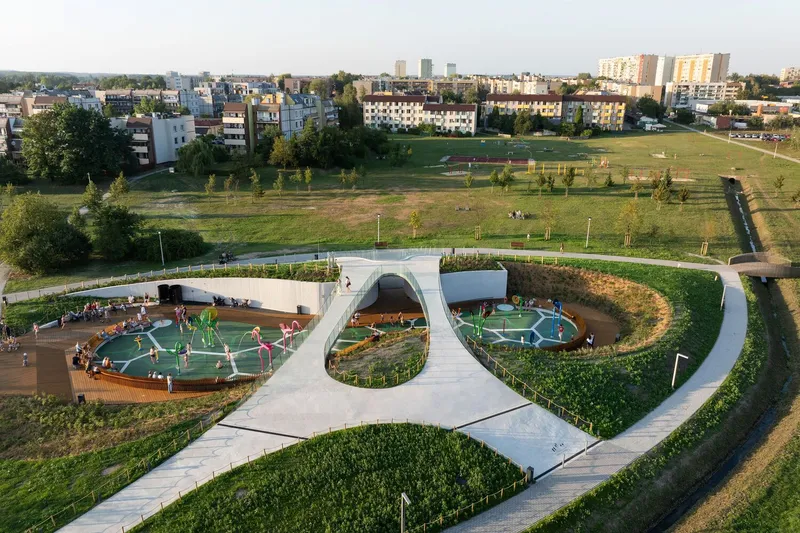
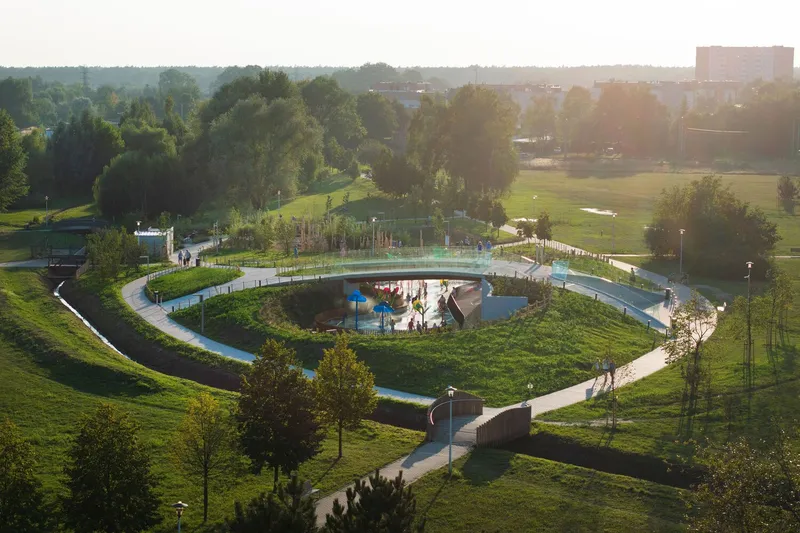
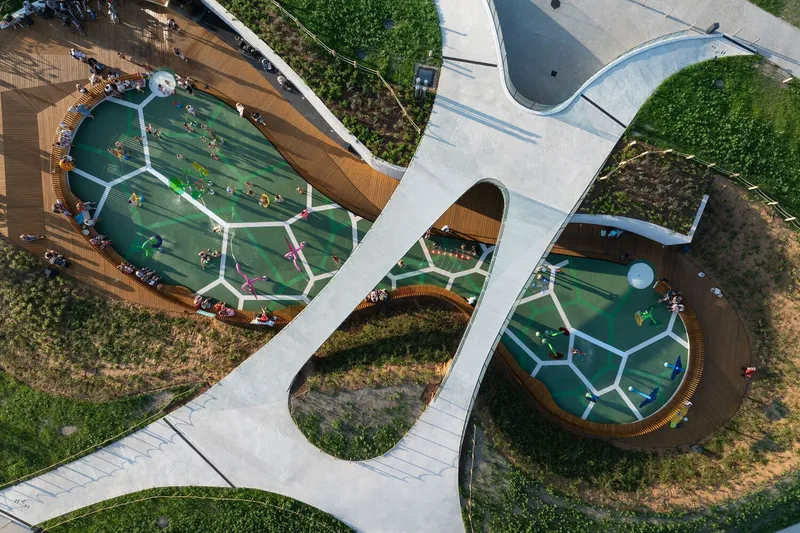
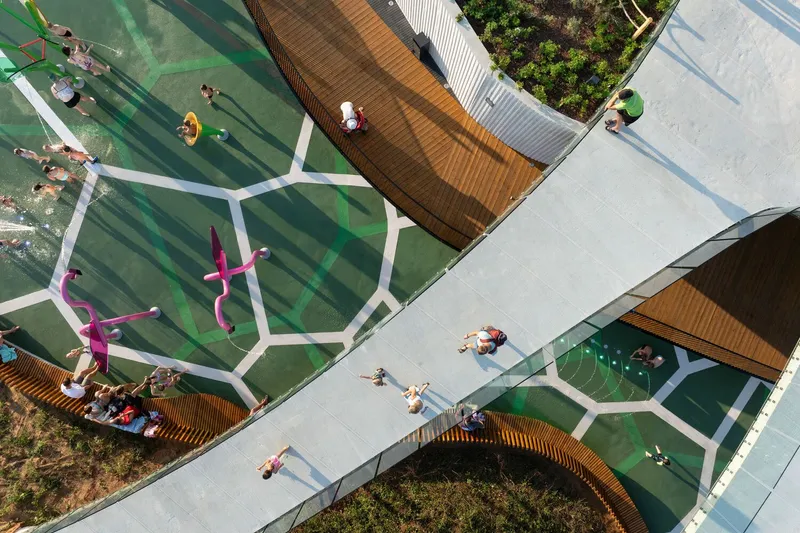
From above, the project reads as a series of concentric loops and planted mounds rather than a conventional playground footprint. The site's two artificial hills create an oblong basin for the water play zone while acting as acoustic barriers for the surrounding residential towers. That is a clever dual function: the berms generate enclosure and intimacy at ground level while deflecting noise upward and away from balconies.
The white concrete pathways arc and spiral between these mounds, linking play zones without the rigid geometry of a typical municipal park. Their curving profiles echo the organic contours of the terrain, making it difficult to tell where engineered surface ends and landscape begins. That blurring is intentional and effective.
The Bridge as Connective Spine
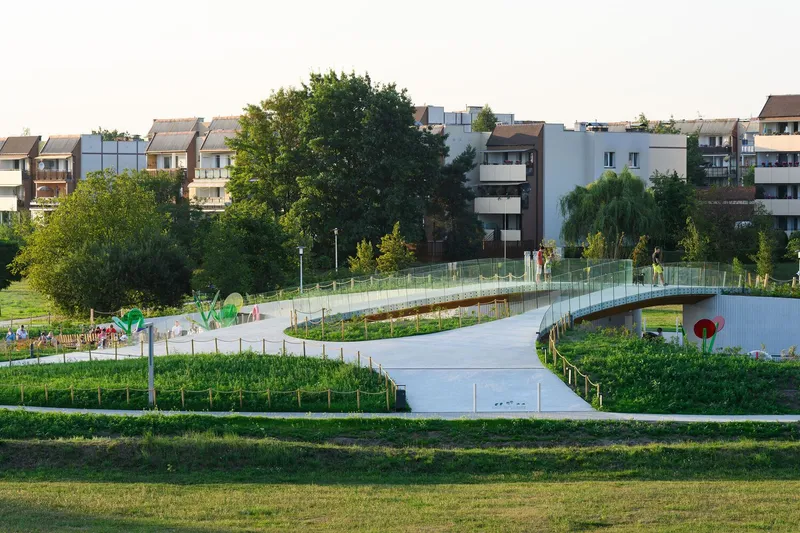
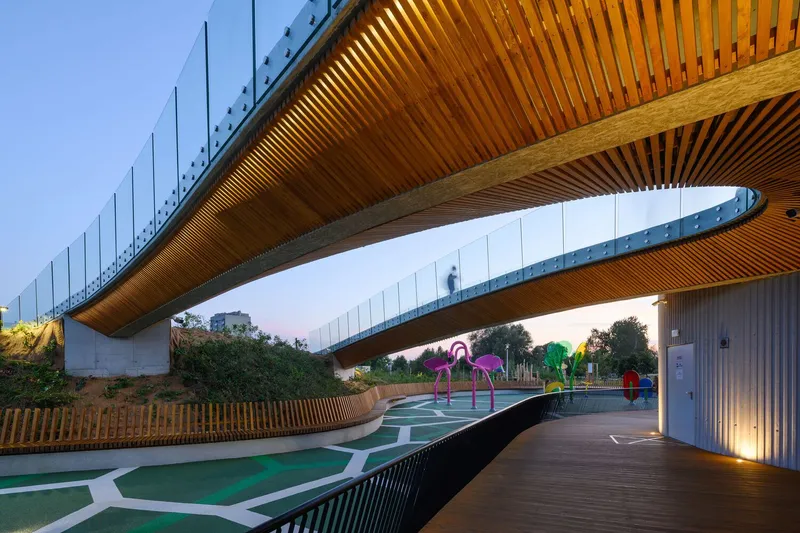
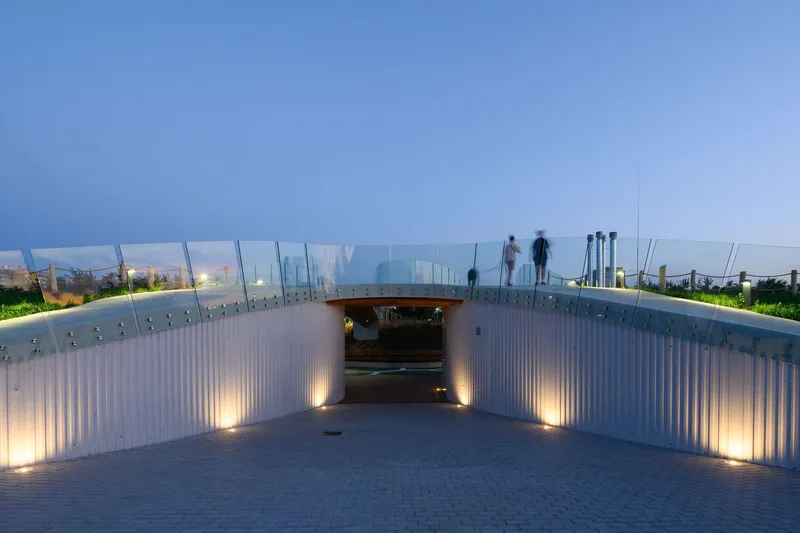
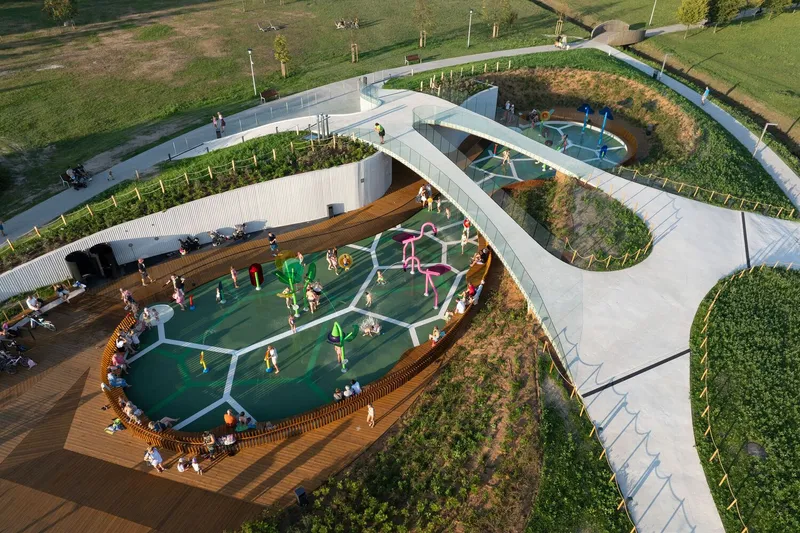
A reinforced concrete footbridge, supported on two piers at the crests of the artificial hills, stitches the park's northern and southern halves together. Its glass railings keep sightlines open, which matters practically: parents standing on the bridge can scan the entire play basin below. The structure maintains through-movement for walkers and cyclists who have no interest in the playground, preserving the park's role as a transit corridor.
Underneath, the bridge's soffit becomes part of the play experience. Colorful sculptural elements occupy the space beneath the span, and the underside of the timber-slatted deck filters light into the zone below. It is a generous gesture, turning infrastructure into shelter and spectacle simultaneously.
Water Play Within the Basin
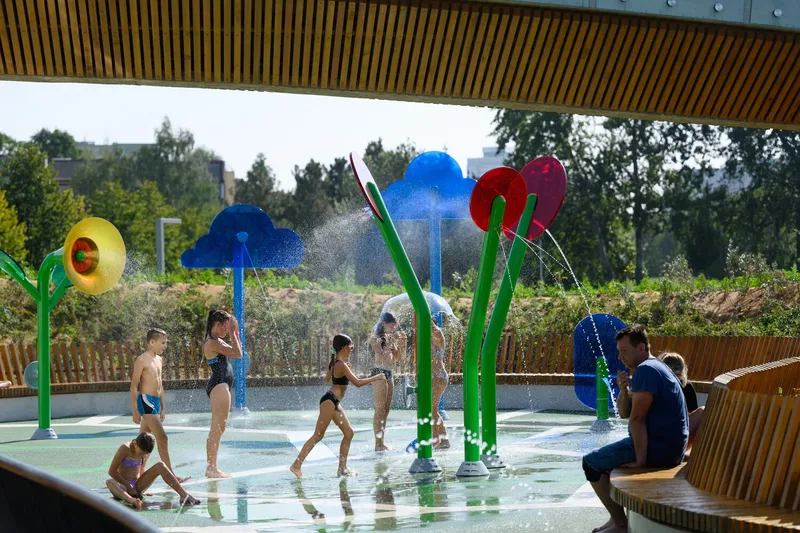
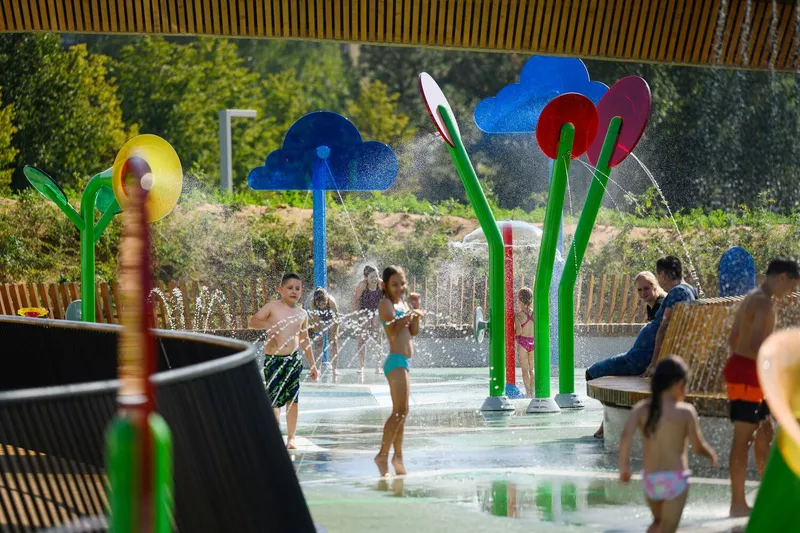
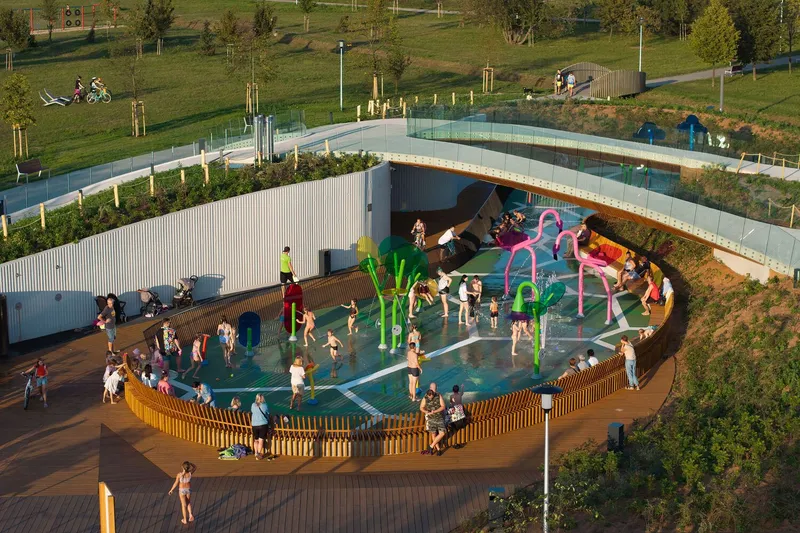
The eastern zone houses a water playground equipped with flower-shaped spray features from the Atis Classic and Atis Natura collections. Set inside the natural basin formed by the two hills, the splash pad sits on a hexagonal green play surface ringed by timber decking. The hills surrounding the basin create a sheltered microclimate that holds warmth and blocks wind, extending the season of comfortable outdoor play.
A technical building servicing the water features is buried discreetly within one of the slopes, invisible to visitors. That commitment to hiding mechanical infrastructure keeps the landscape reading as landscape, not as a theme park grafted onto a hillside. The corrugated metal screen walls enclosing parts of the splash pad add a utilitarian texture that contrasts well with the organic planting.
The Canopy Ribbon
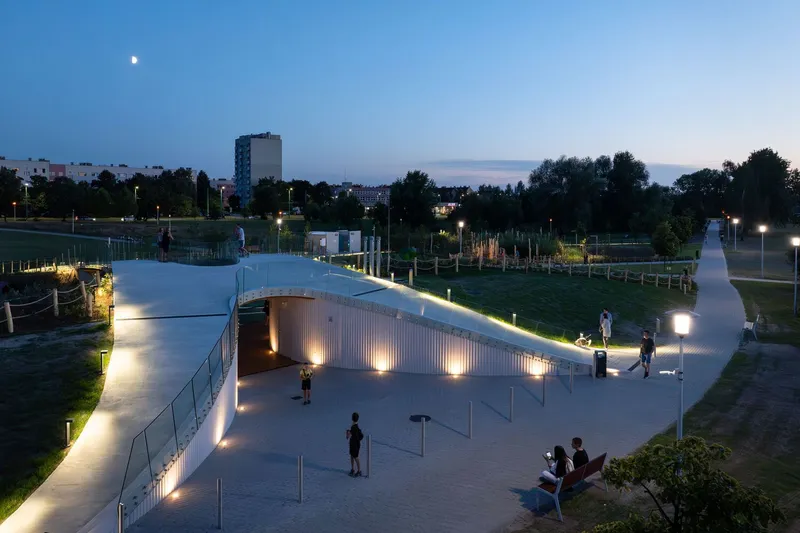
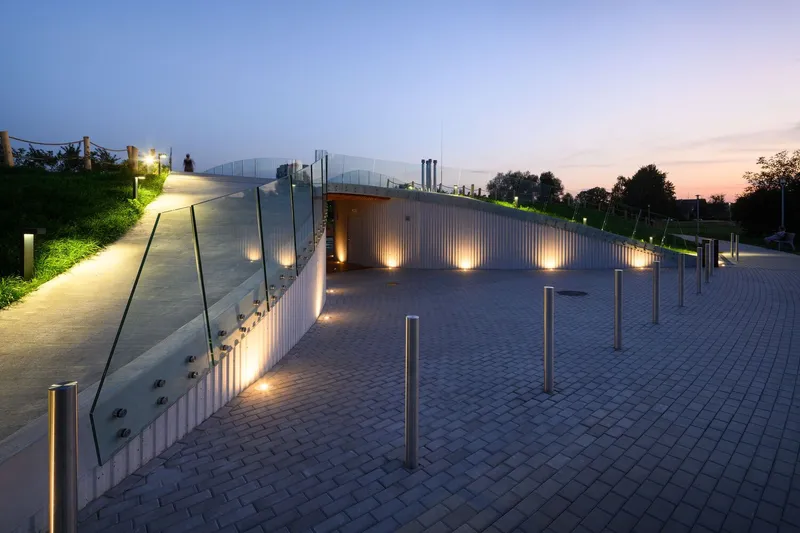
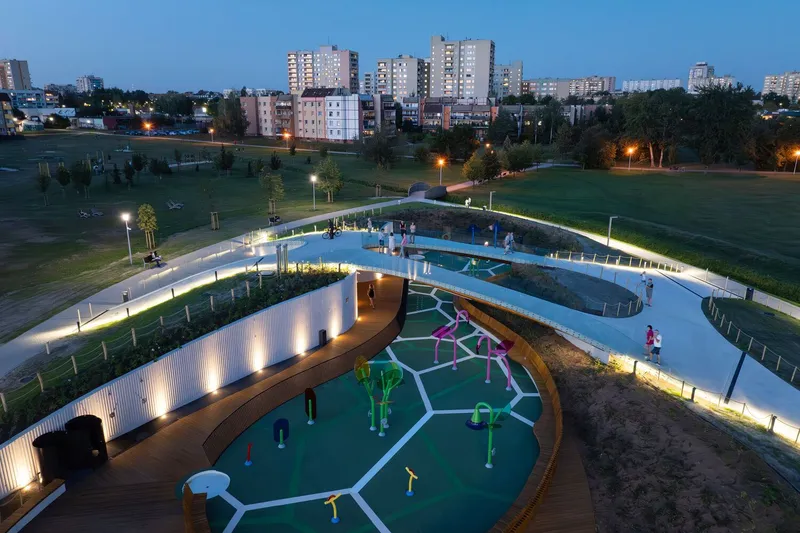
A curving canopy structure with vertical slat cladding wraps portions of the play zones, offering shade and rain cover while maintaining visual permeability. At dusk, integrated uplighting transforms the canopy into a glowing ribbon that traces the park's topography. The translucent roof sections allow diffused daylight through during the day and become lanterns after dark, making the playground legible and inviting from the surrounding housing blocks.
The canopy's timber-slatted soffit extends the material language of the play structures into the overhead plane. Walking beneath it feels continuous with walking along the timber decks, which is a small but meaningful detail that unifies the visitor's experience across horizontal and vertical surfaces.
Natural Play and Material Honesty
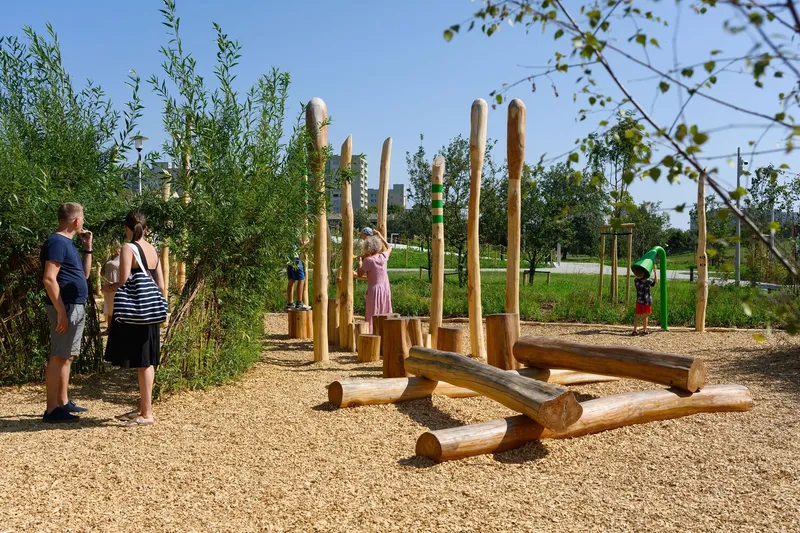
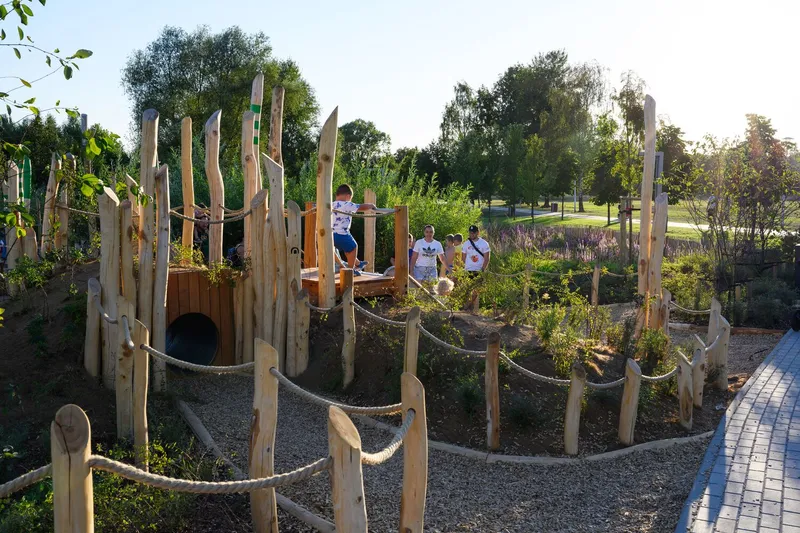
The western natural playground zone relies on wood, wicker, gravel, sand, wood chips, and jute rope. These are deliberately unfinished, tactile materials that invite sensory engagement rather than prescribing a single mode of play. Timber log balance structures and rope bridges wind through young trees and ornamental grasses, creating a play landscape that will only improve as the planting matures.
Rain gardens thread through the winding pathways in this zone, capturing stormwater and feeding it back into the local water cycle. They also serve as planted buffers between play areas, introducing biodiversity at the edges of activity. The replanting strategy combines trees in trunk and multi-stem form with shrubs, perennials, and climbers, building a layered canopy that will provide increasing shade and habitat over the coming decades.
Dusk and the Social Life of the Park
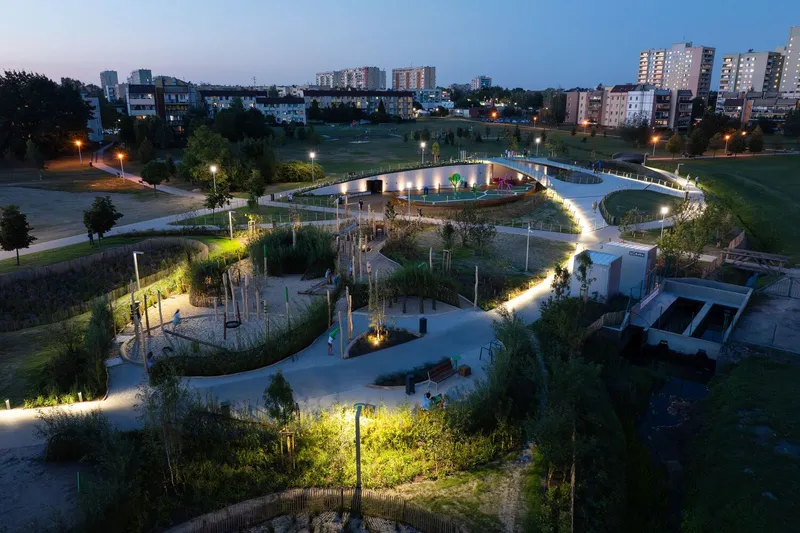
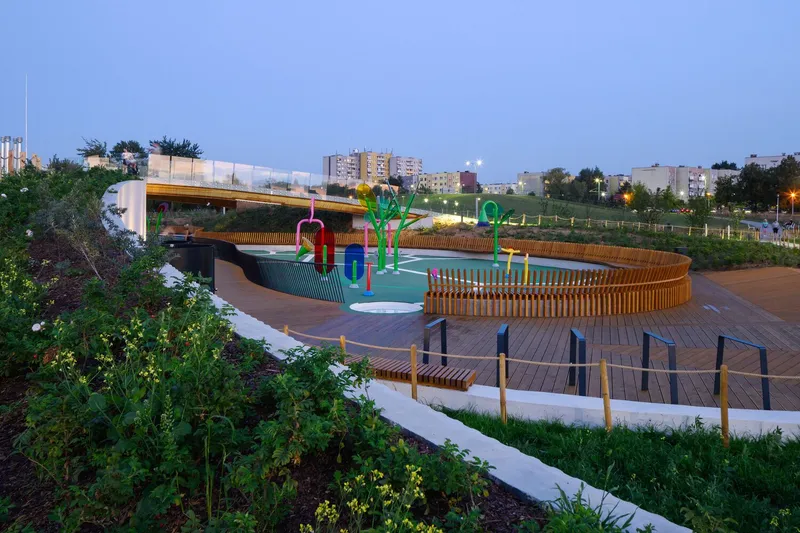
The aerial dusk photographs reveal how lighting extends the park's usability deep into the evening. The spiraling walkways glow against the planted slopes, and the residential towers beyond provide a backdrop that anchors the playground firmly in its urban context. These are not countryside follies; they are public infrastructure for a dense neighborhood, and the lighting strategy acknowledges that families in housing estates use parks after working hours, not just on weekend afternoons.
Timber-edged decks beside the planted slopes become gathering spots at golden hour. The design provides seating opportunities without littering the landscape with benches: the deck edges, the slope crests, and the bridge itself all offer places to sit, watch, and socialize. The park activates community life by making observation comfortable and intuitive.
Circulation and Underground Infrastructure
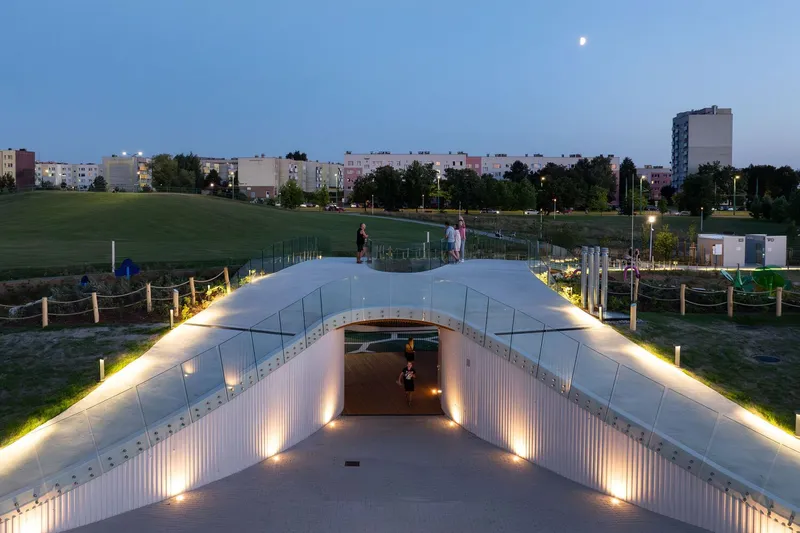
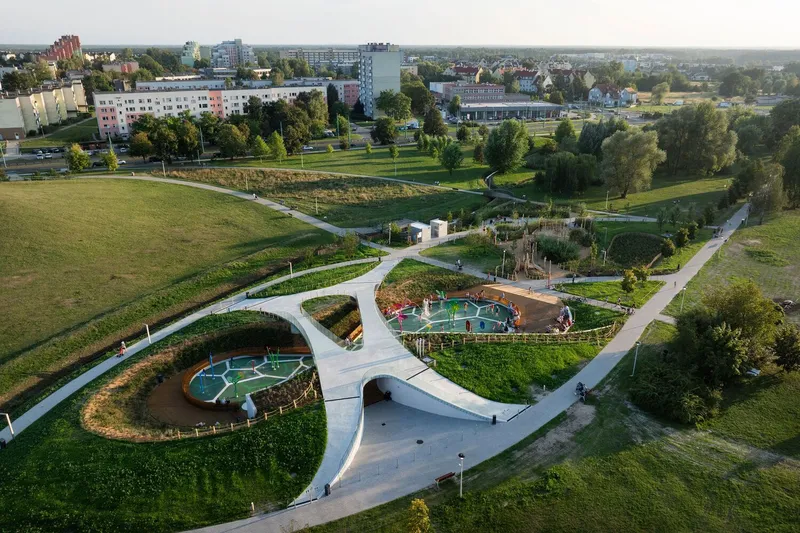
A glass-edged ramp descends into an illuminated underpass beneath one of the grassy slopes, connecting underground utility spaces to the surface. The underground level houses changing rooms and mechanical systems for the water playground, all tucked beneath the terrain so that the park's surface remains uninterrupted green. White concrete pathways loop overhead, weaving between circular play zones and planted beds in a figure that is easy to navigate but difficult to exhaust, encouraging exploration.
Plans and Drawings
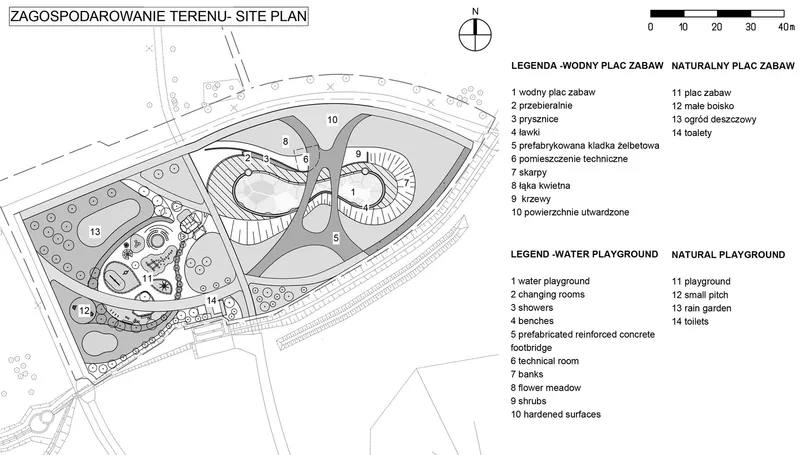
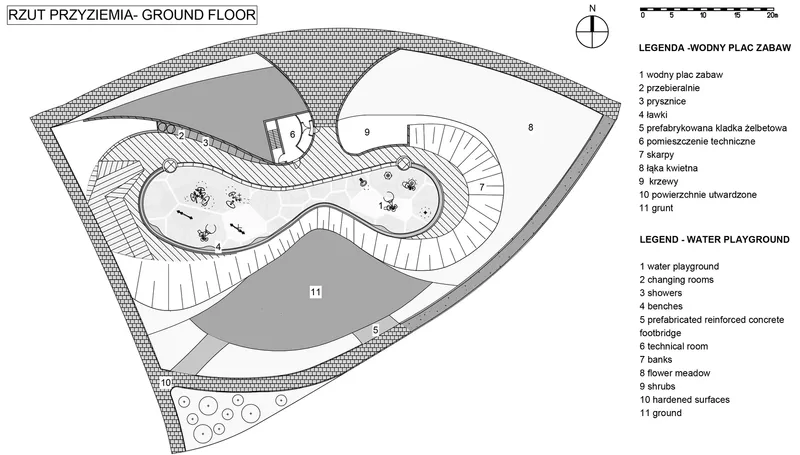
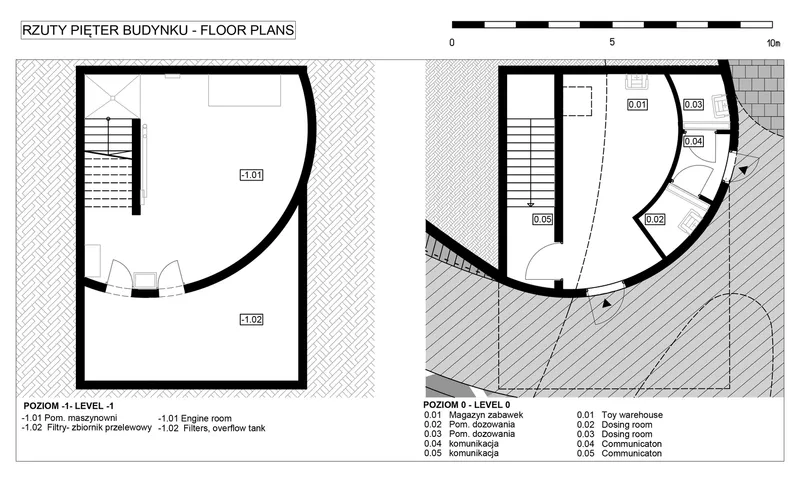
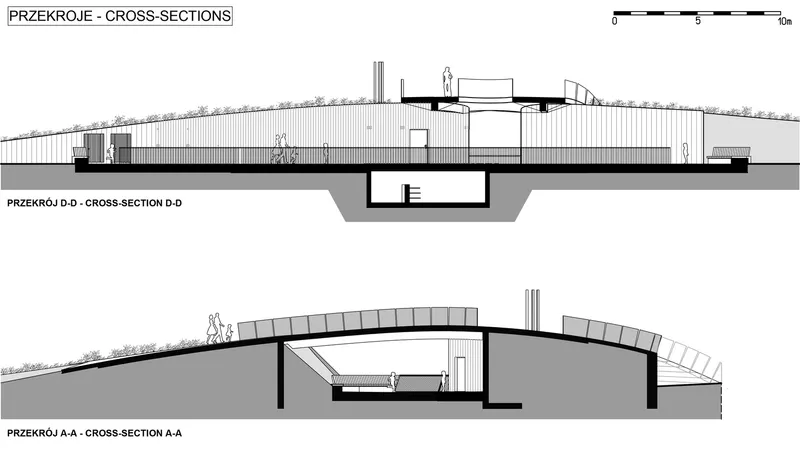
The site plan reveals the full extent of the looping path system and the strategic placement of underground facilities beneath the artificial hills. Floor plans of the underground structure show two levels accommodating stairs, utility rooms, and changing facilities. The cross-sections are the most informative drawings: they show how the sloped roof structure bridges the play basin, how the underground pool volume nests beneath the terrain, and how the scale of the intervention relates to the human figure. The ground floor plan of the water playground illustrates the organic geometry of the paths and pool, with changing rooms and planted areas integrated seamlessly into the basin's perimeter.
Why This Project Matters
Most urban playgrounds are catalogs of equipment bolted to rubber surfacing. RS+ Robert Skitek's intervention in Jaworek Park argues for a different model: one where the ground itself is the primary design material. By reshaping topography, burying infrastructure, and threading circulation through planted landforms, the studio has produced a public space that reads as park first and playground second. That hierarchy matters because it means the space will remain relevant and dignified as play trends change and equipment ages.
The project also demonstrates that ecological ambition and recreational generosity are not competing goals. Rain gardens, replanted trees, and natural play materials coexist with a high-performance splash pad and illuminated concrete canopies. For cities across Central Europe grappling with how to upgrade postwar housing estates without erasing their green infrastructure, Jaworek Park offers a persuasive template: build with the landscape, not on top of it.
Playgrounds in Jaworek Park, Tychy, by RS+ Robert Skitek. Located in Tychy, Poland. Area: 7,874 square meters. Completed 2024. Photography by Tomasz Zakrzewski.
About the Studio
Share Your Own Work on uni.xyz
If projects like this are the kind of work you want to make, uni.xyz is a place to publish your own, find collaborators, and enter design competitions.



Popular Articles
Popular articles from the community


Co-life: Sustainable Architecture for Age-Friendly Community Living
Co-life reimagines sustainable architecture for seniors through courtyards, rammed earth, shared gardens, and spaces designed for belonging.

Conexión: Biophilic Design Reimagines High-Rise Living in Hong Kong
Conexión reimagines high-rise living in Hong Kong through biophilic design, green facades, shared spaces, daylight, water and nature within.

Play: Fragments of Their World
Familiar architecture becomes modular playground design, creating safe spaces where displaced children can learn, connect, imagine and play.

Riyadh For All: Intergenerational Urban Design for Active Aging in Rabat
Riyadh For All reimagines urban design in Rabat with intergenerational co-living, adaptive courtyards, and Moroccan cultural exchange today.


Similar Reads
You might also enjoy these articles


Hodi-Mandai Geram
Project Function: Preservation and revitalization of the Intangible heritage and socio-spatial identity of the Hodi by Housing, Cultural Memory Center, Sacred Grove, landscape, local tourism economy


Olio Towers: A Mid-Rise for Performers That Fuses Housing, Rehearsal, and Stage
Located blocks from Houston's Theater District, this modular tower stacks living units around a central performance atrium.

Oasis: Modular Green Housing Carved into Dhaka's Urban Fabric
A shortlisted Plugin Housing entry reclaims unauthorized settlements in Dhaka with stepped concrete volumes, green roofs, and ventilation-driven design.

Black Hole: A Floating Megastructure for the Post-Physical Era
Emiliano Mazzarotto envisions a spherical, self-scaling arena where e-sports, digital hotels, and holographic stadiums replace traditional public space.


Explore Playground Competitions
Discover active competitions in this discipline



Challenge to reimagine the Iron Throne


Photograph architecture without architects


Illustrate the lost glory of Angkor Wat - Render Challenge


Design challenge to reuse E-waste
Comments (0)
Please login or sign up to add comments
No comments yet. Be the first to comment!