

Nick Kent Design Builds a Lightweight Steel House as a Kit of Parts in Bondi
On a narrow Sydney lot near Bondi Beach, an architect's own home trades mass for an adaptable, climate-responsive steel frame.


Most houses in the residential streets near Bondi Beach are assemblages of compromise: bastardized bungalows, infill flats, camelback cottages shouldering each other on narrow lots with no collective rhythm. When Nick Kent Design set out to replace a derelict building on one such 7.5-metre-wide plot, the studio, led by its principal designing for his own family, chose to treat the site as a provocation rather than a constraint. The result, completed in early 2024, is Bondi House: a two-storey steel-framed dwelling that reads less like a permanent fixture and more like a precisely calibrated instrument calibrated to light, wind, and the subtropical arc of the Sydney sun.
What makes the project genuinely interesting is its refusal to rely on the usual tricks of small-lot residential architecture. There are no heroic cantilevers, no monolithic concrete walls projecting power. Instead, every decision circles back to lightness: a standardized portal-frame structure of 150UC steel sections, non-load-bearing facades that can open almost entirely, and a limited palette of pre-finished materials used repetitively. The house was conceived as a "kit of parts" that could, in theory, be reconfigured or relocated. That is a bold conceptual posture for a family home in one of Sydney's most expensive postcodes.
An Exposed Frame, Not a Box
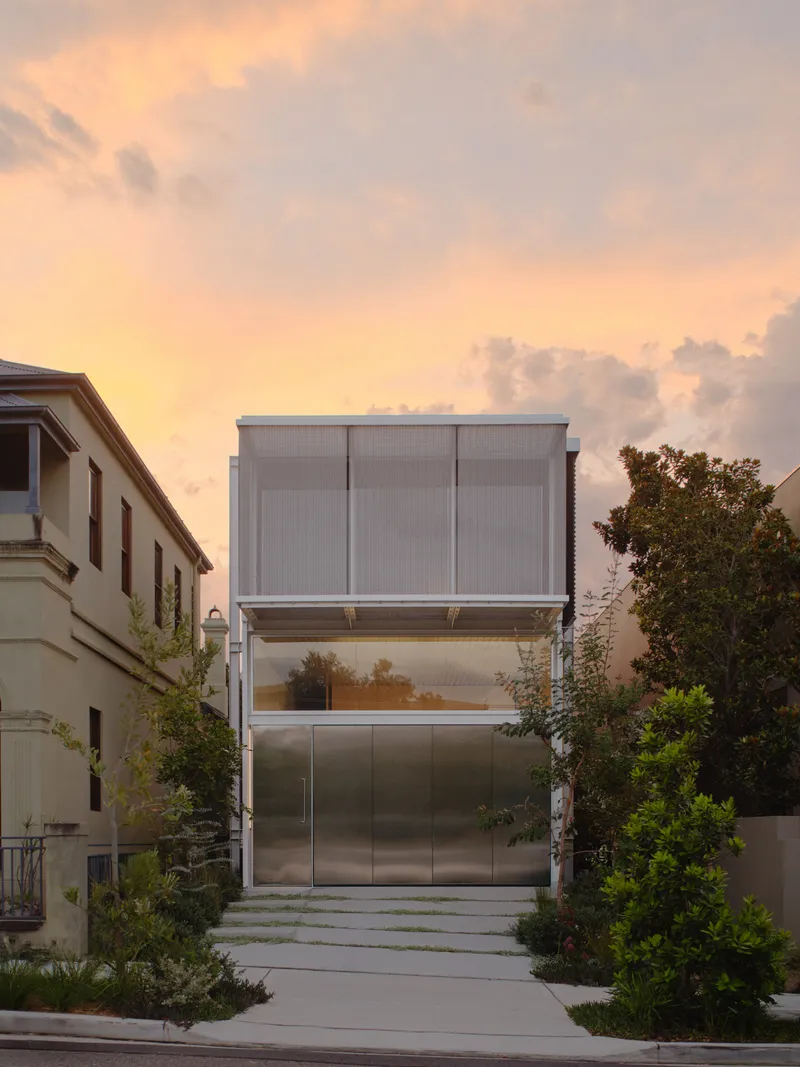
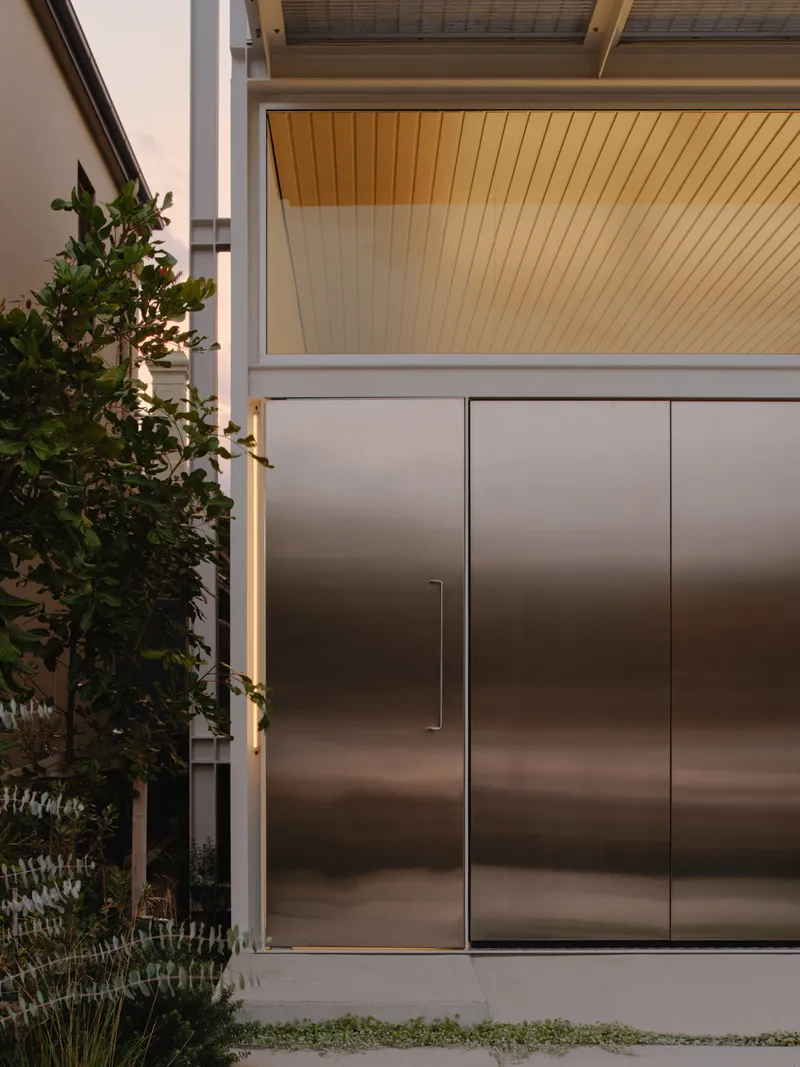

From the street, the house announces its structural logic immediately. White-painted steel portal frames step forward and back, with polycarbonate panels, louvered screens, and glass filling the bays between them. Nothing pretends to be structural that is not. The facade is layered rather than solid: translucent panels glow warmly at dusk, mesh screens filter views, and retractable textile awnings slide up or down depending on the season. The overall impression is of a scaffold that has been inhabited, not a building that has been decorated.
At ground level, the brushed-metal entry sits beneath a wood-paneled soffit, keeping the threshold modest. The upper storey is elevated and set back from the predominant street frontage, creating a screened terrace that faces the public domain without surrendering privacy. It is an unusually generous posture for a narrow lot, increasing the setback from the street boundary and allowing a continuous planted edge to blur the line between private garden and public sidewalk.
Open Ground, Elevated Light


The spatial organization is direct. The ground floor is an open-plan living zone that connects to a native garden, while the upper level holds bedrooms and a studio, raised to capture northern sun. Because no internal wall is load-bearing, rooms are defined by timber joinery volumes and sliding partitions rather than by structure. The 4.5-metre-wide central zone becomes surprisingly spacious when you can see through both of its long facades to planting on either side.
Natural light is managed with real specificity. Floor-to-ceiling glazing on the garden side opens the dining room to views of native planting and a large boulder that anchors the landscape composition. Deeper in plan, translucent vertical panels and frosted glass screens diffuse light without blocking it, producing a gradient from bright to soft as you move through the plan. The slatted oak ceilings play their own part, casting ruled shadow lines across white walls that shift through the day.
Climate as Architecture
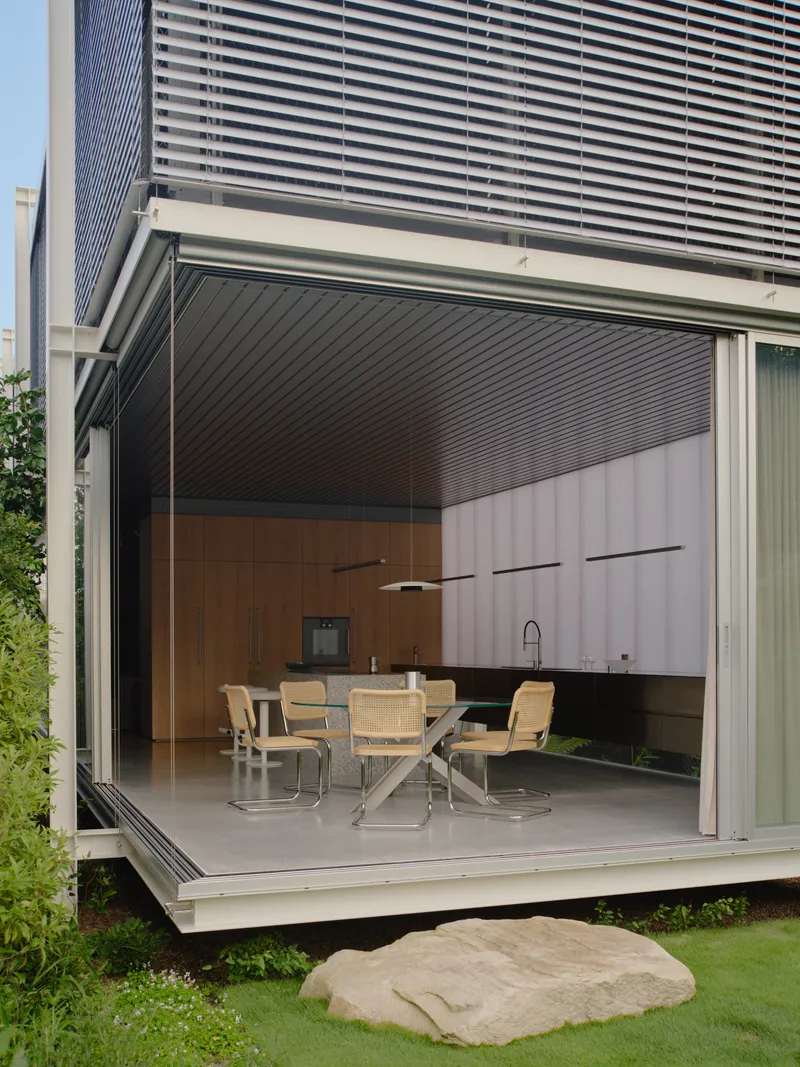

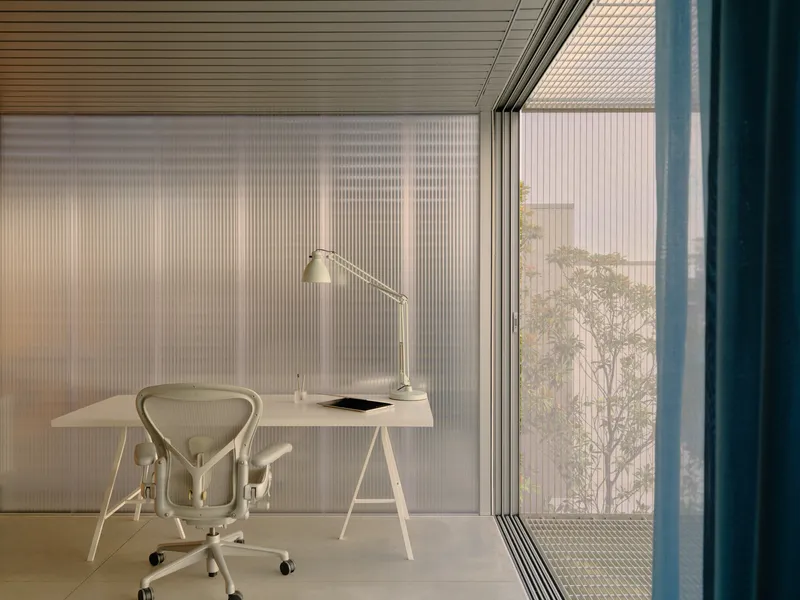
Every facade responds to its orientation, and this is where the kit-of-parts logic pays real dividends. The ground-floor kitchen pavilion can retract its corner glazing entirely, turning the room into an open-air shelter. Adjustable louvres on the first floor modulate sun and breeze along the northern elevation. Retractable composite textile awnings on the south provide passive cooling in summer and pull back in winter to let solar radiation reach the concrete floor slabs, which act as thermal mass. Hydronic floor heating supplements the passive strategy on cooler days.
The environmental commitment runs deeper than operable shading. The gas line was removed from the site. A heat-pump hot water system and rooftop PV panels handle energy loads. Rainwater is collected at 100 percent for reuse. All external walls, roofs, and floor assemblies are insulated, and the polycarbonate panels deliver thermal performance equivalent to double glazing. None of this is visible as green technology; it simply disappears into the material and structural logic of the house.
Timber, Steel, and a Restrained Palette


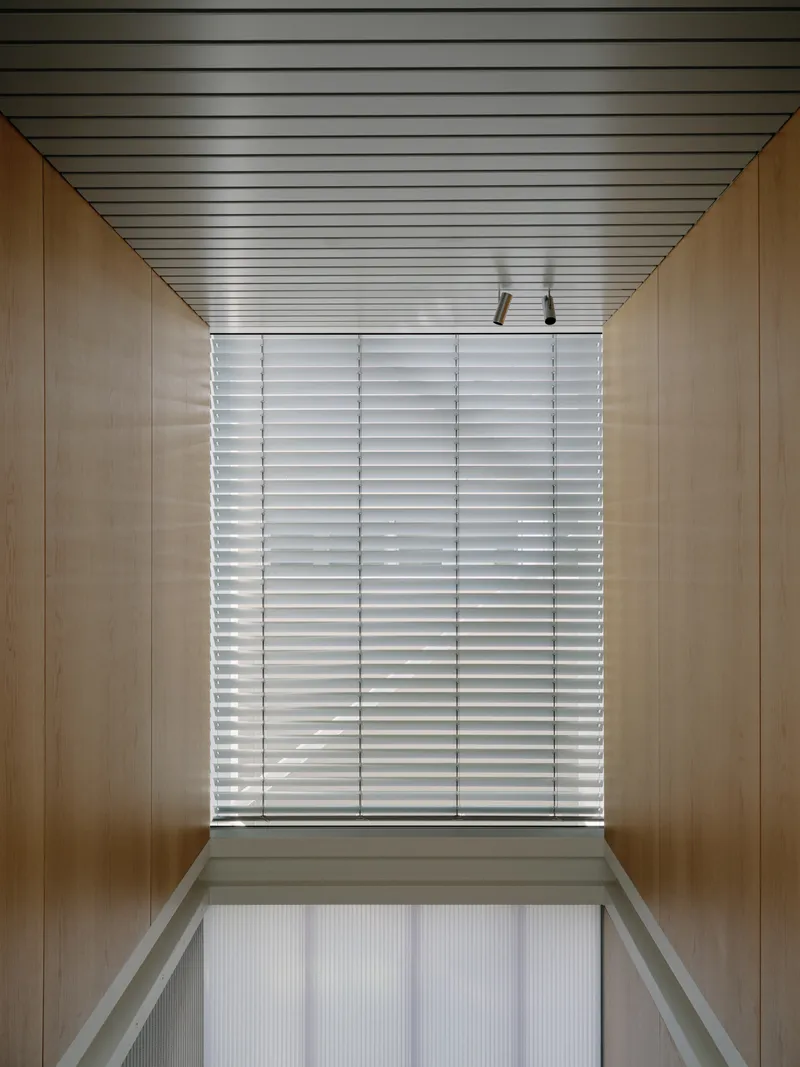
The interior material world is deliberately narrow. Oak paneling, joinery, and cabinetry handle warmth and storage. White-painted steel and stainless-steel details handle structure and hardware. Black granite countertops and base units anchor the kitchen. Translucent corrugated polycarbonate brings diffuse daylight into zones that would otherwise be dark on a narrow lot. The repetition of materials is a feature, not a limitation: it collapses the visual complexity of a small house and lets spatial quality do the talking.
The corridor on the upper level demonstrates this well. Slatted timber ceilings run continuously overhead while a horizontal louvered window at the end pulls the eye to a specific, framed slice of sky. It is a hallway, but it is also an exercise in compression and release, which is something that narrower houses must get right if they are to feel like places worth inhabiting rather than routes between rooms.
Thresholds and Soft Boundaries

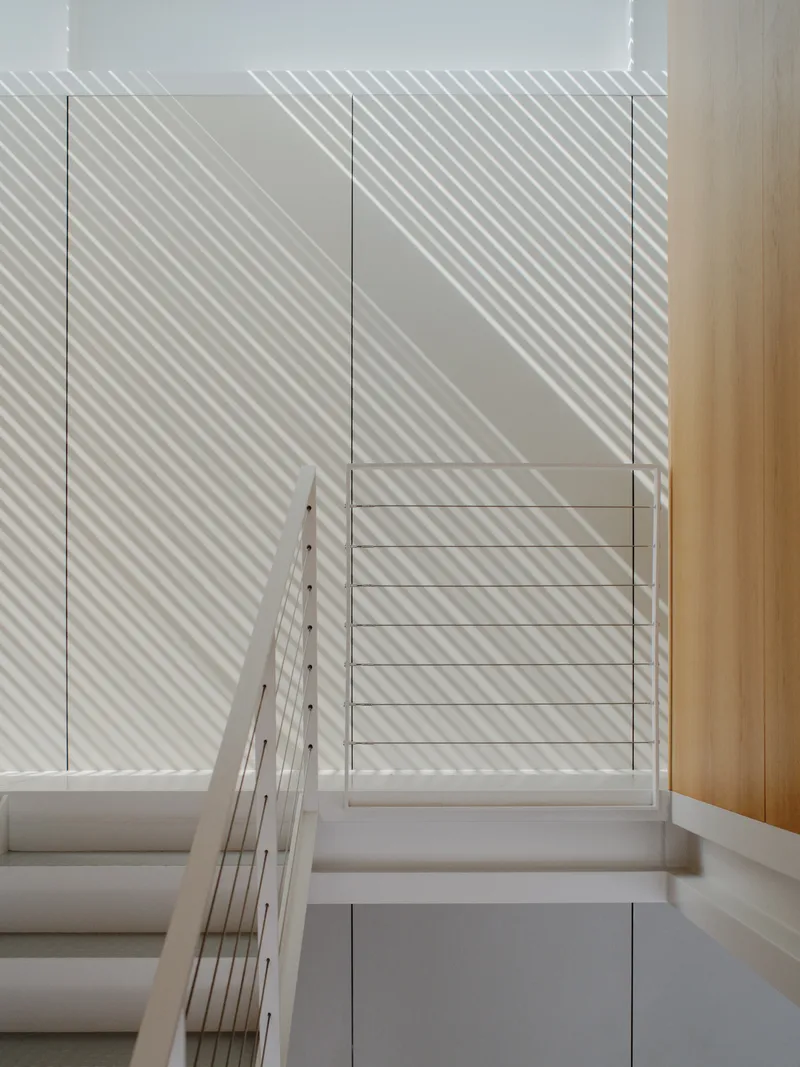

One of the quiet pleasures of Bondi House is how it handles transitions. The white steel staircase presses against a wood-paneled wall, with a translucent curtain filtering daylight from the street side. Climb it and you move through shifting diagonal shadow patterns thrown by exterior louvers. These moments are not incidental; they are the result of the layered facade system, which produces different light effects at every hour and season.
Interior thresholds use the same logic. Sliding mesh screens, blue curtains, pink curtain panels, and frosted glass all participate in a system of soft boundaries that let occupants calibrate privacy and openness room by room. The bedroom threshold, framed by oak cabinetry and timber ceiling slats, makes the passage from common space to private space feel deliberate without being heavy-handed.
Intimate Rooms, Specific Details

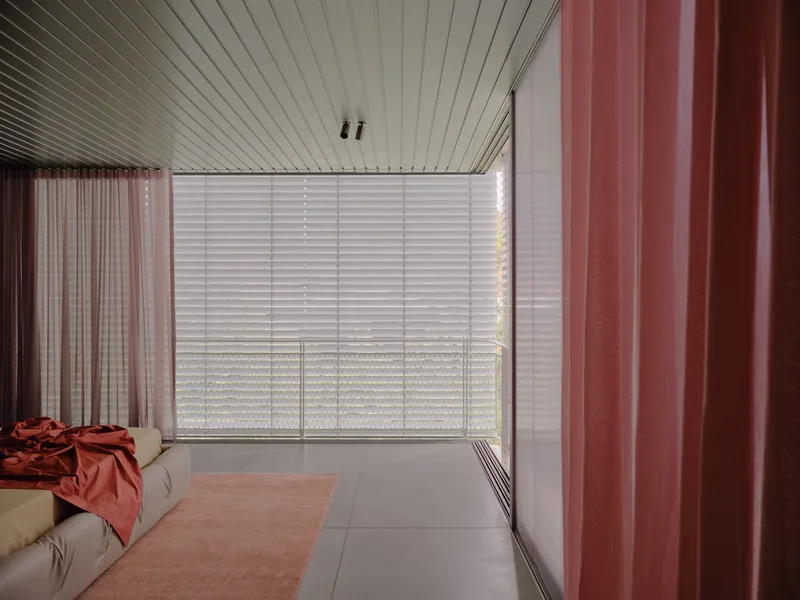

The bedrooms and bathroom reveal how much personality a restrained palette can carry when the details are specific. The bedroom pairs white side tables with oak paneling and a slatted ceiling that keeps the room from feeling closed in despite its compact dimensions. The living room downstairs layers a frosted glass privacy screen against pink curtain panels, a combination that might read as whimsical on paper but reads as considered in person, softening the interior light to a warm glow.
The bathroom introduces teal tile in the shower enclosure, the one assertive color in the house. Against white floor tiles and the omnipresent timber framing, it registers as a deliberate punctuation mark. Small moments of material contrast like this keep the house from feeling austere even as its structural ambitions tend toward abstraction.
Landscape as Partner

The native landscape is not decoration; it is part of the thermal and spatial strategy. Newly planted native trees and shrubs along the northern facade create a planted screen that filters light and casts moving shadows into the interior. The garden beneath the elevated floor slabs receives indirect sun and rain, establishing a microclimate that benefits both the planting and the thermal performance of the ground floor. The boulder in the garden reads as both a sculptural anchor and a nod to the coastal geology of Bondi itself.
By pulling the building back from the street and running planting continuously from the private garden into the public domain, the project contributes something to its immediate context that most Bondi houses do not: a generous, vegetated edge that softens the street and invites the neighborhood in, at least visually.
Plans and Drawings


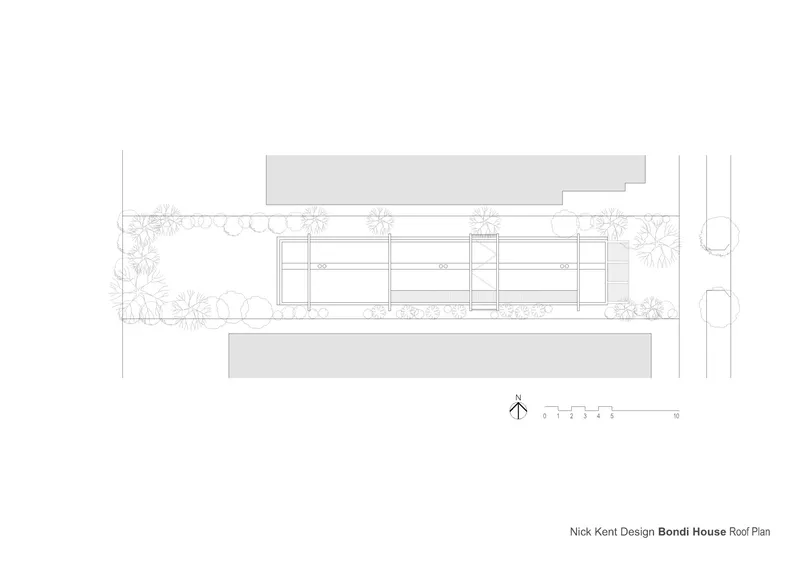
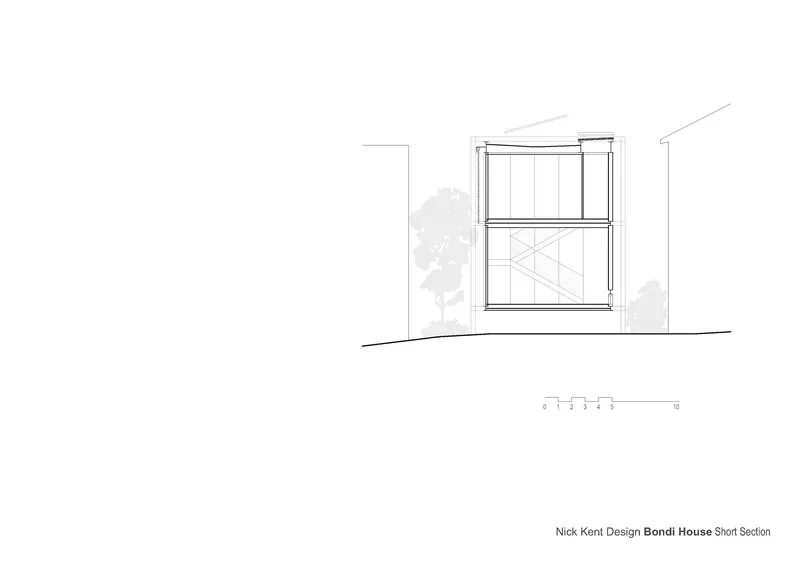
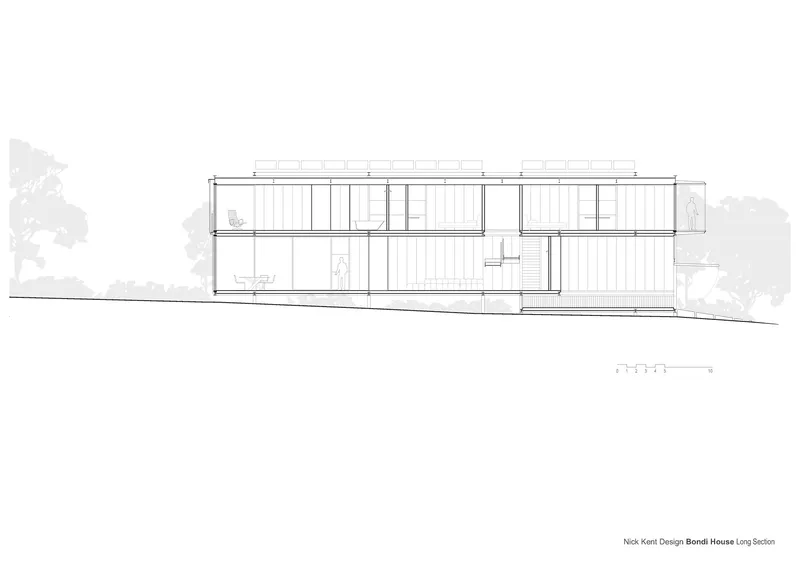
The floor plans confirm what the photographs suggest: a rigorously linear plan organized around a central stair, with landscaped yards flanking both the north and south sides of the narrow lot. The ground floor is almost entirely open, with rooms implied by furniture and joinery rather than walls. The first floor carves out bedroom volumes and a studio within the same structural grid, using the same 2000mm by 900mm module throughout.
The short section reveals the compact two-storey volume alongside the silhouette of a mature tree, underscoring the intended relationship between built form and landscape. The long section is more revealing: it shows how slatted facade screens run the full length of the house, how internal room divisions sit independently of the steel frame, and how the roof plates float above the upper level without bearing on any interior partition. The drawings make the constructional discipline legible in a way the photographs, for all their beauty, can only hint at.
Why This Project Matters
Bondi House matters because it asks a question that most architect-designed residences in expensive coastal suburbs never bother to pose: what if a house could be light enough, modular enough, and open enough to behave more like a well-made tool than a permanent monument? The kit-of-parts framework, the standardized steel sections, the pre-finished materials, and the significantly shortened construction timeline all point toward a way of building that is replicable without being generic. In a city where residential construction is notoriously slow, expensive, and wasteful, that is a proposition worth taking seriously.
The project also succeeds on terms that have nothing to do with systems or ideology. It is a good house. It is filled with changing light, it breathes with the seasons, it sits gently on its narrow site, and it gives something back to the street. Nick Kent, designing for his own family and studio, had the rare luxury of being both client and architect, and the result feels calibrated at a level that commissions for strangers rarely achieve. Bondi House is proof that rigor and warmth are not opposites.
Bondi House by Nick Kent Design, Sydney, Australia. Completed 2024. Built by Toki Construction. Photography by Tom Ross.
About the Studio
Share Your Own Work on uni.xyz
If projects like this are the kind of work you want to make, uni.xyz is a place to publish your own, find collaborators, and enter design competitions.


Popular Articles
Popular articles from the community

Opera by the Sea Estonia: Three Shells Dissolving Architecture into Tallinn's Coastline
A winning opera house proposal replaces monumental form with interconnected shells that blur the boundary between building, park and Baltic Sea.

Opera on the Sea: Driftwood Logic Shapes a Timber Opera House on Estonia's Coast
Trevor Orgill's opera house translates the entangled drift of floating timber into a civic building where wood, water, and music converge.

Cloaked Colonization: A Mobile Underwater Habitat That Moves Like a Fish
Micah Abaya's shortlisted EHC Pacific entry reimagines ocean settlement as a dispersed network of self-sustaining architectural organisms.

Singing Woman: Contemporary Architecture Inspired by Estonia’s Voice and the Sea
Singing Woman turns Estonia’s song culture into flowing opera house architecture, blending public life, landscape, sea, and national memory.

Similar Reads
You might also enjoy these articles

Bao Huynh Watercolor Atelier: A Serene Art Retreat in Hội An
Bao Huynh Watercolor Atelier in Hội An blends multifunctional art spaces, sustainable design, local materials, and family-friendly living in a serene environment.

Atelier Macri Concept Store Interior Design by CASE-REAL
Atelier Macri store features a "ko" counter, walnut wood details, cork displays, blending retail, gallery, and seamless customer experiences.

Manuel Vargas Izquierdo Stadium and High-Performance Sports Center: Architectural Excellence in Jalpa de Méndez
The Manuel Vargas Izquierdo Stadium blends sustainable design, inclusive sports facilities, and cultural-inspired architecture, revitalizing Jalpa de Méndez’s public spaces.

KAKR Buluh Awar Hall: Revitalizing Community and Ecology Through Bamboo Architecture
Community built bamboo hall revitalizes Buluh Awar village, empowering youth, restoring ecology, celebrating vernacular craftsmanship through sustainable architecture and culture.

Explore Plug-In House Competitions
Discover active competitions in this discipline

Challenge to design mud housing for contemporary communities

Challenge to reimagine the Iron Throne

Photograph architecture without architects

Illustrate the lost glory of Angkor Wat - Render Challenge
Comments (0)
Please login or sign up to add comments
No comments yet. Be the first to comment!