
Note House: A Vertical Home Tuned to Music, Mobility, and Multi-Generational Life
A compact urban dwelling that treats circulation as performance, accessibility as non-negotiable, and domestic life as creative practice.


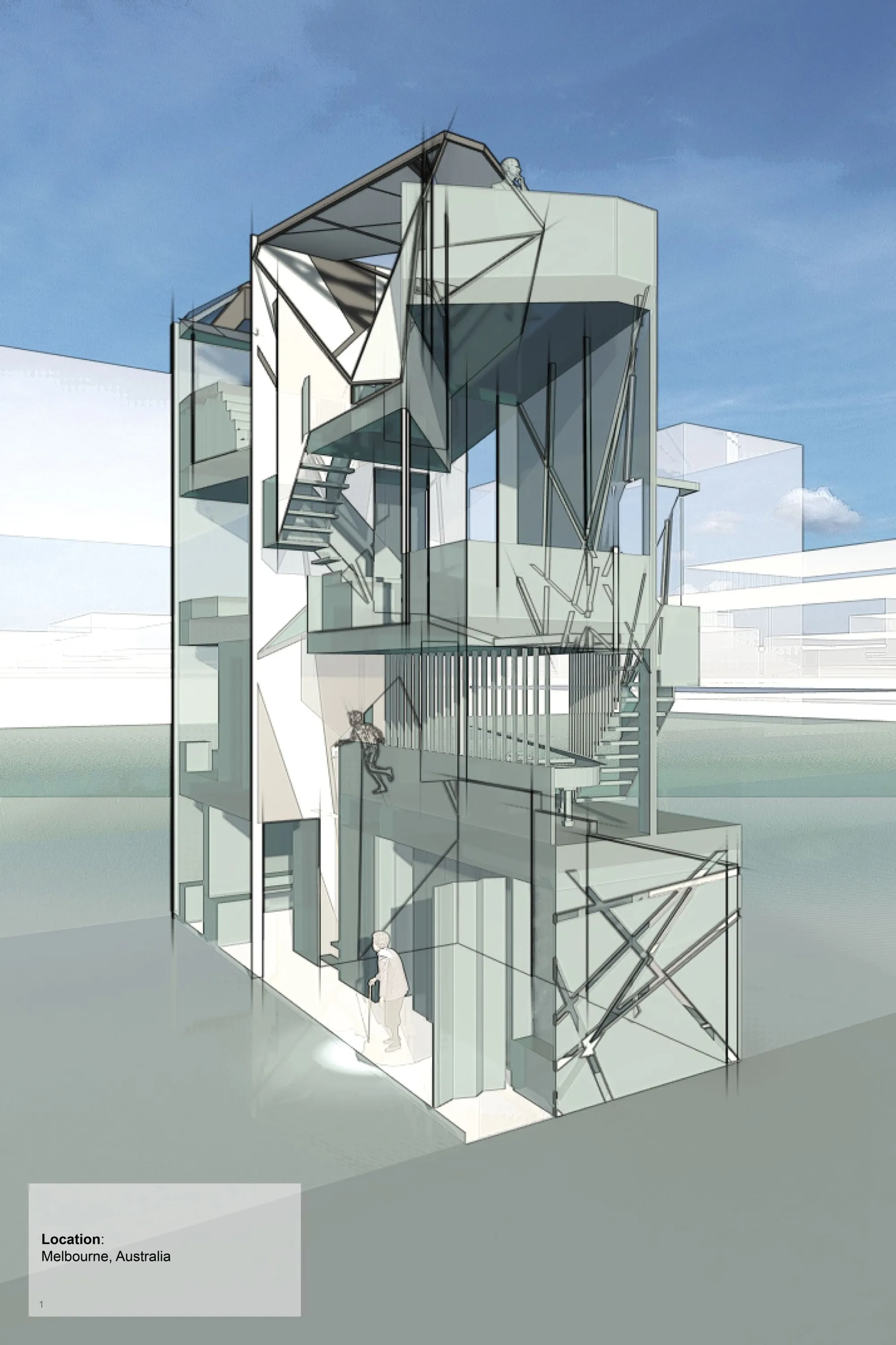
What happens when you design a house around the assumption that everyday life is already a kind of performance? The Note House takes that question literally. Built for a family of five spanning three generations, the project organizes a tight urban footprint into a vertical sequence of spaces where a musician can rehearse, an elderly grandmother can move freely by wheelchair, a seven-year-old can play, and a working couple can retreat. The architecture doesn't just accommodate these overlapping routines; it orchestrates them, using double-height voids, bridges, and shifts in material to give each activity its own acoustic and spatial register.
Designed by Emma Kunz and Maral Mendybayeva, the Note House is a project that reimagines the multi-generational home as something more than an exercise in floor plan efficiency. Its southern facade doubles as a transitional edge between domestic life and the street, projecting a subtle theatricality outward. The northern side, by contrast, withdraws into acoustically controlled bedrooms and studios. Between these two poles, the house stages a continuous negotiation between togetherness and solitude.
A Section That Reads Like a Score
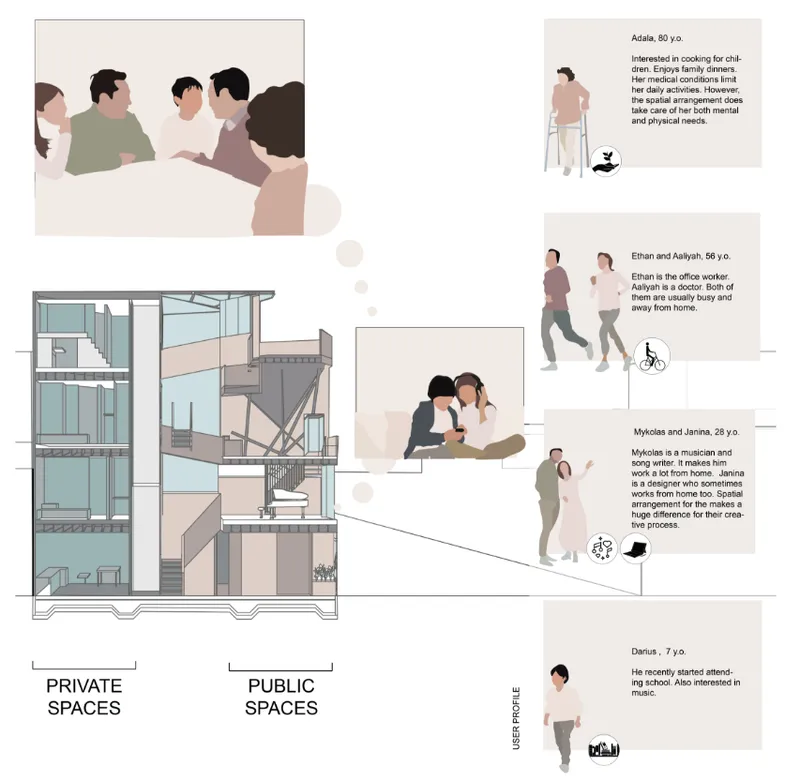

The section drawing reveals the project's fundamental logic: public and private zones are separated along a north-south axis, then layered vertically across multiple levels. Illustrated user profiles annotate each zone, showing where Adala (80) cooks and dines, where Mykolas and Janina (both 28) collaborate or work solo, and where Darius (7) finds space for play and study. This is not a generic stacking exercise. Each level responds to the specific physical and emotional needs of its occupants, with full wheelchair accessibility integrated across all floors via lift access.
The axonometric rendering strips the house to its structural essentials: white volumes connected by open staircases across three main levels. What becomes immediately clear is how the designers use voids and visual continuity between floors to prevent the compact footprint from feeling claustrophobic. Circulation here is not residual corridor space. It is spatial event, with sculptural staircases and bridges turning the act of moving through the house into an experience as deliberate as entering a room.
The South Facade as Urban Stage

Seen at dusk, the elevated timber walkway with its steel frame canopy marks the threshold between the family's private world and the city beyond. The south facade is conceived as a transitional edge: part screen, part backdrop. Domestic life is projected outward, not as spectacle but as a quiet assertion that creative practice and care belong in the public realm. Figures on the walkway suggest this is a space used as much for pause and observation as for passage, reinforcing the idea that circulation in the Note House is always doing double duty.
Light Wells and Vertical Wood Slats Shape Interior Atmosphere

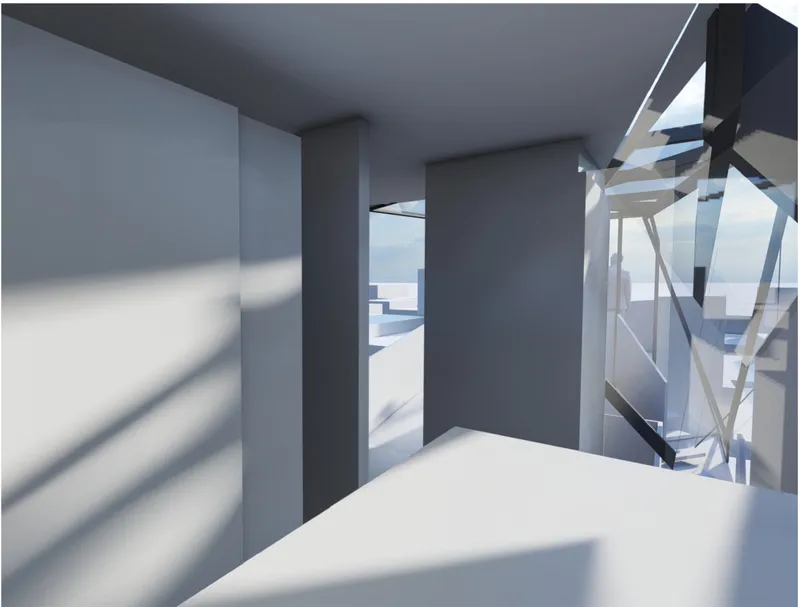
Sunlight streaming through a triangular window catches vertical wood slats, scattering light deep into the interior. This is one of several carefully placed light wells designed to bring daylight into a structure that could easily become dark given its dense urban context. The effect is not decorative. It is a deliberate sensorial strategy: shifts in natural lighting, material texture, and spatial compression and expansion work together to mark transitions between zones and moods, from the openness of the shared music room to the intimacy of a bedroom.
A second interior view reveals angular steel framework visible through a glazed opening, casting diagonal shadows across a minimalist corner. The material palette here is restrained, allowing geometry and light to carry the spatial drama. These details point to the project's broader sustainability approach: thermal mass, passive solar design for temperature regulation, natural ventilation through operable skylights and airflow corridors. The architecture performs its environmental work quietly, folding energy strategy into the same sensorial language that drives the rest of the design.
Exploded Views Clarify the Choreography of Shared and Private Life

The exploded axonometric and labeled section drawings make the organizational logic fully legible. Public circulation zones, including dining, the music room, and shared living areas, are concentrated on the southern side. Private retreats, acoustically controlled studios and bedrooms, occupy the north. Between these, vertical connections (stairs, voids, the lift) weave the two systems together. For Ethan and Aaliyah, the busy working couple, flexible layouts allow for remote work without sacrificing connection to the rest of the household. For Janina and Mykolas, the creative spaces offer volumes scaled for both collaboration and solitary focus.
Why This Project Matters
Multi-generational housing projects often default to a simple adjacency model: put the grandparent on the ground floor, the kids at the top, and call it inclusive. The Note House refuses that formula. By treating each resident's daily rhythms, from Adala's need for full accessibility to Janina's need for acoustic control to Darius's need for play, as genuine spatial inputs rather than afterthoughts, Kunz and Mendybayeva produce a home that is genuinely responsive rather than merely functional.
More importantly, the project makes the case that density, creativity, and care are not competing demands. They are complementary forces that, when designed for simultaneously, produce architecture richer than any one of them could alone. On a tight city plot, the Note House manages to be a rehearsal space, an accessible residence, a childhood playground, and a workplace, all without losing coherence. That is not just good design. It is a working argument for what urban housing can become.
View the Full Project
About the Designers
Designers: Emma Kunz, Maral Mendybayeva
Enter a Design Competition on uni.xyz
uni.xyz runs architecture and design competitions year-round that reward proposals with spatial conviction and real site intelligence.
Project credits: Note House by Emma Kunz, Maral Mendybayeva.




Popular Articles
Popular articles from the community

EW PARK: Sustainable Architecture Reimagines the Future of Urban Parking
EW PARK reimagines city parking as a modular wooden tower combining automation, solar energy, electric mobility, and adaptable urban design.

Co-life: Sustainable Architecture for Age-Friendly Community Living
Co-life reimagines sustainable architecture for seniors through courtyards, rammed earth, shared gardens, and spaces designed for belonging.

The Earth Pod: 3D Printed Homes for Resilient Refugee Communities
The Earth Pod reimagines refugee housing through 3D printed homes made from clay, combining resilience, self-sufficiency, and rapid shelter.

Co-Life: Senior Housing Design That Reconnects Older Adults With the City
Co-Life reimagines senior housing design through healing gardens, shared streets, workshops, and a sustainable community across generations.


Similar Reads
You might also enjoy these articles

Day and Night Park: A Time-Based Urban Newsstand in Beijing
A temporary urban newsstand in Beijing blending travel, light, and reading through poetic colors, compact form, and community-focused design.

Modernist Patio Renovation in El Masnou, Barcelona by Oliver Segura Arquitectura + Cebrià Arquitectura
Modernist patio renovation blending tradition and innovation with a movable pool, leveled floors, and Catalan materials in El Masnou.

Alto Residencial Coop: Cooperative Housing Development in Santiago de Compostela by Carbajo Barrios Arquitectos
A linear cooperative housing complex blending white volumes and perforated metal façades, enhancing community living, natural light, privacy, and urban integration.
Vil Genis School by BPA ARCHITECTURE – Massy, France
Vil Genis School in Massy, France, features sustainable design, south-facing classrooms, community integration, accessible spaces, and modern educational architecture.

Explore Conceptual Architecture Competitions
Discover active competitions in this discipline


Challenge to design luxury tourism on rails


VR headsets Storefront design competition

Designing a staircase for a client
Comments (0)
Please login or sign up to add comments
No comments yet. Be the first to comment!