
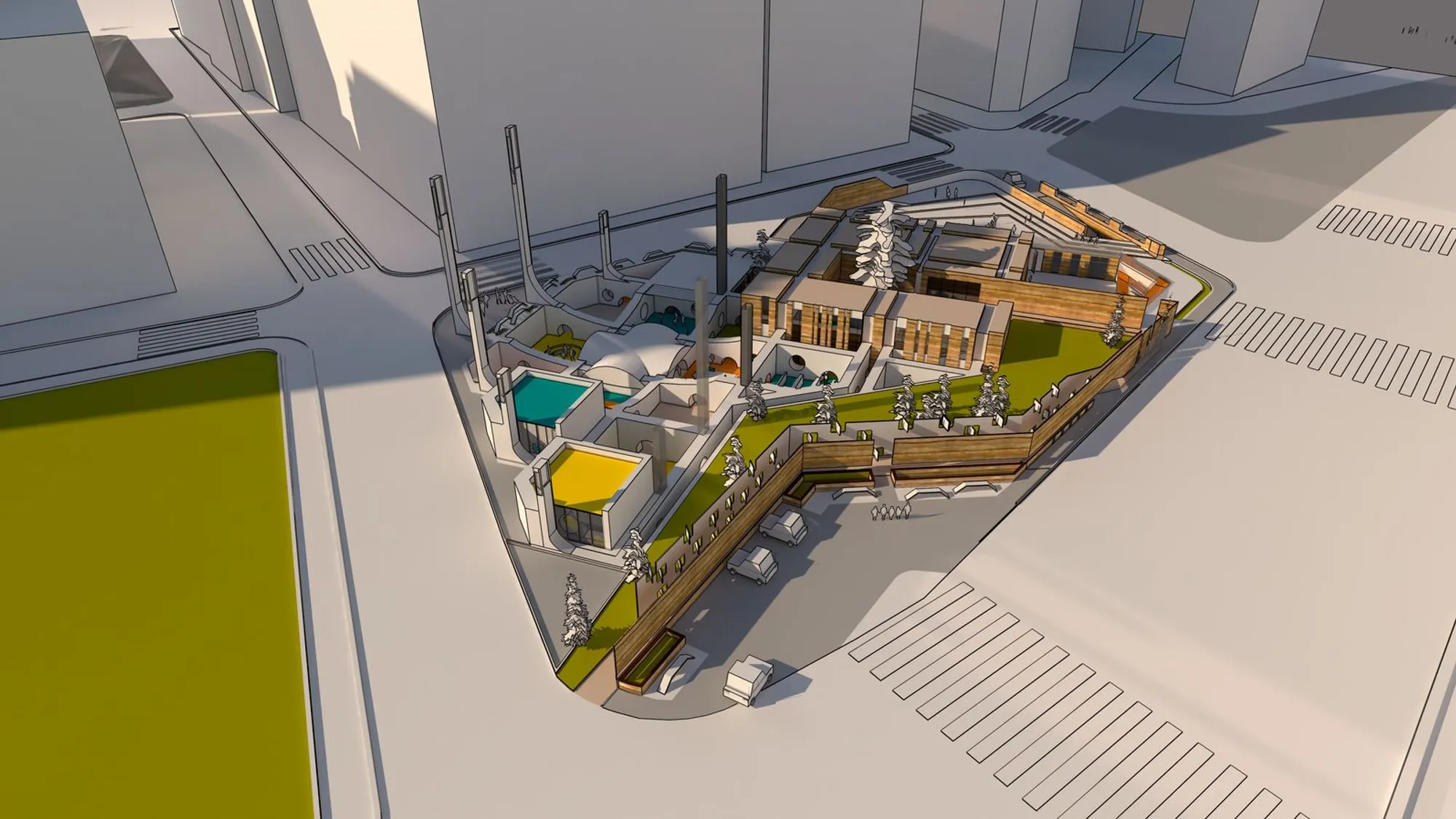
Organon Day Care: A Building That Breathes for Children in Yazd's Desert Climate
Wind catchers, earth sheltering, and courtyards transform passive climate strategies into a spatial playground for a daycare embedded in the ground.


What if a building could breathe? Not as metaphor alone, but as measurable performance: wind captured, cooled underground, drawn through inhabited spaces, and expelled through solar chimneys. Organon Day Care takes its name from the musical instrument that produces sound through controlled airflow and applies that logic to architecture. The result is a daycare center in Yazd, Iran, where the desert's harshest forces, intense solar radiation, dry winds, and extreme diurnal temperature swings, become the very inputs that generate comfort, light, and air for children.
Designed by Javad Edalat, Mansoureh Khesali, Zahra Deheshjoo, and Forough Farhadi, the project was submitted to Form Follows Climate 2020. Set in a city renowned for one of the world's richest traditions of passive environmental design, Organon does not merely cite vernacular strategies; it reinterprets wind catchers, rammed-clay walls, courtyards, and earth sheltering within a contemporary program where every climate system doubles as a spatial experience for young users.
A Closed Fist Against the Desert Sun
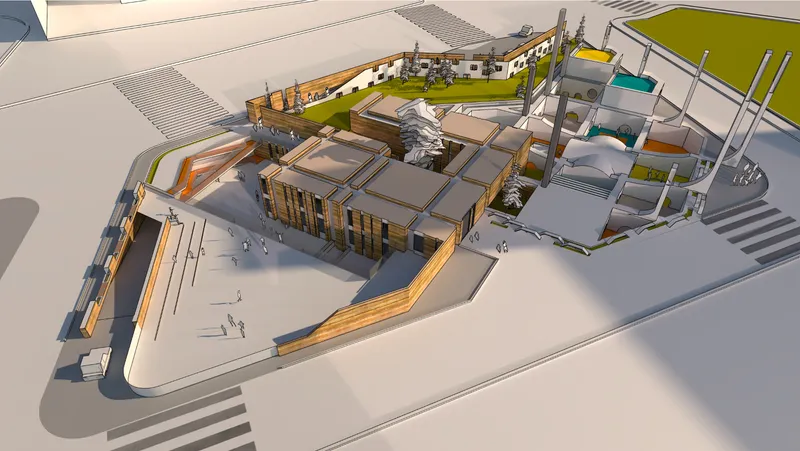
The designers describe the architectural form as a closed mass resembling the knotted fingers of a fist: compact, introverted, and deliberately opaque to the exterior. The axonometric rendering reveals how timber-clad volumes cluster around a central courtyard, with planted green roofs softening the roofscape and reducing heat gain. This dense configuration minimizes the building's exposed surface area to Yazd's punishing solar radiation while concentrating spatial complexity inward. It is not defensive so much as strategic, a compact body that conserves cool air the way a desert animal conserves water.
Beneath this solid exterior, the heart of the daycare is partially embedded in the ground. Earth sheltering acts as a thermal buffer, stabilizing indoor temperatures across seasons and drastically reducing the need for mechanical cooling. The soil itself becomes an active architectural element: insulation, comfort, and a sense of refuge all at once. For a daycare, this inward, sheltered quality carries a psychological resonance too; children occupy spaces that feel protected without being sealed off from sky, air, and light.
Courtyards as Climatic Engines and Play Spaces
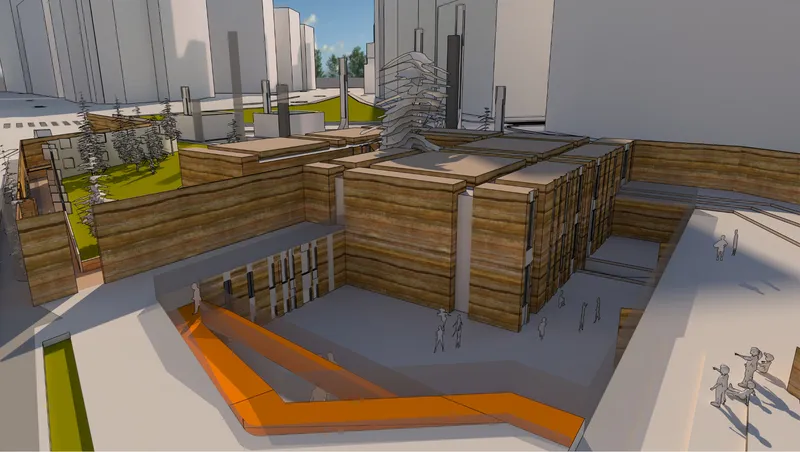
The courtyard view captures what may be the project's most compelling argument: that climate performance and child-centered design are not parallel agendas but the same agenda. Horizontal timber cladding wraps the surrounding volumes in warm, tactile materiality, while orange ground plane elements punctuate the space with color and orientation cues. Under afternoon sun, the courtyard reads as a shaded outdoor room, filtering daylight, encouraging cross-ventilation, and creating a microclimate tuned for activity rather than endurance.
Positioned centrally within the plan, these courtyards introduce natural light deep into the building's buried levels while supporting the airflow loops driven by wind catchers and solar chimneys above. The gradual transition from enclosed underground spaces to semi-open courtyards and then to surface-level landscapes establishes a layered spatial sequence that children move through physically. Towers, shafts, and vertical openings are not abstract technical systems hidden behind walls; they are the spatial markers that frame play, movement, and curiosity.
Stacking Program Below Grade
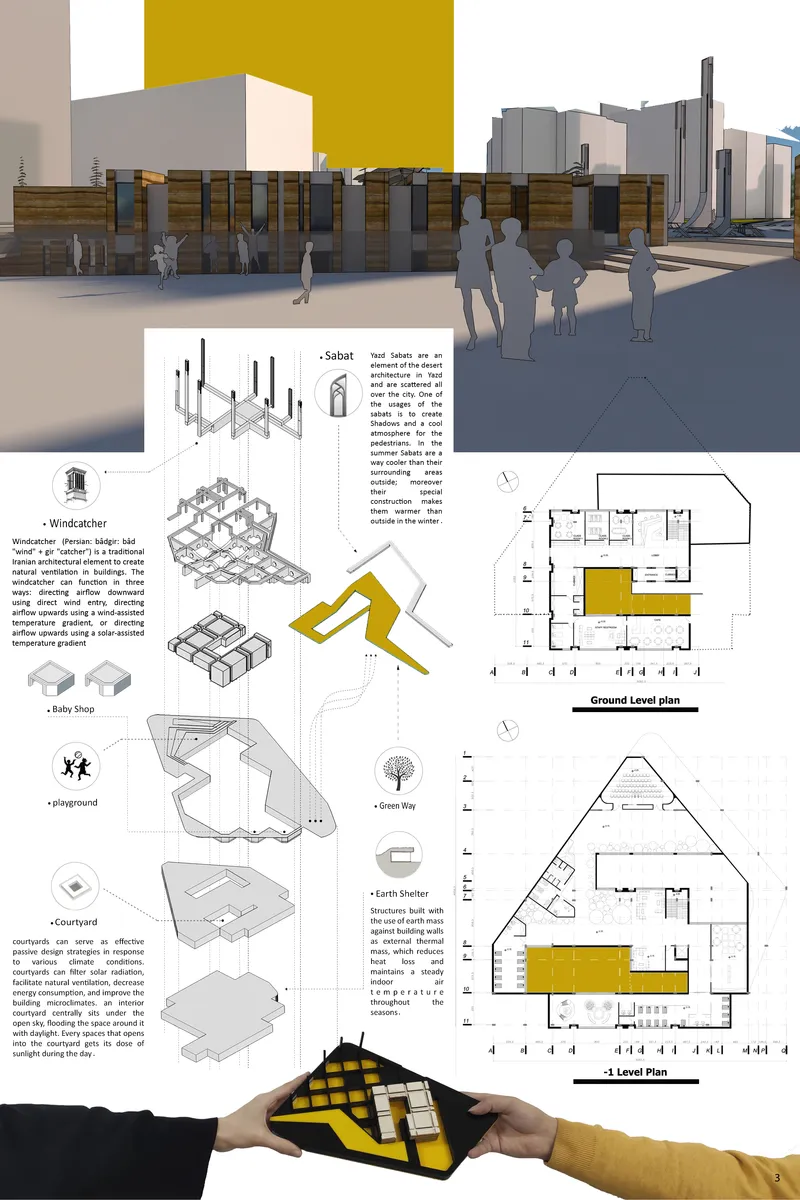
The presentation board lays out the project's organizational logic with precision. The ground level accommodates public and service-oriented functions: reception, administration, learning spaces, staff facilities, and a café. One level below, dedicated entirely to children and parents, the program expands into play areas, libraries, amphitheaters, clinics, washing rooms, and age-specific activity zones. Service functions including kitchens, storage, and parking occupy the lowest level, maintaining operational efficiency without intruding on the children's world above.
Circulation reinforces the environmental narrative. Pedestrian paths are choreographed for safety, shade, and intuitive movement. Rammed-clay walls mark green routes through the site, while vegetation native to arid climates, including cypress trees and drought-resistant ground cover, provides filtered shade and ecological resilience without excessive water consumption. The axonometric diagrams and floor plans visible on the board confirm that every corridor and threshold participates in the building's passive ventilation strategy.
The Respiratory Section: Wind, Earth, and Undulating Ground
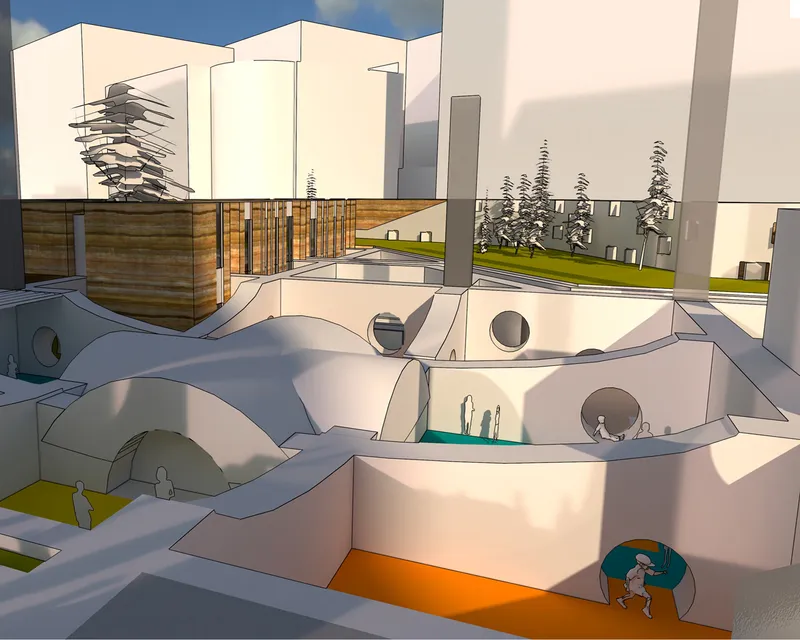
The section rendering is where Organon's respiratory metaphor becomes most legible. Undulating floor levels rise and fall beneath a plaza scattered with trees, while circular apertures puncture the ground plane to bring light, air, and visual connection between above and below. Wind catchers and solar chimneys, positioned based on airflow simulations, capture prevailing winds, guide cooled air downward through underground ducts, and use temperature gradients to expel warm air upward. The section reads less like a building and more like a lung in cross-section: air enters, is conditioned by the earth, circulates through inhabited volumes, and exits.
For children occupying these spaces, the experience is one of continuous spatial variation. Ceilings rise and dip. Light arrives from unexpected directions. Air moves perceptibly. The architecture does not hide its performance; it stages it as environment. Energy performance, rigorously tested through computational simulation, validates what the section already suggests: that Yazd's ancient passive strategies, translated into contemporary form, can achieve substantial reductions in mechanical cooling demand.
Why This Project Matters
Organon Day Care refuses the common assumption that climate-responsive architecture is a technical overlay, something resolved in a mechanical room and forgotten. Instead, it positions passive environmental systems as the primary generators of spatial quality, making wind catchers into towers children look up at, courtyards into play spaces cooled by stack ventilation, and earth sheltering into a literal embrace around the program. The building does not merely respond to Yazd's climate; it performs it.
What makes this entry particularly strong within the Form Follows Climate brief is its insistence that climate performance and pedagogical architecture are inseparable. Children in this building would not learn about sustainability from a poster on the wall. They would learn it from the air moving past them, the light shifting through circular apertures, and the cool ground beneath their feet. The design team has produced a project where environmental strategy and lived experience converge completely, and that convergence is the architecture.
View the Full Project
About the Designers
Designers: Javad Edalat, Mansoureh Khesali, Zahra Deheshjoo, Forough Farhadi
Enter a Design Competition on uni.xyz
uni.xyz runs architecture and design competitions year-round that reward proposals with spatial conviction and real site intelligence.
Project credits: Organon Day Care by Javad Edalat, Mansoureh Khesali, Zahra Deheshjoo, Forough Farhadi Form Follows Climate 2020 (uni.xyz).




Popular Articles
Popular articles from the community


Conexión: Biophilic Design Reimagines High-Rise Living in Hong Kong
Conexión reimagines high-rise living in Hong Kong through biophilic design, green facades, shared spaces, daylight, water and nature within.

The Musturak Paradise: Senior Living Architecture for a Connected Future in Temara, Morocco
The Musturak Paradise reimagines senior living architecture in Temara via private homes, social spaces, culture, community, and shared care.

The Earth Pod: 3D Printed Homes for Resilient Refugee Communities
The Earth Pod reimagines refugee housing through 3D printed homes made from clay, combining resilience, self-sufficiency, and rapid shelter.

The Ocean Hive: Sustainable Architecture for a Self-Sufficient Civilization at Sea
The Ocean Hive imagines sustainable architecture at sea, where modular habitats, algae, wave power and ocean waste sustain a growing colony.

Similar Reads
You might also enjoy these articles
Sustainable Architecture Design: Embracing Nature and Modernity at Villa Solsidan
The article explores Villa Solsidan by AndrénFogelström, showcasing its sustainable architecture design and integration with the natural surroundings in Saltsjöbaden, Sweden.
Scientific and Educational Monitoring Center of the Yenisei, Krasnoyarsk
Architecture as an instrument for ecological research, education, and environmental awareness along Russia’s largest river.
Development of Andretta Artist’s Village, Palampur, Himachal Pradesh, India
Reimagining Andretta as a living cultural landscape where art, architecture, and community converge to shape a global creative village.
Street Children Rehabilitation Center: A Model of Social Architecture for Community Rehabilitation
An inclusive social architecture project that transforms streets into nurturing environments, restoring dignity, identity, and opportunity for vulnerable children.


Comments (0)
Please login or sign up to add comments
No comments yet. Be the first to comment!