

O.U.V.R.A.G.E.S Converts a Brussels Neighborhood Restaurant into Adaptable Housing
In Watermael-Boitsfort, a former restaurant becomes a set of evolving dwellings that grow with their inhabitants over time.


A neighborhood restaurant closing its doors is usually a quiet loss, a shift in the social fabric that passes without ceremony. In Watermael-Boitsfort, a leafy commune in southern Brussels, the firm O.U.V.R.A.G.E.S, led by architects Louis del Marmol and Dimitri Stassin, saw in one such closure the opportunity for something more interesting than demolition and replacement. Their project, Crabe Fantôme, takes the bones of the old building and reimagines them as a set of dwellings designed to change over time, built around a principle of spatial evolution rather than fixed domestic typology.
What makes this project worth examining is the clarity with which it handles a familiar challenge: how to insert contemporary residential architecture into a tight, historically textured Belgian streetscape without producing either a timid replica or an aggressive interruption. The answer here is a white rendered volume that acknowledges its gabled neighbors while reorganizing the interior around courtyards, light wells, and a circulation strategy that allows spaces to be combined or separated as household needs shift. At 395 square meters on a constrained triangular plot, every square meter has to earn its keep.
Fitting a Gable Between Gables
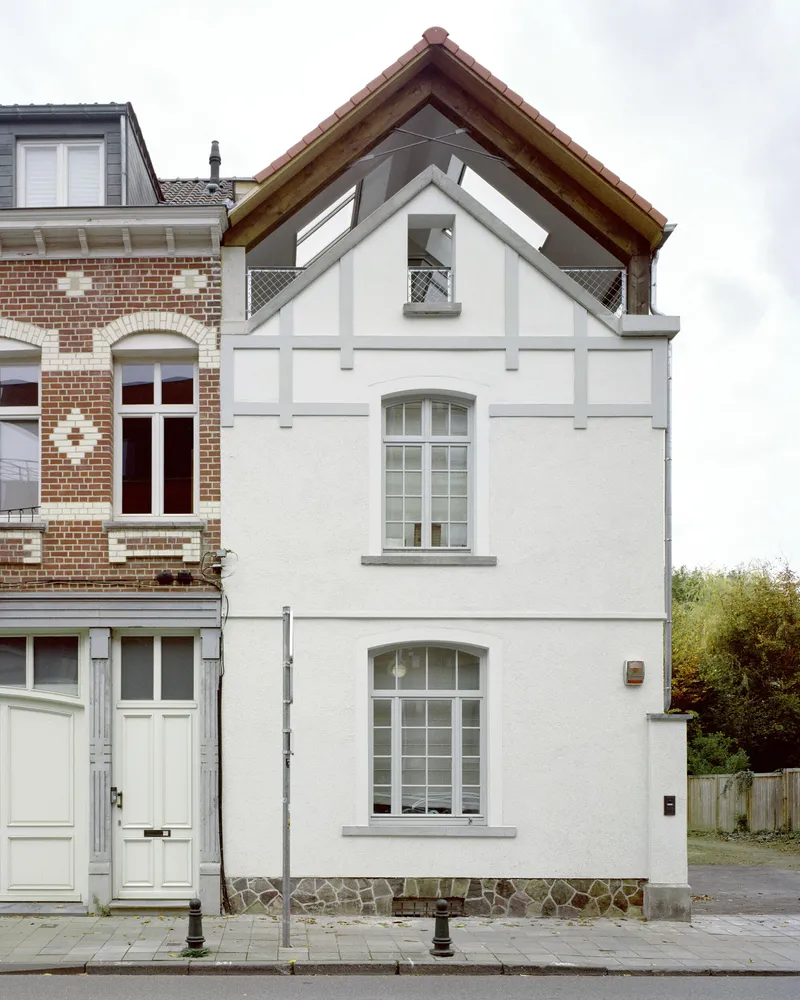
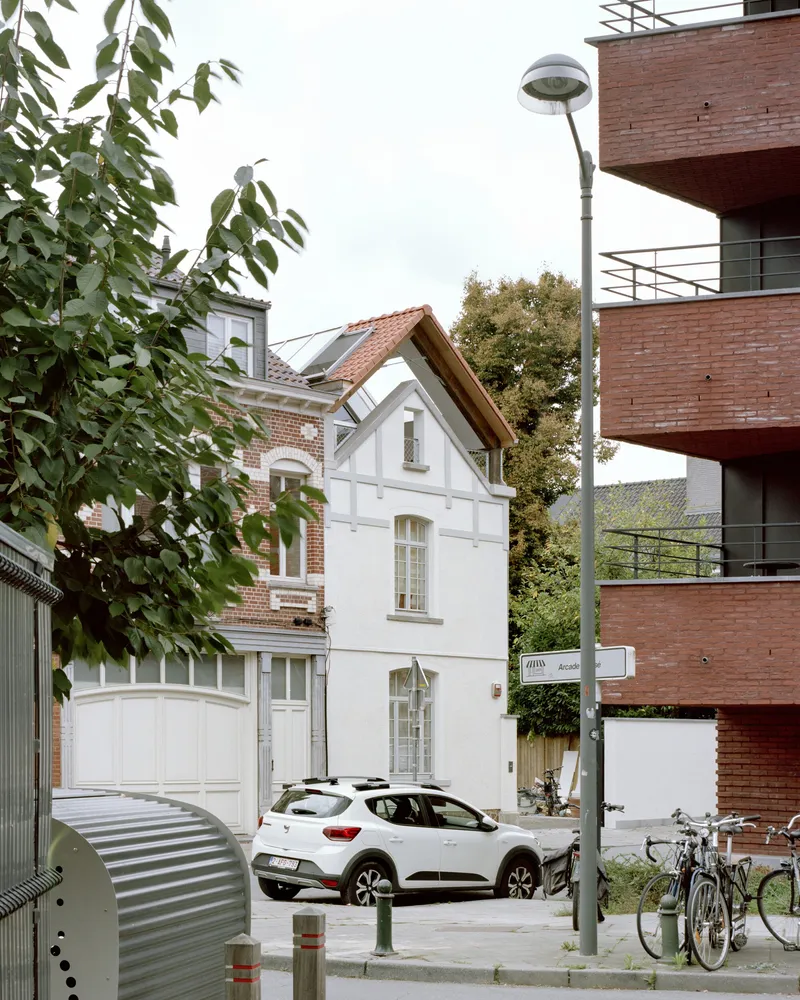
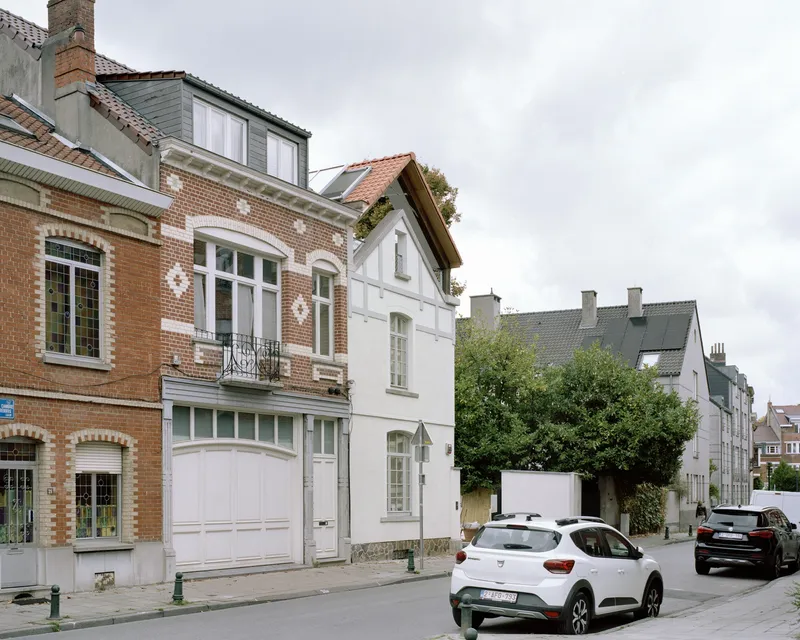
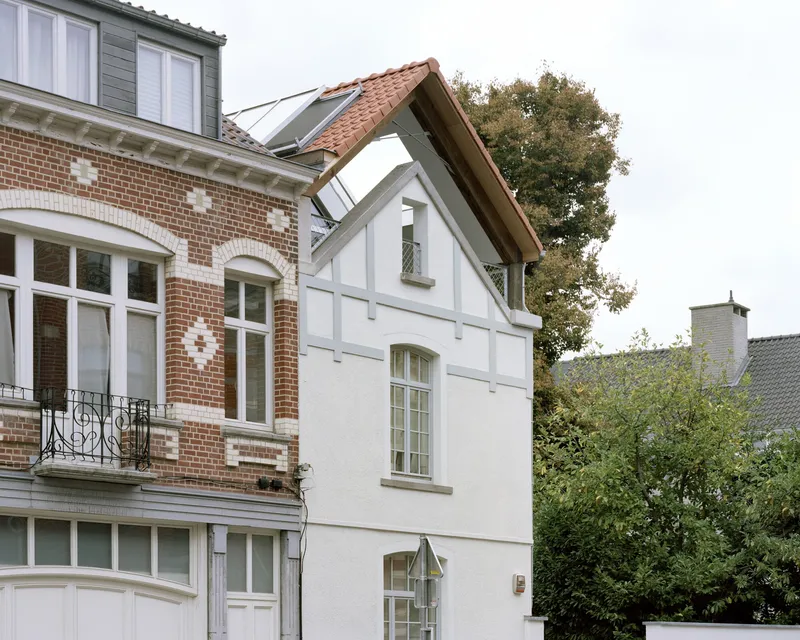
From the street, Crabe Fantôme reads as a composed neighbor. The white render distinguishes it immediately from the ornate brickwork on either side, but the gabled roof profile and the proportions of the arched windows keep the new facade in conversation with the existing rhythm of the block. There is no mimicry here, no pastiche brick detailing. The building is plainly contemporary, yet it defers to the datum lines and massing of its context.
The half-timbered gable visible in some views nods to a regional vernacular without committing to it fully, an architectural wink rather than a costume. Parked cars and autumn trees soften the reading further, grounding the building in the everyday texture of a Brussels residential street rather than isolating it as an object.
Garden Rooms and Courtyard Logic
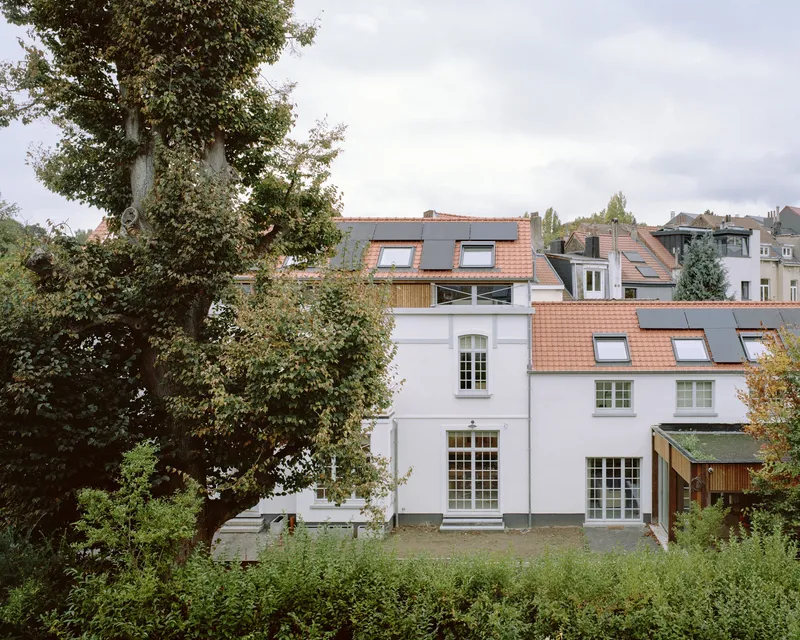
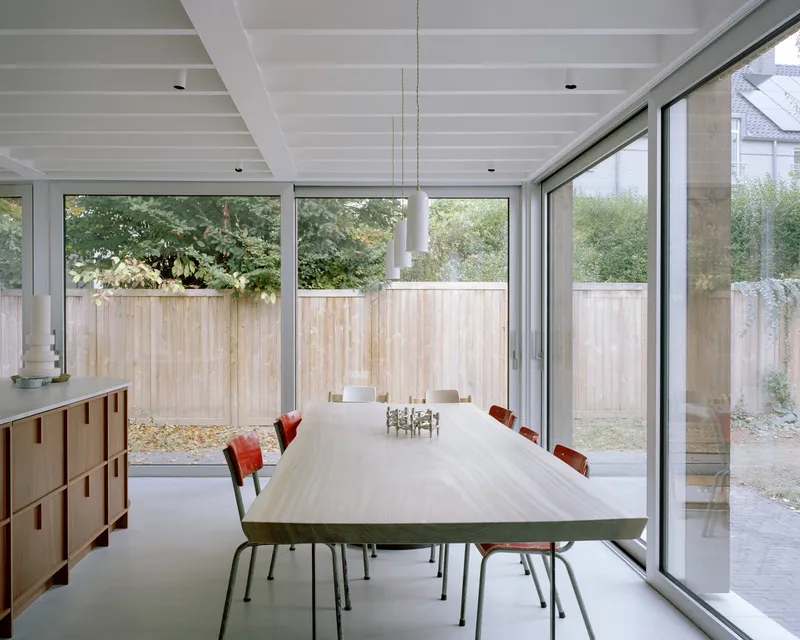
The rear facades reveal a different character. White rendered walls step back and forth, creating pockets of planting and framing views into a garden that feels unexpectedly generous for such a constrained site. Terra cotta tiled roofs unify the various volumes, lending warmth and a sense of domesticity to what could otherwise read as a clinical composition.
The dining area captures this dual relationship well: a white beamed ceiling holds the interior together overhead, while full-height glazing dissolves the boundary between table and garden. A timber fence provides privacy from neighbors without blocking green views. The architecture works hardest at the seams between inside and out, and these moments are where Crabe Fantôme is most convincing.
Interior Warmth in a White Shell
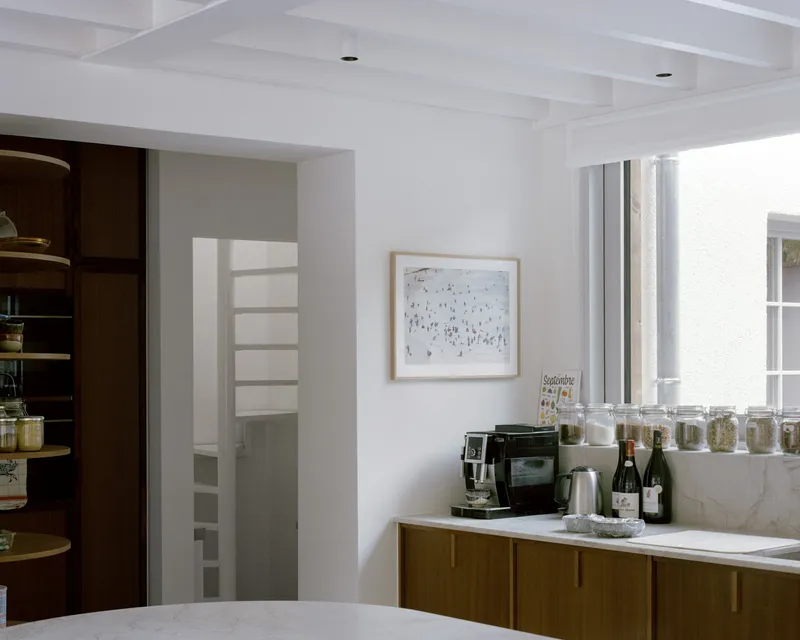
Inside, the palette is restrained but not austere. Walnut cabinetry in the kitchen brings a richness that the white coffered ceiling above amplifies by reflection. Marble countertops catch soft daylight from carefully placed openings. The effect is precise without being precious, a kitchen designed for use rather than display.
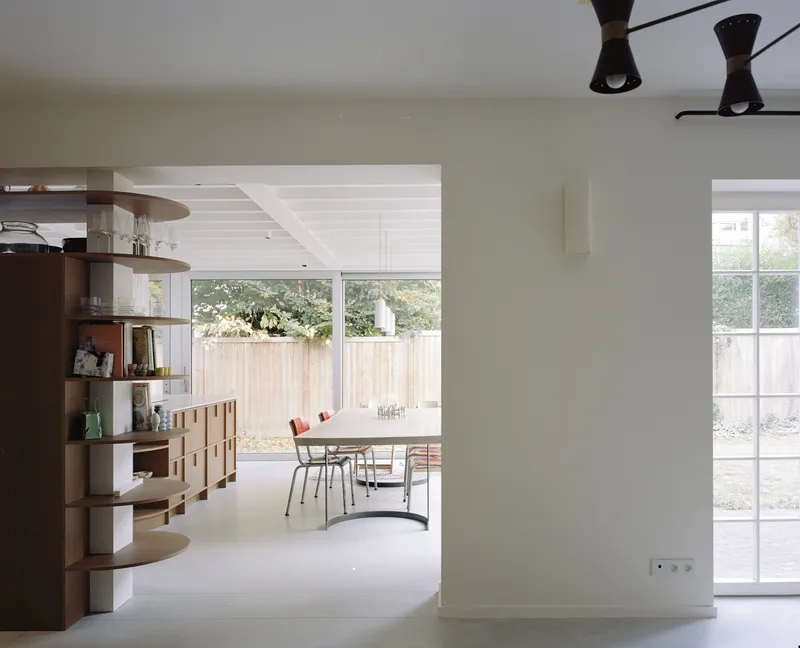
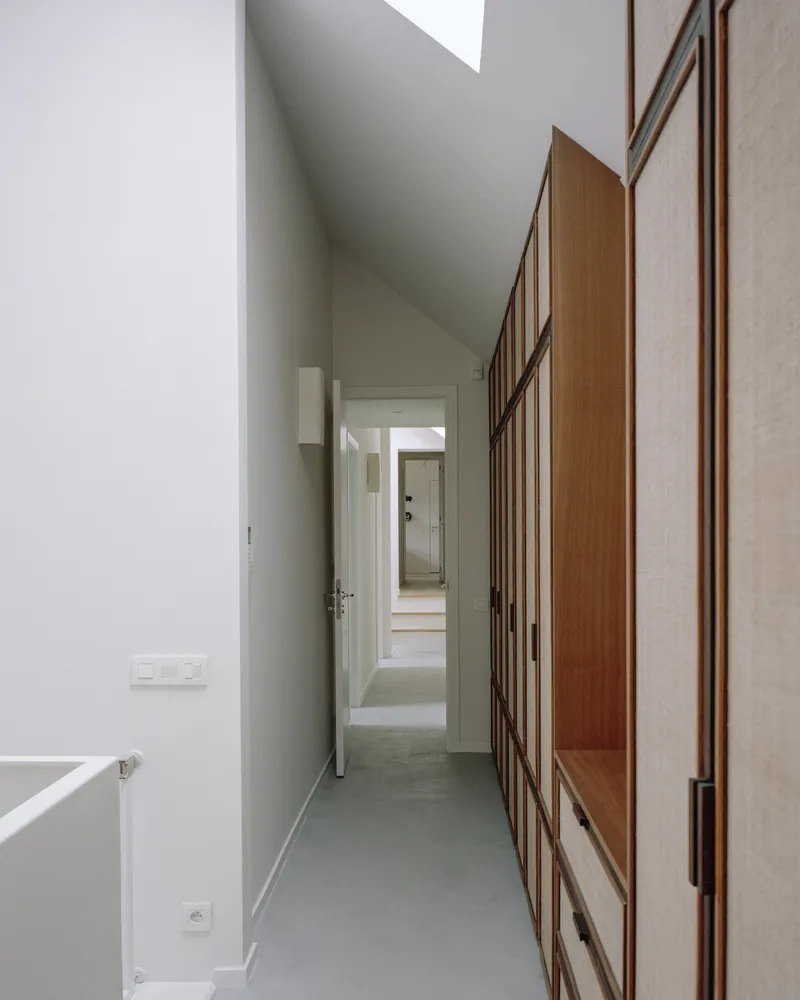
The curved timber shelving unit in the main living space is the project's signature interior gesture. It serves as both room divider and storage, guiding movement through the plan while framing a long view from the front of the house to the garden beyond. In the hallway, timber-framed storage units line the walls beneath a skylight, turning a typically dead circulation zone into something useful and well lit. The grey resin flooring throughout is tough and unfussy, an honest surface for a house built to be lived in hard.
Light from Above
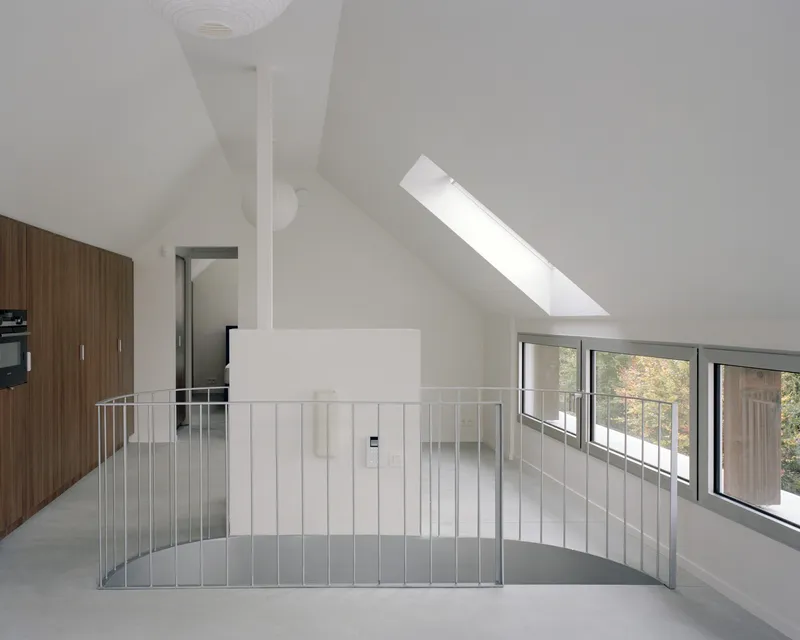
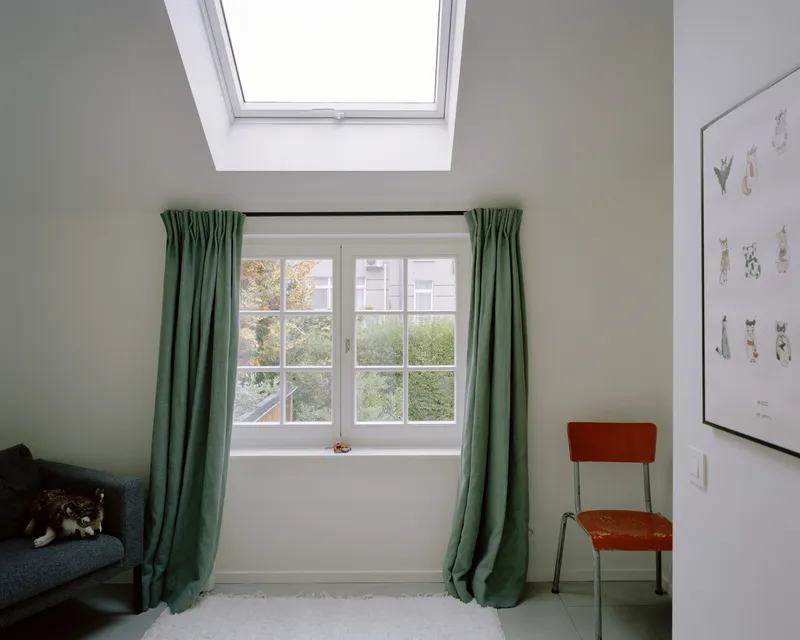
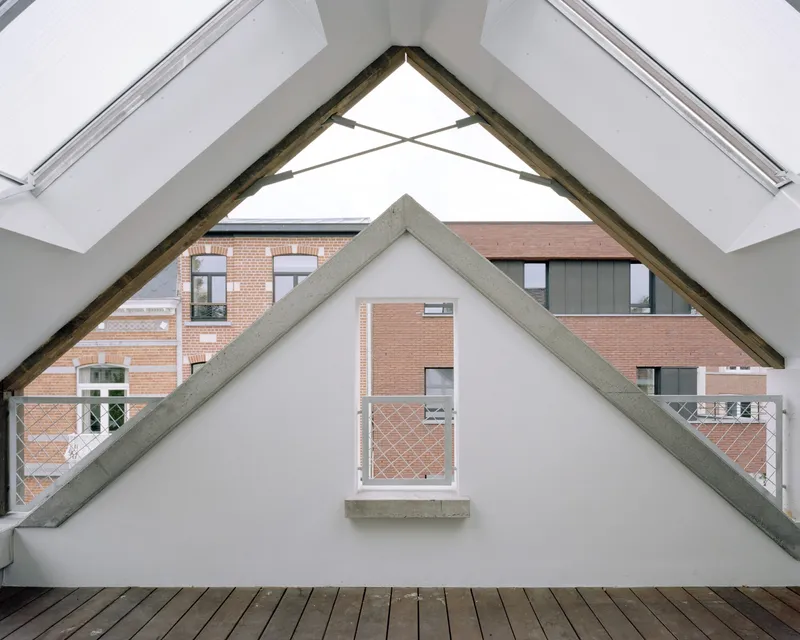
Skylights do serious work across the project. On the top floor, a sloped ceiling channels light down through a stairwell opening ringed by a metal railing, making a vertical connection that is spatial as much as functional. In the bedroom, a skylight sits directly above a white casement window framed by green curtains, layering two sources of daylight in a single composition.
The exposed timber roof truss framing a gable window overlooking the brick courtyard is perhaps the most evocative image of the project. It captures the dialogue between old structure and new intervention, the rawness of the timber against the precision of the white plaster, the depth of the domestic interior against the openness of the sky. These top-floor moments give the house its vertical identity and reward the climb.
Living on the Roof
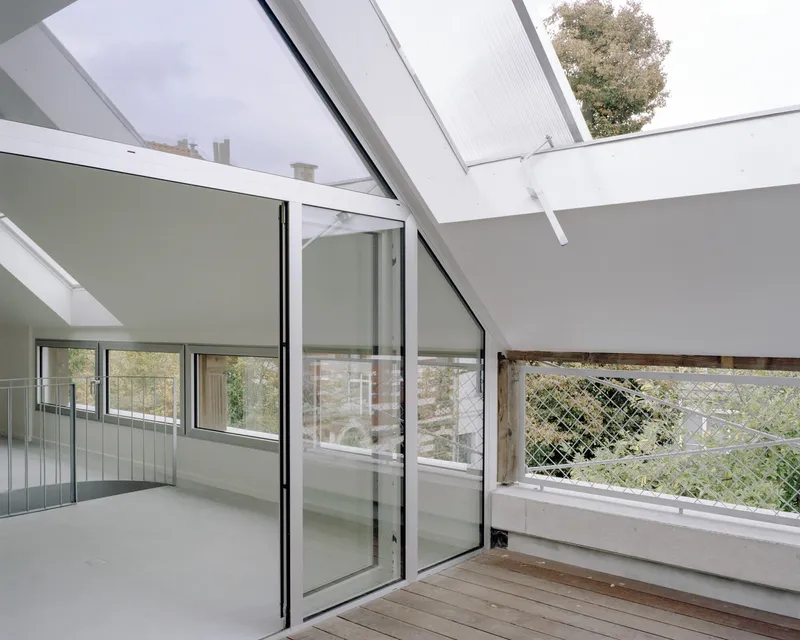
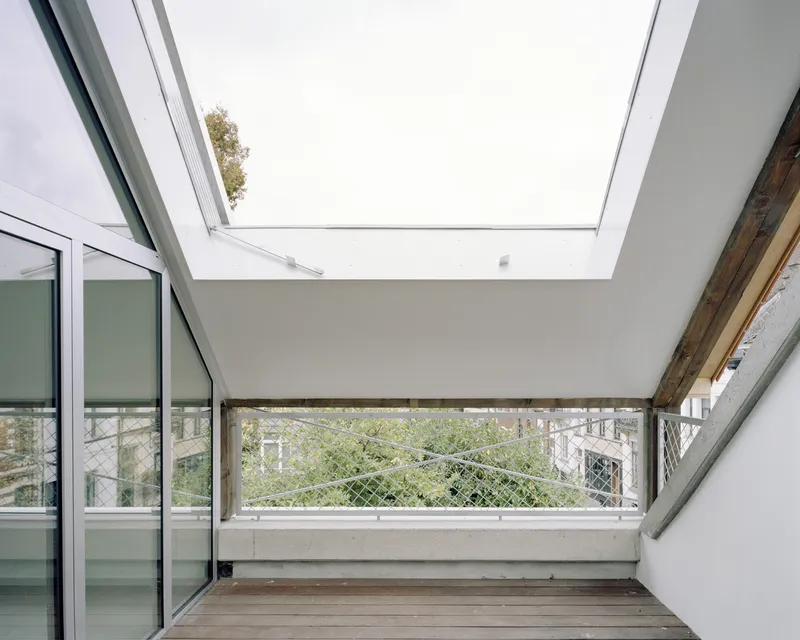
The roof terrace is treated as genuine living space rather than leftover area. Timber decking, glazed sliding doors, and a wire mesh balustrade create an outdoor room that overlooks the surrounding greenery of Watermael-Boitsfort. An open skylight above the terrace blurs the line between covered and uncovered, inviting the sky into the section of the house.
The wire mesh balustrade is a pragmatic choice that maintains transparency and keeps sightlines open. It also keeps the weight and visual mass of the rooftop addition to a minimum, a respectful gesture toward neighbors and toward the building's own proportions below.
Plans and Drawings
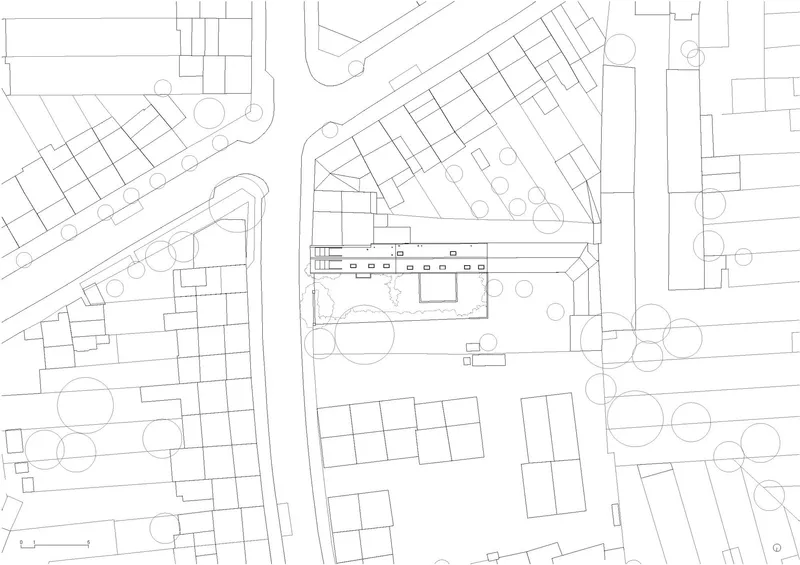
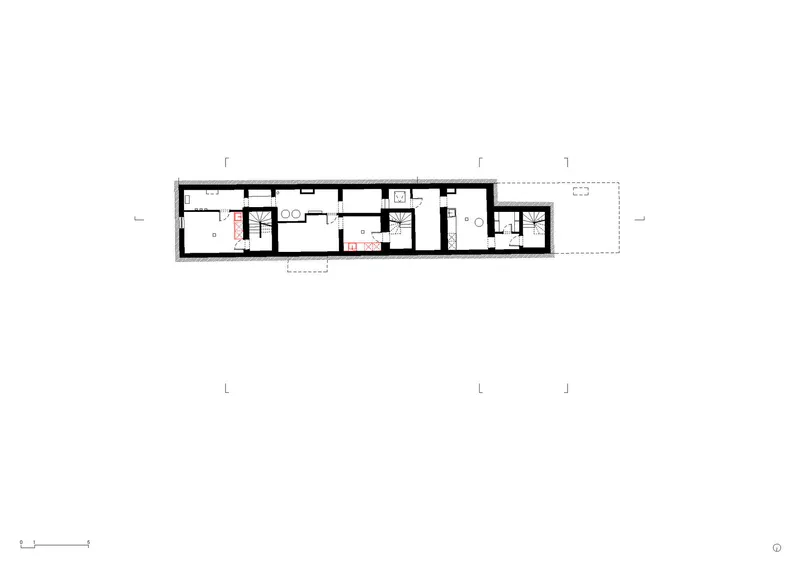
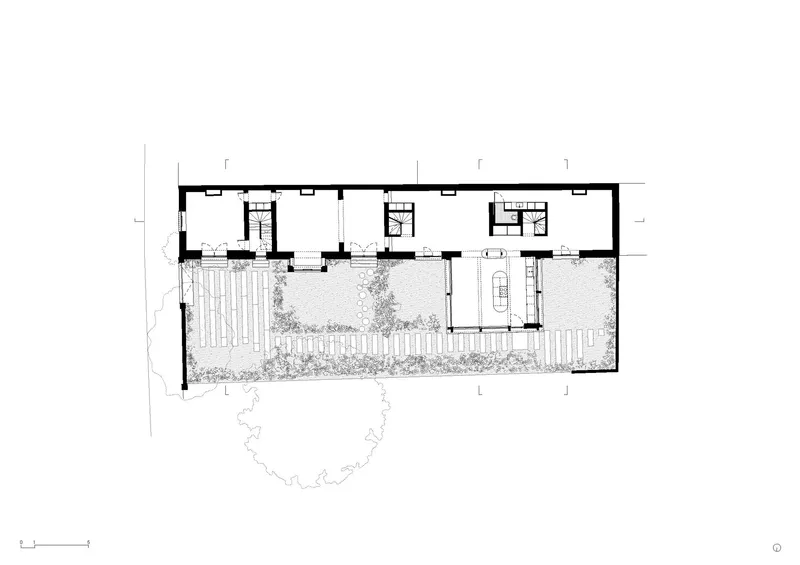
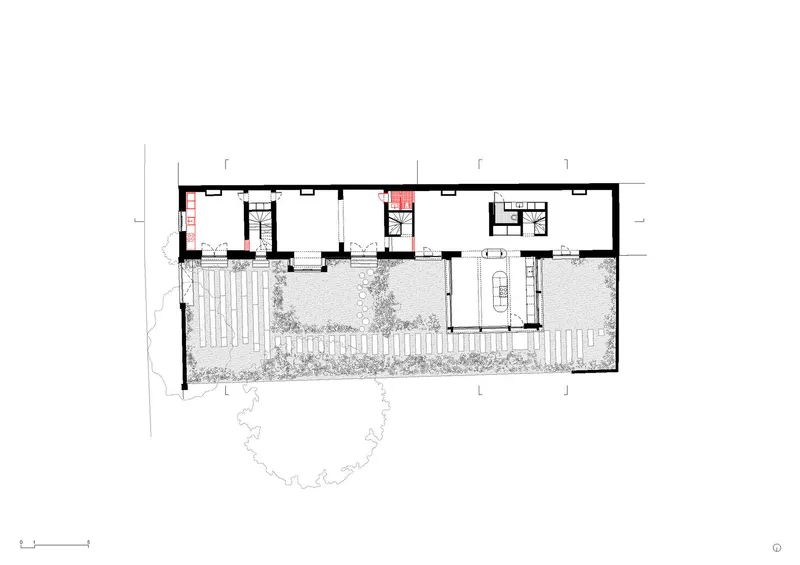
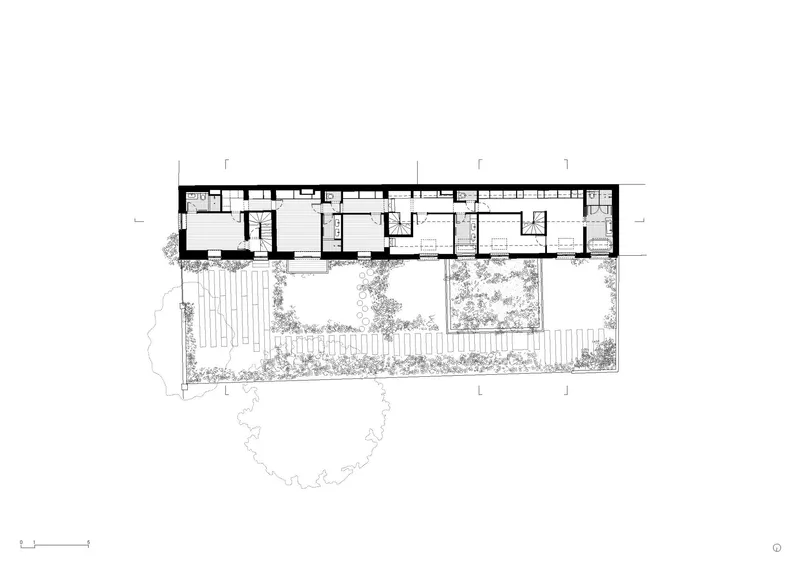
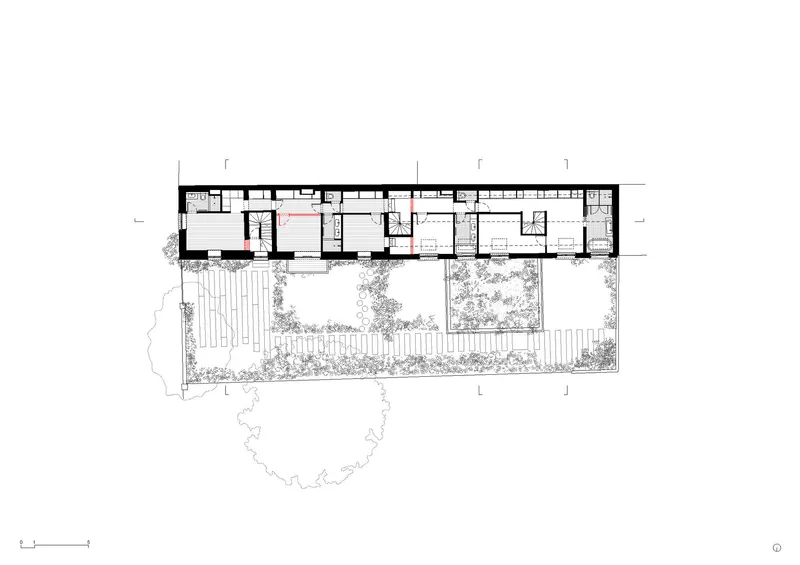
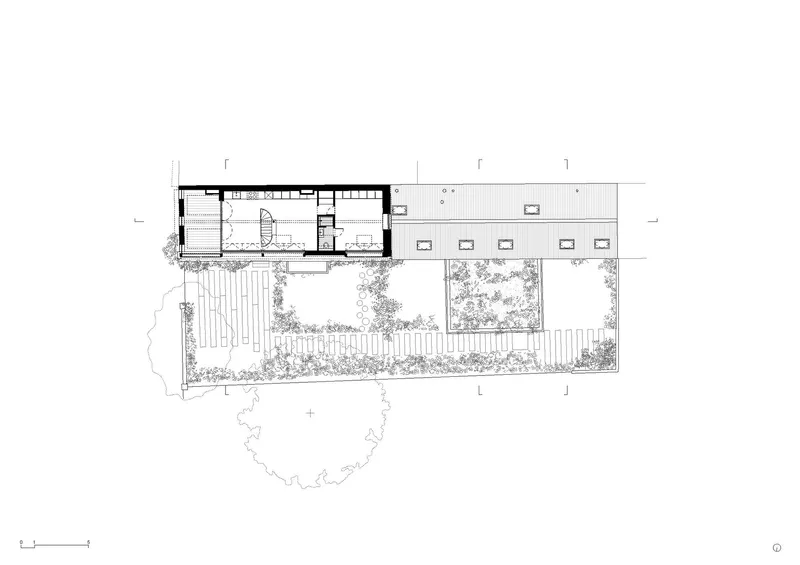
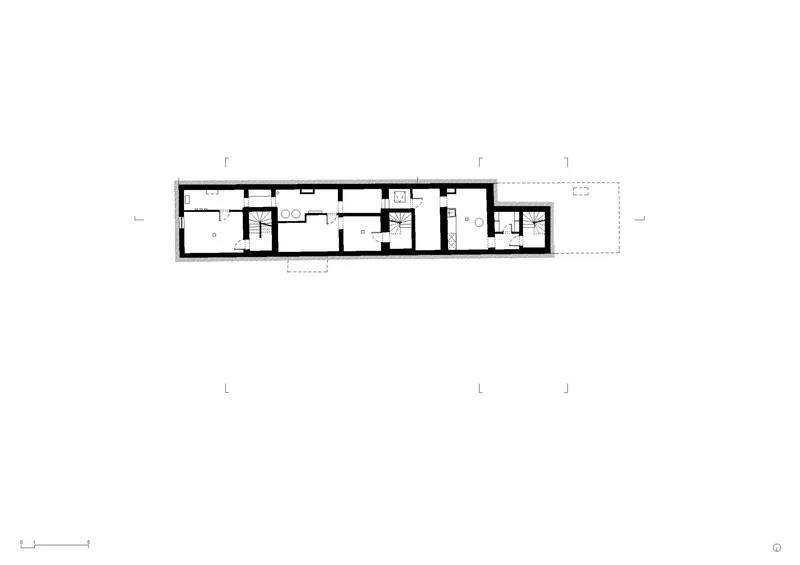
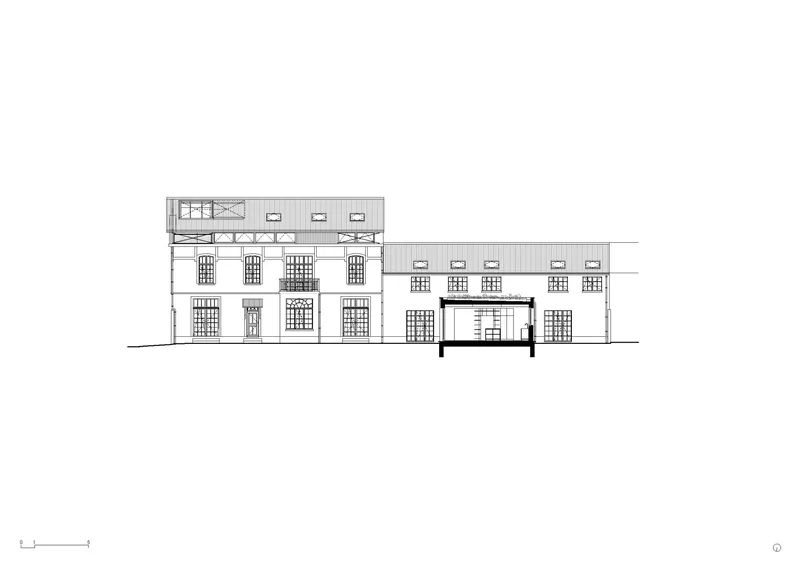
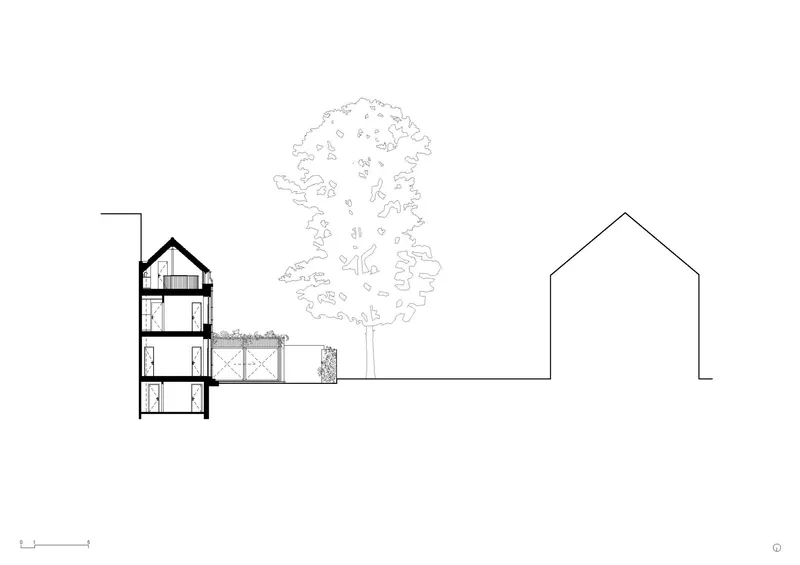
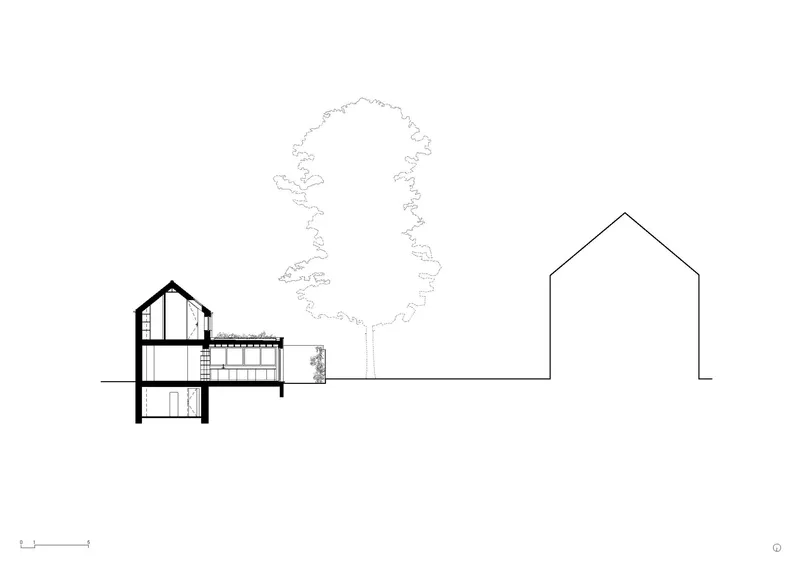
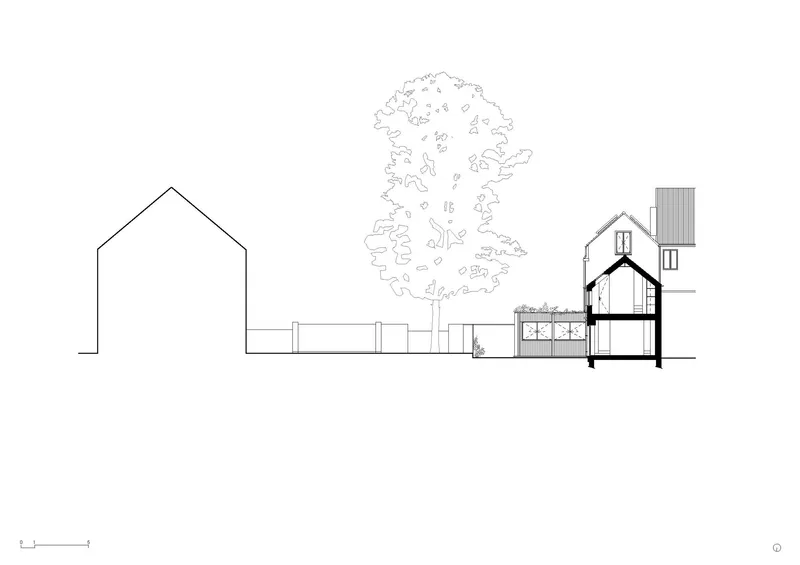
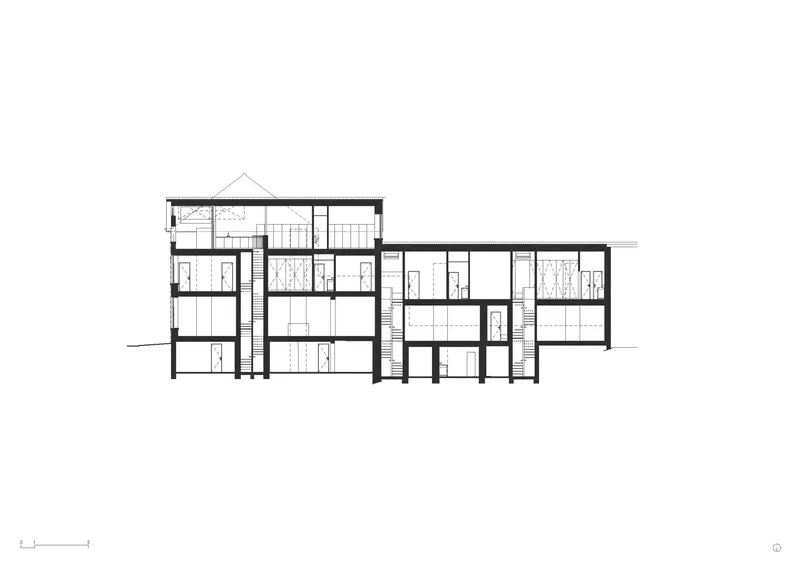
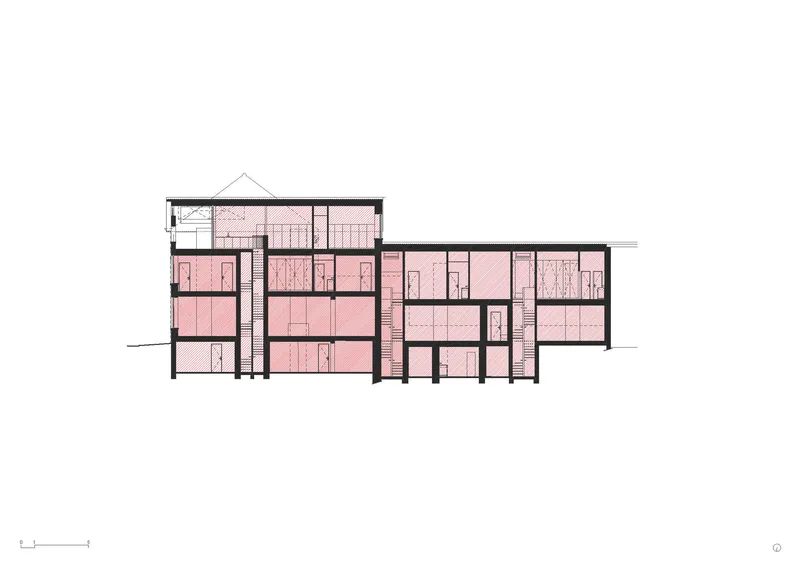
The site plan confirms what the photos suggest: the plot is an awkward triangle pinched between streets and neighboring buildings. The architects exploit this constraint by stretching the plan linearly and punctuating it with courtyard gardens that bring light and air into the center of the volume. Red circulation diagrams overlaid on several plans make the adaptability strategy legible. Vertical stair cores are positioned to allow future subdivision or recombination of units, giving the building the capacity to serve a single family, multiple households, or something in between.
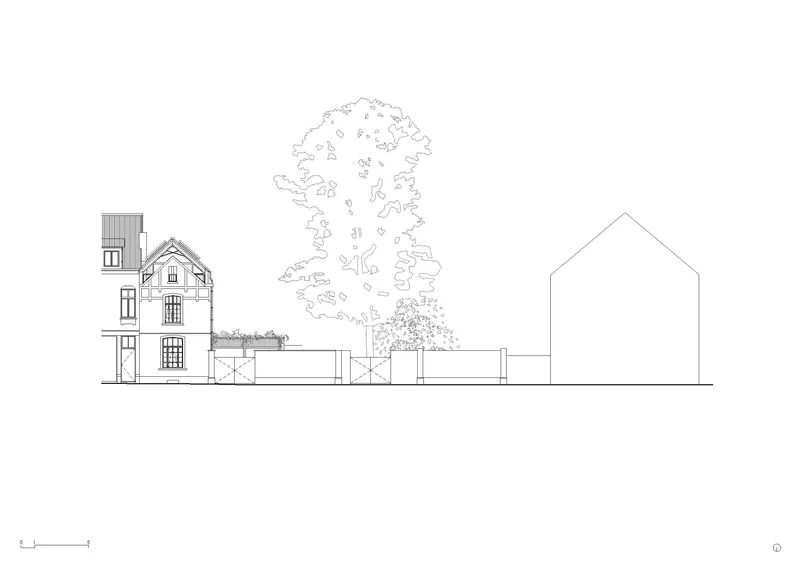
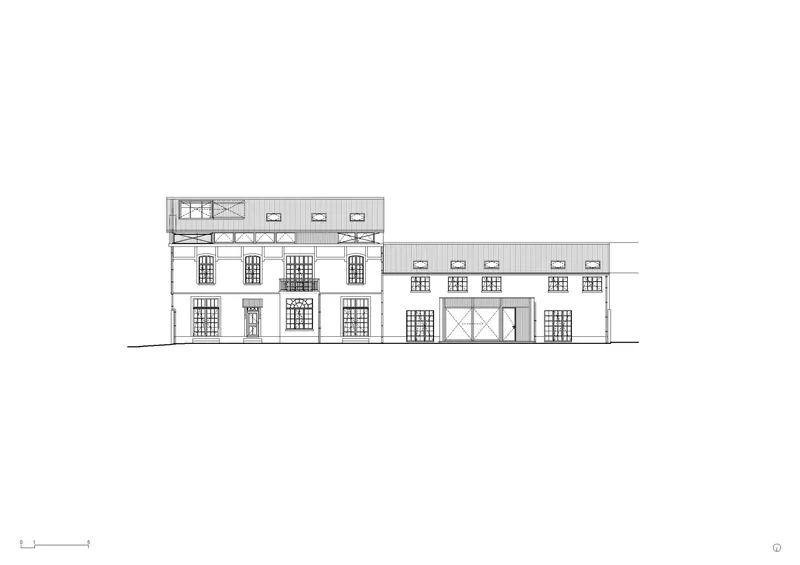
The sections are equally revealing. They show how the project negotiates significant level changes and nests rooms within the pitched roof volumes, stacking half-levels to extract maximum usable area from the envelope. The pink-infilled programmatic section lays out the logic most clearly: living zones, sleeping zones, and circulation are distributed across the full height of the building, connected by stairs that shift position from one dwelling to the next. The relationship to the large tree on site is maintained carefully, with the single-story extension stepping down to preserve the root zone.
Why This Project Matters
Crabe Fantôme matters because it refuses to treat housing as a fixed product. In a city where real estate pressure encourages maximum extraction from every plot, O.U.V.R.A.G.E.S has delivered a building that is spatially generous and temporally open. The adaptability here is not theoretical; it is built into the circulation, the structural grid, and the placement of wet rooms and stair cores. The house can change because its architects planned for change from the start.
It also matters as a demonstration of how to convert commercial buildings into housing without erasing the idiosyncrasies of the original structure. The restaurant's footprint, its relationship to the street, and its position within the block all survive in the new plan, transformed but not obliterated. In a European context where adaptive reuse is increasingly understood as an environmental imperative, this project offers a convincing model: modest in scale, precise in execution, and generous in the life it makes possible.
Crabe Fantôme, Evolutive Housing by O.U.V.R.A.G.E.S (Louis del Marmol, Dimitri Stassin). Watermael-Boitsfort, Belgium. 395 m². Completed 2025. Photography by Maxime Delvaux.
About the Studio
Share Your Own Work on uni.xyz
If projects like this are the kind of work you want to make, uni.xyz is a place to publish your own, find collaborators, and enter design competitions.


Popular Articles
Popular articles from the community


Aquadapt: An Underwater Habitat That Rewrites Its Rooms by the Hour
Curved modules ring the seabed while one shell shifts from breakfast room to cinema, farm and football pitch as residents' needs change.

Manzana Morphosis: Stretching Barcelona's Grid into a Living Landscape for 2050
A radical reworking of the Eixample manzana turns density into a tool for generous public space, vertical ecology, and environmental performance.


FCC Arquitectura Expands a Portuguese Granite House with a Board-Marked Concrete Wing
In Portugal, JV House pairs a cleaned-up whitewashed and granite dwelling with a timber-shuttered concrete extension, courtyards and a garden pool.

The Amber Palace Opera: A Geological Fiction Surfaces on Tallinn's Baltic Waterfront
Pierre Brillard reimagines a Baltic legend as a public landscape, opera house, and waterfront promenade rooted in Tallinn's coastal identity.

Similar Reads
You might also enjoy these articles

LAVA Architecten Gives Vocational Education a Sawtooth-Roofed Face on a Mechelen School Campus
In Mechelen, Belgium, a 2,053 m² STEM school on a 6×6 m grid turns workshops and classrooms into rooms that can be rearranged as teaching changes.

KEMA Studio Turns a Derelict Marvila Attic into a 60 m² Lighthouse Apartment Above Lisbon
In Lisbon's Marvila district, a rebuilt roof, four skylights and two plywood volumes turn an unlivable attic into a bright home facing the Tagus.

Pixel Gardens: One Repeated Module Stacked Into a Terraced Social Housing Tower for Famagusta
Salem Bader's shortlisted housing tower builds a vertical neighbourhood from one repeated module, offsetting units to carve terraces, light and air.

Bao Huynh Watercolor Atelier: A Serene Art Retreat in Hội An
Bao Huynh Watercolor Atelier in Hội An blends multifunctional art spaces, sustainable design, local materials, and family-friendly living in a serene environment.

Explore Slumscraper Competitions
Discover active competitions in this discipline

Challenge to design luxury tourism on rails

VR headsets Storefront design competition

Designing a staircase for a client
Comments (0)
Please login or sign up to add comments
No comments yet. Be the first to comment!