
2P Architectes Wraps Europe's Largest Indoor Arena in 592 Luminous Aluminum Scales at La Défense
Paris La Défense Arena in Nanterre fuses a 30,000-seat rugby stadium, concert hall, and office complex under one colossal roof.


A rugby stadium that moonlights as a 45,000-capacity concert venue and houses 33,000 square meters of office space: the Paris La Défense Arena is not a building that plays it safe. Designed by 2P Architectes & Associés and completed in 2017, the arena sits at the foot of the Grande Arche in Nanterre, embedded in the dense urban grid of the Seine-Arche redevelopment zone. It replaced the historic Stade Olympique Yves-du-Manoir as the home of Racing 92, but calling it a replacement undersells the ambition by a factor of ten.
What makes the project genuinely interesting is not its size, though the numbers are staggering. It is the decision, made during the design phase itself, to abandon the pure stadium typology and instead produce a hybrid that could flip between a horseshoe-shaped rugby pitch and a fully enclosed theater in roughly eleven hours. That pivot transformed the structural logic, the envelope, the program, and ultimately the urban role of the building. Twenty-seven firms were invited to a closed tender in 2010. Christian de Portzamparc won in 2011, and the resulting architecture treats flexibility not as a marketing bullet point but as the organizing principle of every system in the building.
A Facade of 645 Concrete Shells and 592 Glass Scales
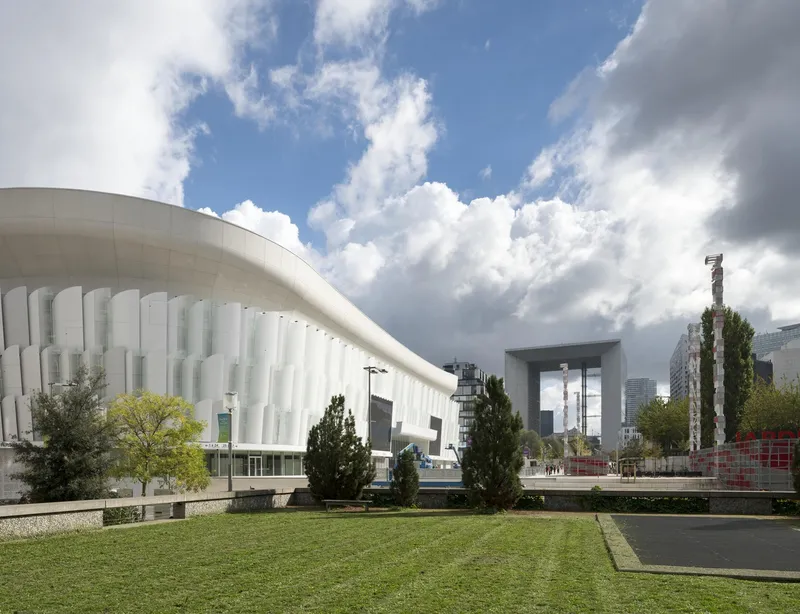
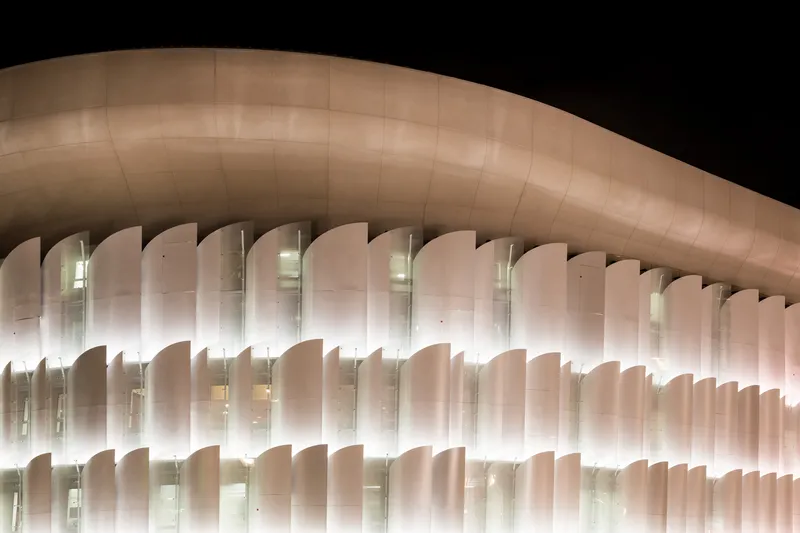
The envelope is one of the most technically complex cladding systems built in the last decade. Beneath the organic, whale-like profile lies a prefabricated concrete facade composed of 645 individual shells: 368 flat, 193 cylindrical, 47 toric, 42 conical, 16 developable, and a handful of composite and singular geometries. Overlaying this concrete substrate are 592 giant aluminum and glass scales, each formed from white and gray aluminum panels and lightly serigraphed glass. The result reads as a single continuous surface, but it is actually a double skin with enormous tectonic variety hidden in plain sight.
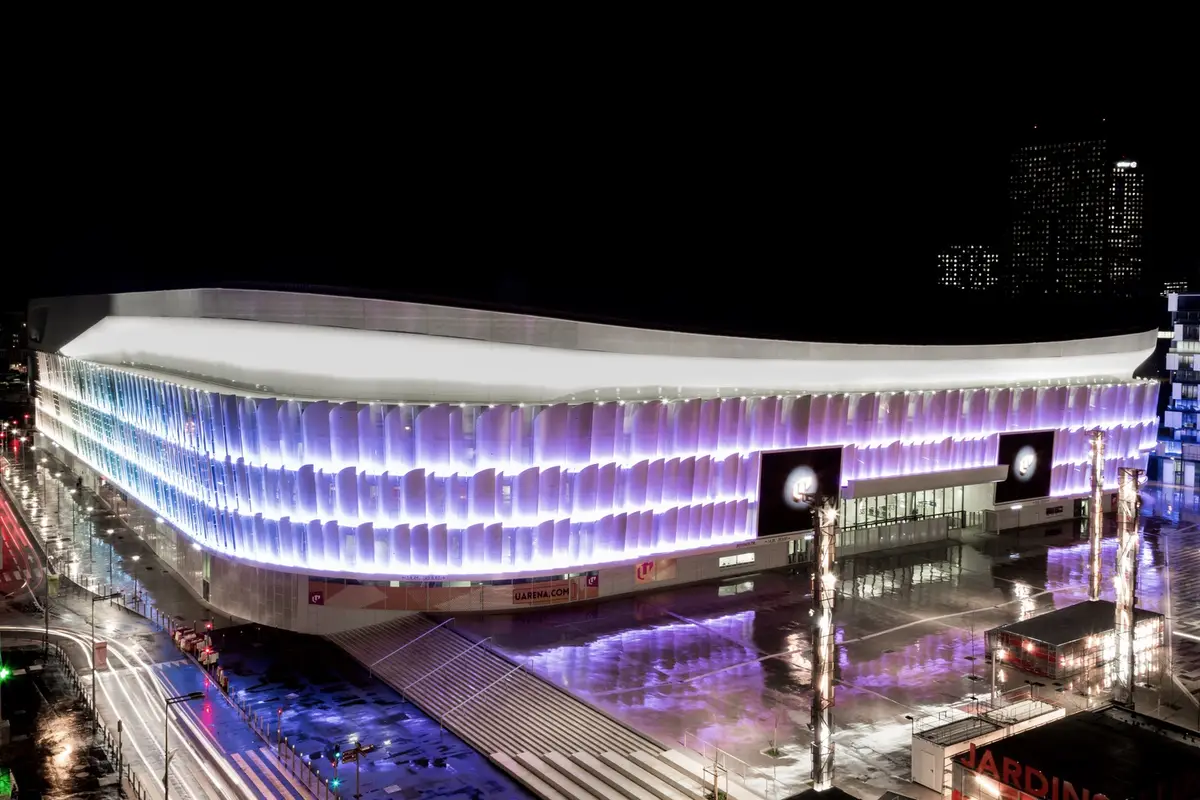
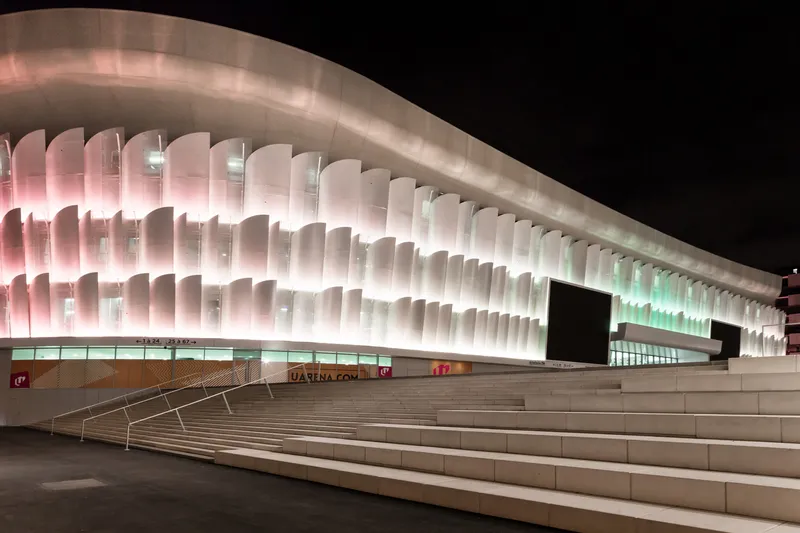
During the day, the scales diffuse sunlight into the lobbies and dressing rooms behind them, turning the facade into a translucent lantern from within. At night, 3,000 LED strips embedded behind the scales allow the building to shift color across its entire surface, a capability that turns the arena into a billboard-scale urban signal visible from the La Défense axis. The vertical fin rhythm reads differently depending on your angle of approach, oscillating between opacity and transparency.
The Nighttime Transformation
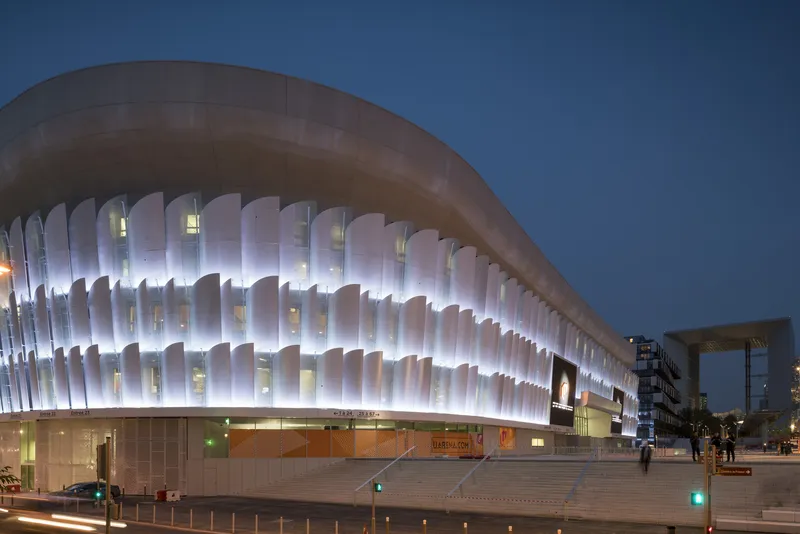
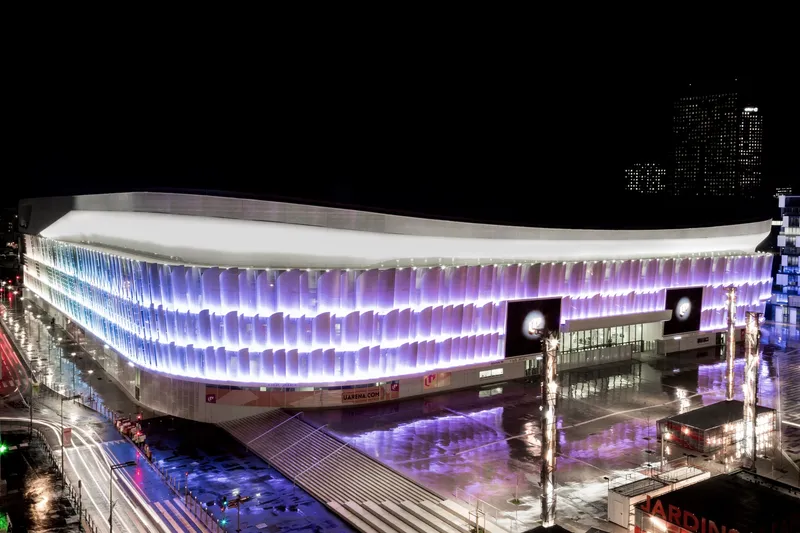
If the daytime facade is restrained, the night version is spectacle. Purple, blue, magenta, and white wash across the louvered panels, and the curvature of the roof line amplifies the effect, making the building appear to glow from within rather than to be lit from without. The broad staircase at the main entrance becomes a kind of urban stage, drawing pedestrians upward toward the light.
There is a risk with programmable LED facades: they can make a building look like a trade-show booth. Here, the materiality of the aluminum and glass scales provides enough texture and depth that the lighting reads as atmosphere rather than advertising. The wet streets in front of the arena on a rainy evening double the effect, turning the surrounding urban ground plane into a reflective pool.
A 6,100-Ton Roof Lifted in Twelve Hours
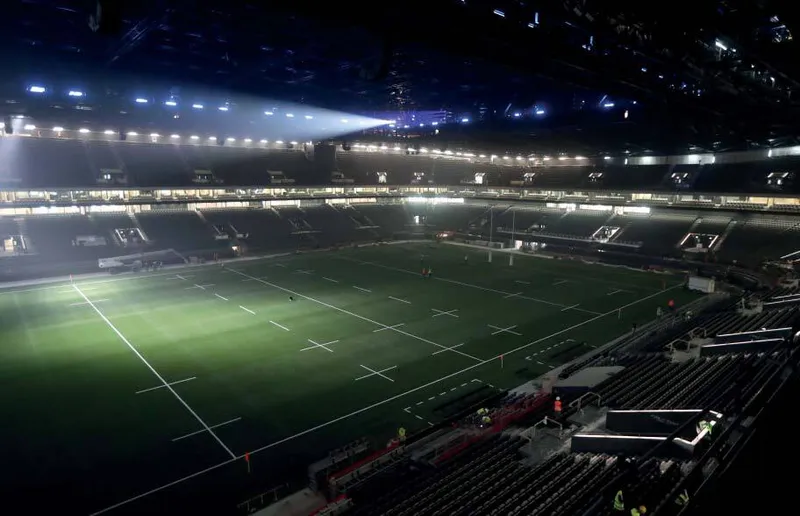
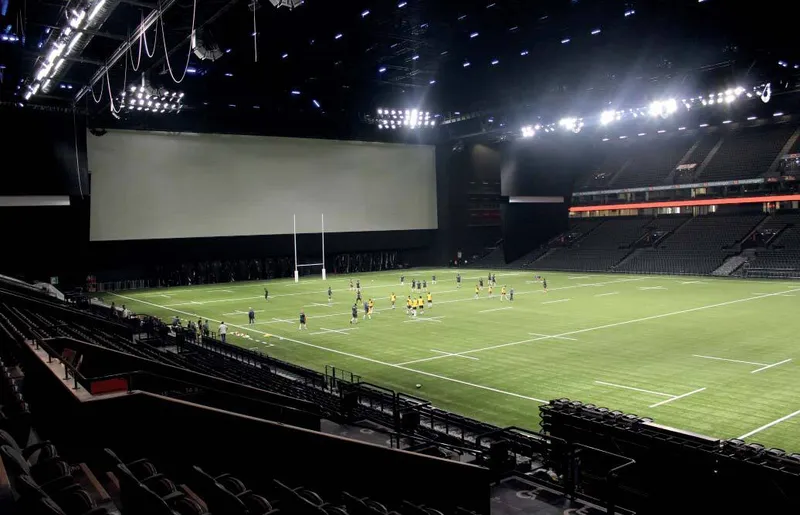
The roof is the structural headline. Four mega girders, the largest weighing 1,200 tons, form a span of 150 by 110 meters at a height of 40 meters. The entire steel mesh structure, weighing around 6,000 tonnes, was prefabricated on the ground and then hoisted into position in a single twelve-hour lifting operation using twelve H400 strand jacks, each rated at 400 tonnes of capacity, roughly three times the actual load. That operation alone speaks to the engineering ambition of the project.
From inside the bowl, the roof reads as an exposed lattice of steel, 14 meters thick, hovering above the seating tiers. It creates a sense of epic enclosure without the oppressive weight that a solid ceiling would produce. The double-skin curved acoustic roofing system beneath the steel mesh controls sound propagation, a critical factor given that the arena must perform acoustically for both a roaring rugby crowd and amplified concert sound.
The Horseshoe Bowl and Its Moveable Wall
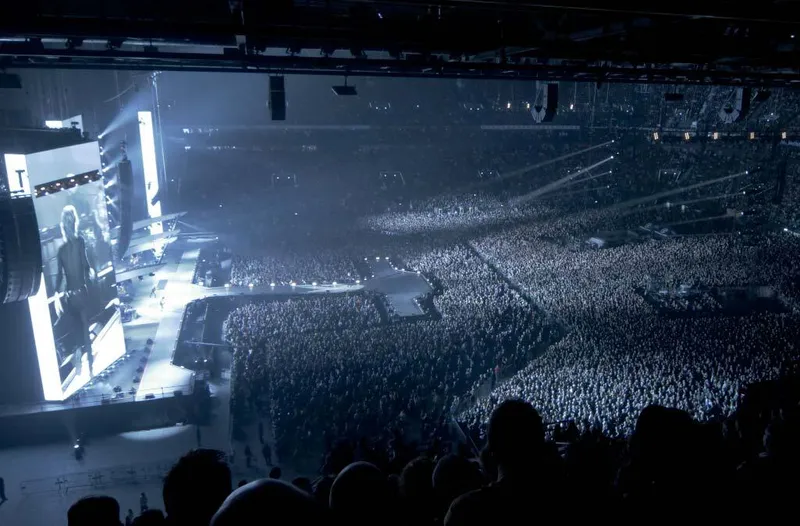
The arena adopts a U-shaped layout. One side of the horseshoe is formed by an office building housing the Hauts-de-Seine County Council, effectively integrating 31,000 square meters of workplace into the stadium's architectural mass. The moveable back wall, where the concert stage mounts, is the hinge of the entire program. Slide it one way and you have a 30,681-seat rugby configuration with a synthetic turf pitch. Cover the field with slabs, reconfigure the moveable stand, and you have a concert hall that, following a 2024 upgrade, can hold up to 45,000.
The eleven-hour changeover is logistically impressive but also architecturally consequential. It means the seating geometry, the sightline calculations, the air circulation strategy, and the acoustic tuning all had to be designed for two fundamentally different spatial conditions. The 13 kilometers of terraced white concrete seating, the 1,400-square-meter screen, and the 16 entrances are all calibrated to serve both modes without compromise.
Urban Insertion at the Foot of the Grande Arche
Siting a 117,000-square-meter arena in a dense urban neighborhood demands more than a good plan. The building occupies the rectangle formed by the new neighborhood's road grid, set at the intersection of four main road axes. Its main entrance aligns with the core axis of La Défense, linking it visually to the procession of towers and plazas that define the district. The organic contours soften what could have been a brutally scaled box, giving the building a profile that registers as landscape as much as architecture.
Beneath the seating tiers, the architects carved out reception areas, dressing rooms, and refreshment spaces that receive natural light from the street level. The mixed-use program, including 300 student rooms, shops, a brewery, and a gourmet restaurant, ensures the building animates its surroundings on non-event days. It is, in effect, a piece of city rather than an island of spectacle.
Why This Project Matters
The Paris La Défense Arena demonstrates that the large-venue typology does not have to be a single-purpose shed surrounded by parking. By embedding offices, housing, retail, and public space into the mass of the stadium itself, 2P Architectes challenged the assumption that arenas are dead zones between events. The horseshoe plan, the moveable wall, and the eleven-hour changeover protocol are not gimmicks; they are the logical consequences of designing a building that refuses to sit idle.
At the level of construction, the project pushed prefabrication, cladding geometry, and structural lifting techniques to extremes that few European projects have matched since. The 645 uniquely shaped concrete shells and the single-lift roof installation are engineering achievements that serve the architecture rather than undermining it. In a district defined by corporate towers and monumental gestures, the Arena holds its own by being genuinely complex rather than merely large.
Paris La Défense Arena by 2P Architectes & Associés. Located in Nanterre, France. 117,000 m². Completed in 2017. Photographed by Nicolas Borel.
About the Studio
Share Your Own Work on uni.xyz
If projects like this are the kind of work you want to make, uni.xyz is a place to publish your own, find collaborators, and enter design competitions.


Popular Articles
Popular articles from the community


Lunar Spiral: Space Architecture Shaped by the Mathematics of the Universe
Lunar Spiral reimagines space architecture through Fibonacci geometry, lunar regolith, levitating habitats, and self-sustaining Moon living.

Conexión: Biophilic Design Reimagines High-Rise Living in Hong Kong
Conexión reimagines high-rise living in Hong Kong through biophilic design, green facades, shared spaces, daylight, water and nature within.

Co-Life: Senior Housing Design That Reconnects Older Adults With the City
Co-Life reimagines senior housing design through healing gardens, shared streets, workshops, and a sustainable community across generations.

The Ocean Hive: Sustainable Architecture for a Self-Sufficient Civilization at Sea
The Ocean Hive imagines sustainable architecture at sea, where modular habitats, algae, wave power and ocean waste sustain a growing colony.

Similar Reads
You might also enjoy these articles


Hodi-Mandai Geram
Project Function: Preservation and revitalization of the Intangible heritage and socio-spatial identity of the Hodi by Housing, Cultural Memory Center, Sacred Grove, landscape, local tourism economy


Olio Towers: A Mid-Rise for Performers That Fuses Housing, Rehearsal, and Stage
Located blocks from Houston's Theater District, this modular tower stacks living units around a central performance atrium.

Oasis: Modular Green Housing Carved into Dhaka's Urban Fabric
A shortlisted Plugin Housing entry reclaims unauthorized settlements in Dhaka with stepped concrete volumes, green roofs, and ventilation-driven design.

Black Hole: A Floating Megastructure for the Post-Physical Era
Emiliano Mazzarotto envisions a spherical, self-scaling arena where e-sports, digital hotels, and holographic stadiums replace traditional public space.

Explore Sports Architecture Competitions
Discover active competitions in this discipline

Challenge to design a barrier free sports center

Challenge to design an outdoor ice-rink and park

Challenge to reimagine the Iron Throne

Photograph architecture without architects
Comments (0)
Please login or sign up to add comments
No comments yet. Be the first to comment!