
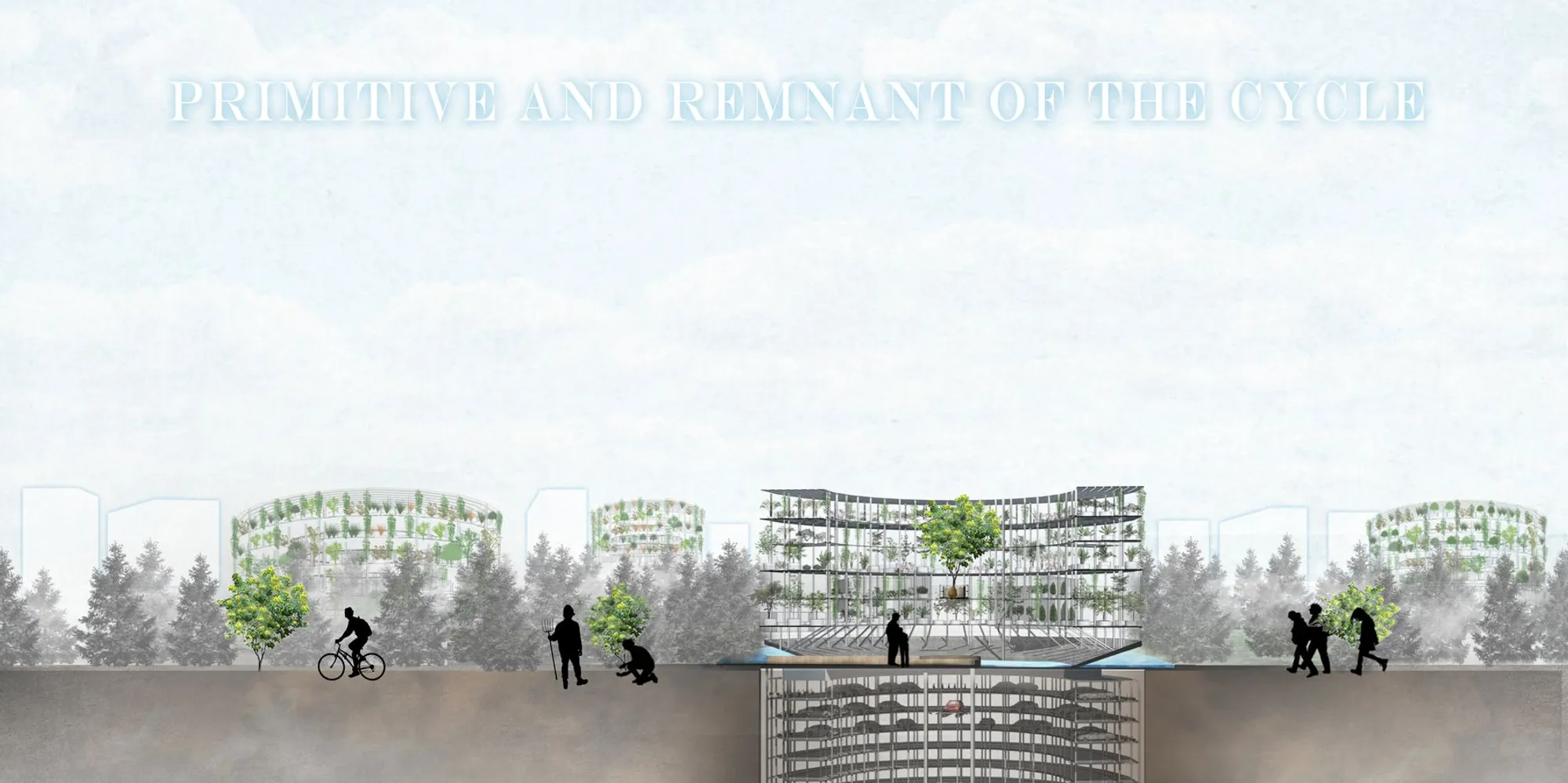
Primitive and Remnant of the Cycle: Rethinking Burial as Urban Forestry
A vertical tree nursery replaces tombstones with living memory, composting the departed and planting them across the city as public green infrastructure.


What if the dead could reforest a city? That question sits at the center of Primitive and Remnant of the Cycle, a proposal that dissolves the boundary between cemetery and public park by replacing coffins with biodegradable pods, each one planted with a tree. The deceased decompose, nourish the sapling, and eventually that tree is relocated to a roadside, a park, or a plaza, embedding remembrance into the everyday landscape. It is burial recast as civic infrastructure.
Designed by Annie Kwan, the project was shortlisted in the Circle of Life competition. Drawing on the Capsula Mundi burial method developed by Anna Citelli and Raoul Bretzel, Kwan proposes a vertical cylindrical building that functions simultaneously as tree nursery, farewell space, and mechanical composting structure. Juror Manuel Herrera, Partner and Architect at Taller Diez 05, praised the concept for its emotional strength: "Simple but strong idea… there are great spaces."
A Diamond Plan with a Circular Heart
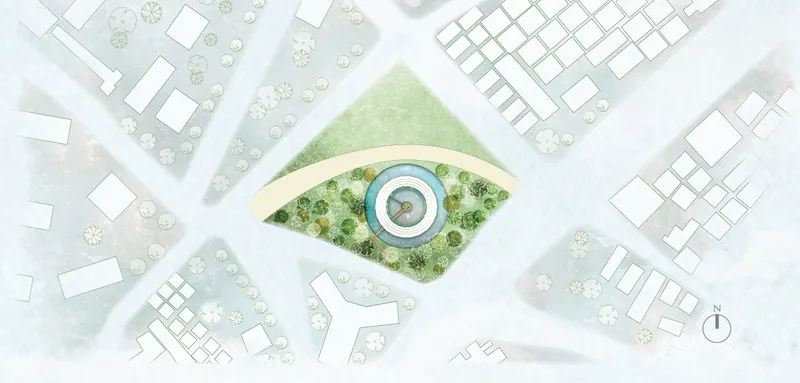
The site plan reveals a diamond-shaped footprint organized around a central circular courtyard and reflecting pool, ringed by trees. That geometry is deliberate: the southern end of the site is densely forested to create a sheltered zone for private ceremonial moments, while the northern section opens toward the city, inviting public access through a shortcut pathway that integrates the park into daily pedestrian movement. The separation between grief and everyday life is spatial, not absolute.
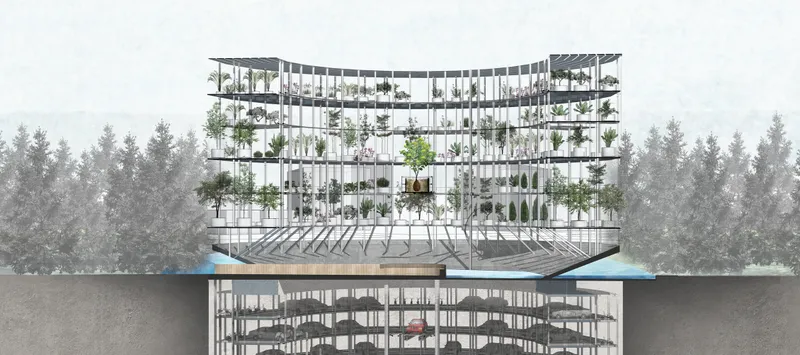
In section, the building's logic becomes clearer. Planted terraces rise above ground, stacking living canopy into a vertical nursery, while parking levels and tree pod storage occupy the subterranean levels. By layering vehicle infrastructure and composting chambers underground, Kwan reclaims the entire surface as usable park space, a critical strategy for dense cities with shrinking burial land. The section reads less like a mausoleum and more like a productive landscape turned on its side.
Mist, Water, and the Architecture of Farewell
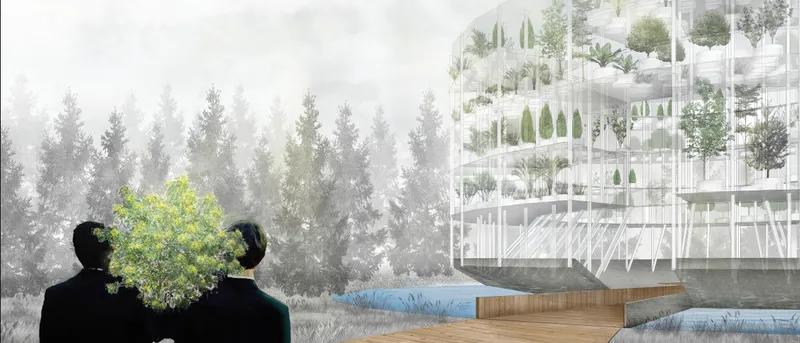
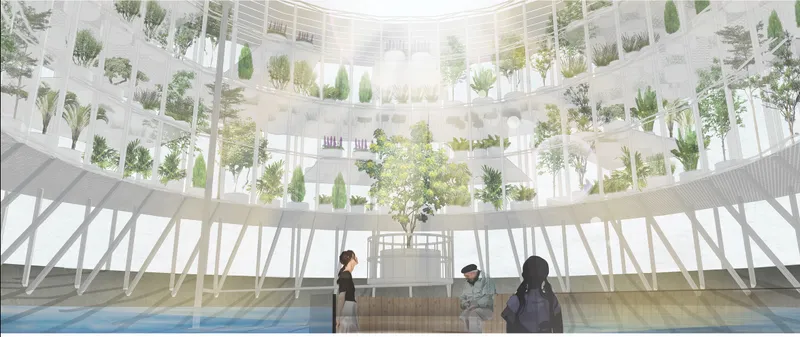
Two renderings capture the experiential quality Kwan is after. From outside, the building appears as a planted structural frame hovering beyond a reflecting pool, its mass softened by mist. Two figures stand at the water's edge in a moment that feels both intimate and monumental. The atmosphere is deliberately quiet, neither sterile nor mournful, just still. It is a farewell space that borrows its emotional register from landscape rather than from stone.
Inside, the cylindrical atrium opens vertically through planted terraces held by diagonal structural bracing. Looking upward, the view telescopes through layers of green and light. This is where the automated lift system operates, lowering tree pods containing the organic burial capsule as families watch their loved one begin the journey back into the earth. The architecture frames that descent not as loss but as transformation, a spatial sequence designed around the understanding that mourning is cyclical rather than linear.
From Burial Pod to City Tree
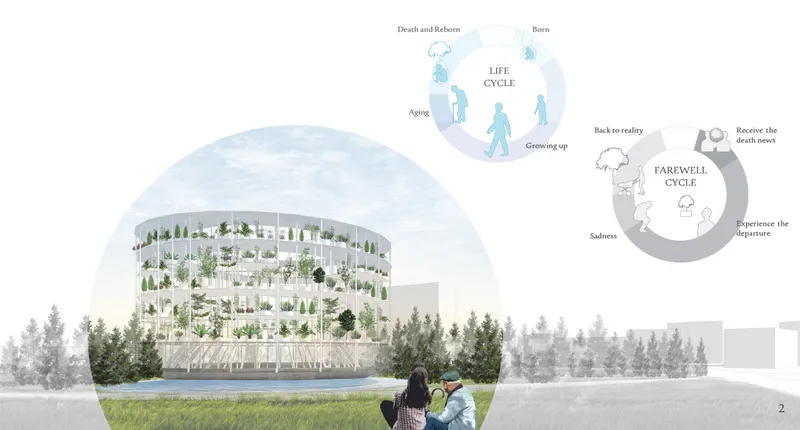
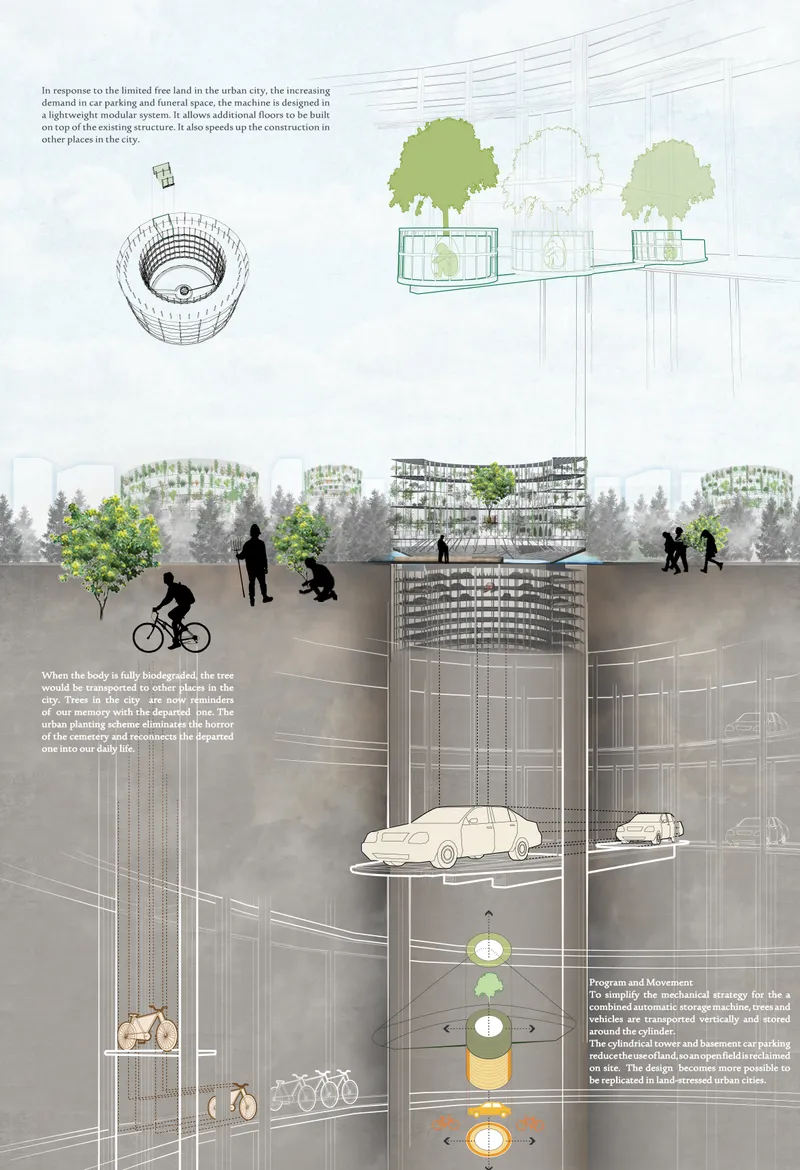
The elevation rendering situates the cylindrical building in its urban context, topped by conceptual diagrams that map the life and farewell cycles. Above the architecture floats the thesis: every body returns to its primitive state, and architecture should acknowledge that return rather than fight it. The building is modular and replicable, designed to be adapted to various urban locations as a scalable solution for sustainable end-of-life infrastructure.
The composite diagram at the bottom of the sequence illustrates the full lifecycle. Underground parking levels eventually transform as tree pods mature and are relocated to public spaces across the city: parks, roadsides, plazas. People cycle past at ground level, oblivious to the composting process below, encountering only the result: a growing urban forest. Kwan's scheme eliminates what she calls "the horror of the cemetery" by dispersing memory into the living landscape. There is no single plot to visit; instead, the entire city becomes the memorial.
Why This Project Matters
Most cemetery proposals operate within a familiar tension: how to honor the dead without consuming land the living desperately need. Kwan sidesteps that tension entirely by proposing a system where burial actively produces urban green infrastructure. The dead don't occupy space; they generate it. That reframing, from consumption to contribution, is the project's most radical move, and it positions end-of-life architecture within urgent conversations about urban ecology, biodiversity, and the scarcity of land in dense cities.
The structural and mechanical details remain, as Herrera noted, somewhat unresolved. How exactly the automated lift system operates at scale, how tree relocation is managed logistically, how the modular cylinder adapts to wildly different urban fabrics: these are questions that a next iteration would need to answer with precision. But the conceptual clarity is powerful. By preserving intangible legacies (memories, values, emotions) rather than physical remains, Primitive and Remnant of the Cycle argues that the most meaningful monument is not a stone but a living thing, growing taller each year in a park you walk through on your way to work.
View the Full Project
About the Designers
Designer: Annie Kwan
Enter a Design Competition on uni.xyz
uni.xyz runs architecture and design competitions year-round that reward proposals with spatial conviction and real site intelligence.
Project credits: Primitive and Remnant of the Cycle by Annie Kwan Circle of Life (uni.xyz).



Popular Articles
Popular articles from the community


Co-Life: Senior Housing Design That Reconnects Older Adults With the City
Co-Life reimagines senior housing design through healing gardens, shared streets, workshops, and a sustainable community across generations.

The Musturak Paradise: Senior Living Architecture for a Connected Future in Temara, Morocco
The Musturak Paradise reimagines senior living architecture in Temara via private homes, social spaces, culture, community, and shared care.

Play: Fragments of Their World
Familiar architecture becomes modular playground design, creating safe spaces where displaced children can learn, connect, imagine and play.

The Ocean Hive: Sustainable Architecture for a Self-Sufficient Civilization at Sea
The Ocean Hive imagines sustainable architecture at sea, where modular habitats, algae, wave power and ocean waste sustain a growing colony.


Similar Reads
You might also enjoy these articles

Bao Huynh Watercolor Atelier: A Serene Art Retreat in Hội An
Bao Huynh Watercolor Atelier in Hội An blends multifunctional art spaces, sustainable design, local materials, and family-friendly living in a serene environment.

Atelier Macri Concept Store Interior Design by CASE-REAL
Atelier Macri store features a "ko" counter, walnut wood details, cork displays, blending retail, gallery, and seamless customer experiences.

Manuel Vargas Izquierdo Stadium and High-Performance Sports Center: Architectural Excellence in Jalpa de Méndez
The Manuel Vargas Izquierdo Stadium blends sustainable design, inclusive sports facilities, and cultural-inspired architecture, revitalizing Jalpa de Méndez’s public spaces.

KAKR Buluh Awar Hall: Revitalizing Community and Ecology Through Bamboo Architecture
Community built bamboo hall revitalizes Buluh Awar village, empowering youth, restoring ecology, celebrating vernacular craftsmanship through sustainable architecture and culture.

Comments (0)
Please login or sign up to add comments
No comments yet. Be the first to comment!