

Puerta Costanera Building by Turner Arquitectos: Urban Landmark in Santiago’s Mixed-Use Transformation
Puerta Costanera by Turner Arquitectos blends exposed concrete, ventilated façades, and open commercial spaces to connect parks in Santiago.


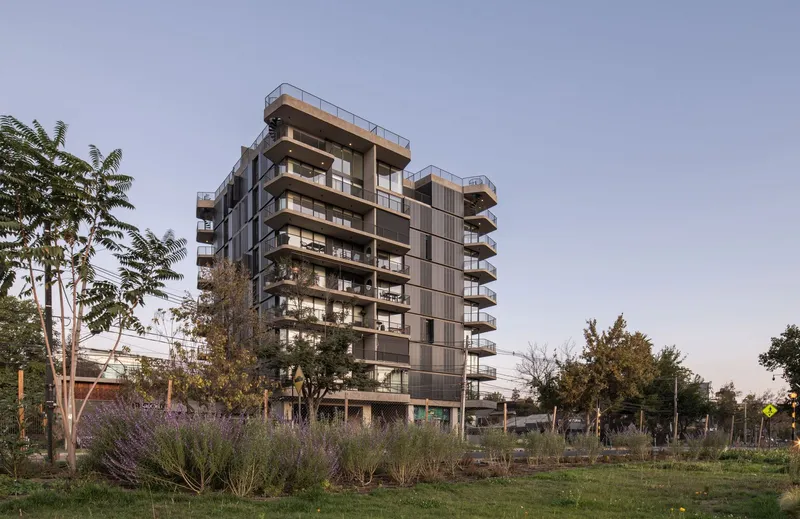
Located at the intersection of Nueva Costanera Avenue and Américo Vespucio in Santiago, Chile, the Puerta Costanera Building by Turner Arquitectos stands as the first phase of an ambitious mixed-use development that seeks to redefine the urban connection between Américo Vespucio Park and Bicentenario Park. This 8,678 m² residential and commercial project is more than a single architectural volume—it is the beginning of a revitalized urban corridor that blends functionality, scale, and civic engagement.
A Gateway Between Parks: Reimagining the Public Realm
Strategically positioned at a junction that links two of Santiago’s most prominent green spaces, the Puerta Costanera Building introduces a new model for mixed-use developments. The design emphasizes urban integration and public connectivity, serving as a transitional gateway between natural and built environments. The ground floor and commercial basement operate as the project’s “first commercial floor”, intentionally conceived as an open, pedestrian-friendly plinth. This accessible base enhances the street-level experience for residents, visitors, and shoppers alike, forging a seamless connection to the public realm.
A Compositional Strategy: Base, Body, and Top
Turner Arquitectos organized the building around a three-part vertical composition—base, body, and top—each addressing distinct urban scales and functional demands:
1. The Base
The base features a fully open plinth composed of a ground floor and commercial basement. Facing outward to the surrounding sidewalks, this transparent zone activates the streetscape, encouraging interaction and permeability. Its design fosters a welcoming atmosphere for pedestrians, commercial users, and building residents, while setting the tone for the development’s public character.
2. The Body
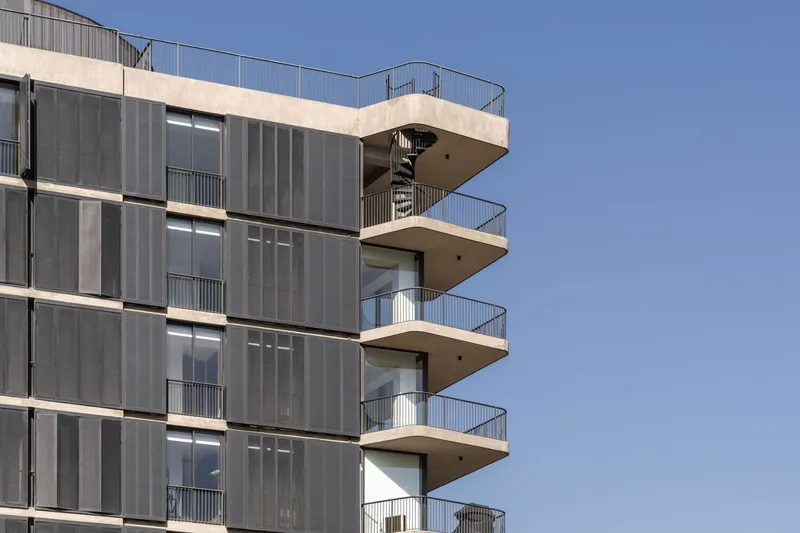
Above the base, the main body of the building champions material honesty and minimalism. The structure showcases exposed reinforced concrete, intentionally left without paint or cladding. The material’s inherent plasticity is highlighted through the curved terraces, creating rhythmic movement along the facades. These soft curves break the rigidity typically associated with concrete buildings, offering a more dynamic and expressive architectural language.
Complementing the exposed structure is the building’s ventilated façade system, made up of modular panels and operable metal louvers. This double-skin strategy enhances thermal insulation and solar control, supporting passive environmental performance while adding texture and depth to the elevation.
3. The Top
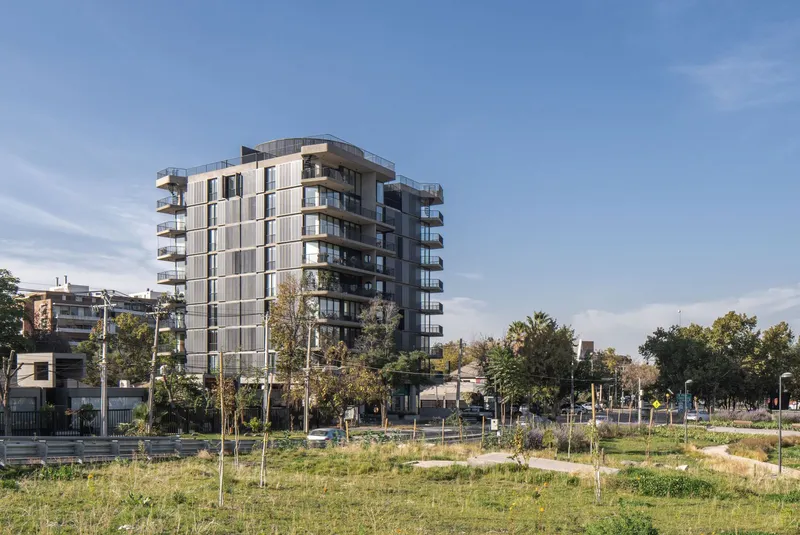
Far from being a functional afterthought, the building’s top is treated as a fifth façade. Turner Arquitectos designed it as a habitable and visually integrated rooftop, concealing technical equipment beneath a large circular metal ring. This striking element, visible from a distance, becomes a visual landmark and reinforces the building’s sculptural identity within Santiago’s urban skyline.

Sustainability and Urban Performance
The climate-conscious façade, combined with the passive design approach of the structure, supports the building’s energy efficiency. The use of operable blinds and a ventilated skin mitigates solar gain, while the robust concrete frame provides thermal mass, reducing the reliance on mechanical systems.
Moreover, the open base and integration with the surrounding public space promote walkability and urban vibrancy, aligning with broader goals of sustainable city development and livable urban design.
An Iconic Addition to Santiago’s Architectural Landscape
With its minimalist expression, contextual sensitivity, and layered composition, the Puerta Costanera Building by Turner Arquitectos sets a precedent for future stages of the development. It demonstrates how architecture can be a mediator between city and nature, while also creating memorable urban experiences through form, material, and spatial openness.
Project Details
- Project Name: Puerta Costanera Building
- Architects: Turner Arquitectos
- Location: Santiago, Chile
- Program: Residential and Commercial
- Total Area: 8,678 m²
- Photography: © Nico Saieh
.


Popular Articles
Popular articles from the community


LT2A and OPEN Architectes Thread a Brick and Glass High School Through a Wooded Belgian Campus
In Braine-l'Alleud, a 3,000 m² wing for Collège Cardinal Mercier pairs pale brick with a glazed colonnade, deferring to a small chapel and a dense wood.

Cube Design Draws an Ecological Corridor Between Two Shenzhen Hills with the Nankai Building
Beside Shenzhen's container docks, the Nankai Building pairs stacked balconies with a climbing green screen to connect two hillsides across its height.

U.GA Architects Wraps an Oval Rooftop Pool in Curved Board-Formed Concrete on Busan's Jeollidan-gil
In Busan's Jeonpo-dong, a 454 m² mixed-use block stacks a neighborhood facility, guest rooms and an oval rooftop pool inside spiraling concrete walls.

David Macias Steps a Doorless Stone and Plaster House Down a Tropical Colombian Hillside
In the humid hills of Colombia, Threshold House replaces the front door with an open void and terraces its 850 m² down the slope instead of fighting it.

Similar Reads
You might also enjoy these articles


Hodi-Mandai Geram
Project Function: Preservation and revitalization of the Intangible heritage and socio-spatial identity of the Hodi by Housing, Cultural Memory Center, Sacred Grove, landscape, local tourism economy


Olio Towers: A Mid-Rise for Performers That Fuses Housing, Rehearsal, and Stage
Located blocks from Houston's Theater District, this modular tower stacks living units around a central performance atrium.

Oasis: Modular Green Housing Carved into Dhaka's Urban Fabric
A shortlisted Plugin Housing entry reclaims unauthorized settlements in Dhaka with stepped concrete volumes, green roofs, and ventilation-driven design.

Black Hole: A Floating Megastructure for the Post-Physical Era
Emiliano Mazzarotto envisions a spherical, self-scaling arena where e-sports, digital hotels, and holographic stadiums replace traditional public space.

Explore Residential Building Competitions
Discover active competitions in this discipline

Challenge to design mud housing for contemporary communities

Challenge to reimagine the Iron Throne

Photograph architecture without architects

Illustrate the lost glory of Angkor Wat - Render Challenge
Comments (0)
Please login or sign up to add comments
No comments yet. Be the first to comment!