

Restructuring Dwarka MRTS Station Precincts: Turning Residual Metro Land into a Civic Gateway
A layered public realm of plazas, elevated decks, subways and parks stitches Dwarka's fragmented metro corridor back into everyday pedestrian life.


Metro lines promise connection, yet the ground beneath them often tells a different story: vacant plots, hostile crossings and edges that nobody owns. Restructuring Dwarka MRTS Station Precincts: Urban Design for Public Good starts from that contradiction. It refuses to treat the metro station as an isolated transport node and instead reads it as a catalyst, a place where mobility, commerce, recreation and community can finally overlap.
The proposal is by Sahil Harjai, and it targets Dwarka Sub City in South West Delhi, one of the largest planned residential developments in Asia. Shaped by the Delhi Development Authority's expansion programme, Dwarka has a structured grid, wide roads and zoned land use. Its MRTS station precincts, however, remain underdeveloped and dominated by vehicles. Harjai names the problem precisely: these are spaces that are used but not designed, the residue left when large-scale planning never reaches ground-level experience.
A Station Precinct Rebuilt as Gateway to the Sub City
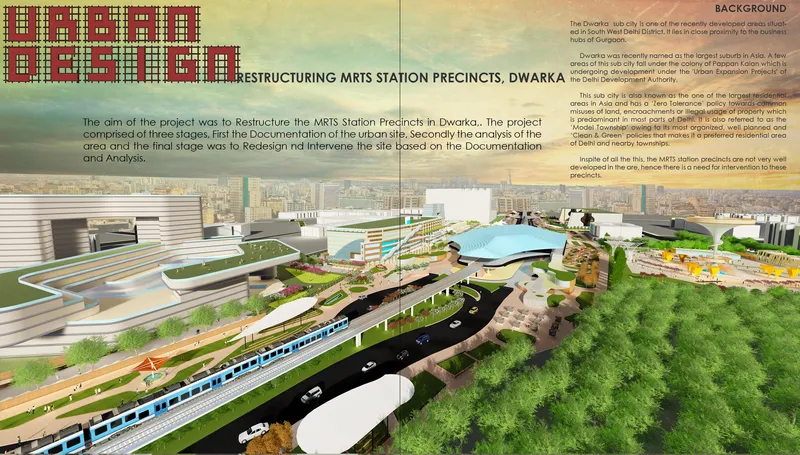
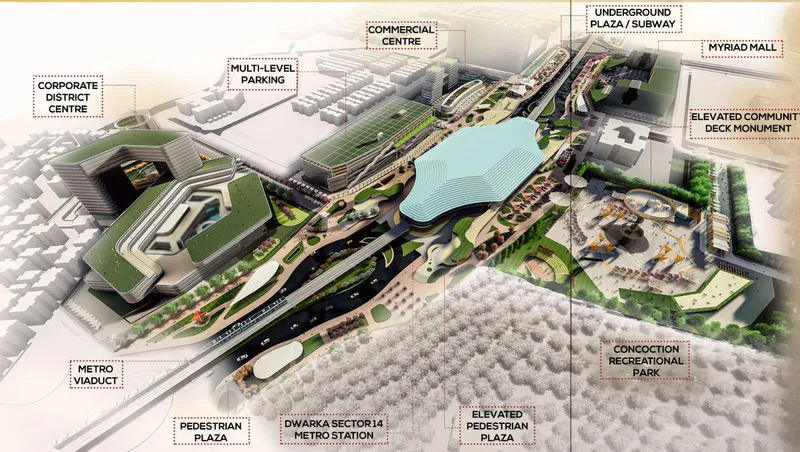
The aerial rendering sets the ambition. The elevated metro line and blue-roofed station no longer sit in a void; green-roofed terraces step toward them while a dense tree canopy holds the opposite edge. The annotated version strips the surrounding city to white so the programme reads clearly: station, elevated plazas, parking, mall and recreational park, arranged as one connected precinct instead of a scatter of unrelated plots.
The idea at work is vertical layering. Harjai stacks the public realm across pedestrian plazas at grade, elevated community decks, and underground plazas and subways, then ties these levels into recreational parks and green corridors. Multi-level parking is folded into public space instead of left as a separate concrete block, and commercial and mixed-use hubs cluster near the transit node. The result reads as a continuous civic landscape, which is exactly what a gateway to Dwarka should be.
Mapping the Corridor Before Drawing on It
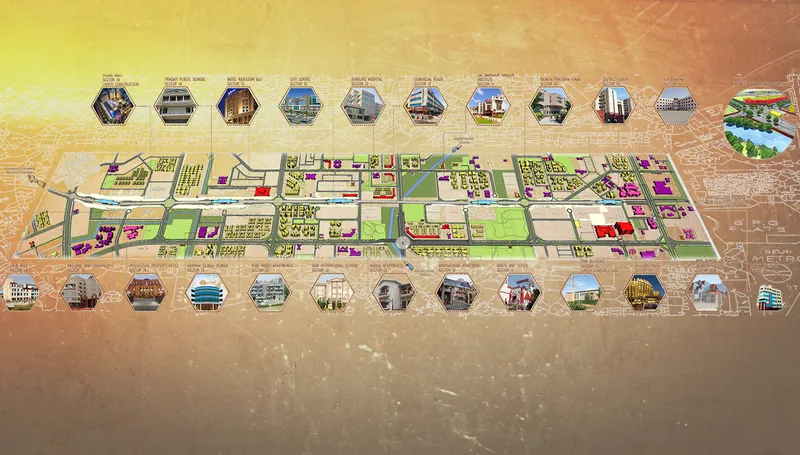
This axonometric is the evidence behind the renderings. The long urban strip is laid out with colour-coded blocks, roads and green patches, ringed by hexagonal photographs of the buildings that actually stand there today. That framing device matters: it keeps the existing city visible while the proposal is being tested against it.
The method followed three stages: documentation of physical, social and infrastructural conditions; urban analysis of land use, accessibility, vegetation, activity patterns, footfall and conflict zones; and only then design intervention. The analysis found pedestrians negotiating unsafe crossings and inactive edges, large vacant tracts sitting beside intense informal activity, and green spaces broken into inaccessible fragments. Footfall peaked during office hours, school dispersals and evenings, which argues for flexible, multi-use space over single-purpose plazas. Harjai lets these readings drive the form, and the project is stronger for it.
Designing at Walking Speed
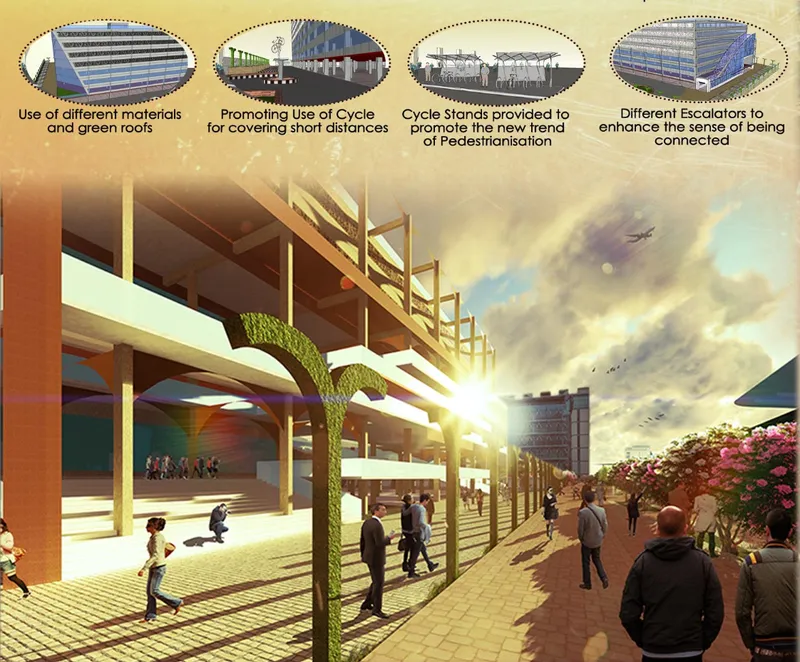
The eye-level rendering is where the philosophy of people before traffic becomes tangible. A pedestrian walkway runs between flowering trees and a colonnade topped with green arches, and the figures move toward a low sun with nothing forcing them aside. The colonnade gives the edge rhythm and shade; the planting softens the scale of the corridor without hiding it.
Harjai frames this as designing the city from eye level, with walking speed, viewing angles, sound, texture and spatial proportion informing decisions. That is a deliberate inversion of the vehicular logic that produced Dwarka's current station surroundings. It also follows the core argument of transit-oriented design: accessibility, density, mixed use and public life only reinforce one another when the walk to the station is worth taking.
Recovering Fragmented Green as a Shared Park

The final rendering turns to the recreational park. Curving paths thread between flowering shrubs, white canopy shelters mark places to pause, and a banded, bridge-like building closes the view at sunset. The green that the analysis found scattered and closed off is gathered here into a single public ground that sits within the transit precinct.
This is where the evening footfall peak finds a destination. A park adjacent to the station gives commuters, students and residents a reason to linger after the journey ends, and it supplies the distinct urban character the analysis found missing from Dwarka's precincts. Linked by green corridors to the plazas and decks, the park completes the layered system instead of standing apart as a decorative add-on.
Why This Project Matters
Indian cities are building metro networks faster than they are designing the ground around them. Harjai's proposal targets that gap directly, showing that the station precinct, not just the station, is where transit investment either becomes public life or dissolves into parking and dead edges. Its value lies less in any single gesture than in the discipline of the process: document, analyse, then intervene.
The layered public realm, combining plazas at grade, elevated decks, subways and parks, offers a transferable framework for other planned districts where generous roads and zoning have not produced a good street. Dwarka has the structure of a well-planned city; this project argues that what it lacks is attention at eye level, and it makes a persuasive case for supplying it.
View the Full Project
About the Designers
Designer: Sahil Harjai
Enter a Design Competition on uni.xyz
uni.xyz runs architecture and design competitions year-round that reward proposals with spatial conviction and real site intelligence.
Project credits: Restructuring Dwarka MRTS Station Precincts - Urban Design for Public Good by Sahil Harjai.


Popular Articles
Popular articles from the community


Tsunami Convergenics: Turning Catastrophic Ocean Forces into Underwater Housing Infrastructure
A speculative underwater settlement off the coast of Onagawa, Japan, treats tsunamis and typhoons as energy sources rather than threats.

Manzana Morphosis: Stretching Barcelona's Grid into a Living Landscape for 2050
A radical reworking of the Eixample manzana turns density into a tool for generous public space, vertical ecology, and environmental performance.

Cloaked Colonization: A Mobile Underwater Habitat That Moves Like a Fish
Micah Abaya's shortlisted EHC Pacific entry reimagines ocean settlement as a dispersed network of self-sustaining architectural organisms.
Faces of the Soviet Avant-Garde: Turning Moscow's Street Names into an Open-Air Museum
A network of sculptural installations across a Moscow residential district transforms forgotten architect names into spatial encounters with cultural memor

Similar Reads
You might also enjoy these articles

Maya Harvest: A Cacao Resort Village Rooted in Mayan Tradition and Local Craft
Situated within a Tabasco cacao plantation, this shortlisted resort proposal merges vernacular materials with hands-on cultural immersion.
Harmonia: A River-Shaped Community That Grows Over Decades in Boa Vista
Curved pathways and modular grid structures along the Branco River create a phased settlement designed to evolve from 2030 to 2050.
The Architecture of Bathing: A Mughal Hammam Reimagined Across the Yamuna
Charlotte May's honorable mention entry for The Black Taj reinterprets Agra's bathing rituals through red sandstone, water, and framed views of the Taj Mah
Om-1: A Wall-Hung System That Moves Your Workspace Off the Desk
Modular plywood boards, magnetic pegs, and utility elements migrate clutter from the horizontal surface to the vertical plane.

Comments (0)
Please login or sign up to add comments
No comments yet. Be the first to comment!