

Guangzhou's Twin Towers Interiors Move Like Water
DuShe Architectural Design shapes the lobbies of a massive Guangzhou transit hub with undulating ceilings and deep geological materiality.


Guangzhou Baiyun Station is regularly cited as one of the largest railway transportation hubs in Asia, and projects of that scale tend to produce interiors that feel institutional, transactional, and forgettable. The east plot twin towers, completed in 2025 by DuShe Architectural Design, push hard against that tendency. At 16,320 square meters of office interior, the lobbies and corridors here are designed not as afterthoughts but as the primary architectural experience of entering the complex.
What makes this project genuinely worth studying is its commitment to a single spatial idea carried across every surface: the undulating ribbed ceiling that flows continuously through lobbies, corridors, and elevator vestibules, treating the overhead plane as a topographic landscape rather than a flat grid. Paired with dark veined stone walls and polished reflective floors, the result is a series of spaces that feel carved from the earth and shaped by wind. It is a bold strategy for a commercial office interior, and it works.
The Ribbed Ceiling as Organizing Principle
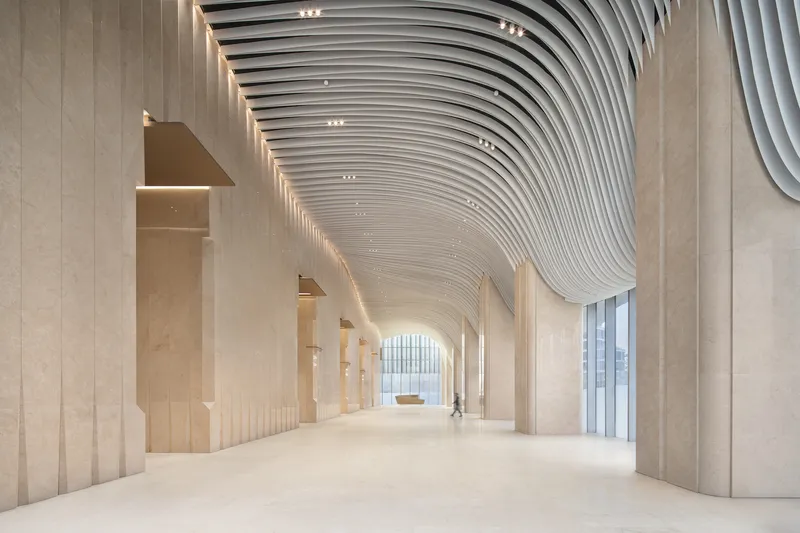
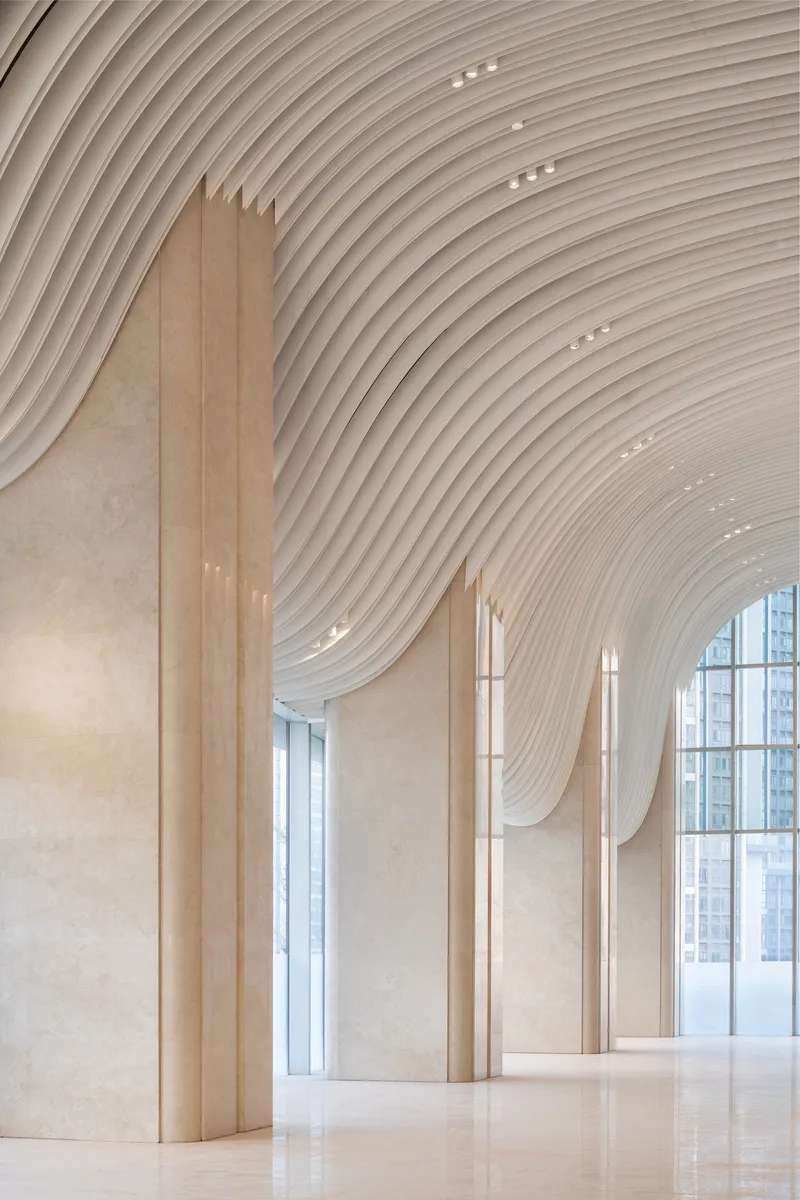

The undulating ribbed ceiling dominates every major interior view. Its ribs are neither decorative appliqué nor structural expression; they function as a continuous surface language that gives direction, rhythm, and warmth to spaces that could easily feel oversized and cold. The ribs compress and expand as they move through the plan, subtly guiding occupants along corridors and toward natural light at the curtain wall edges.
Where the ceiling meets the glazed facade, the ribs terminate cleanly against the mullion grid, creating a deliberate tension between the organic overhead form and the rationalized curtain wall. That junction is handled with enough precision that it reads as intentional contrast rather than collision. The pale sky filtering through the glass gives the ribs a shifting tonal quality throughout the day.
Stone, Reflection, and Geological Weight
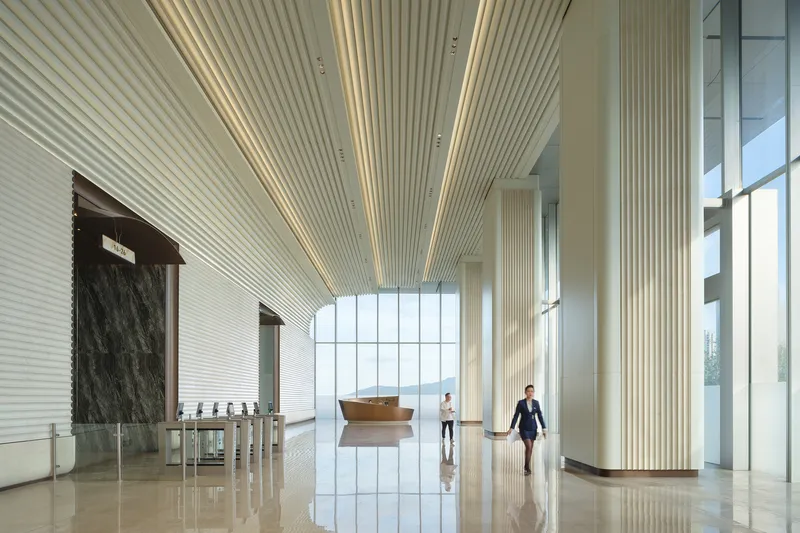
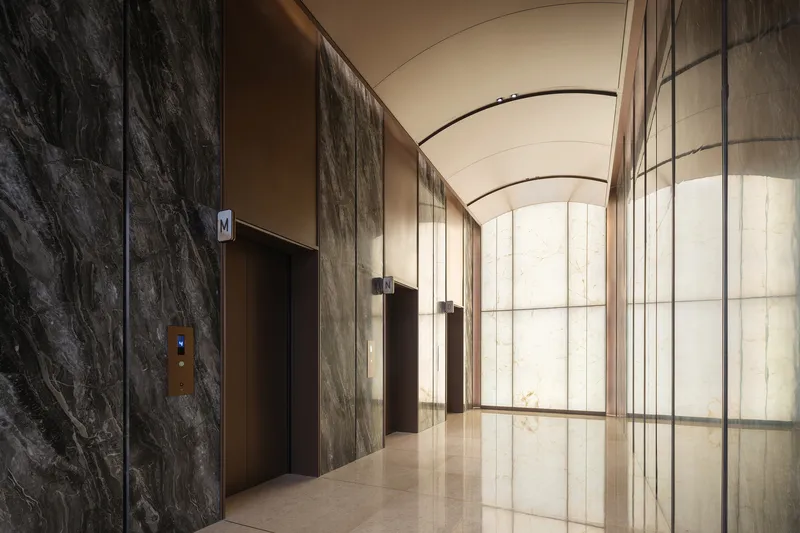
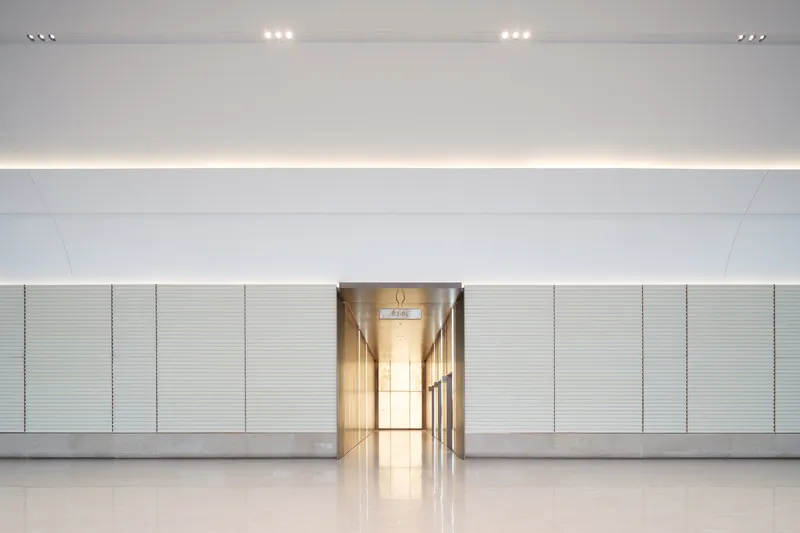
The material palette is deliberately limited: dark veined marble, polished stone floors, and muted tones that let the ceiling and lighting do the expressive work. The dark marble feature walls in the lobby register as geological strata, grounding the flowing ceiling above in something heavier and more permanent. The polished floors double every vertical surface in reflection, effectively doubling the perceived height of spaces and amplifying the drama of the ribbed overhead plane.
In the elevator lobby with its arched translucent glass partition and barrel vault ceiling, DuShe shifts registers entirely. The arch form introduces a classical resonance that the ribbed corridors deliberately avoid. The veined stone walls here frame silhouettes rather than illuminate them, creating a sense of passage and threshold that is rare in commercial office design. The horizontal ribbed wall panels in adjacent corridors complete a material vocabulary that is rich without being excessive.
Arched Thresholds and the Art of Transition
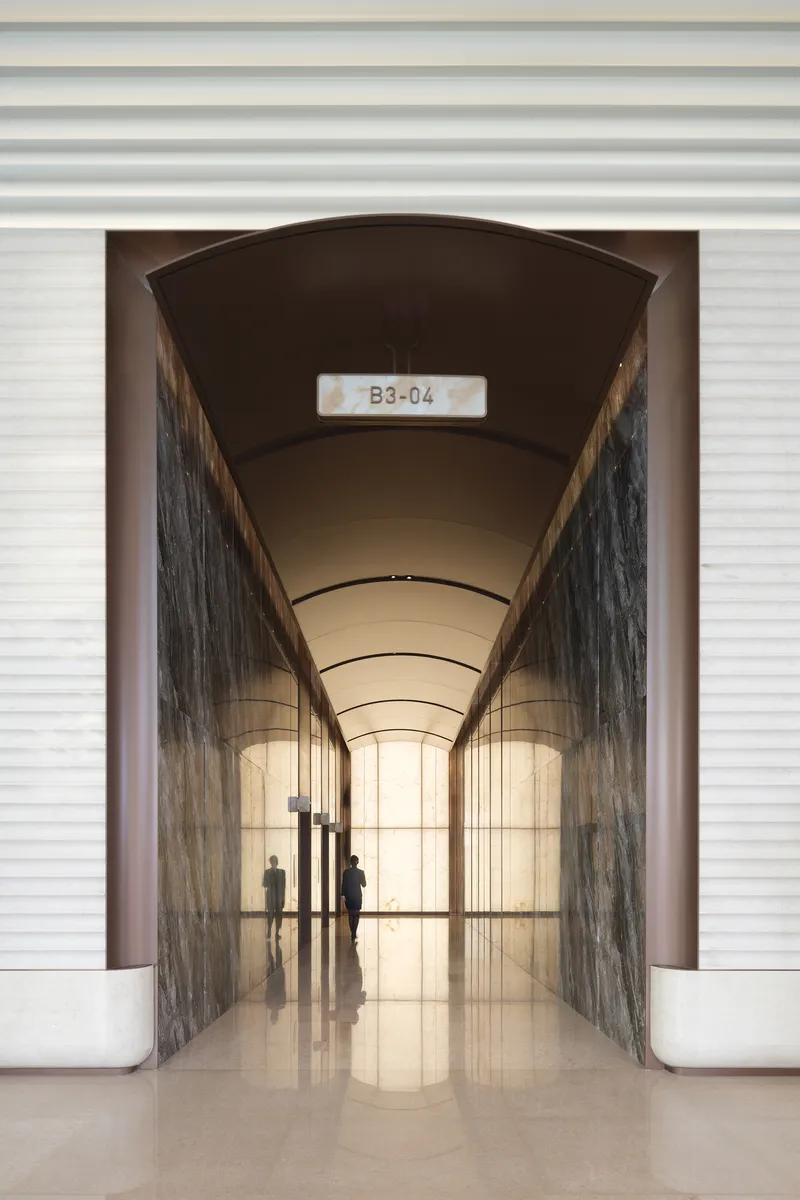
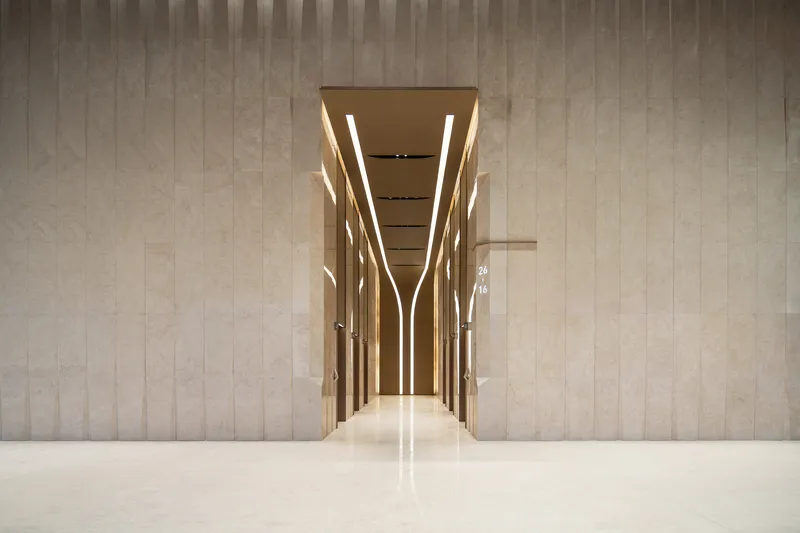
The arched passageway is the most photogenic moment in the project, and for good reason. The barrel vault ceiling, combined with the deep veined stone walls, produces a tunnel effect that compresses space before releasing it into the wider lobby beyond. The two silhouetted figures captured in reflection on the polished floor are not incidental; they demonstrate how the space is scaled to the body, not to the building's infrastructure.
The elevator lobbies extend this logic. Illuminated vertical mullions create a lantern effect around the lift cores, turning a purely functional zone into something almost ceremonial. The polished floor reflections here are so precise they nearly dissolve the boundary between floor and ceiling, an effect that requires not just good materials but careful coordination of lighting angles and surface finishes.
The Tower Base at Street Level
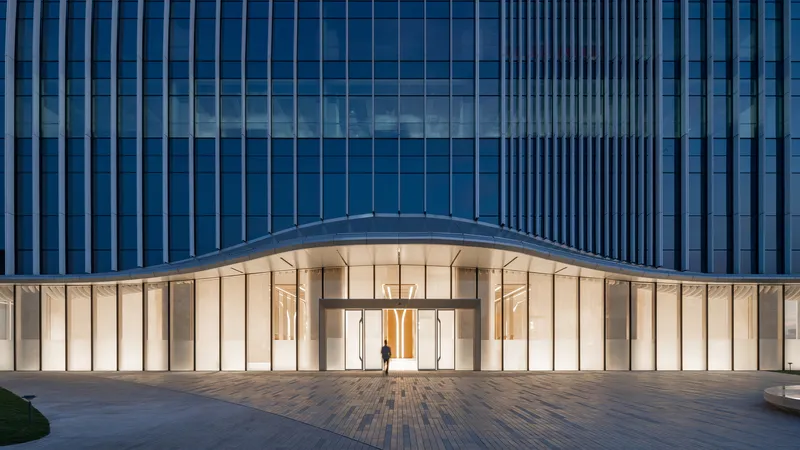
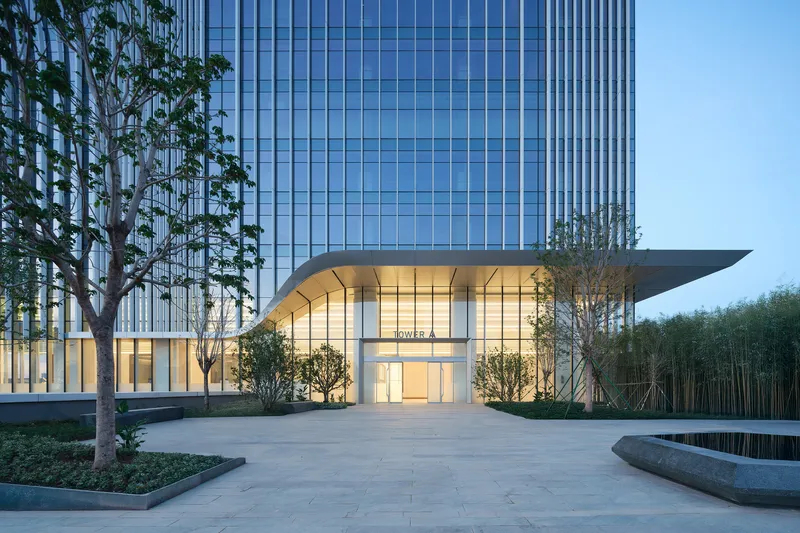
From the exterior, the twin towers' base meets the street through a curved canopy and vertical stone panels that telegraph the interior material language before you step inside. The dusk photographs reveal how the glazed tower base becomes a lantern, the interior lighting turning the lobby into a public spectacle visible across the reflecting pool and through the flanking trees.
The curved canopy is a generous gesture for a transit hub context, where pedestrian experience is often sacrificed to vehicular logistics. Here, the canopy establishes a clear threshold between the infrastructure of the station and the architectural ambition of the office complex. It signals that the interior experience has been designed with the same rigor as the building envelope.
Plans and Drawings
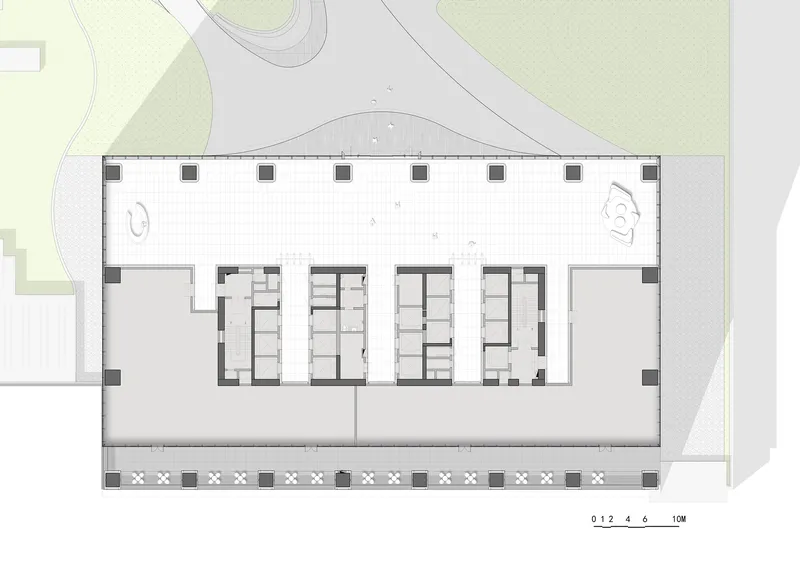
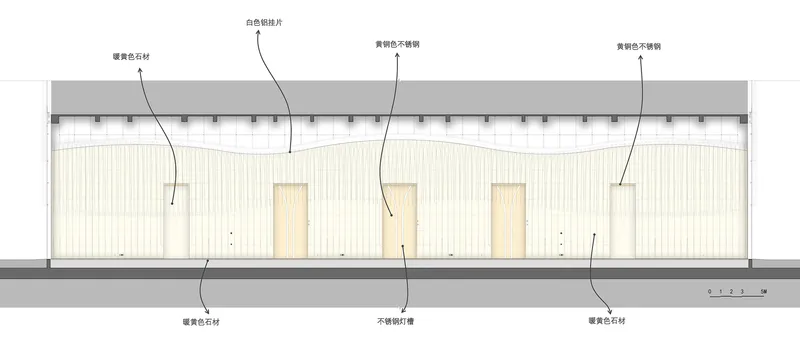
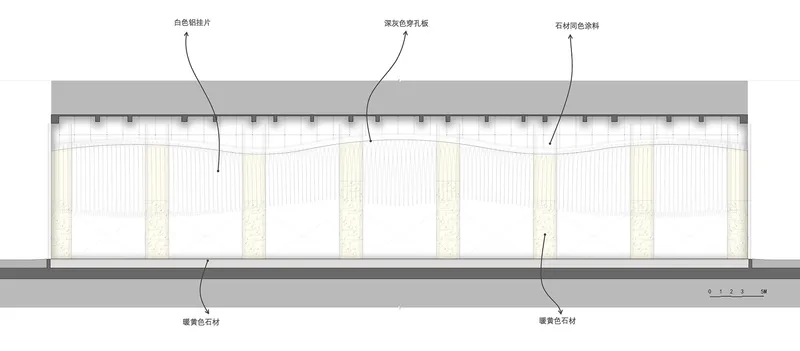
The floor plan reveals a straightforward rectangular layout organized around a central core, with perimeter columns set back from landscaped edges. The simplicity of the plan is the point: it provides a neutral framework that allows the ceiling and wall treatments to carry the spatial narrative. The elevation drawings show two distinct facade strategies, one with horizontal ribbed panels and evenly spaced door openings, the other with vertical paneling and a flat roof canopy, each corresponding to different functional zones of the base.
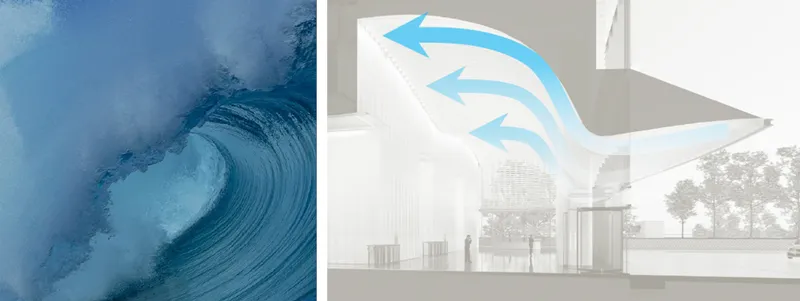
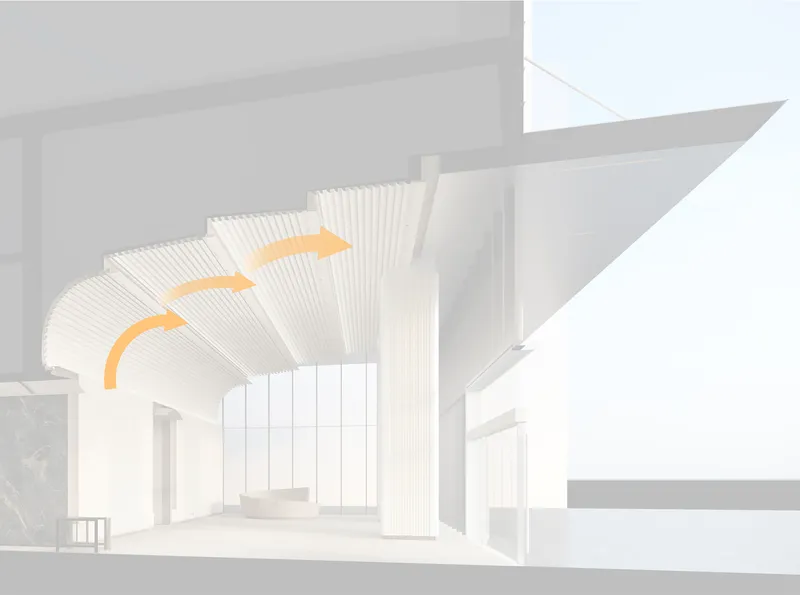
The section drawings are the most revealing. They illustrate airflow patterns through the curved roof and into interior spaces, suggesting that the undulating ceiling form is not purely aesthetic but is informed by environmental performance. Circulation arrows in the second section show how the ribbed ceiling flows into and connects disparate interior volumes, confirming that the ceiling serves as both a wayfinding device and a climate management strategy. The integration of passive ventilation with the formal language of the ribs is a level of synthesis that elevates the project beyond surface decoration.
Why This Project Matters
Commercial office lobbies in transit hubs are, more often than not, designed as branding exercises: slick, forgettable, and interchangeable. DuShe's interior for the Guangzhou Baiyun twin towers refuses that formula. By investing heavily in a continuous ceiling language, a restrained material palette, and carefully calibrated lighting, the firm has produced spaces that reward attention and slow movement. In a context defined by speed and throughput, that is a quietly radical position.
The project also demonstrates that environmental performance and spatial atmosphere are not competing goals. The section drawings make clear that the flowing ceiling form participates in airflow management, meaning the most visually striking element in the building is also doing real work. For a 16,320 square meter interior to maintain this level of coherence from entrance canopy to elevator core is an achievement that deserves serious attention from anyone designing large-scale commercial interiors in China and beyond.
Guangzhou Baiyun (Tangxi) Station East Plot – Twin Towers Interior by DuShe Architectural Design. Lead architects: Yijia Liu, Tianqi Ding, Yudan Li, Yanxin Li, Yujia Zhai. Guangzhou, China. 16,320 m². Completed 2025. Photography by TAL.
About the Studio
Share Your Own Work on uni.xyz
If projects like this are the kind of work you want to make, uni.xyz is a place to publish your own, find collaborators, and enter design competitions.


Popular Articles
Popular articles from the community


ETEH Reworks the Shared Spaces of São Domingos School in Brazil Around Timber, Color and Hanging Plants
At São Domingos School in Brazil, 436 m² of hall, refectory and library are recast with timber joinery, a yellow and blue code and trailing greenery.


Opera on the Sea: Driftwood Logic Shapes a Timber Opera House on Estonia's Coast
Trevor Orgill's opera house translates the entangled drift of floating timber into a civic building where wood, water, and music converge.

David Ortega Stacks a Two-Story Mexico City Penthouse Around a Steel Stair and a Pergola-Shaded Roof Terrace
In Colonia Roma, a 300 m² penthouse uses oak joinery, a planted steel stair and a slatted roof pergola to make a new-build apartment feel like a house.

FCC Arquitectura Expands a Portuguese Granite House with a Board-Marked Concrete Wing
In Portugal, JV House pairs a cleaned-up whitewashed and granite dwelling with a timber-shuttered concrete extension, courtyards and a garden pool.

Similar Reads
You might also enjoy these articles

LAVA Architecten Gives Vocational Education a Sawtooth-Roofed Face on a Mechelen School Campus
In Mechelen, Belgium, a 2,053 m² STEM school on a 6×6 m grid turns workshops and classrooms into rooms that can be rearranged as teaching changes.

KEMA Studio Turns a Derelict Marvila Attic into a 60 m² Lighthouse Apartment Above Lisbon
In Lisbon's Marvila district, a rebuilt roof, four skylights and two plywood volumes turn an unlivable attic into a bright home facing the Tagus.

Pixel Gardens: One Repeated Module Stacked Into a Terraced Social Housing Tower for Famagusta
Salem Bader's shortlisted housing tower builds a vertical neighbourhood from one repeated module, offsetting units to carve terraces, light and air.

Bao Huynh Watercolor Atelier: A Serene Art Retreat in Hội An
Bao Huynh Watercolor Atelier in Hội An blends multifunctional art spaces, sustainable design, local materials, and family-friendly living in a serene environment.

Comments (0)
Please login or sign up to add comments
No comments yet. Be the first to comment!