
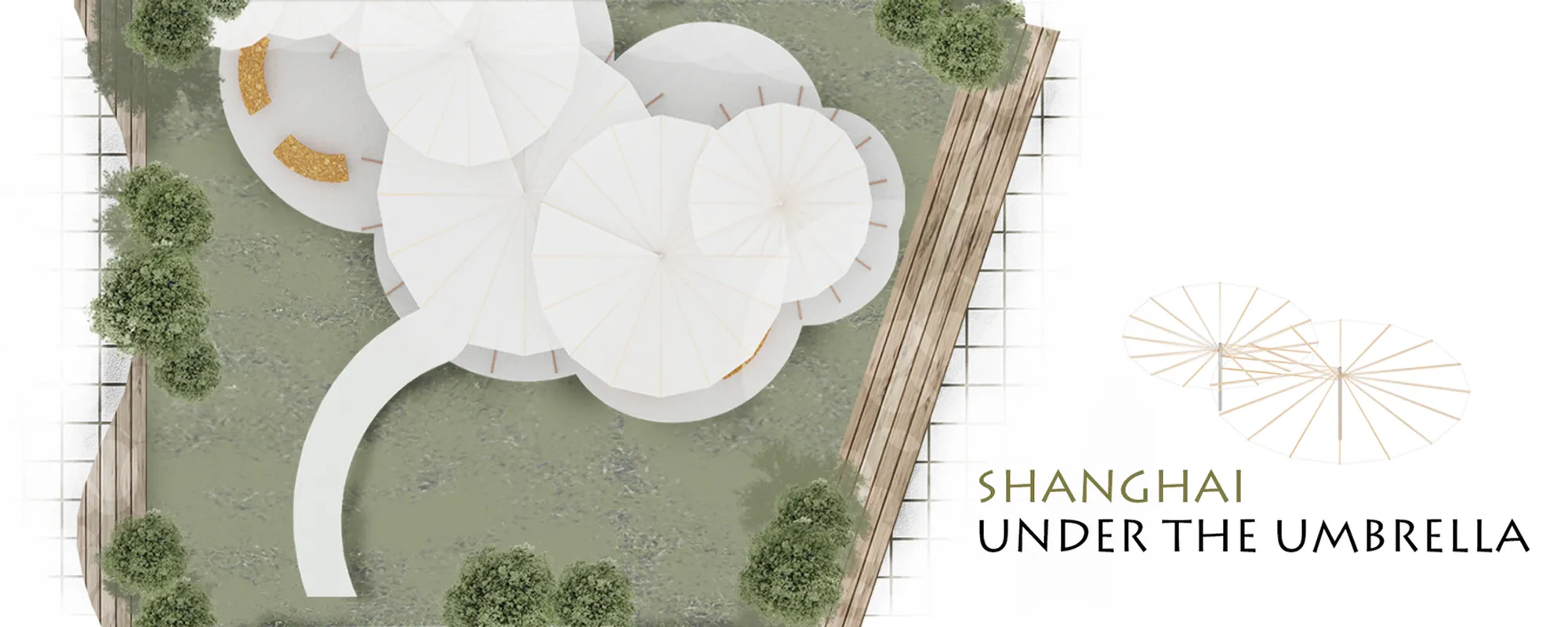
Shanghai Under the Umbrella: Oil-Paper Canopies Recast as Modular Community Infrastructure
A rooftop public space system draws on the radial geometry of traditional umbrellas to consolidate evening services in dense Shanghai neighborhoods.


The oil-paper umbrella is one of East Asia's most recognizable craft objects: bamboo ribs radiating from a central post, rice paper pulled taut into a translucent canopy. In Shanghai, three designers have scaled that geometry up to the size of a public pavilion and asked it to do far more than shed rain. Their modular canopy system collects courier lockers, pet enclosures, senior exercise areas, and waste-sorting stations under a single radial roof, consolidating four services that residents typically chase across sprawling residential compounds every evening between six and nine o'clock.
"Shanghai Under the Umbrella" is a shortlisted entry in the Urbanscape: Symbiosis competition, designed by Zixin Chen, 霝鑫 石, and Kyle Sun. Sited in a dense Shanghai neighborhood, the proposal grows out of resident interviews with a young professional, a housewife, and a retired teacher, all of whom flagged the same friction: essential daily services are scattered, poorly timed, and disconnected from one another. The designers' response is to unify those services spatially and temporally, landing lightweight umbrella modules on existing rooftops so that no ground-level function is displaced.
Timed Flows: Designing for the 6 PM to 9 PM Window
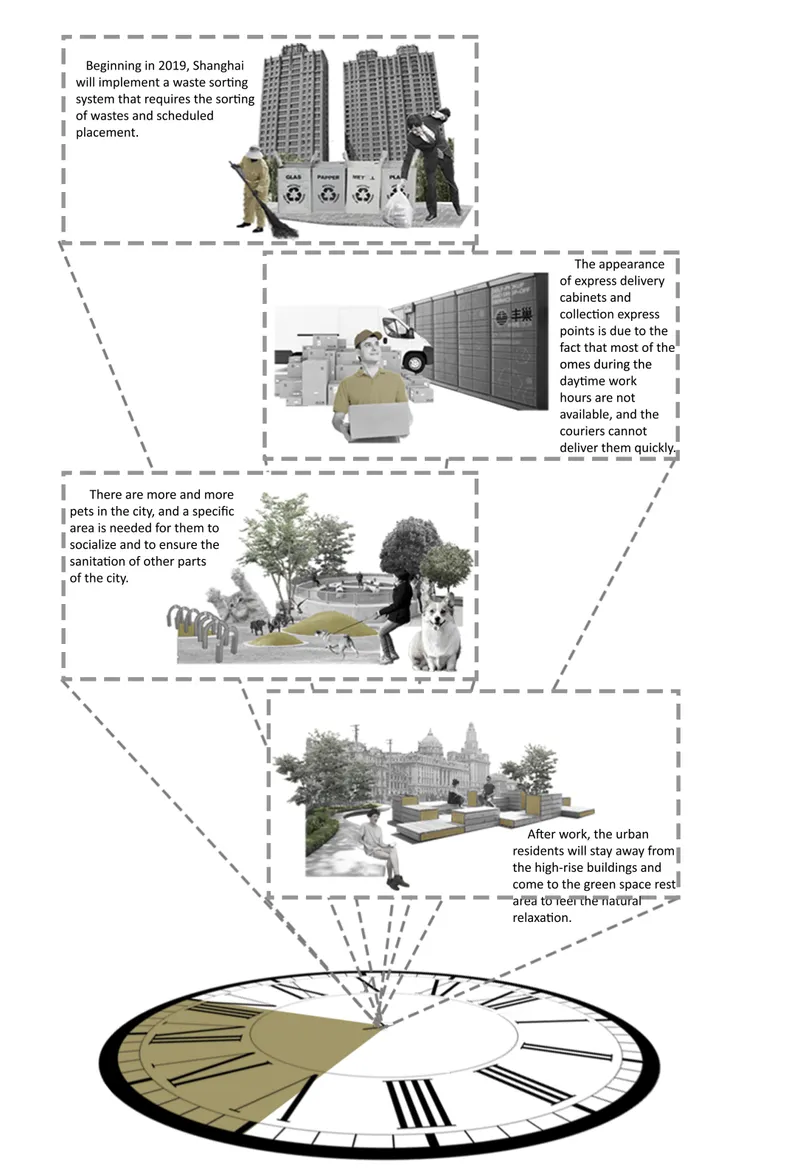
The diagram above maps how waste sorting, package retrieval, and pedestrian movement converge during the three-hour evening window when most residents return home. Rather than planning space purely by function, the designers introduce time as a primary design axis. Arrows track the flow of people and materials between residential towers and collection bins, revealing the bottleneck that forms when everyone needs the same services simultaneously. By consolidating those services into a single node activated during peak hours, the proposal eliminates redundant infrastructure and concentrates social energy where it matters most.
Heritage Alleys and the Memory of Shelter

A narrow paved lane between timber houses offers the emotional starting point for the project's formal language. A solitary figure walks away beneath a parasol, framed by the warm patina of aged wood on either side. The image anchors the design in lived cultural memory: the umbrella is not imported as a novelty motif but extracted from the daily rhythms of the neighborhood itself. That gesture, a single person sheltered in a tight alley, scales up into the canopy modules that later crown the rooftops above.
By rooting the architecture in this specific spatial condition, the designers avoid the trap of generic cultural reference. The umbrella form earns its place because it already belongs here, in the hand of every resident who navigates these lanes in summer rain or afternoon heat.
Radial Canopy and Cork Seating: The Pavilion Up Close
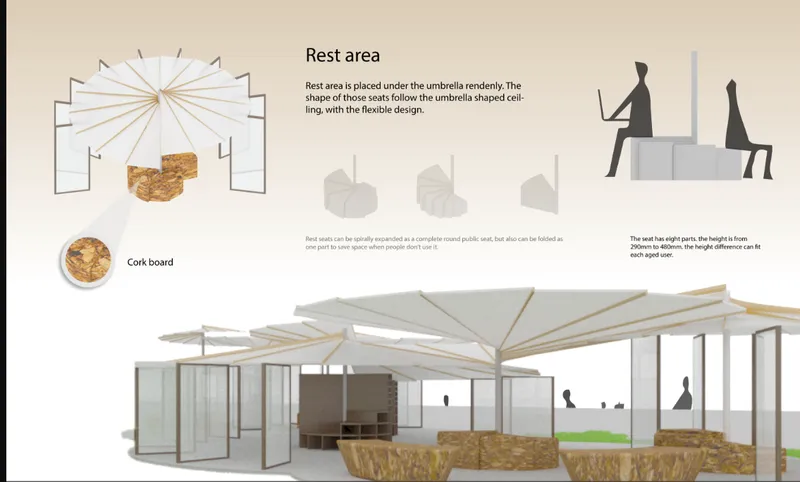
The axonometric rendering reveals how the umbrella geometry translates into buildable structure. Ribs radiate from a central timber column to support a broad canopy, beneath which spiral seating wraps outward at varying heights. The seats are specified in corkboard, a material chosen for its warmth, light weight, and suitability for all ages. Adjustable seating heights accommodate children and elderly residents alike, while the spiral arrangement encourages face-to-face interaction rather than the parallel rows typical of conventional park benches.
The canopy itself can be expanded or retracted depending on usage, a direct echo of the collapsible umbrella's mechanics. That scalability is what makes the module viable for rooftops of different sizes across the city: the same structural logic holds whether one unit or a cluster is deployed.
Ground-Level Activation: Dogs, Deliveries, and Daily Life
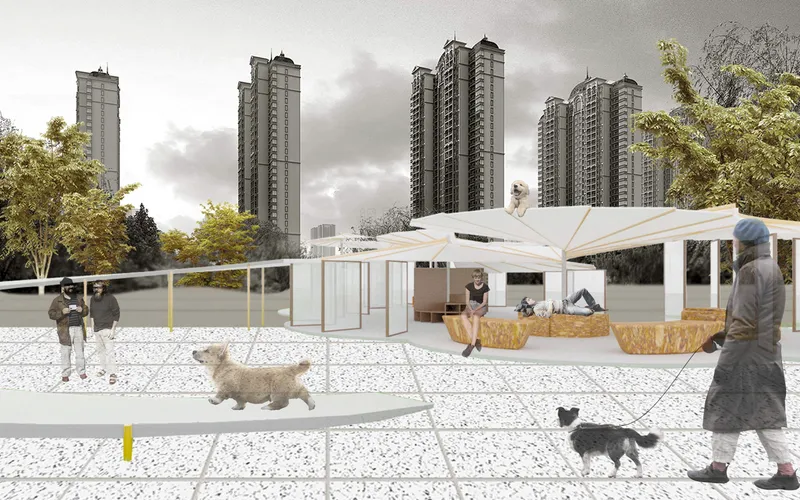
At plaza level, the umbrella pavilion becomes a social condenser. People walk dogs through a dedicated pet zone, collect packages from courier lockers tucked under the canopy's edge, and pause on benches oriented toward the surrounding residential towers. The cloudy Shanghai sky overhead reinforces why continuous overhead shelter matters in this climate. By separating pet circulation from pedestrian paths, the designers resolve a conflict that the interviewed residents identified as a daily source of tension, turning a potential hazard into a programmed amenity.
Floating Canopies Over Timber Heritage
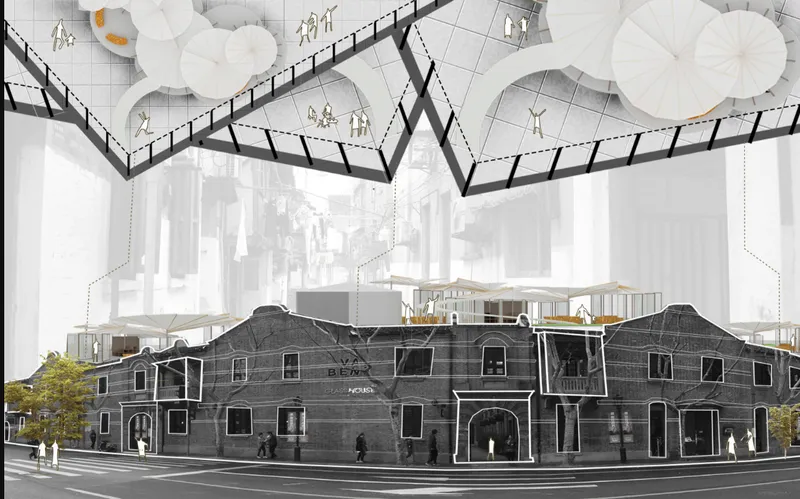
The sectional perspective makes the structural strategy legible. Umbrella canopies float above existing timber heritage buildings on slender supports, creating a raised public plaza that hovers over the existing roofscape without demolishing or displacing anything below. The lightweight construction allows rapid installation and minimal load on the host structures, a critical consideration in a city where heritage fabric and density coexist uneasily. What emerges is a second ground plane, an elevated civic layer threaded between old and new Shanghai.
The section also clarifies the project's relationship to scale. At the level of the alley, the umbrella is intimate, personal. At the level of the rooftop, it becomes communal, infrastructural. The same radial logic operates at both scales, giving the project a rare formal coherence from the hand-held parasol to the neighborhood canopy.
Why This Project Matters
"Shanghai Under the Umbrella" succeeds because it treats cultural form not as decoration but as structural logic. The oil-paper umbrella's radial ribs generate the canopy, its collapsibility generates the modularity, and its everyday familiarity generates the emotional connection to place. That is a more rigorous use of heritage than most projects achieve. At the same time, the design is grounded in interview data and temporal analysis, ensuring that every square meter of new public space earns its keep during the hours when it is most needed.
For cities wrestling with density, scattered services, and the erosion of shared cultural identity, the proposal offers a replicable template. Land a lightweight module on a rooftop, consolidate the evening program beneath it, and let the form remind residents that they share more than an address. It is a small architectural move with outsized civic ambition, and it deserves the attention its shortlisting at Urbanscape: Symbiosis has brought it.
View the Full Project
About the Designers
Designers: Zixin Chen, 霝鑫 石, Kyle Sun
Enter a Design Competition on uni.xyz
uni.xyz runs architecture and design competitions year-round that reward proposals with spatial conviction and real site intelligence.
Project credits: Shanghai Under the Umbrella by Zixin Chen, 霝鑫 石, Kyle Sun Urbanscape: Symbiosis (uni.xyz).



Popular Articles
Popular articles from the community


The Ocean Hive: Sustainable Architecture for a Self-Sufficient Civilization at Sea
The Ocean Hive imagines sustainable architecture at sea, where modular habitats, algae, wave power and ocean waste sustain a growing colony.

Lunar Spiral: Space Architecture Shaped by the Mathematics of the Universe
Lunar Spiral reimagines space architecture through Fibonacci geometry, lunar regolith, levitating habitats, and self-sustaining Moon living.

Hill & Cross Opera: Sculptural Opera House Architecture Shaped by Tallinn’s Landscape and Identity
Hill & Cross Opera reimagines opera house architecture in Tallinn through its sculptural hill, civic plaza, glass wave and a luminous cross.

The Musturak Paradise: Senior Living Architecture for a Connected Future in Temara, Morocco
The Musturak Paradise reimagines senior living architecture in Temara via private homes, social spaces, culture, community, and shared care.

Similar Reads
You might also enjoy these articles

Bao Huynh Watercolor Atelier: A Serene Art Retreat in Hội An
Bao Huynh Watercolor Atelier in Hội An blends multifunctional art spaces, sustainable design, local materials, and family-friendly living in a serene environment.

Atelier Macri Concept Store Interior Design by CASE-REAL
Atelier Macri store features a "ko" counter, walnut wood details, cork displays, blending retail, gallery, and seamless customer experiences.

Manuel Vargas Izquierdo Stadium and High-Performance Sports Center: Architectural Excellence in Jalpa de Méndez
The Manuel Vargas Izquierdo Stadium blends sustainable design, inclusive sports facilities, and cultural-inspired architecture, revitalizing Jalpa de Méndez’s public spaces.

KAKR Buluh Awar Hall: Revitalizing Community and Ecology Through Bamboo Architecture
Community built bamboo hall revitalizes Buluh Awar village, empowering youth, restoring ecology, celebrating vernacular craftsmanship through sustainable architecture and culture.


Explore Cultural Architecture Competitions
Discover active competitions in this discipline



Challenge to reimagine the Iron Throne


Photograph architecture without architects


Illustrate the lost glory of Angkor Wat - Render Challenge


Bring back Drive In's
Comments (0)
Please login or sign up to add comments
No comments yet. Be the first to comment!