
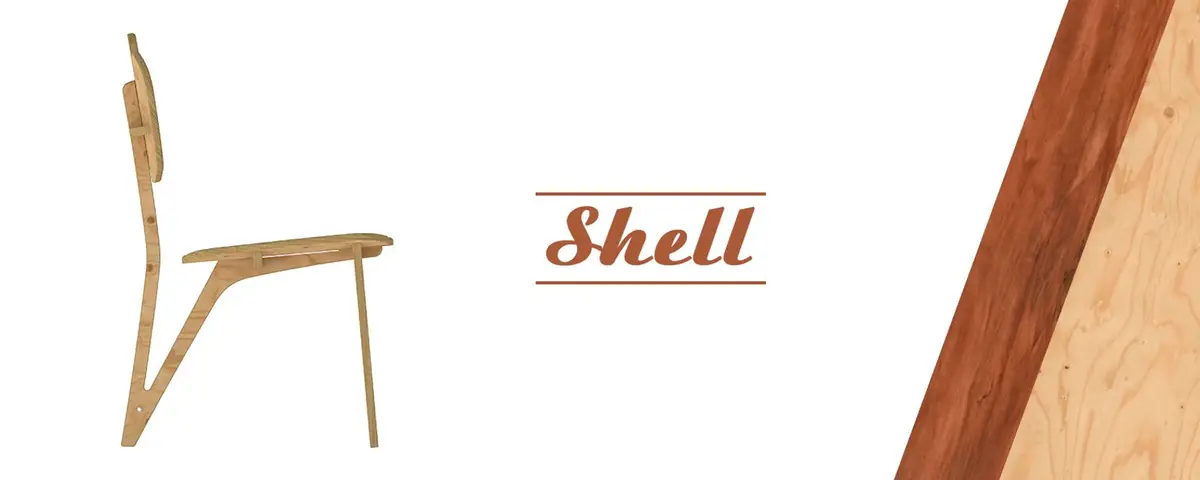
Shell Chair: A Plywood Seat That Trades Four-Legged Certainty for an Unfolding Experience
Maryam Moradi and Reza Kabudmehri split a plywood backrest into unfolding panels, turning the act of sitting into an encounter with balance and enclosure.


The four-legged chair is one of design's most settled agreements: a box of stability we lower ourselves into without a second thought. The Shell Chair reopens that agreement. Its question is disarmingly plain: how can a chair offer a different experience? The answer is a seat whose backrest breaks into separate plywood panels that fan open around the sitter. It feels less like furniture you use and more like a small structure you enter and balance within.
Designed by Maryam Moradi and Reza Kabudmehri and published on uni.xyz, the project sits in the territory of architectural furniture design, where an everyday object becomes a testing ground for structure, material and perception. The designers do not argue against stability. They argue against a standardised expectation of it, and they make their case with plywood, CNC precision and traditional joinery.
A Backrest That Unfolds Instead of Enclosing
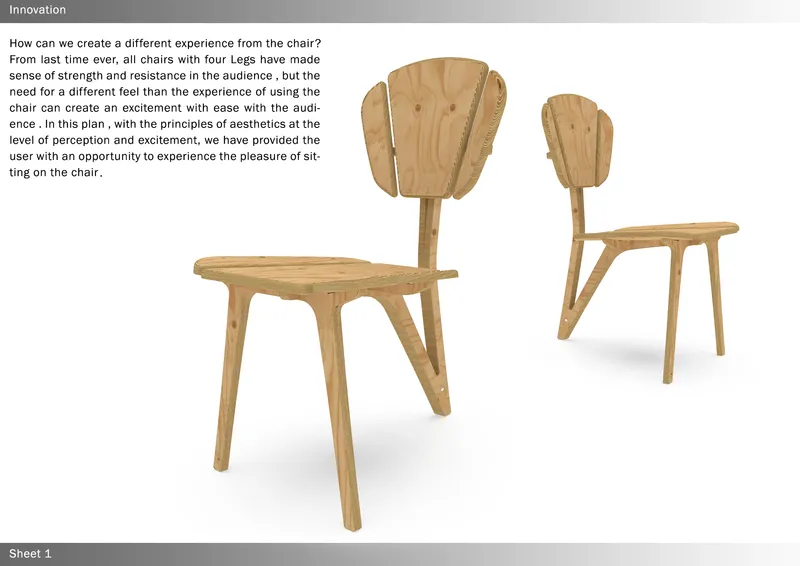
The opening sheet sets two chairs side by side, and the fan-shaped, split backrest takes over the composition immediately. A solid back would cup the body. Here the separated panels hold the shoulders while leaving gaps that let light and air through. The designers describe this as enclosure without rigidity, and that phrase captures the project's central move: support is spread across several planes rather than gathered into one surface.
This matters because it shifts the emotional register of sitting. The chair asks to be read before it is used. The open shell signals that the object is meant to be met, an encounter with form and balance, and the designers put perception and excitement alongside comfort as goals.
Exposed Plies and the Logic of the Repeated Object
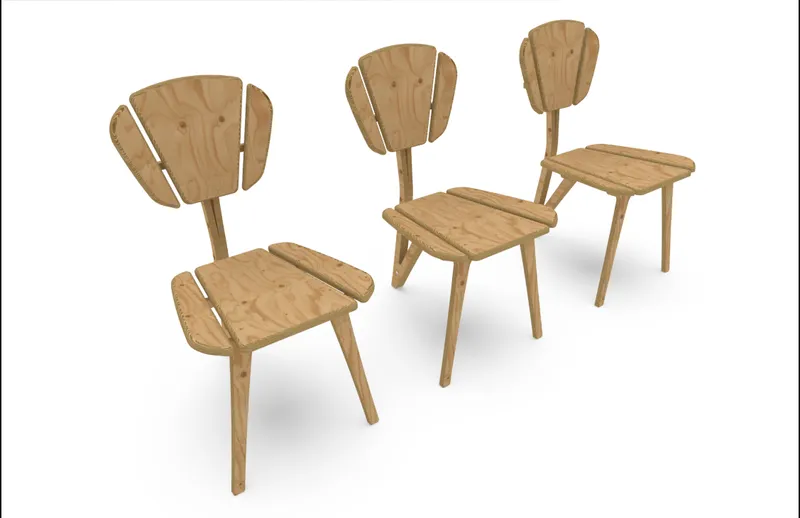
Lined up in a row of three, the chairs show off their slatted seats and three-legged frames, and they read as a product as much as a sculpture. Plywood carries both readings. Its strength-to-weight ratio keeps the chair light while preserving load-bearing capacity, and its layered grain is left exposed, an act of material honesty that turns the edge of every panel into a visible record of how the sheet was built.
The repetition also makes a production argument. CNC machining gives the precision and easy assembly that a multi-panel design needs, and plywood keeps the piece affordable and scalable. The chair sits where workshop craft meets digital fabrication, which is where much contemporary architectural furniture is now made.
Splayed Legs, a Thin Spine and Joinery That Stays Out of Sight
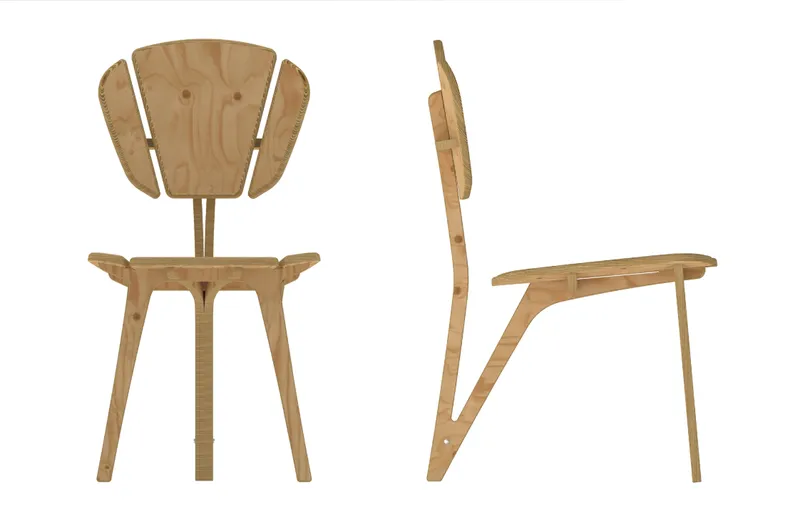
The front and side elevations reveal the structural story behind the gesture: splayed legs, a thin spine and a three-panel backrest. The slender legs and angled supports spread loads across a stable base without adding visual weight. Components are joined with traditional mortise-and-tenon joints reinforced with wood glue, a deliberate choice of time-tested methods for longevity and clarity. The lower structure gains extra rigidity from a double-bolted connection between the main bodies, fixed with a double-sided screw that stays visually discreet.
The elevations also prove the designers' point about multiple perspectives. Front-on, the chair is a fan. In profile, it becomes a lean diagonal of spine and leg. That shift in proportion and silhouette as you move around it is a quality usually given to buildings, and it suits the chair to exhibition settings as well as interiors. The gaps between seat and back panels add rhythm and negative space, so the structure reads cleanly from every side.
Why This Project Matters
The Shell Chair treats a chair as architecture at the scale of the body. Its most useful lesson is restraint. There are no exotic materials or elaborate mechanisms, only one sheet material, a familiar joint and a careful split of the backrest into panels. From those limited means, Moradi and Kabudmehri create an object that changes how sitting feels and how a chair is perceived from across a room.
For young designers working between architecture and product design, the project shows how a single clear question can organise every later decision, from grain exposure to bolt placement. Innovation here does not come from complexity. It comes from looking again at the most familiar object in any room and asking what else it could do.
View the Full Project
About the Designers
Designers: Maryam Moradi, Reza Kabudmehri
Enter a Design Competition on uni.xyz
uni.xyz runs architecture and design competitions year-round that reward proposals with spatial conviction and real site intelligence.
Project credits: Shell Chair by Maryam Moradi, Reza Kabudmehri.


Popular Articles
Popular articles from the community


Singing Woman: An Opera House That Performs Before the Curtain Rises
Ovidiu Cristian Pavel's conceptual opera house translates Estonia's choral identity into a sculpted waterfront landmark facing the Baltic Sea.

Opera by the Sea Estonia: Three Shells Dissolving Architecture into Tallinn's Coastline
A winning opera house proposal replaces monumental form with interconnected shells that blur the boundary between building, park and Baltic Sea.

Manzana Morphosis: Stretching Barcelona's Grid into a Living Landscape for 2050
A radical reworking of the Eixample manzana turns density into a tool for generous public space, vertical ecology, and environmental performance.

Extended Shell: Retrofitting Kolkata's Balconies as Living Urban Thresholds
A modular retrofit system recovers the social and environmental intelligence of Kolkata's historic verandas for contemporary Park Street residents.

Similar Reads
You might also enjoy these articles


Maya Harvest: A Cacao Resort Village Rooted in Mayan Tradition and Local Craft
Situated within a Tabasco cacao plantation, this shortlisted resort proposal merges vernacular materials with hands-on cultural immersion.
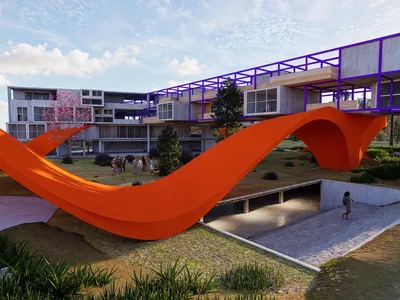
Harmonia: A River-Shaped Community That Grows Over Decades in Boa Vista
Curved pathways and modular grid structures along the Branco River create a phased settlement designed to evolve from 2030 to 2050.

The Architecture of Bathing: A Mughal Hammam Reimagined Across the Yamuna
Charlotte May's honorable mention entry for The Black Taj reinterprets Agra's bathing rituals through red sandstone, water, and framed views of the Taj Mah
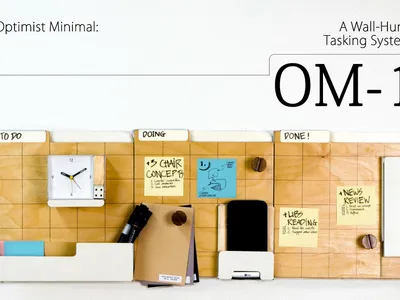
Om-1: A Wall-Hung System That Moves Your Workspace Off the Desk
Modular plywood boards, magnetic pegs, and utility elements migrate clutter from the horizontal surface to the vertical plane.

Explore Furniture Design Competitions
Discover active competitions in this discipline

Design challenge to equip cities with modern furniture

Competition to design a workstation for architects

Packaging challenge - Design meets sustainability
Comments (0)
Please login or sign up to add comments
No comments yet. Be the first to comment!