

skimA Slots a Vertical Metal Tower into a Yeonnam-dong Brick House to Make It Mixed Use
A 292-square-meter renovation in Seoul's cafe-lined Yeonnam-dong grafts a new circulation spine onto a low-rise residential shell.


Yeonnam-dong sits adjacent to the Gyeongui Line Forest Road, the repurposed rail corridor Seoulites have nicknamed "Yeontral Park." As foot traffic grew, the neighborhood's low-rise houses began converting, one by one, into cafes, bars, and small offices. Most of these renovations swap interiors while leaving the envelope untouched. skimA, led by Sejin Kim, took the opposite approach with YN241: they kept the existing brick volume largely intact but appended a slender vertical tower of corrugated metal and steel slat screens, adding a new stair core that lets each floor operate independently as a different program.
The result is a 292-square-meter building that reads as two distinct materials and two distinct eras fused at the hip. Red brick on one side speaks the language of the original residential block. Vertical metal fins on the other side catch passing headlights and cast striped shadows into the stairwell. What makes the project genuinely interesting is how that narrow addition, barely the width of a staircase, unlocks a commercial ground floor, an office level, and a rooftop residence from a structure that was never designed to hold all three.
Two Buildings in One Skin
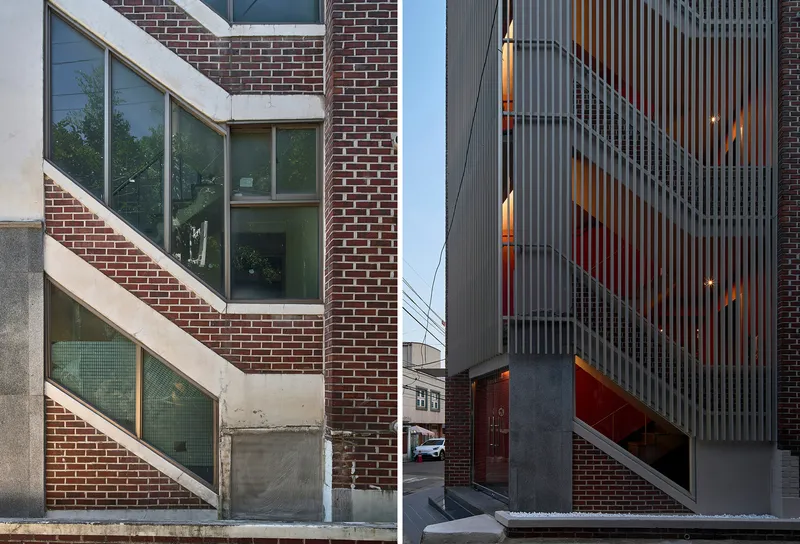
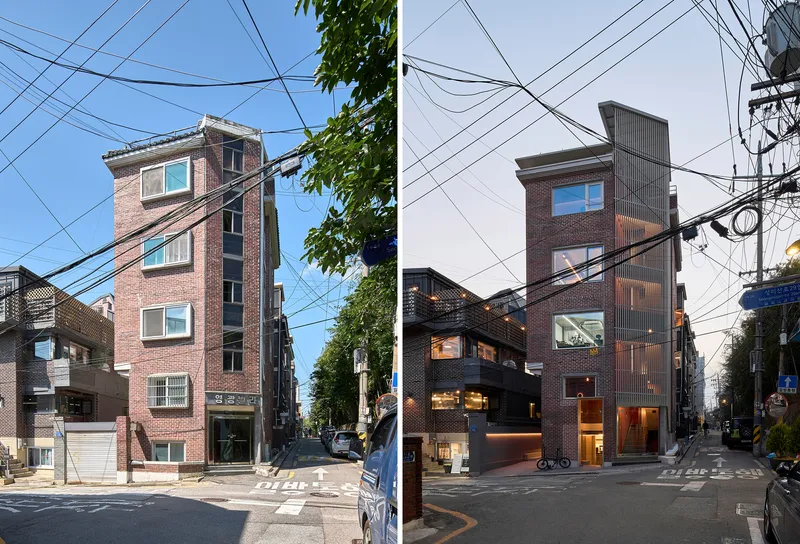
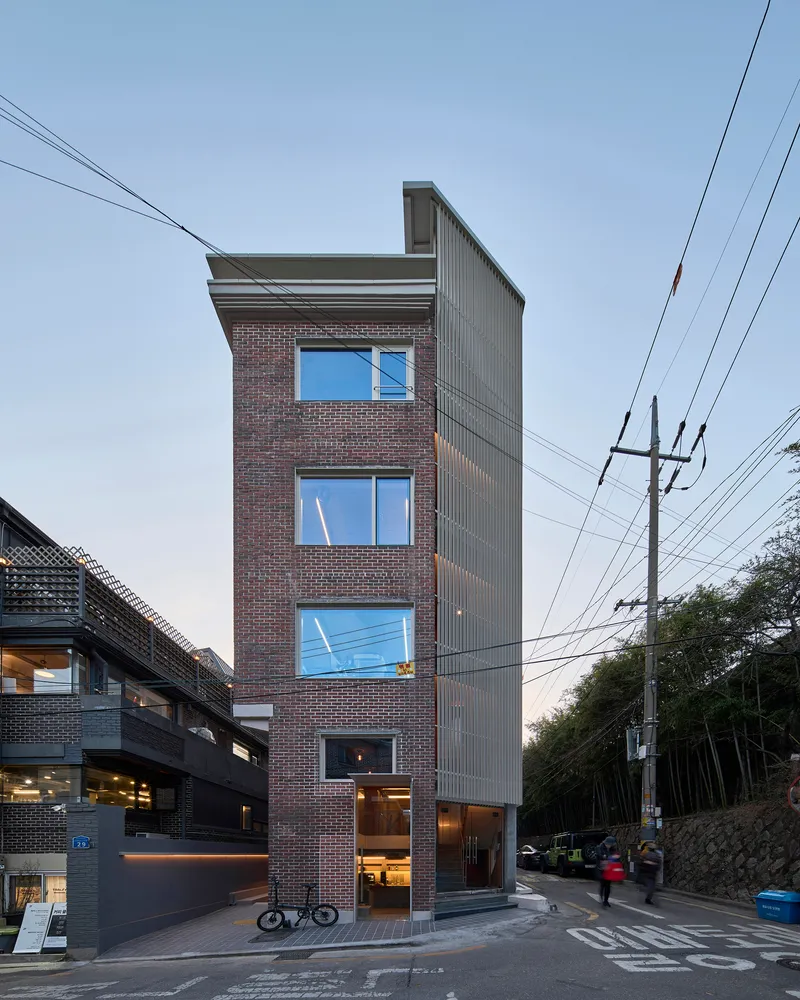
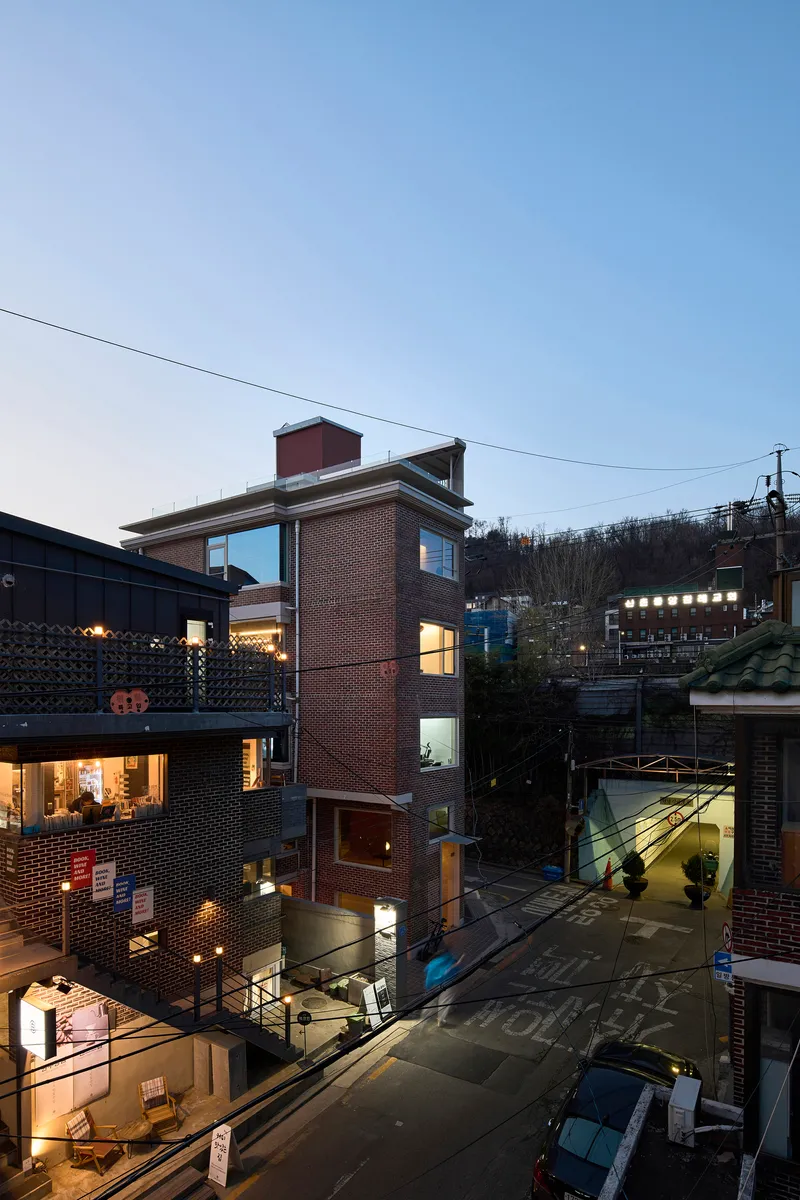
The before-and-after street views tell the whole story in a glance. The original house was a compact brick box, its windows punched in at regular intervals, its roofline receding behind neighboring walls. skimA's intervention added a vertical slice of building on the corner, taller than the existing structure and clad entirely in metal fins. Rather than trying to match the old brickwork or conceal the seam, the architects celebrate the collision. Brick stops, metal begins, and the joint between them is precisely where the new circulation happens.
The slenderness of the tower is striking when seen from across Yeonnam-dong's rooftops. Wedged between neighbors, it rises like a periscope, pulling daylight down through its screened walls and giving the upper floors views over the surrounding low-rise fabric.
Brick, Metal, and the Logic of Layering
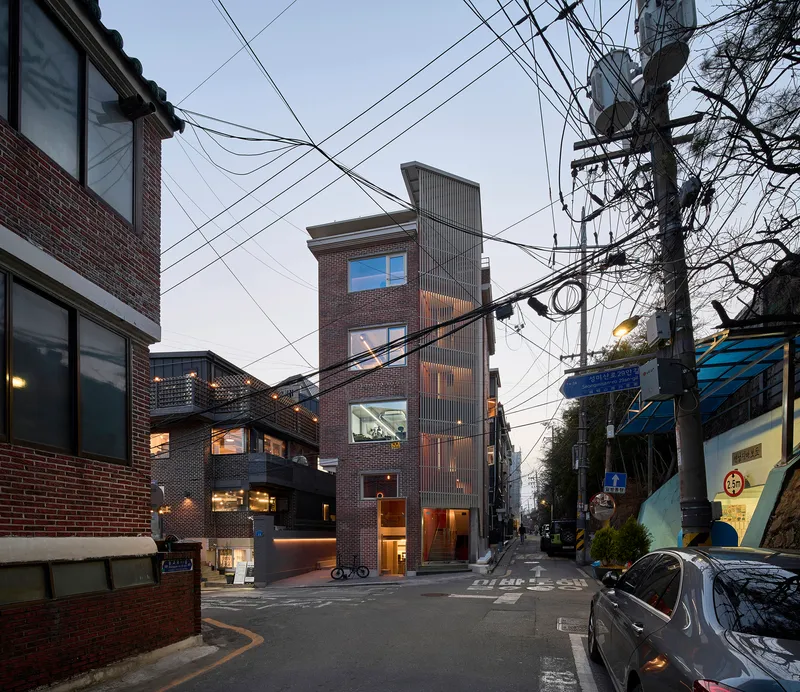
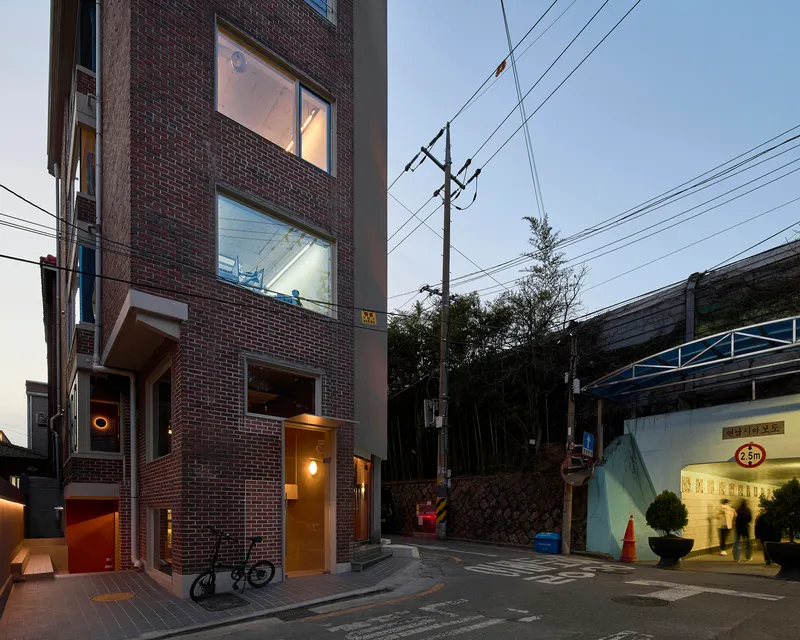
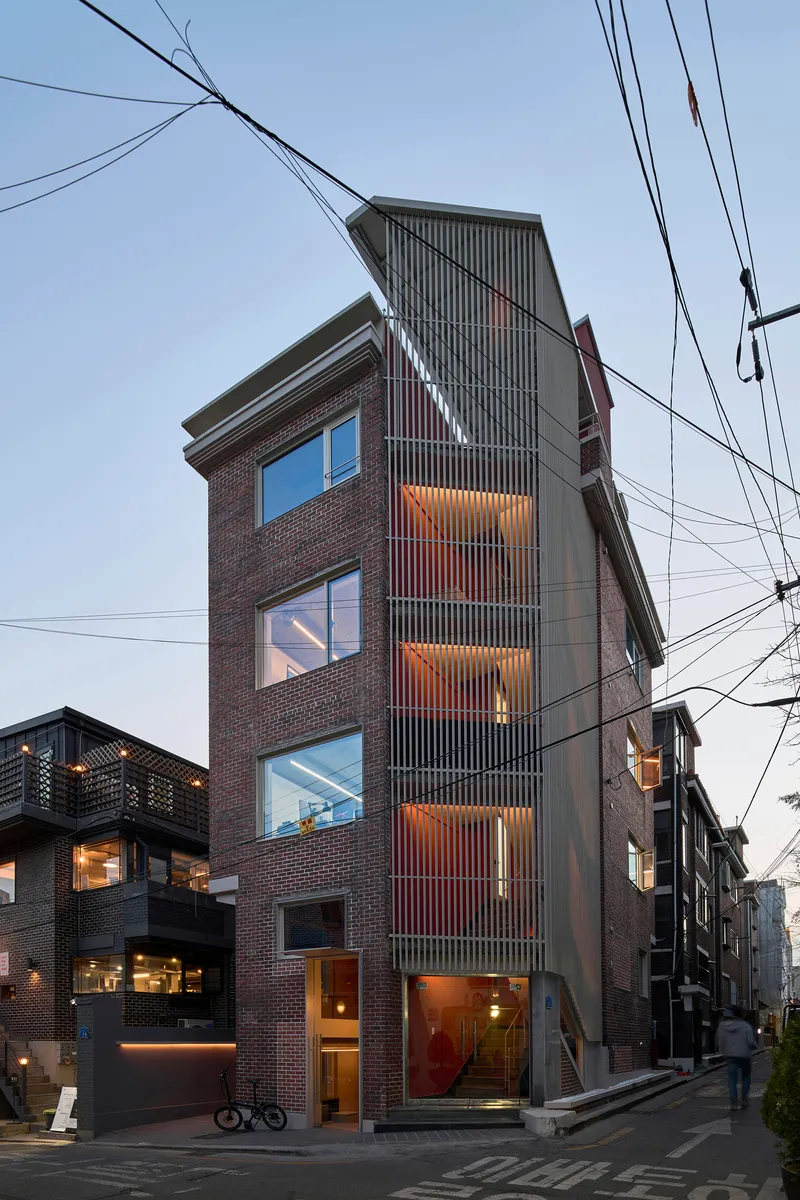
The facade materials are simple: red brick for the retained volume, corrugated and perforated metal for the new one. But the effect depends on the hour. In daylight, the brick dominates and the metal tower almost disappears against the sky. At dusk, interior light floods through the slat screen and the tower becomes a lantern while the brick turns mute. This reversal is not accidental. The metal fins are oriented to maximize transparency from oblique angles, so pedestrians walking along the sloped street see more of the interior the closer they get.
The entrance canopy, a minimal steel plate projecting from the brick wall, is the only element that bridges the two materials. Everything else is deliberate contrast: rough mortar joints against clean metal seams, punched openings against continuous screens.
A Stairwell That Does Double Duty
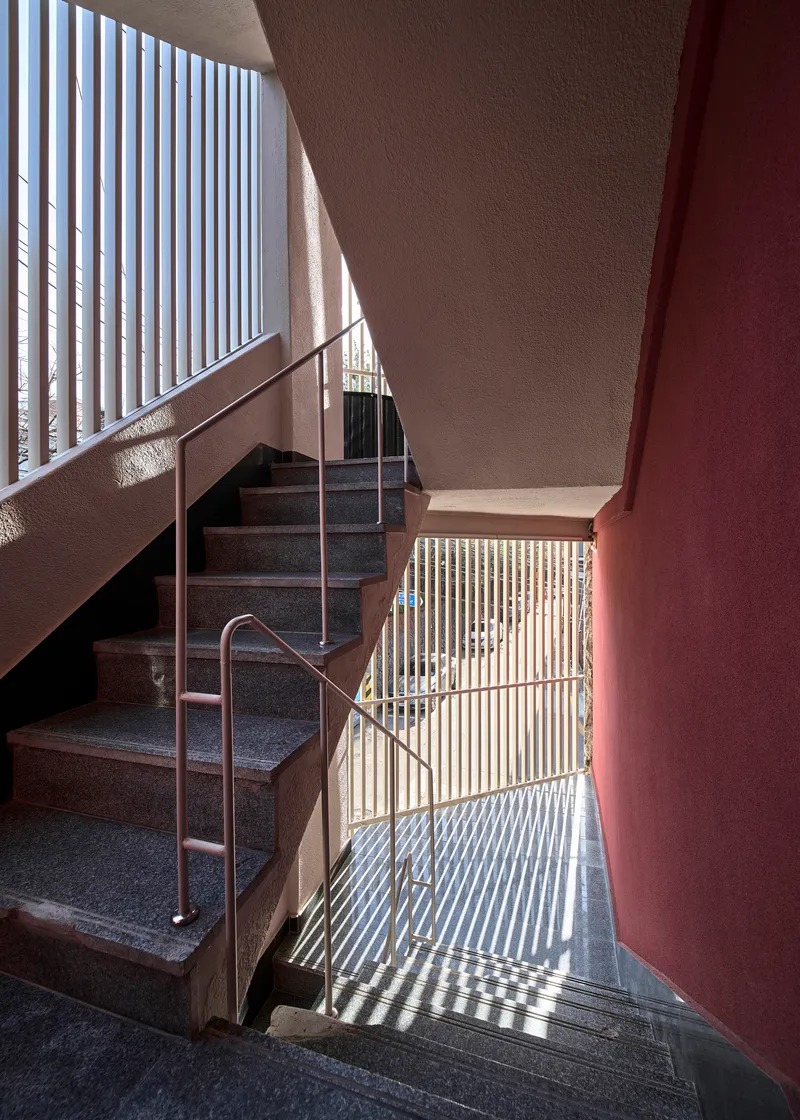
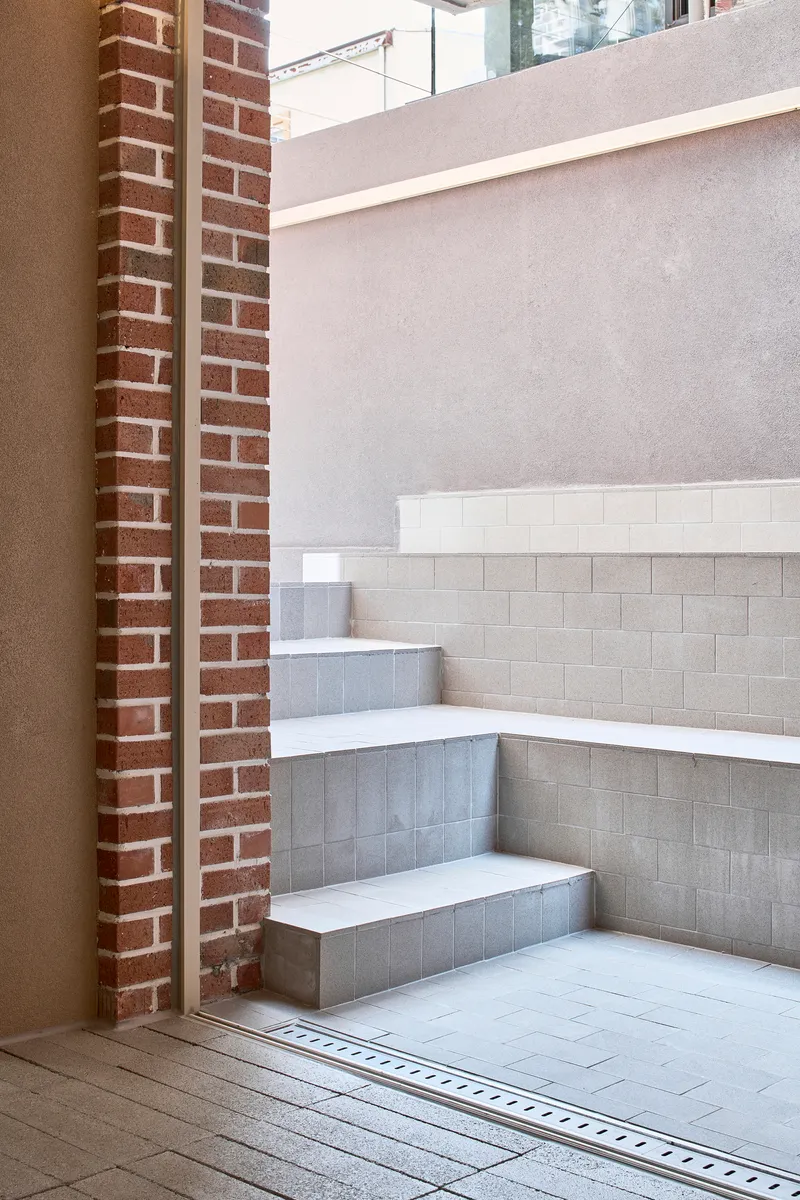
The new stair tower is where the project's ambitions are most visible. Terrazzo steps, maroon-painted walls, and vertical slat screens work together to create a circulation space that feels generous despite its narrow footprint. Light enters through the metal fins and arrives on the treads as sharp, striped shadows that shift through the day. The stairwell is not just a fire escape bolted on; it is the social spine of the building, visible from the street and readable as a signal that each floor is accessible independently.
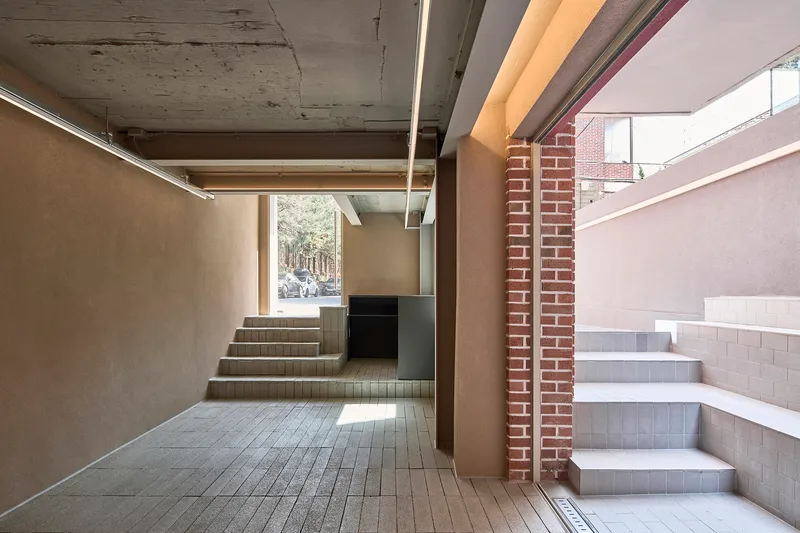
At ground level, the entry hall reveals exposed concrete ceiling beams and a brick column flanked by two tiled staircases. The material palette here, raw concrete above, white tile below, signals the transition from the old structure overhead to the new insertions underfoot.
Interior Rooms and the Corner Window
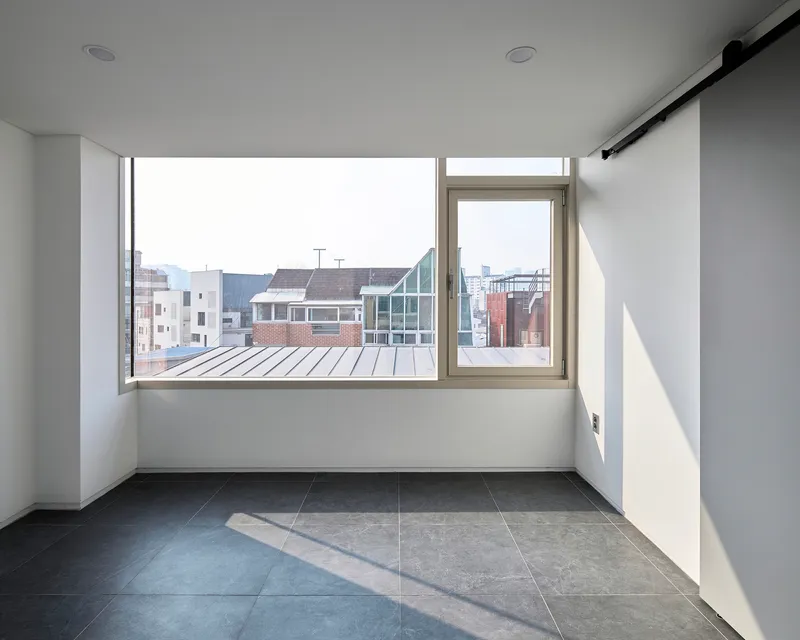
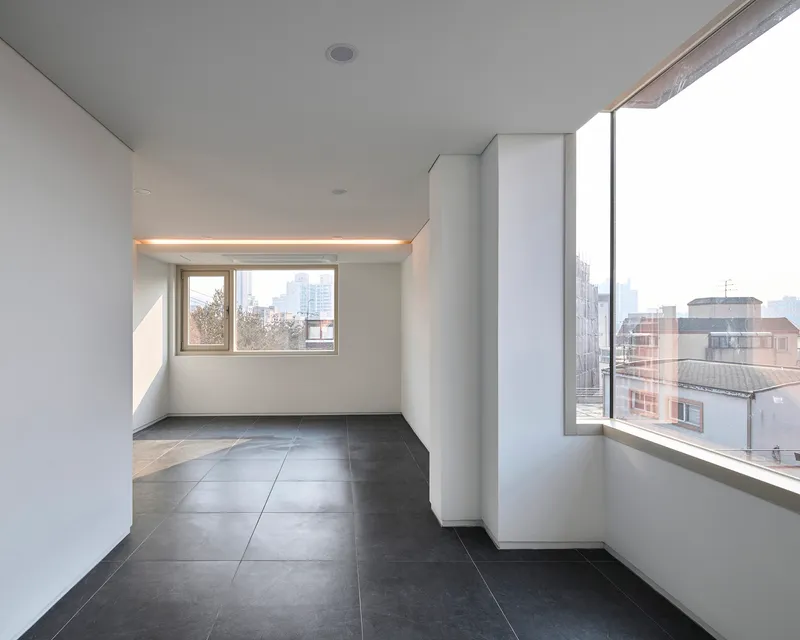
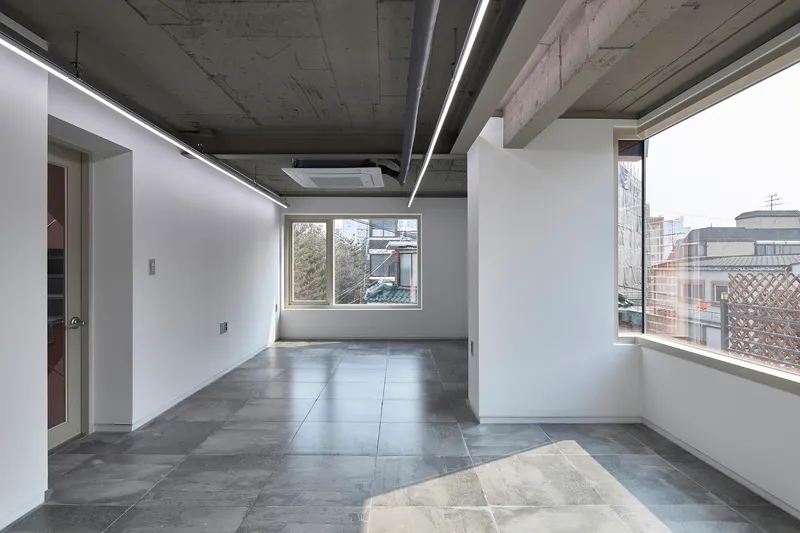
Inside, the floors are stripped to their essentials. Large-format grey tiles, exposed concrete soffits, and integrated linear lighting define the cafe and office levels without unnecessary ornament. The most effective move is the corner window on the upper floors: two glazing planes meeting at the building's edge, framing a panorama of neighboring brick and glass facades. It is a simple detail, but in a neighborhood of opaque party walls, it makes a small room feel twice its size.
The angled window walls on the residential floor use a similar strategy at a smaller scale. A narrow horizontal slit beside a taller opening creates layered depth, pulling light into the room from two heights. Linear lighting integrated into the wall joint above the slit ensures the composition reads clearly after dark.
Material Details Up Close
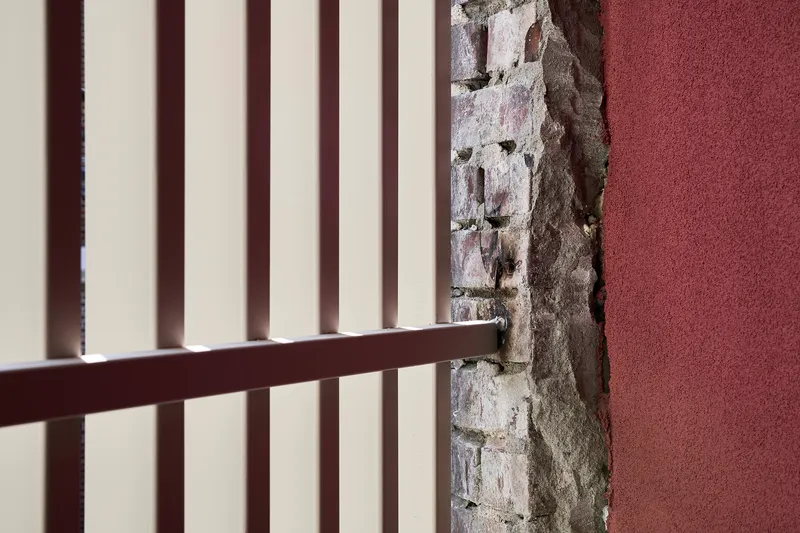
The junction between the maroon metal railing and the exposed whitewashed brick wall is worth a second look. The mortar joints are deliberately rough, the brick surfaces left unfinished, and the railing sits proud of the wall on visible standoffs. skimA treats the old and new as co-equal: neither is hidden, neither is dominant. The whitewashed brick reads as a halfway point between the raw red exterior and the clean painted interiors, a transitional material that mediates the building's two identities.
Plans and Drawings
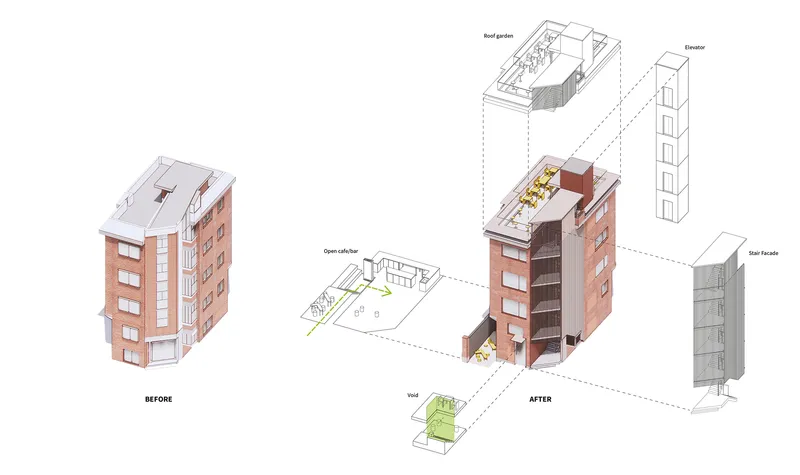

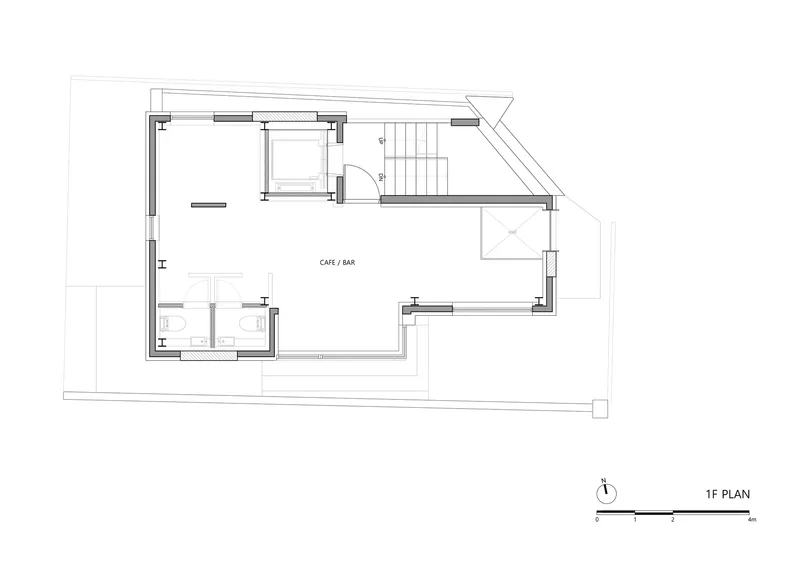
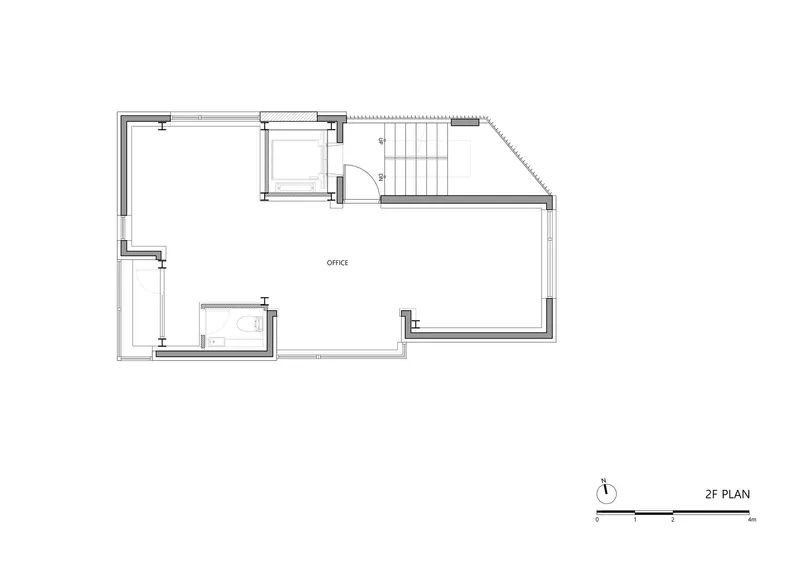
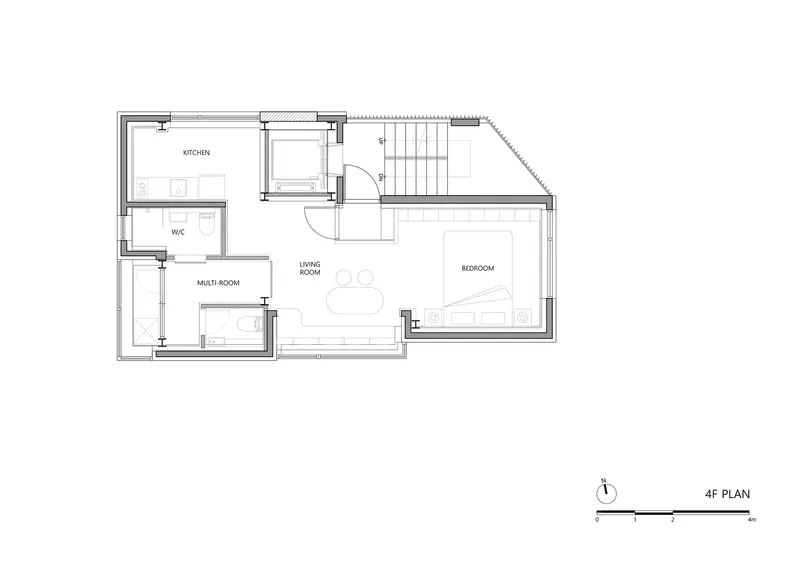
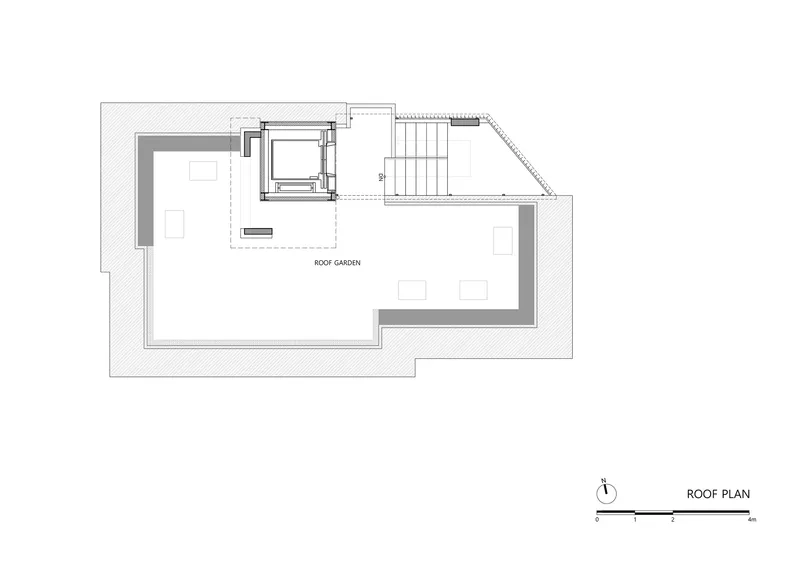
The axonometric drawing makes the surgical nature of the intervention unmistakable. The existing volume is left almost entirely intact while a narrow vertical tower is appended at the corner, containing the new stair and servicing every level. The ground-floor plan reveals a cafe and bar organized around a curved corner facade, while the upper levels shift from open office space to a compact apartment with kitchen, living room, bedroom, and a multi-room. A roof garden and skylight crown the top, giving the residential floor access to outdoor space in a neighborhood where private terraces are rare.
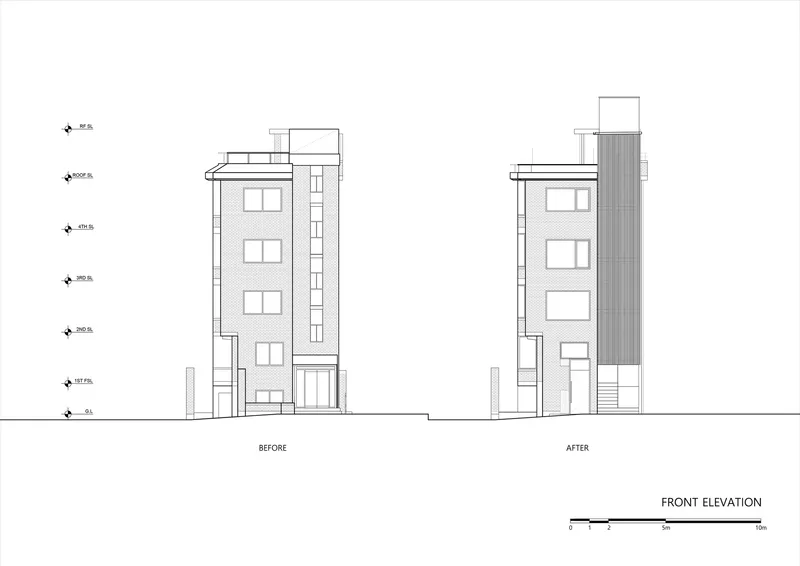
The front elevation comparison, before and after, is the clearest diagram of skimA's thesis: do not demolish, do not disguise, just add the missing piece. The new tower gains one storey over the original roofline, enough to assert its presence on the street without overpowering the block.
Why This Project Matters
Yeonnam-dong's transformation is happening building by building, mostly through interior fit-outs that leave the street unchanged. YN241 proposes something more legible: a renovation that announces itself structurally, adds a distinct material layer, and reorganizes the section so that commercial, professional, and residential uses can coexist vertically. In a neighborhood where land is expensive and lots are tiny, the decision to build up rather than out, and to do so with a circulation tower barely wider than a staircase, is a pragmatic lesson in urban density.
The project also demonstrates that material honesty does not require material uniformity. Brick and metal, old and new, rough and precise: each layer retains its identity, and the building is more interesting for it. For architects working on small-lot mixed-use conversions in Seoul and beyond, YN241 offers a compact, replicable strategy that treats the existing structure as an asset rather than an obstacle.
YN241 Mixed Use Building by skimA (Sejin Kim Architectural), Mapo-gu, Seoul, South Korea. 292 m², completed 2022. Photography by Jinbo Choi.
About the Studio
Share Your Own Work on uni.xyz
If projects like this are the kind of work you want to make, uni.xyz is a place to publish your own, find collaborators, and enter design competitions.


Popular Articles
Popular articles from the community


Cube Design Draws an Ecological Corridor Between Two Shenzhen Hills with the Nankai Building
Beside Shenzhen's container docks, the Nankai Building pairs stacked balconies with a climbing green screen to connect two hillsides across its height.

FCC Arquitectura Expands a Portuguese Granite House with a Board-Marked Concrete Wing
In Portugal, JV House pairs a cleaned-up whitewashed and granite dwelling with a timber-shuttered concrete extension, courtyards and a garden pool.

ETEH Reworks the Shared Spaces of São Domingos School in Brazil Around Timber, Color and Hanging Plants
At São Domingos School in Brazil, 436 m² of hall, refectory and library are recast with timber joinery, a yellow and blue code and trailing greenery.

Manzana Morphosis: Stretching Barcelona's Grid into a Living Landscape for 2050
A radical reworking of the Eixample manzana turns density into a tool for generous public space, vertical ecology, and environmental performance.

Similar Reads
You might also enjoy these articles

LAVA Architecten Gives Vocational Education a Sawtooth-Roofed Face on a Mechelen School Campus
In Mechelen, Belgium, a 2,053 m² STEM school on a 6×6 m grid turns workshops and classrooms into rooms that can be rearranged as teaching changes.

KEMA Studio Turns a Derelict Marvila Attic into a 60 m² Lighthouse Apartment Above Lisbon
In Lisbon's Marvila district, a rebuilt roof, four skylights and two plywood volumes turn an unlivable attic into a bright home facing the Tagus.

Pixel Gardens: One Repeated Module Stacked Into a Terraced Social Housing Tower for Famagusta
Salem Bader's shortlisted housing tower builds a vertical neighbourhood from one repeated module, offsetting units to carve terraces, light and air.

Bao Huynh Watercolor Atelier: A Serene Art Retreat in Hội An
Bao Huynh Watercolor Atelier in Hội An blends multifunctional art spaces, sustainable design, local materials, and family-friendly living in a serene environment.

Explore Mixed-Use Competitions
Discover active competitions in this discipline

Challenge to reimagine the Iron Throne

Photograph architecture without architects

Illustrate the lost glory of Angkor Wat - Render Challenge

Design challenge to reuse E-waste
Comments (0)
Please login or sign up to add comments
No comments yet. Be the first to comment!