
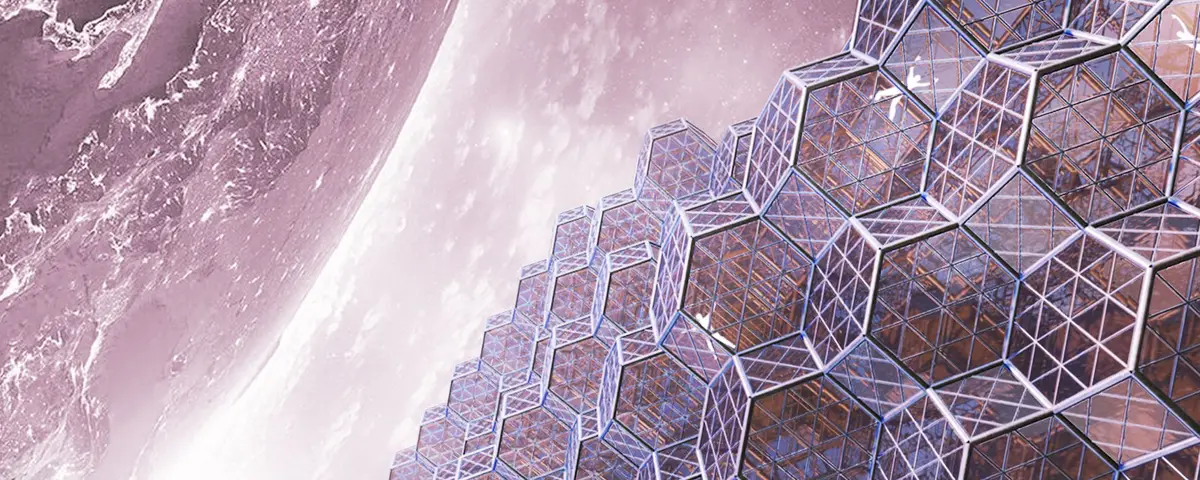
Space Cloud: An Asteroid-Fed Lattice Habitat That Grows Cell by Cell in Zero Gravity
A shortlisted Origyn entry that mines asteroids for water, air and structure, stacking two-person cells into a self-sustaining, ever-expanding lattice.


Most speculative space habitats begin with a hull: a sealed vessel shipped from Earth and defended against the void. Space Cloud begins with a supply chain instead. Its premise is that a settlement in orbit should be assembled from what floats nearby, so the asteroid becomes quarry, reservoir and farm in one. The architecture that results is less a building than a growing cluster of cells, each one plugged into a loop of sun, water, oxygen and food, and each one capable of adding a neighbour when the population demands it.
Designed by Beyza Çapal and Sıddıka Kulu, the project was a shortlisted entry in the Origyn competition, which asked participants to imagine life in a place where the usual limits of time and space fall away. The designers answer with a modular system pitched as cost-effective and scalable, one that treats resource management as part of the architectural framework rather than a service bolted on afterward. Their vision of Origyn is labyrinthine and open-ended: automation handles labour, and inhabitants are left free to explore, build and dream.
A Life-Support Loop Drawn as a Single Line
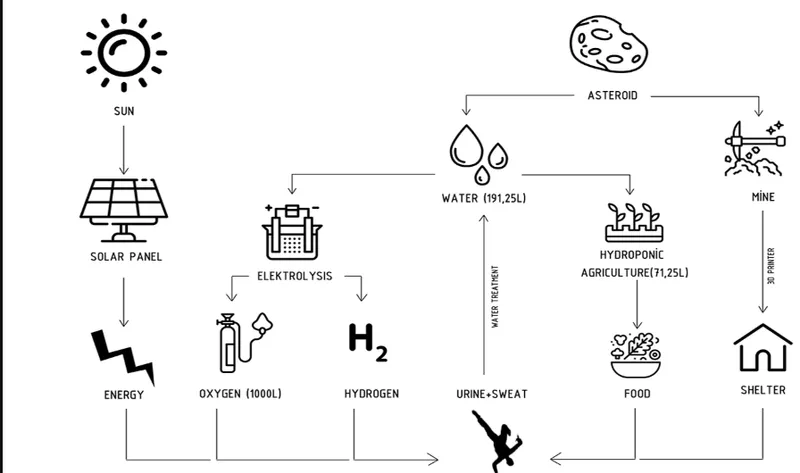
The flow diagram is the project's real site plan. It traces three inputs, the Sun, asteroid water and mined material, through solar power, electrolysis, hydroponics and printed shelter until they converge on a lone human figure. The sequence is rigorous: solar panels supply energy, electrolysis splits harvested water into oxygen for breathing and hydrogen that the designers redirect toward radiation protection, hydroponic systems grow food in nutrient-enriched water, and asteroid material becomes structure. Recycling closes the circuit.
What makes this drawing persuasive is its economy. A by-product such as hydrogen is not waste here but shielding, and water is counted four times over, for drinking, hygiene, agriculture and air. By putting the person at the end of every line, the diagram argues that the habitat is defined by needs before it is defined by form, which is exactly the right order for an environment with no margin for error.
A Truncated-Octahedron Lattice That Expands Without a Boundary
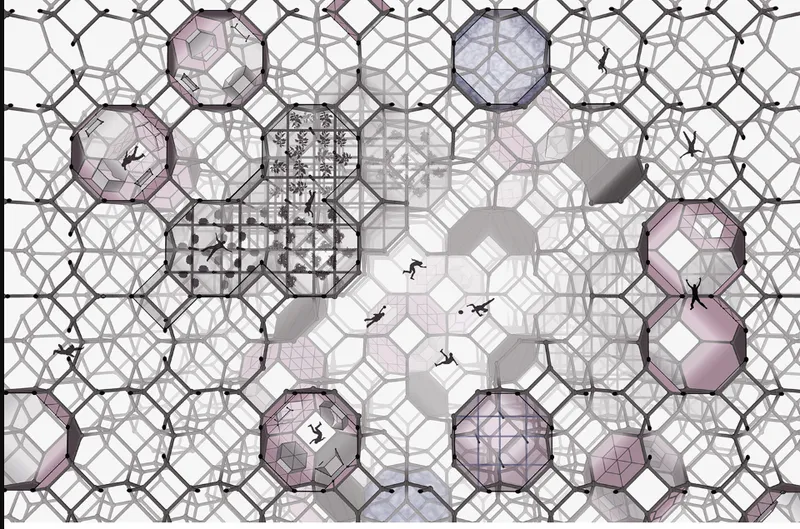
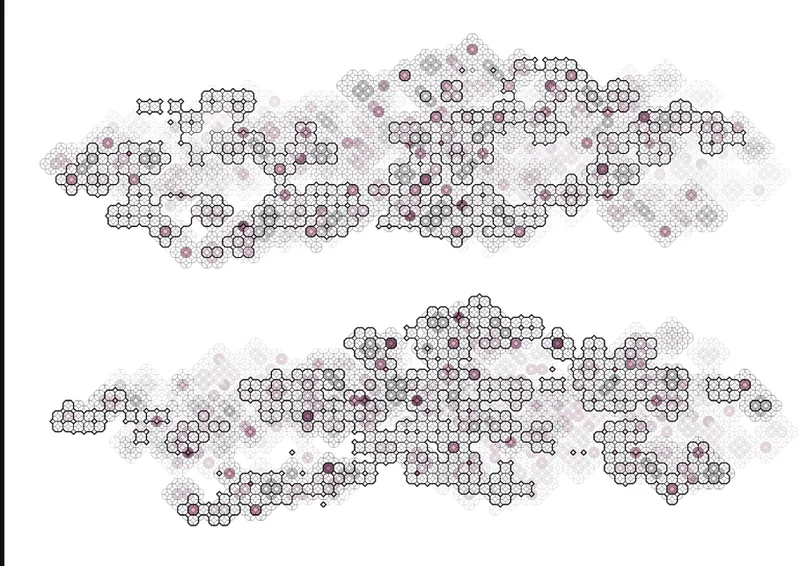
The plan-style drawing reveals the geometry underneath the idea: a lattice of truncated octahedrons, a space-filling solid that packs without gaps and lets every cell meet its neighbours on flat faces. Pink-tinted cells, planted modules and tiny floating figures sit in a pale void with no ground line and no edge. Freed from Earth's gravitational constraints, the designers can propose structures that are expansive yet lightweight, and the drawing makes clear that the cluster can keep accreting in any direction.
The two site plans pull back further, showing honeycomb cells gathered into elongated masses, outlined in black and patched with pink and grey tones. Read together, these drawings explain the programme distribution: compact shelter units for two people, each fitted with sleeping units, toilets and cleaning facilities, interspersed with agriculture units and dedicated water and oxygen units that store, treat and supply resources. The tonal patches suggest a mixed fabric rather than zoned districts, a city where food, air and sleep sit side by side and grow together.
Inside the Cells: Vines, Steel Frames and Weightless Bodies
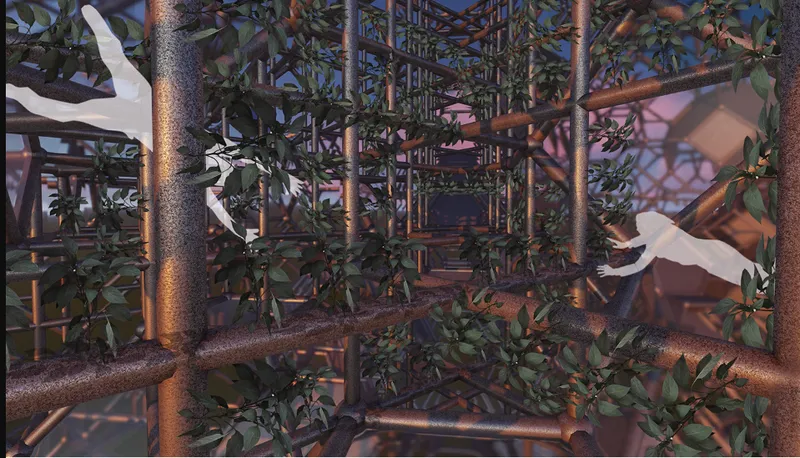
The interior renders are where the system turns into atmosphere. In the first, a rusted steel tube frame is overgrown with leafy vines while white figures reach through the openings at dusk. The hydroponic agriculture pipes described in the brief read here as a living lining, turning structure into trellis. It is a welcome counterpoint to the sterile white capsules that dominate space imagery, and it hints that the agriculture units double as the habitat's landscape.
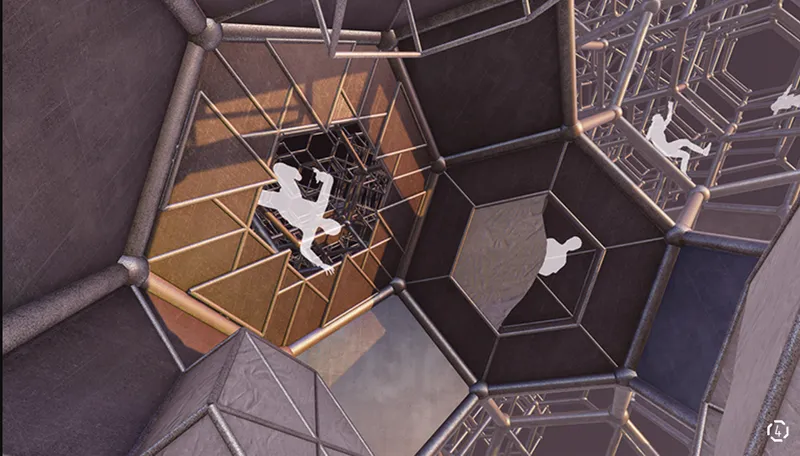
The second render looks upward through faceted polyhedral cells framed in metal, with figures drifting in amber light. Without gravity, there is no floor and no ceiling, only a vertical labyrinth that occupants move through freely. This is the Origyn vision made spatial: a maze that evolves with human experience, where the geometry of the lattice becomes the circulation itself and every face of a cell is a potential threshold.
Why This Project Matters
Space Cloud is valuable because it treats architecture and life support as the same problem. The designers do not design a shell and then ask how to feed it; they design a metabolic loop and let the shelter emerge from it, cell by cell, from material mined a short distance away. The choice of a space-filling polyhedral module gives that loop a convincing spatial logic, one where adding capacity is simply adding another cell to the cluster.
The project leaves open questions, from how cells are joined to how the labyrinth is navigated, but its central proposition is sharp. Settlements beyond Earth will likely be built from local resources and grown incrementally, and Çapal and Kulu show what that could feel like from the inside: overgrown, weightless and unfinished by design. For a competition about imagining new origins, that is a fitting place to start.
View the Full Project
About the Designers
Designers: Beyza Çapal, Sıddıka Kulu
Enter a Design Competition on uni.xyz
uni.xyz runs architecture and design competitions year-round that reward proposals with spatial conviction and real site intelligence.
Project credits: SPACE CLOUD by Beyza Çapal, Sıddıka Kulu Origyn (uni.xyz).


Popular Articles
Popular articles from the community


Manzana Morphosis: Stretching Barcelona's Grid into a Living Landscape for 2050
A radical reworking of the Eixample manzana turns density into a tool for generous public space, vertical ecology, and environmental performance.


FCC Arquitectura Expands a Portuguese Granite House with a Board-Marked Concrete Wing
In Portugal, JV House pairs a cleaned-up whitewashed and granite dwelling with a timber-shuttered concrete extension, courtyards and a garden pool.

Cube Design Draws an Ecological Corridor Between Two Shenzhen Hills with the Nankai Building
Beside Shenzhen's container docks, the Nankai Building pairs stacked balconies with a climbing green screen to connect two hillsides across its height.

David Ortega Stacks a Two-Story Mexico City Penthouse Around a Steel Stair and a Pergola-Shaded Roof Terrace
In Colonia Roma, a 300 m² penthouse uses oak joinery, a planted steel stair and a slatted roof pergola to make a new-build apartment feel like a house.

Similar Reads
You might also enjoy these articles
Healing Façade: A Modular Chapel System That Restores Ethiopia's Sacred Forests
Winner of the Eco-Chapel competition, this circular timber façade collects water from air to rebuild soil and reforest degraded Ethiopian landscapes.
Kaffeebühnen: Where Coffee Shop Architecture Becomes a Civic Stage in Vienna
A linear sequence of timber boxes, transparent shells, and open yards turns the Viennese café tradition into a public performance space.
Eco Chapel: A Modular Forest Pavilion That Grows Like the Landscape It Protects
Hexagonal timber modules weave through existing trees, turning a chapel into a living system for prayer, education, and reforestation.

Urban Forest: A Vertical Ecosystem for 5,000 Workers in Singapore's Changi Business Park
Radially stacked pods and layered green decks turn a 7-acre plot into 47 acres of ecological workspace projected for 2040.

Comments (0)
Please login or sign up to add comments
No comments yet. Be the first to comment!