
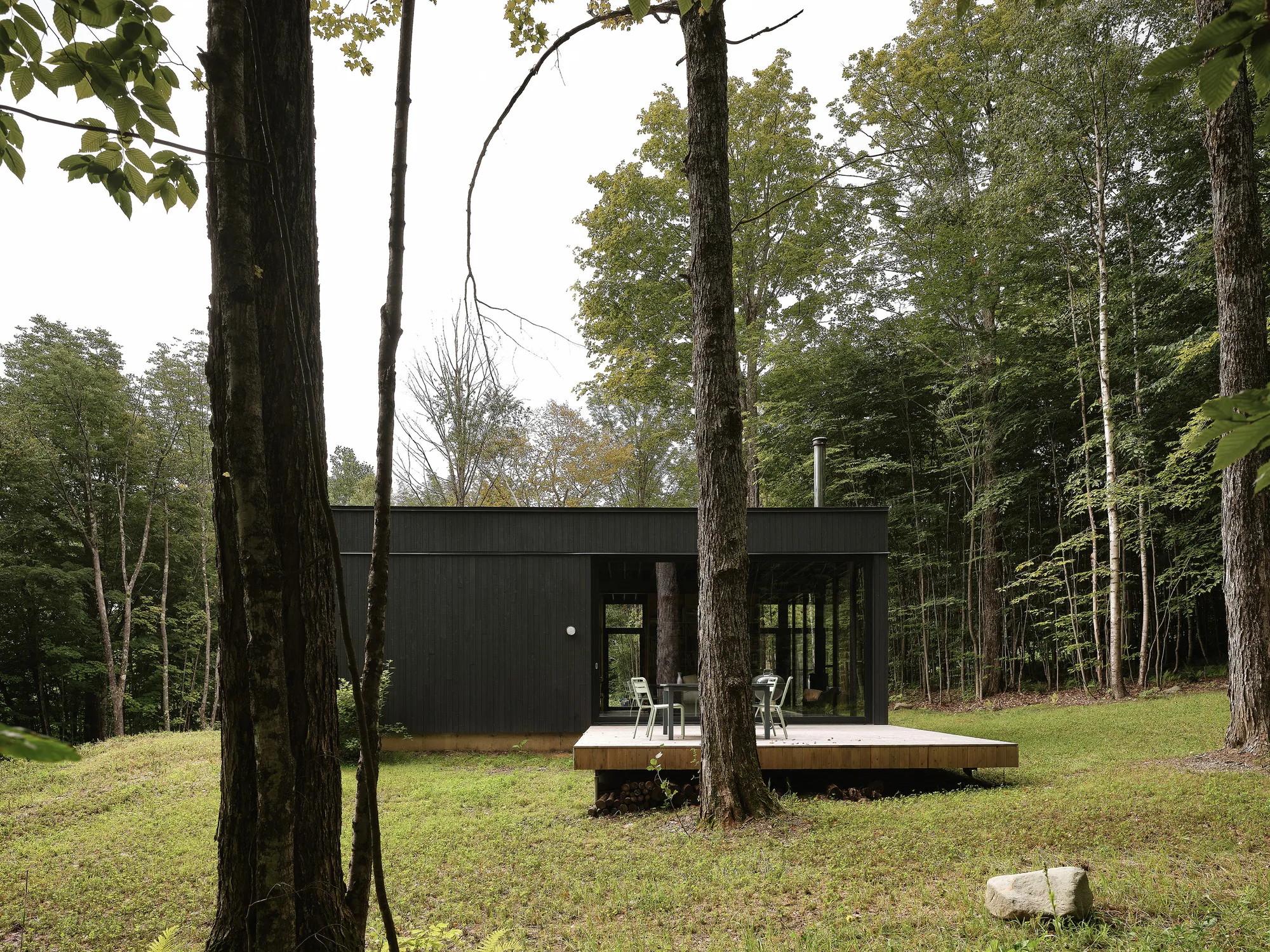
Spinone House by Jérôme Lapierre Architecte: A Minimal Wooden Refuge Immersed in the Quebec Forest
Spinone House by Jérôme Lapierre Architecte is a minimalist wooden cabin embracing simplicity, craftsmanship, and harmony with Quebec’s forest landscape.


In the quiet municipality of Canton de Potton, Canada, Spinone House by Jérôme Lapierre Architecte emerges as a delicate balance between architecture and landscape, where simplicity, structure, and nature intertwine. Inspired by the contemplative atmosphere of its forested site, the home reinterprets the timeless idea of the wooden cabin—a retreat that honors material honesty, sustainable living, and connection to place.
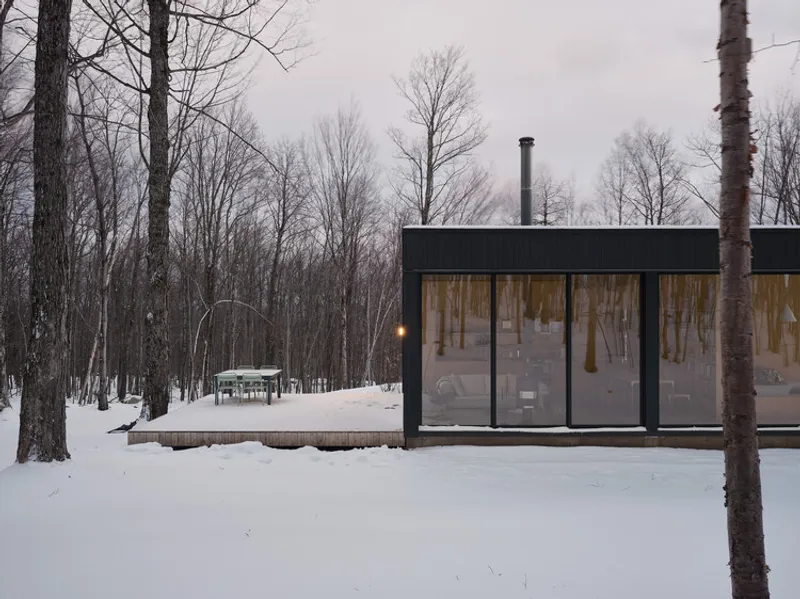
This 1,000-square-foot residence stands not as an imposition upon nature but as a measured gesture of integration. The project’s strength lies in its modesty, its quiet geometry, and its clear dialogue between interior warmth and the untamed beauty of the forest.
An Architecture of Intimacy and Awareness
Nestled among trees and boulders, Spinone House sits gently atop its site, its minimal footprint designed to preserve the land’s natural contours. Its orientation and placement stem from a deep respect for existing vegetation and topography. Rather than opening dramatically to distant views, the architecture seeks proximity and introspection.
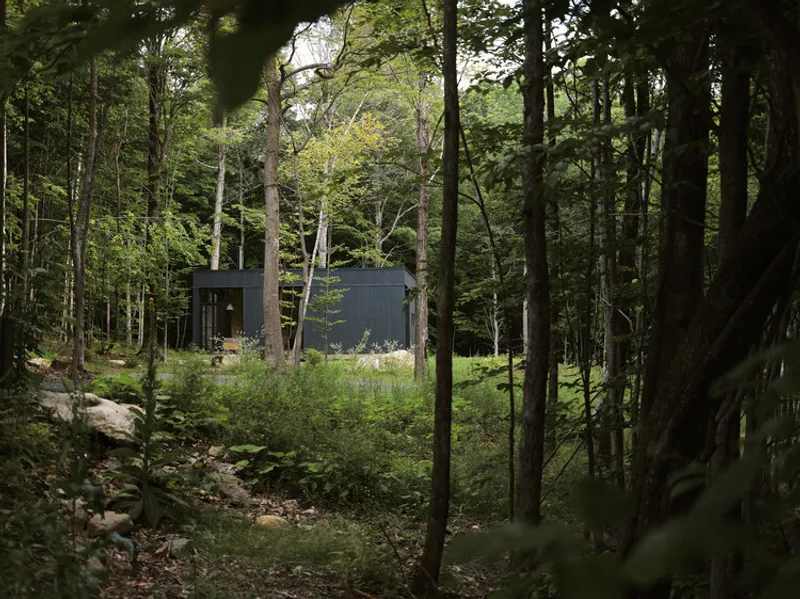

The design follows an introspective approach, exploring how architecture can foster intimacy with the surrounding forest. Inside, spaces draw attention inward, framing close-up views of trunks, rocks, and shadows. The result is an atmosphere of serene isolation and quiet belonging—a refuge for reflection amid wilderness.

The home embodies the principle of “doing more with less.” Each line, material, and proportion serves both aesthetic clarity and environmental purpose, demonstrating that restraint can be the most eloquent expression of beauty.
A Wooden Cabin for Contemporary Living
Spinone House is a modern reinterpretation of the Canadian cabin, defined by its structural rigor and material sincerity. Its timber frame and cedar cladding blur the boundaries between architecture and forest. The design celebrates wood not as decoration but as structure and soul.

The main living space forms the heart of the house: a fully glazed volume that opens to the forest and extends onto a terrace. This spatial continuity dissolves the boundary between inside and outside, allowing natural light to flow and seasons to animate the interior.


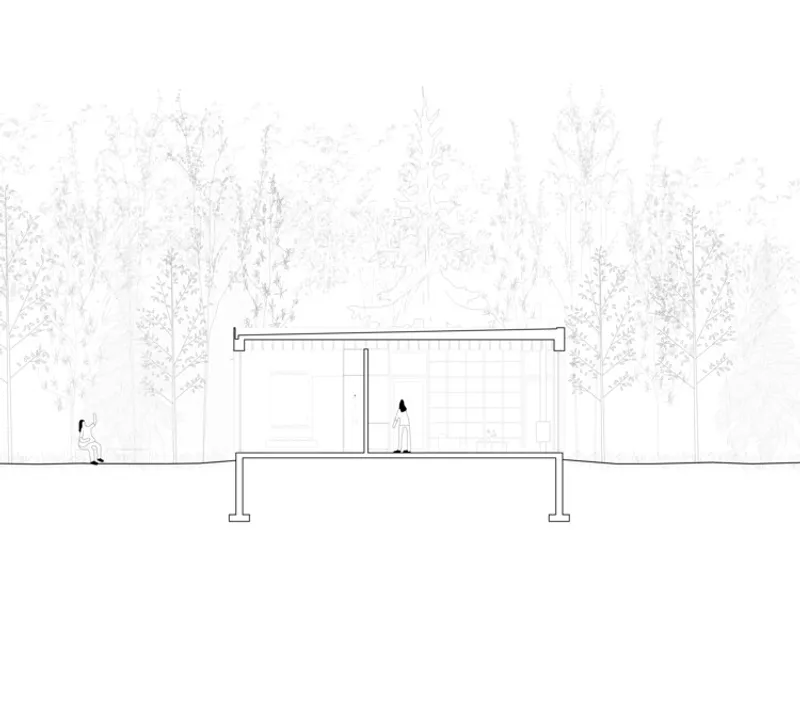
The architects’ use of a central functional core—a band of built-in furniture—maximizes efficiency, concealing utilities while maintaining clear visual order. The core includes the kitchen, storage, and technical systems, integrating them seamlessly without disturbing the purity of space.
This central element anchors the home’s plan, dividing the layout into two domains:
- The social space, connected with light and landscape.
- The private zone, designed for calm and retreat.
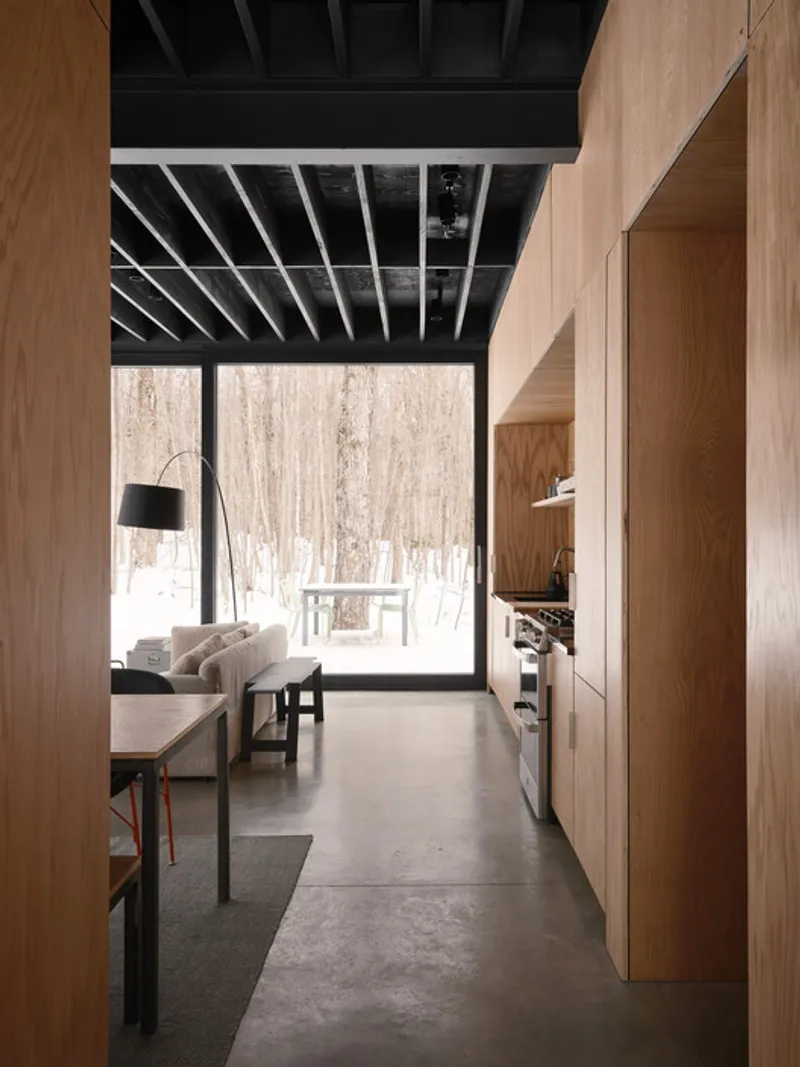
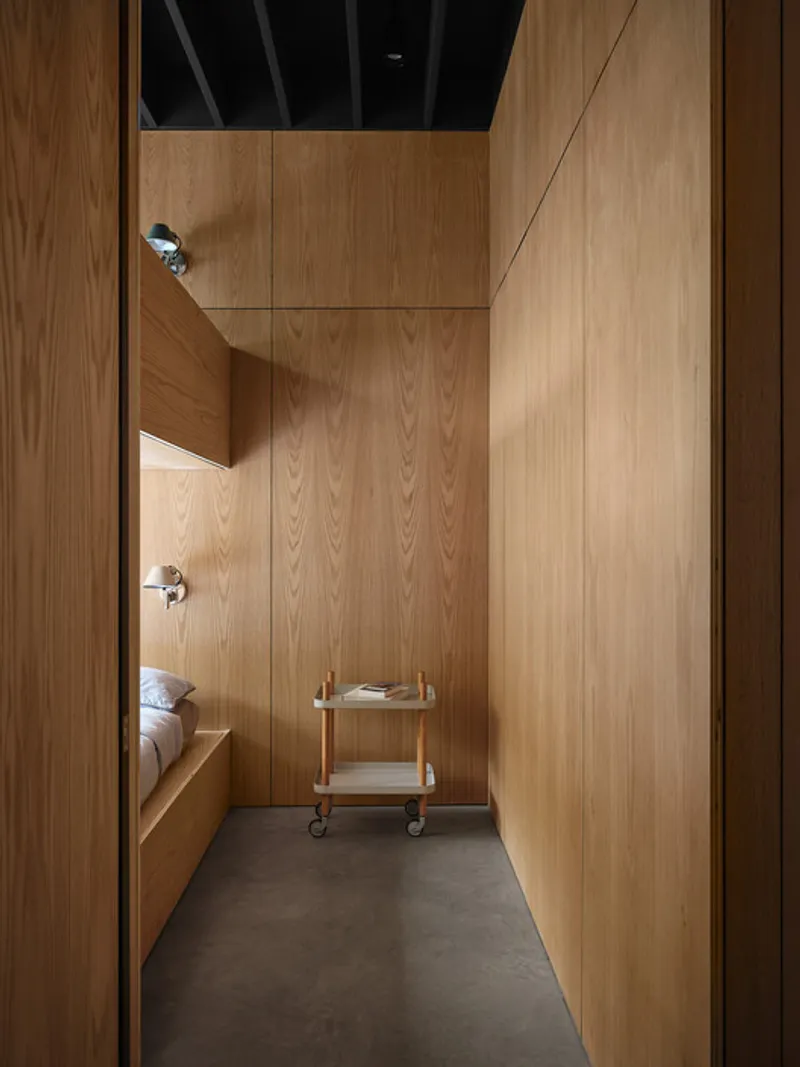
Each transition—from open to enclosed, public to private—is carefully choreographed. The low-ceiling threshold leading to the sleeping area amplifies the shift in atmosphere, emphasizing intimacy and enclosure. Two bedrooms flank a central zone of service spaces and bathrooms, creating a gradient of privacy that unfolds with human scale and rhythm.
Material Discipline and Craft
Material selection in Spinone House reflects a philosophy of architectural economy and artisanal precision. The structural grid dictates every component: corridor widths, joinery alignments, window positions, and door placements. This disciplined system minimizes material waste and refines construction logic, making the project both sustainable and tactilely expressive.
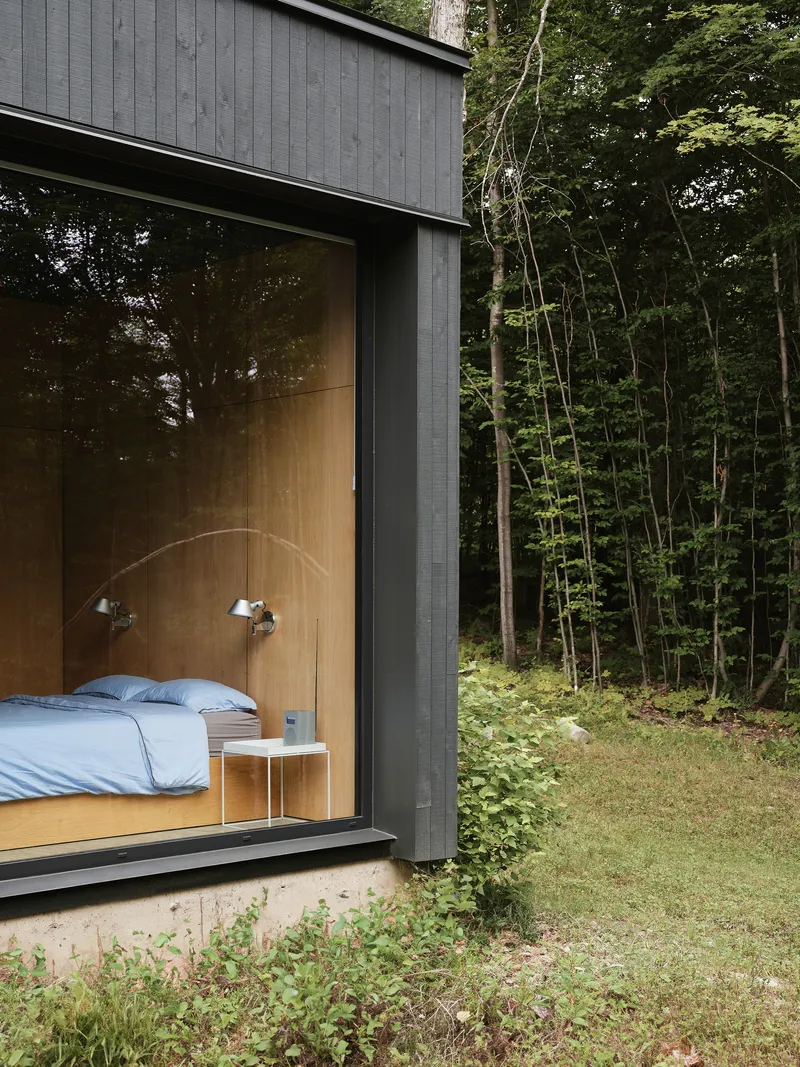

Unlike typical large-scale glue-laminated timber (glulam) constructions, the house relies on more frugal, locally sourced wood elements. This approach reduces overall environmental impact while honoring vernacular techniques.
From structure to finish, each decision celebrates the authenticity of materials:
- The wood is untreated, allowing natural aging and patina.
- The glass reflects forest light and movement.
- The steel details provide structure without ornamentation.

Inside, every joint, seam, and surface resonates with a disciplined calm. The result is an architecture that feels both elemental and exquisitely crafted—a fusion of minimalism and warmth.


Framing Nature and Light
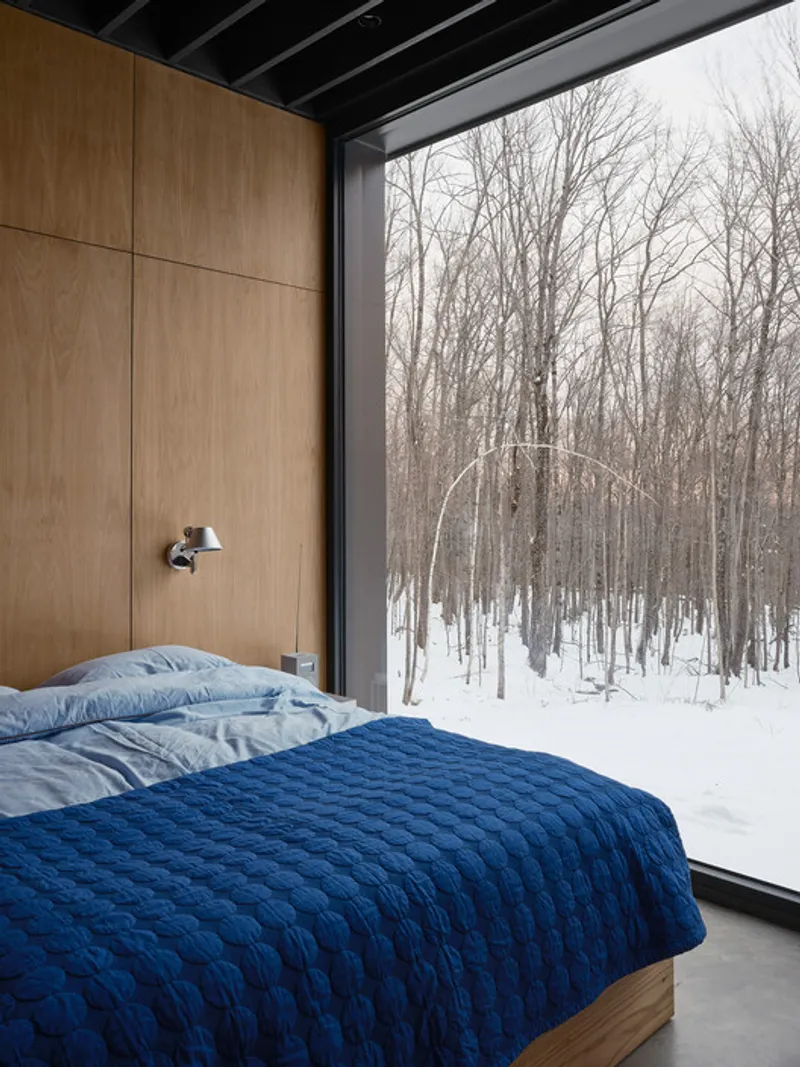
Light plays a central role in shaping the spatial experience. The glazed façade floods interiors with diffuse daylight while revealing constant shifts in the forest’s tone and texture. As daylight softens into evening, the cabin’s warm wood interior glows against the dark landscape—a lantern of intimacy surrounded by silence.

From the terrace, occupants experience the forest not as backdrop but as a living presence. Each window frames a fragment of nature—a trunk, leaf, or rock—transforming everyday life into a meditative act.
This careful orientation allows the house to breathe with the environment, responding naturally to shade, sunlight, and temperature variations, minimizing the need for mechanical conditioning.

Sustainability and Humility
Sustainability in Spinone House extends beyond energy efficiency to encompass integration, restraint, and endurance. Its compact footprint conserves materials and resources while maintaining comfort and flexibility. Passive design strategies—orientation, shading, and cross-ventilation—reduce the need for technology, emphasizing long-term resilience and simplicity.


The project embodies the idea that sustainable architecture begins with respect for context. In avoiding the urge to dominate the site, Jérôme Lapierre creates architecture that listens—architecture that belongs quietly to its landscape.
The Poetry of Simplicity
Ultimately, Spinone House transcends being a mere dwelling; it is an essay in measured living. Every design choice reflects a discipline of reduction—removing excess to allow space, light, and material to speak freely.
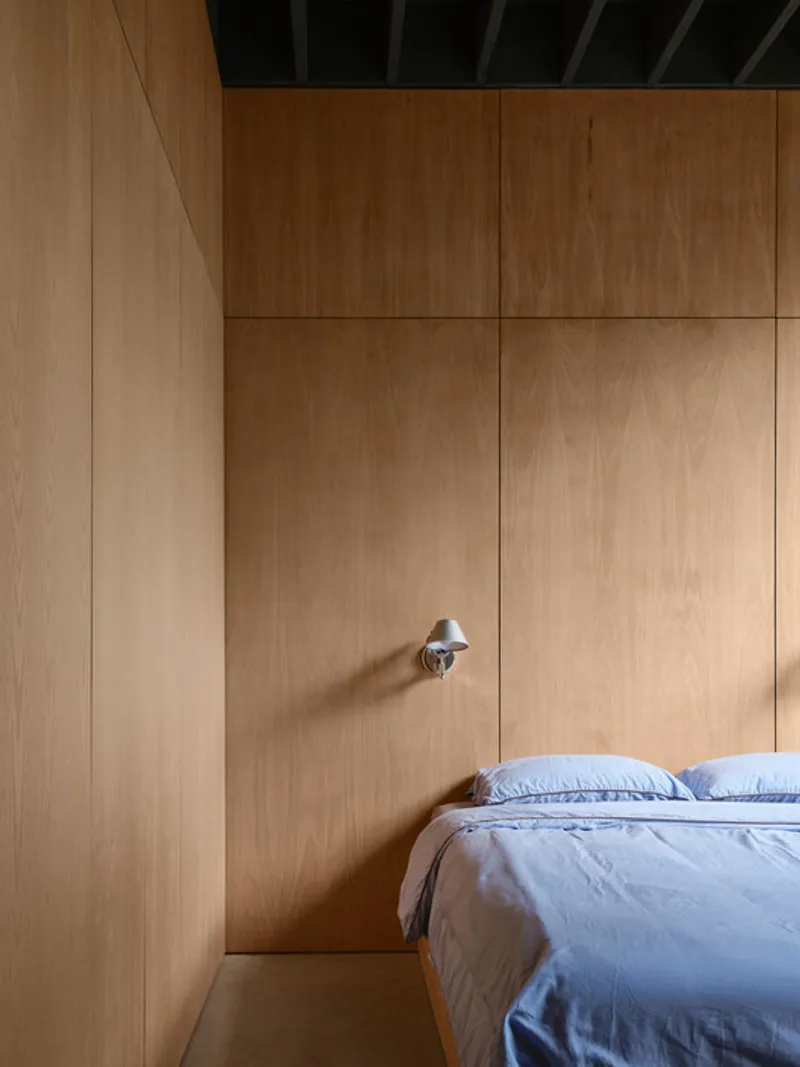

Its architectural language invites stillness rather than spectacle, beauty in proximity rather than panorama. Through its modest scale and precise craftsmanship, the project offers a model for contemporary rural architecture—where sustainability meets emotion, and humanity can rediscover its place within nature.
It is, as the architect describes, “a humble, poetic architecture—rooted in context and defined by restraint.”
All the photographs are works of Maxime Brouillet



Popular Articles
Popular articles from the community


Conexión: Biophilic Design Reimagines High-Rise Living in Hong Kong
Conexión reimagines high-rise living in Hong Kong through biophilic design, green facades, shared spaces, daylight, water and nature within.

Riyadh For All: Intergenerational Urban Design for Active Aging in Rabat
Riyadh For All reimagines urban design in Rabat with intergenerational co-living, adaptive courtyards, and Moroccan cultural exchange today.

The Earth Pod: 3D Printed Homes for Resilient Refugee Communities
The Earth Pod reimagines refugee housing through 3D printed homes made from clay, combining resilience, self-sufficiency, and rapid shelter.

Co-life: Sustainable Architecture for Age-Friendly Community Living
Co-life reimagines sustainable architecture for seniors through courtyards, rammed earth, shared gardens, and spaces designed for belonging.


Similar Reads
You might also enjoy these articles


Hodi-Mandai Geram
Project Function: Preservation and revitalization of the Intangible heritage and socio-spatial identity of the Hodi by Housing, Cultural Memory Center, Sacred Grove, landscape, local tourism economy


Olio Towers: A Mid-Rise for Performers That Fuses Housing, Rehearsal, and Stage
Located blocks from Houston's Theater District, this modular tower stacks living units around a central performance atrium.

Oasis: Modular Green Housing Carved into Dhaka's Urban Fabric
A shortlisted Plugin Housing entry reclaims unauthorized settlements in Dhaka with stepped concrete volumes, green roofs, and ventilation-driven design.

Black Hole: A Floating Megastructure for the Post-Physical Era
Emiliano Mazzarotto envisions a spherical, self-scaling arena where e-sports, digital hotels, and holographic stadiums replace traditional public space.


Explore Sustainable Living Competitions
Discover active competitions in this discipline



Challenge to reimagine the Iron Throne


Photograph architecture without architects


Illustrate the lost glory of Angkor Wat - Render Challenge


Design challenge to reuse E-waste
Comments (0)
Please login or sign up to add comments
No comments yet. Be the first to comment!