

STARS Lighting Design: Folding Industrial Wire Mesh into a Domestic Constellation of Light
Leto Design Studio folds industrial wire mesh like origami, pairing it with walnut, steel and wool so light breaks into star-like shadows.


Wire mesh is a material we usually notice only when it stands between us and something dangerous: a machine guard, a construction fence, a factory partition. STARS Lighting Design takes that defensive grid and asks it to do the opposite, to invite people closer. By folding the mesh into faceted, origami-like volumes and pairing it with walnut, stainless steel and organic wool, the project turns an object of exclusion into one of intimacy. The light it produces is the best argument for the idea: the folded grid scatters a soft constellation across nearby walls.
The series comes from Nastaran Radmanesh and Saman Khosravi of Leto Design Studio. They frame it as a family of luminaires rather than a single product: a stand lamp, a desk lamp and a ceiling lamp. Every version follows the same rule of material honesty. Nothing is concealed under heavy finishes, so the grain of the wood, the weave of the wool and the structure of the mesh stay legible. The designers treat this as a way of letting beauty emerge from the materials instead of applying it afterwards.
A Soft Landing at the Base of a Hard Material
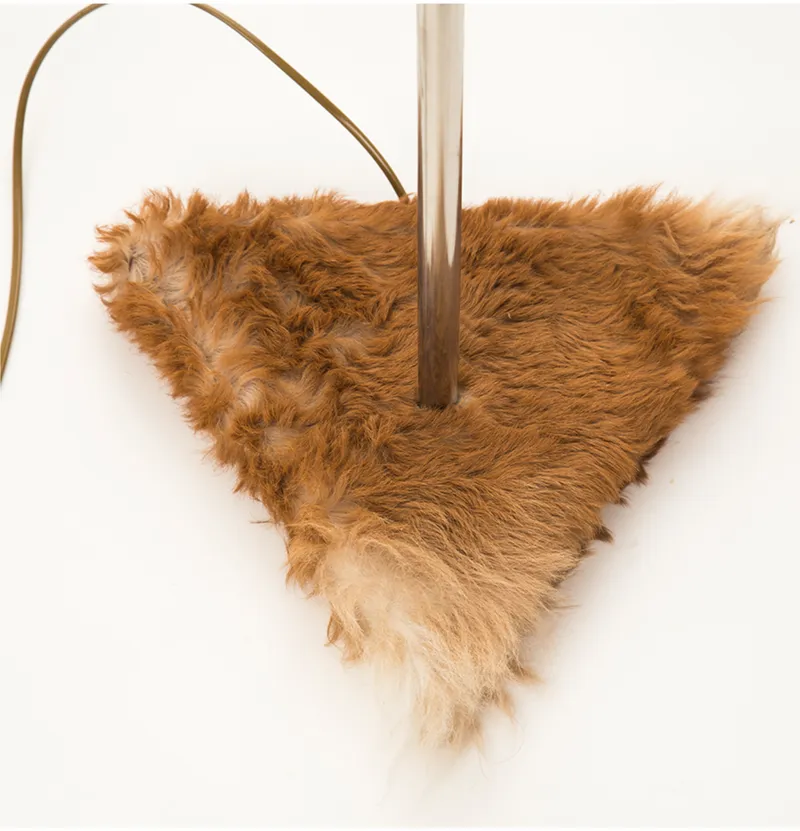
The most telling detail sits at floor level. A slim stainless steel stem rises through a triangular base wrapped in organic wool, and a cord loops casually behind it. The designers say they want to stage a dialogue between hard and soft, cold and warm, and the base is where that dialogue is clearest. Steel arrives at its most pared back just as it meets the most tactile material in the palette.
This matters for the lamp's place in a room. A floor lamp spends its life near feet, rugs and furniture legs, and a wool base reads as part of that domestic layer rather than a piece of hardware set down on top of it. The triangular footprint also prepares the eye for the angular geometry above. From the ground up, the lamp tells you it is built from facets.
Where Walnut Meets the Fold, and Light Escapes Through the Grid
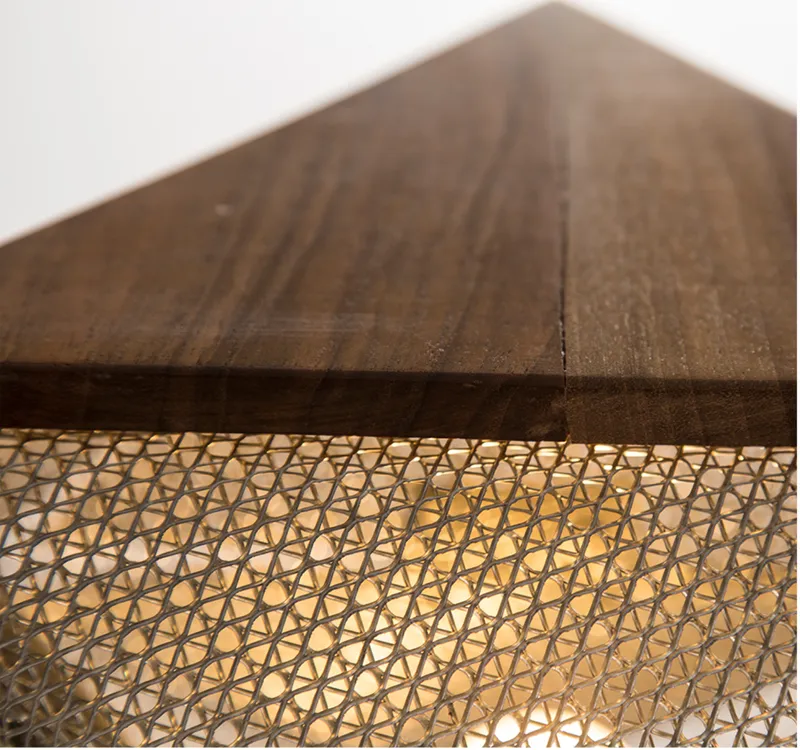
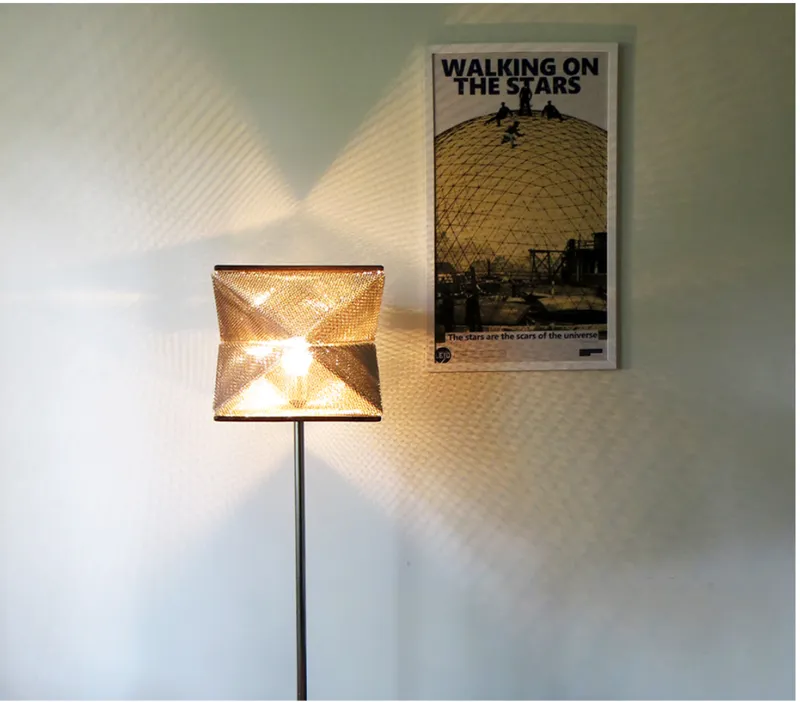
Up close, the walnut cap shows how carefully the material transitions have been managed. The wood forms a warm, solid edge above the folded mesh, giving the shade a defined top while the bulb glows through the grid below. Each layer of mesh thickens the surface visually, so light does not simply pour out. It passes through selectively, and the overlapping wires both diffuse it and cut glare. The result is an ambient glow rather than a point of brightness.
Seen from across the room, that filtering becomes the main event. The lit lamp throws a diamond shadow pattern over a pale wall, so its presence reaches well beyond its physical outline. The framed geodesic dome poster beside it is a fitting companion, since both rely on a triangulated logic to build depth from simple elements. This is where the name earns its meaning. Unlit, the folded shade still stands as a sculptural object. Lit, it turns the surrounding surfaces into part of the luminaire, which is why the designers suggest it for reading corners, galleries and intimate interiors where light is experienced and not only used.
One Folding Logic, Three Scales
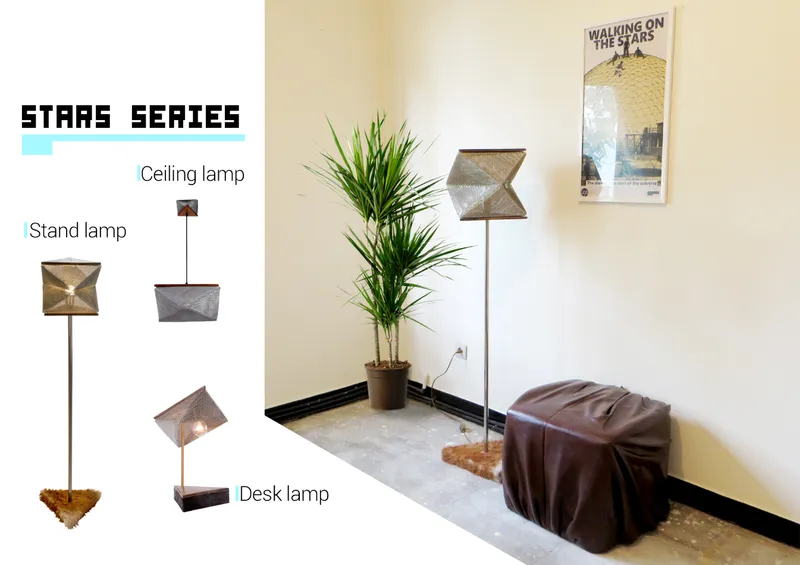
The series layout places the stand, desk and ceiling lamps side by side, and the consistency is notable. The stand lamp provides floor-based ambient light, the desk lamp serves closer, task-oriented settings, and the ceiling version gives the system a suspended architectural presence. Each keeps the same material logic and folded geometry, so the family holds together visually while answering different functional needs.
The photograph of the stand lamp next to a potted palm and a leather-draped stool shows how slender its vertical profile is. The source material stresses a balanced proportion between height and shade width, which lets the lamp fit compact and open interiors alike. Designing a series this way is more demanding than producing one striking object, because the fold has to read correctly whether it hangs overhead, stands at eye level or sits on a desk.
Furnishing a Room, Not Just Lighting It

The illustrated page sets the stand lamp, with its wool base, next to a nesting side table and a fur-draped chair. This is the most revealing image of the set, because it shows the designers thinking about an atmosphere rather than a catalogue item. The lamp is drawn as one member of a domestic grouping where textiles, timber and metal sit together, and that supports the project's claim to be architectural lighting that shapes mood and spatial identity.
Why This Project Matters
STARS shows that material transformation can be a design method in its own right. Radmanesh and Khosravi do not hide the industrial origins of wire mesh or dress it up. They change its character through folding and layering, then soften it with walnut and wool. The mesh keeps its identity as a grid, but its meaning shifts from protection to atmosphere, and the star-like shadows on the wall make that shift easy to read.
For young designers working in lighting and objects, the takeaway is the discipline of the system. One folding logic, a tight palette of four materials and a firm commitment to visible craft produce a coherent family across three typologies. It is a reminder that good lighting design begins with what the light does to the room, and STARS considers that question from its wool base to its walnut cap.
View the Full Project
About the Designers
Designers: Nastaran Radmanesh, Saman Khosravi, Leto Design Studio
Enter a Design Competition on uni.xyz
uni.xyz runs architecture and design competitions year-round that reward proposals with spatial conviction and real site intelligence.
Project credits: STARS Lighting Design by Nastaran Radmanesh, Saman Khosravi, Leto Design Studio.


Popular Articles
Popular articles from the community


Faces of the Soviet Avant-Garde: Turning Moscow's Street Names into an Open-Air Museum
A network of sculptural installations across a Moscow residential district transforms forgotten architect names into spatial encounters with cultural memor

Opera on the Sea: Driftwood Logic Shapes a Timber Opera House on Estonia's Coast
Trevor Orgill's opera house translates the entangled drift of floating timber into a civic building where wood, water, and music converge.

The Amber Palace Opera: A Geological Fiction Surfaces on Tallinn's Baltic Waterfront
Pierre Brillard reimagines a Baltic legend as a public landscape, opera house, and waterfront promenade rooted in Tallinn's coastal identity.
Tsunami Convergenics: Turning Catastrophic Ocean Forces into Underwater Housing Infrastructure
A speculative underwater settlement off the coast of Onagawa, Japan, treats tsunamis and typhoons as energy sources rather than threats.

Similar Reads
You might also enjoy these articles

Healing Façade: A Modular Chapel System That Restores Ethiopia's Sacred Forests
Winner of the Eco-Chapel competition, this circular timber façade collects water from air to rebuild soil and reforest degraded Ethiopian landscapes.
Kaffeebühnen: Where Coffee Shop Architecture Becomes a Civic Stage in Vienna
A linear sequence of timber boxes, transparent shells, and open yards turns the Viennese café tradition into a public performance space.
Eco Chapel: A Modular Forest Pavilion That Grows Like the Landscape It Protects
Hexagonal timber modules weave through existing trees, turning a chapel into a living system for prayer, education, and reforestation.

Urban Forest: A Vertical Ecosystem for 5,000 Workers in Singapore's Changi Business Park
Radially stacked pods and layered green decks turn a 7-acre plot into 47 acres of ecological workspace projected for 2040.

Explore Staarch Architects Competitions
Discover active competitions in this discipline

Design challenge to equip cities with modern furniture

Packaging challenge - Design meets sustainability
Comments (0)
Please login or sign up to add comments
No comments yet. Be the first to comment!