
Polk Stanley Wilcox Architects Grows a Visitor Center from the Geology of Pinnacle Mountain
At the edge of Little Rock, Arkansas, a glulam and glass pavilion dissolves into the forested slope it was built to celebrate.


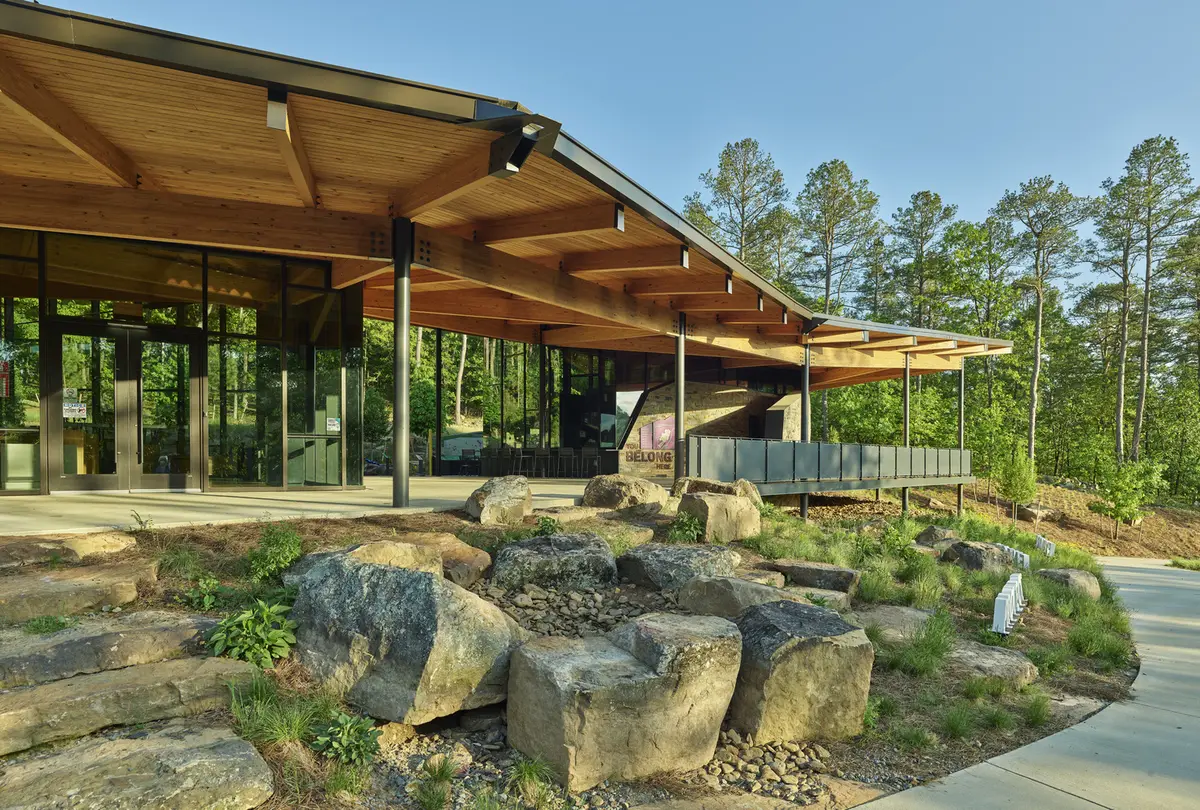
Most state park visitor centers function as tollbooths: you pass through, grab a map, and head for the trail. The new Pinnacle Mountain State Park Visitor Center, designed by Polk Stanley Wilcox Architects, refuses that premise entirely. Spread across 13,700 square feet at the base of a cone-shaped peak just west of Little Rock, the building positions itself as a geological event rather than an administrative one. Three stone volumes sit along a natural rock vein that runs from the summit down into the park's lower terrain, linked by an undulating glulam roof canopy that lifts, dips, and threads through the existing tree canopy. Not a single 90-degree angle appears in the plan.
What makes the project genuinely interesting is the absence of precedent. Other Arkansas state parks can lean on Civilian Conservation Corps lodges from the 1930s for their design language. Pinnacle Mountain had nothing of the sort; its previous visitor center sat inside an abandoned sandstone quarry from the 1960s. With 600,000 annual visitors and Little Rock's suburbs pressing against the park boundary, the architects faced a charged brief: build something that simultaneously registers as a gateway to the entire state park system and disappears into a hillside. The result is one of the more convincing examples of topographic architecture produced for a public client in the American South.
Rock Outcroppings as Program
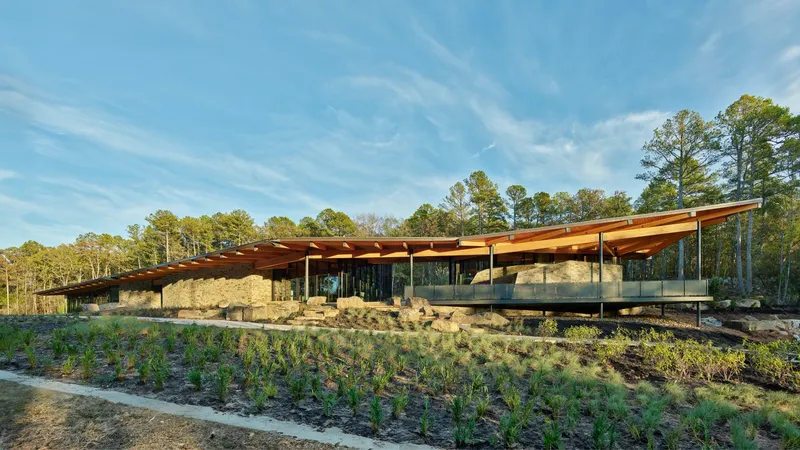
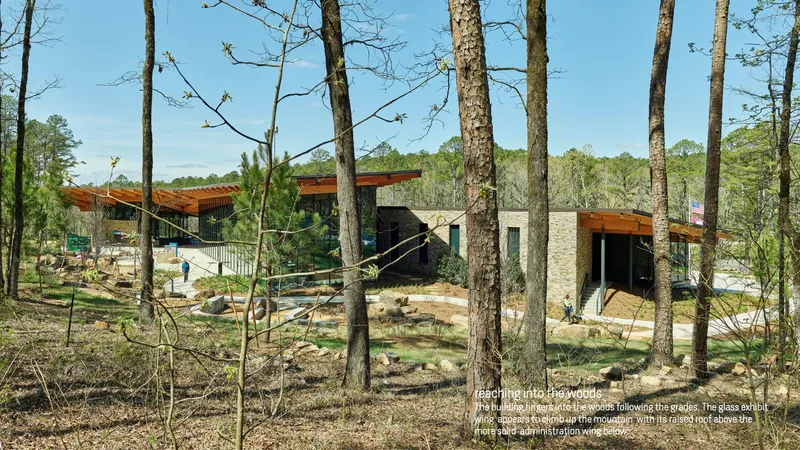
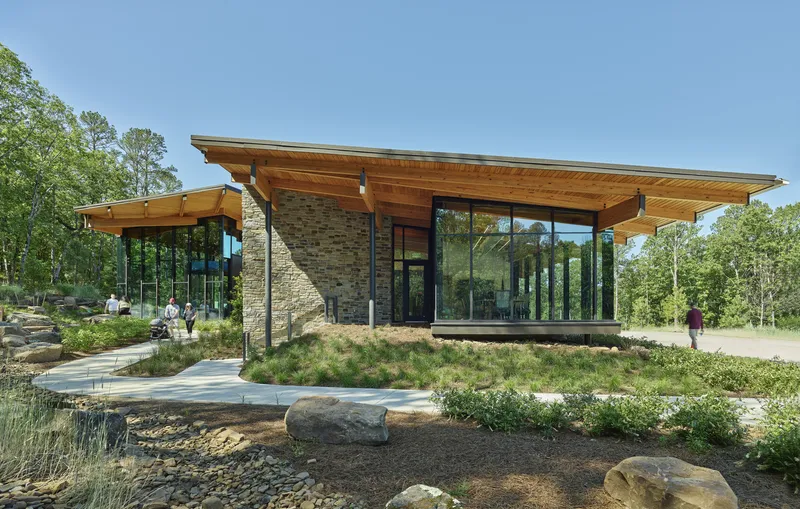
The building's massing strategy borrows directly from geology. Three stone-clad volumes, arranged along the grade like natural outcroppings, contain the primary programmatic functions: reception and exhibits, a catering kitchen, and restrooms with supporting infrastructure. Between and above them, the roof canopy creates covered outdoor zones that feel more like forest clearings than corridors. The approach avoids the monolithic visitor center model in favor of something more fragmented and site-specific, where the gaps between buildings become as important as the buildings themselves.
Two of these volumes frame a gateway that aligns with the opening of the West Summit Trail, so visitors pass between stone walls as they transition from parking lot to wilderness. It is a simple move with outsized spatial impact, collapsing the threshold between architecture and landscape into a single compressed moment.
A Roof That Reads the Terrain
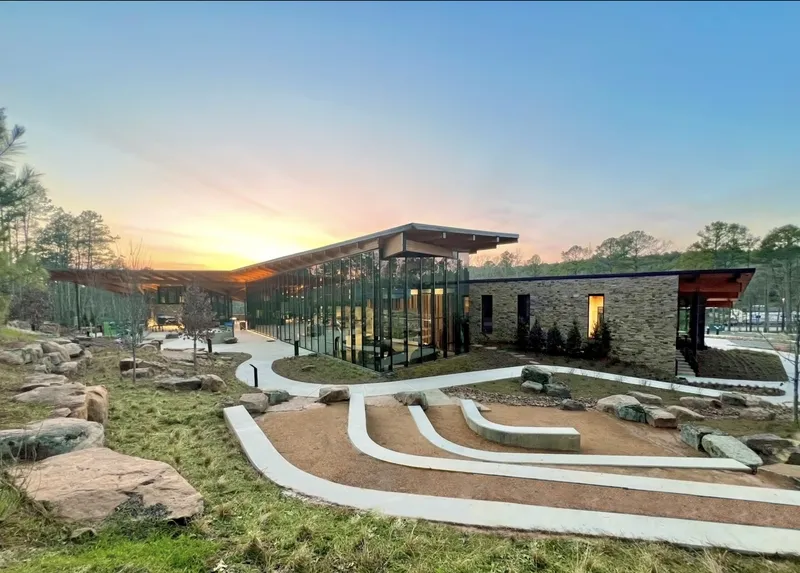
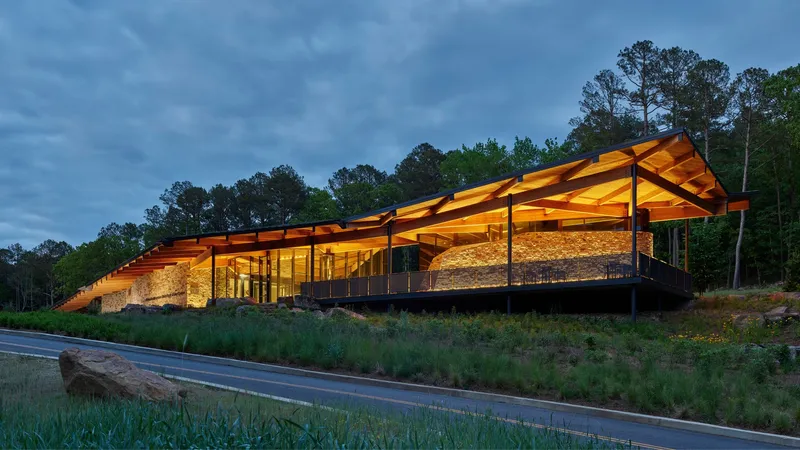
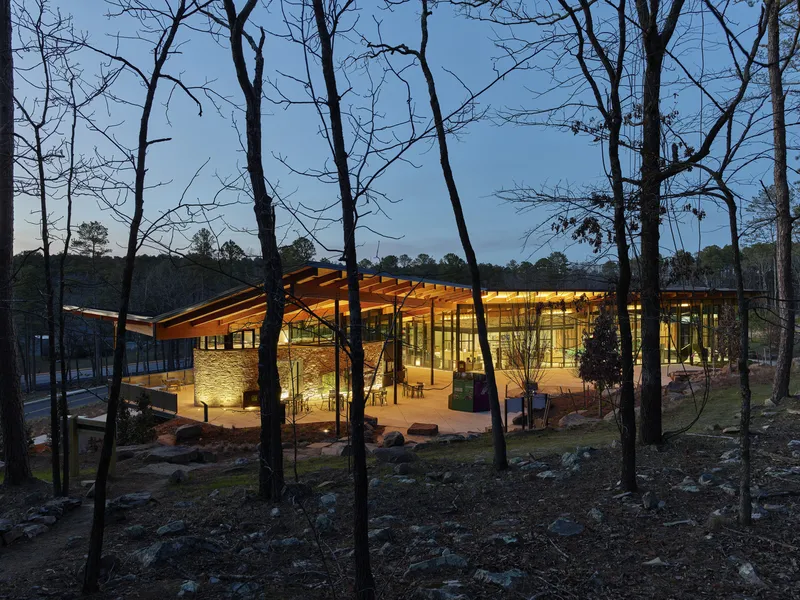
The undulating roof is the project's signature gesture. Its pitch follows the mountain's own slope, directing rainwater toward the natural downhill drainage path rather than fighting it. Glulam beams fan outward in a structural bracing pattern that the architects describe as emulating organic order, and the comparison is apt: seen from below, the timber lattice recalls the branching of loblolly pines overhead. The canopy extends well beyond the glass enclosure to shelter terraces, walkways, and the outdoor café, creating a continuous inhabitable zone that is neither fully interior nor fully exterior.
At night, the transformation is dramatic. Glass walls that reflect forest and sky during the day become transparent, turning the building into a lantern at the base of the mountain. The effect is not accidental; it signals to returning hikers and passing drivers that the park is still present, still active, even after sunset.
Glass Walls and Mountain Views
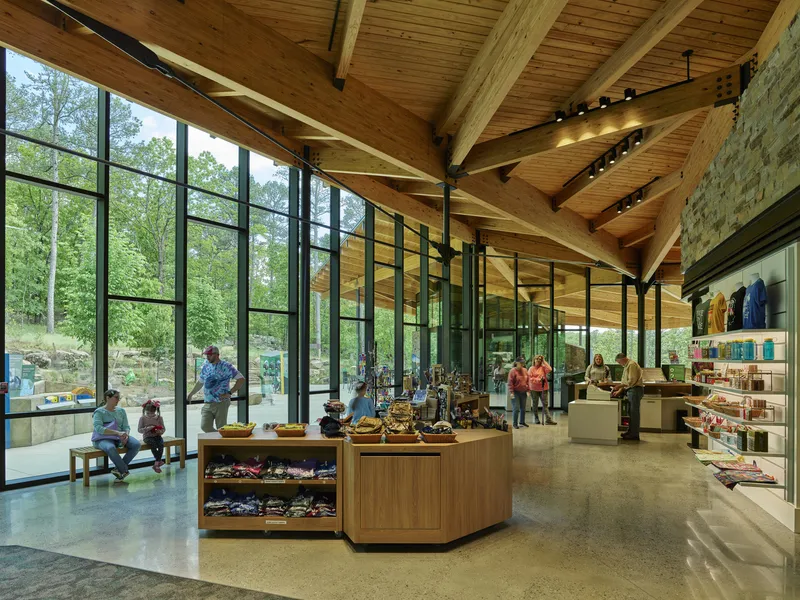
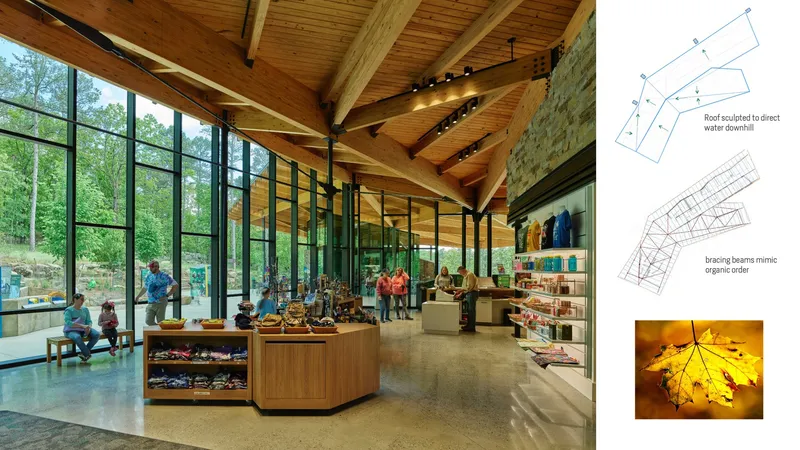
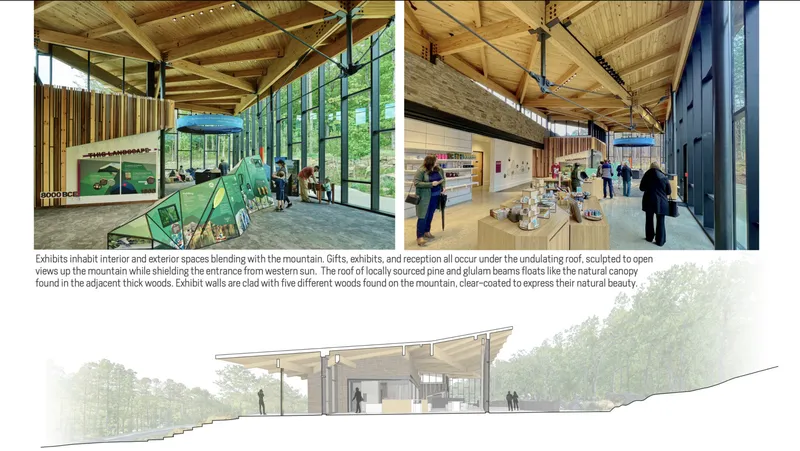
Of the center's 13,700 total square feet, over 8,100 are enclosed by glass walls. That ratio tells you almost everything about the design intent. The reception area, gift shop, and exhibit hall all face the mountain through continuous floor-to-ceiling glazing, making the peak itself the primary exhibit. Interior partitions are kept low or eliminated entirely, so sightlines run uninterrupted from one end of the building to the other.
The retail and exhibit spaces feel less like rooms and more like occupied thresholds. Laminated timber trusses and slender black steel columns define the overhead structure without imposing visual weight, and the merchandise displays are deliberately modest in scale so they never compete with the view beyond. It is a visitor center that constantly reminds you why you came.
Stone, Steel, and the Logic of Place
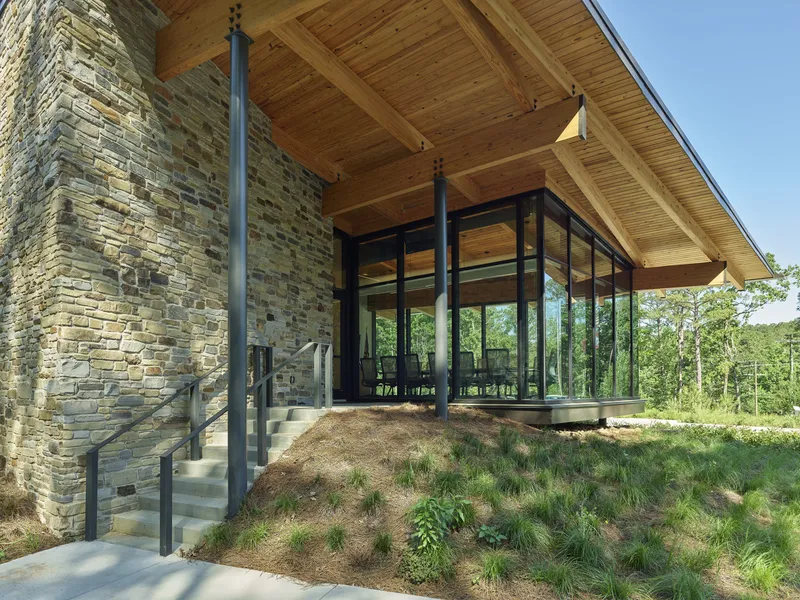
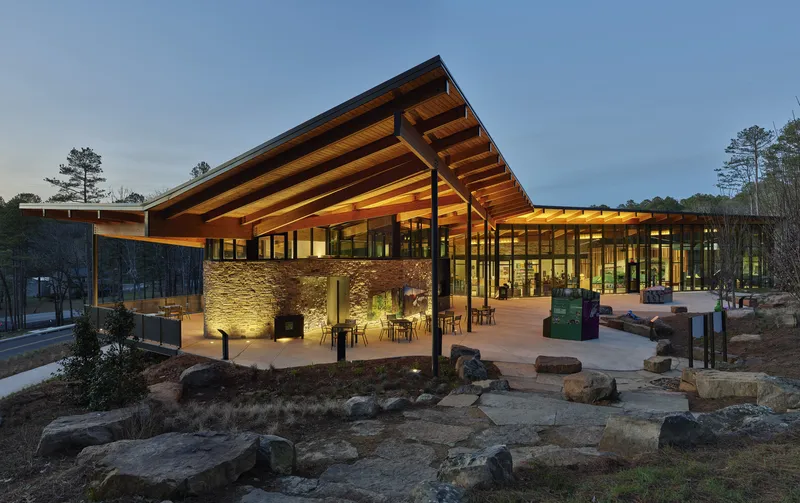
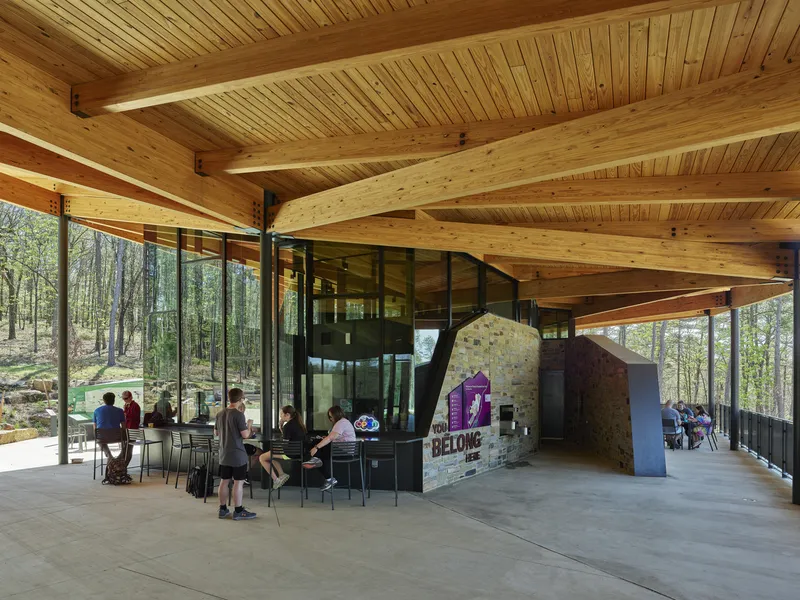
The material palette is tight: local stone, glulam timber, steel, and glass. The stone walls do real structural and spatial work, retaining the hillside at the building's rear, creating windbreaks for terraces, and anchoring the lightweight roof to the ground. Boulder steps lead visitors from the parking area up to the entrance, and a massive stone wall along the back edge doubles as a natural play surface for children, channeling foot traffic toward the base trail.
At dusk, uplighting along the stone cores turns the walls into warm, textured surfaces that feel like exposed bedrock. The steel columns and connections, by contrast, are painted dark and recede into shadow, letting the timber and stone carry the visual narrative. Every material decision reinforces the same idea: the building is of this mountain, not merely on it.
Landscape as Infrastructure
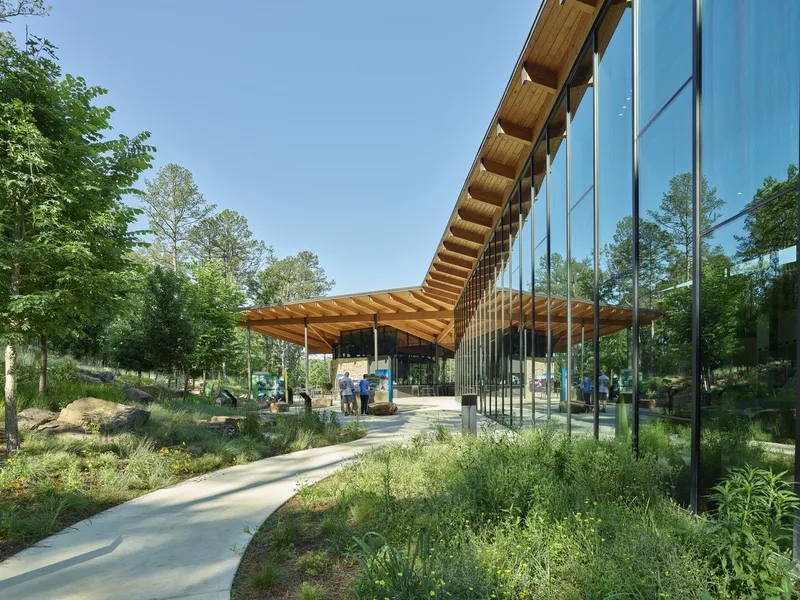
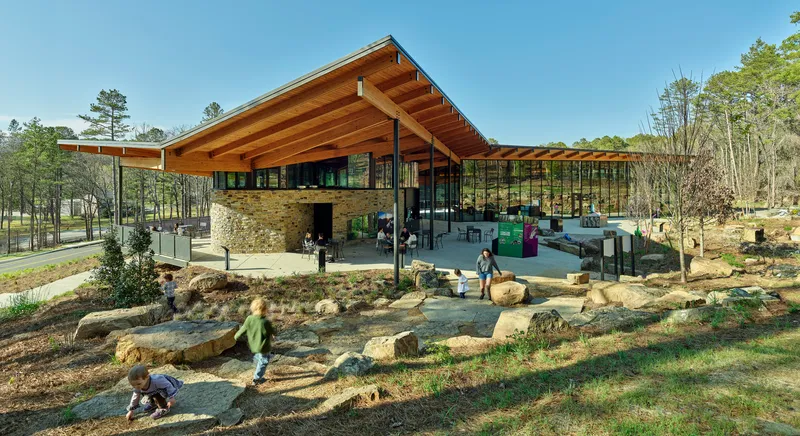
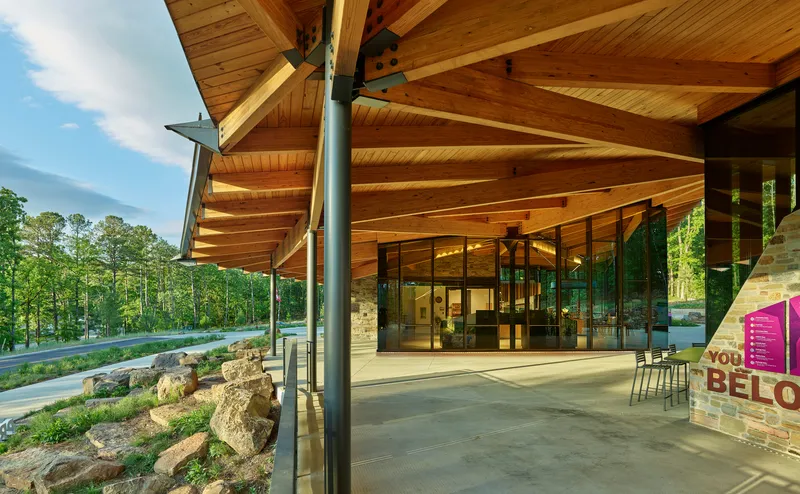
The site strategy is where the sustainability claims move from rhetoric to practice. A bioswale median in the parking lot filters stormwater through native plants before it reaches the surrounding watershed. Catchment basins ringed by boulders capture and display water running off the roof, turning drainage into an interpretive feature. The planting palette was derived from an on-site botanical survey, which means every shrub and grass you see along the approach pathway has a documented local provenance.
New trails radiating from the center connect to the Pinnacle Mountain Base Trail and mountain bike routes, so the building functions as a trailhead hub rather than a standalone destination. Boulder-lined paths, planted beds, and covered terraces blur the line between constructed landscape and managed wilderness, making the transition from car to canopy feel gradual and intentional.
Interior Experience and Exhibition
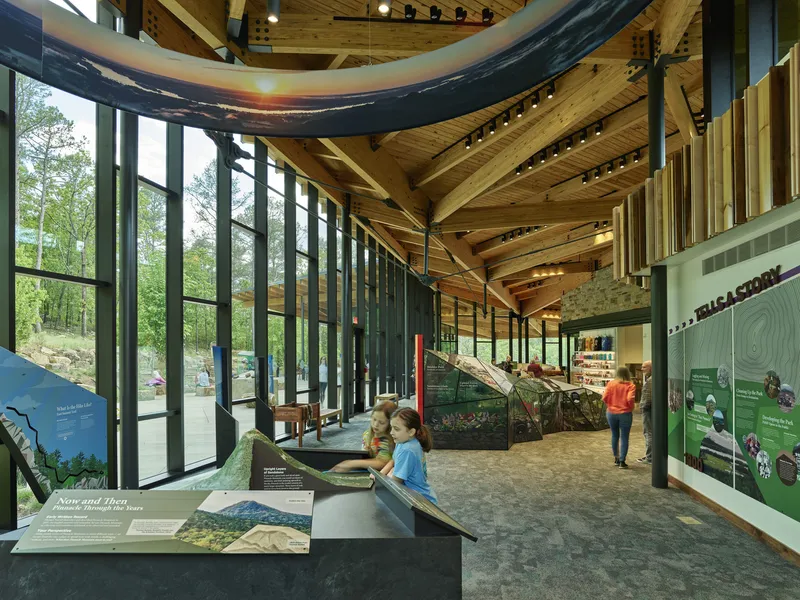
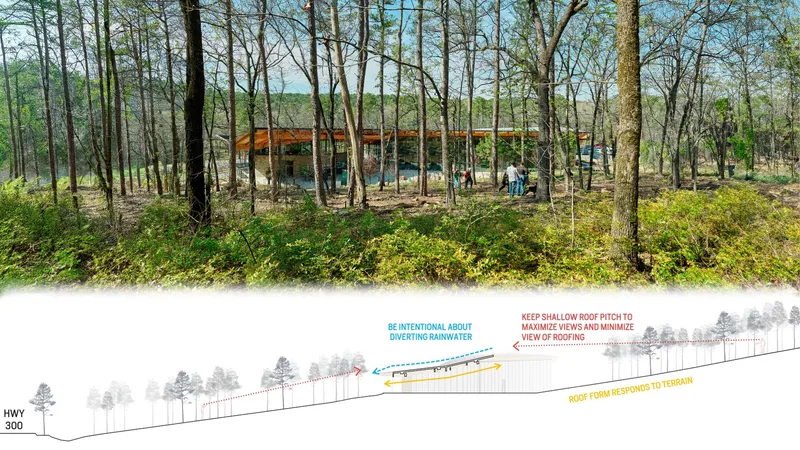
The exhibition hall features radial timber ceiling beams that draw your eye outward toward the glass perimeter, reinforcing the centrifugal pull of the plan. Educational displays line a corridor of glass and steel, but the real pedagogical tool is the building itself: the exposed structure, the visible water management systems, the stone walls that reference the quarry history of the site. Polk Stanley Wilcox understood that a visitor center for a geological park should teach geology through its own construction.
The Loblolly Outpost, an outdoor café space set free under the canopy, gives hikers a reason to linger. Seating areas beneath curved timber beams, backed by fieldstone walls, offer shade and rest without enclosure. It is a detail that respects how people actually use parks: not as curated museum experiences but as places to eat a sandwich, catch your breath, and decide whether to take the summit trail or the creek loop.
Plans and Drawings
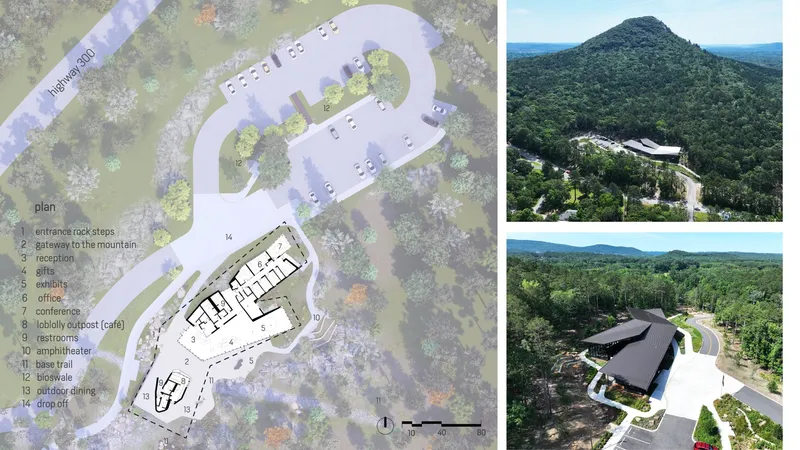
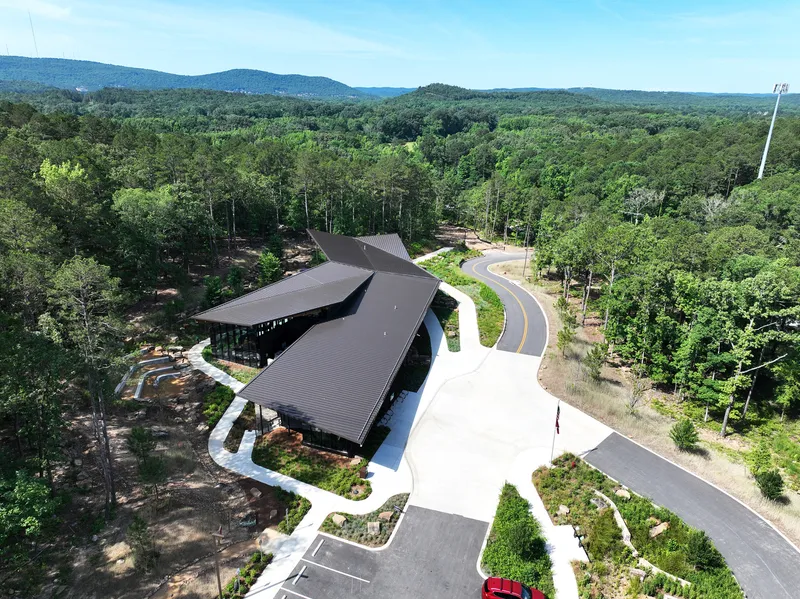
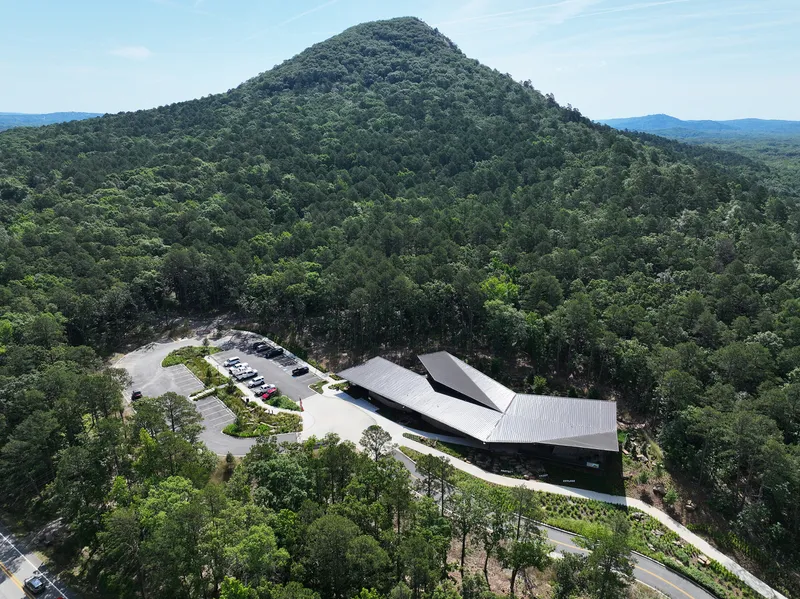
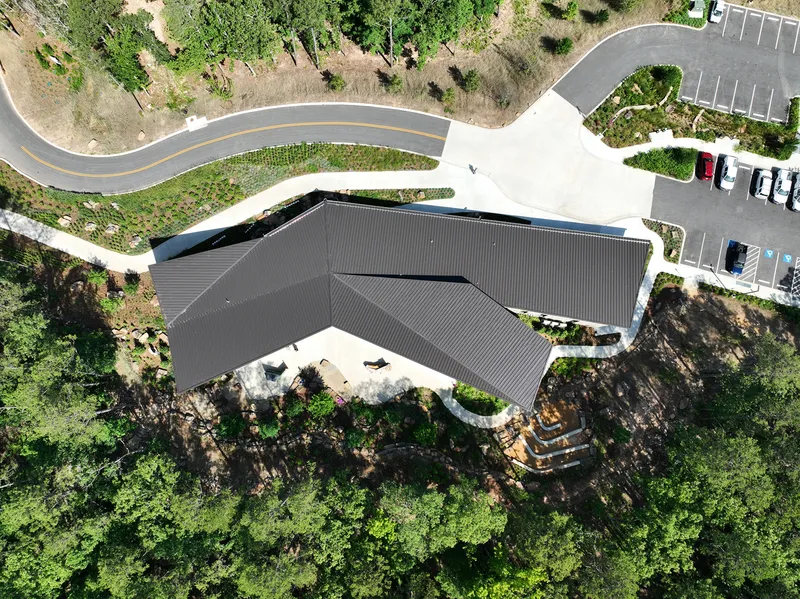
The site plan reveals the full extent of the building's angular logic. The footprint curves and kinks to follow the rock vein running downslope, and parking areas wrap around the perimeter to minimize visual impact from the trail side. Aerial views confirm what the ground-level experience only hints at: the dark metal roof reads as a series of folded planes with clerestory glazing cut between them, almost like tectonic plates shifting along a fault line. The building's relationship to the forested hills behind it is strikingly clear from above, its three lobes nestled precisely at the transition zone where dense tree cover gives way to cleared meadow.
Why This Project Matters
Public architecture in state parks tends to fall into two camps: nostalgic rustic cabins that cosplay a frontier past, or slick modernist boxes that ignore their setting entirely. The Pinnacle Mountain Visitor Center charts a third course. It is unambiguously contemporary in its structural expression, yet it derives its form, materials, and orientation from the specific geological and ecological conditions of this one hillside. The $10 million construction budget was not extravagant for a building of this complexity and civic ambition, and the result serves as proof that public clients can commission serious architecture without sacrificing accessibility or durability.
For a park that sits at the boundary of a growing city and draws 600,000 visitors a year, the stakes were higher than a typical interpretive center. Polk Stanley Wilcox Architects delivered a building that operates on multiple registers: as a trailhead, as an exhibit, as a gathering space, and as a demonstration of how architecture can amplify rather than compete with landscape. It is the rare project where the absence of right angles is not a formal indulgence but a direct consequence of listening to the ground.
Pinnacle Mountain State Park Visitor Center by Polk Stanley Wilcox Architects. Pinnacle Mountain State Park, Little Rock, Arkansas. 13,700 sq ft. Photography by Timothy Hursley.
About the Studio
Share Your Own Work on uni.xyz
If projects like this are the kind of work you want to make, uni.xyz is a place to publish your own, find collaborators, and enter design competitions.


Popular Articles
Popular articles from the community


Co-Life: Senior Housing Design That Reconnects Older Adults With the City
Co-Life reimagines senior housing design through healing gardens, shared streets, workshops, and a sustainable community across generations.

Play: Fragments of Their World
Familiar architecture becomes modular playground design, creating safe spaces where displaced children can learn, connect, imagine and play.

The Musturak Paradise: Senior Living Architecture for a Connected Future in Temara, Morocco
The Musturak Paradise reimagines senior living architecture in Temara via private homes, social spaces, culture, community, and shared care.

Co-life: Sustainable Architecture for Age-Friendly Community Living
Co-life reimagines sustainable architecture for seniors through courtyards, rammed earth, shared gardens, and spaces designed for belonging.

Similar Reads
You might also enjoy these articles


Hodi-Mandai Geram
Project Function: Preservation and revitalization of the Intangible heritage and socio-spatial identity of the Hodi by Housing, Cultural Memory Center, Sacred Grove, landscape, local tourism economy


Olio Towers: A Mid-Rise for Performers That Fuses Housing, Rehearsal, and Stage
Located blocks from Houston's Theater District, this modular tower stacks living units around a central performance atrium.

Oasis: Modular Green Housing Carved into Dhaka's Urban Fabric
A shortlisted Plugin Housing entry reclaims unauthorized settlements in Dhaka with stepped concrete volumes, green roofs, and ventilation-driven design.

Black Hole: A Floating Megastructure for the Post-Physical Era
Emiliano Mazzarotto envisions a spherical, self-scaling arena where e-sports, digital hotels, and holographic stadiums replace traditional public space.

Explore Architecture Competitions
Discover active competitions in this discipline

Challenge to reimagine the Iron Throne

Photograph architecture without architects

Illustrate the lost glory of Angkor Wat - Render Challenge

Design challenge to reuse E-waste
Comments (0)
Please login or sign up to add comments
No comments yet. Be the first to comment!