

Foster + Partners Wraps a Self-Shading Sawtooth Tower Around Three Atria in Ho Chi Minh City
Techcombank's 21-storey headquarters on Le Duan Boulevard uses bamboo-weave screens and solar geometry to chase LEED Platinum.


Most office towers in tropical cities solve the heat problem the same way: curtain wall plus heavy air conditioning. Foster + Partners takes a different path with the Techcombank Headquarters in Ho Chi Minh City's District 1, completed in 2023. The 21-storey tower's floorplates follow a sawtooth plan so that one facet of each tooth faces the sun and gets a woven metal screen, while the opposing facet, which never receives direct sunlight, is left as clear glass. The building literally shades itself through geometry rather than through bolt-on devices.
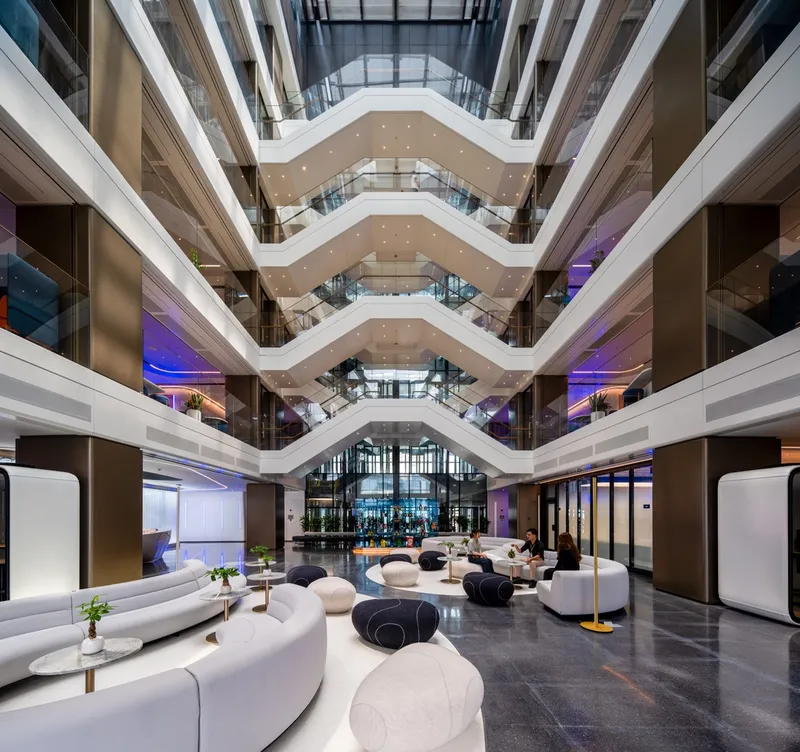
What makes the project genuinely compelling is the interplay between that climate-driven envelope and an interior strategy built around three full-height atria. Each atrium starts at a different level: one rises from the ground to level 9, another from level 11, and a third from level 14, all punching through the building at varying depths. They flood open-plan floorplates with daylight, house meeting pods in their voids, and give 21 storeys of office space a sense of vertical community that most commercial towers never achieve.
A Facade That Does Its Own Work

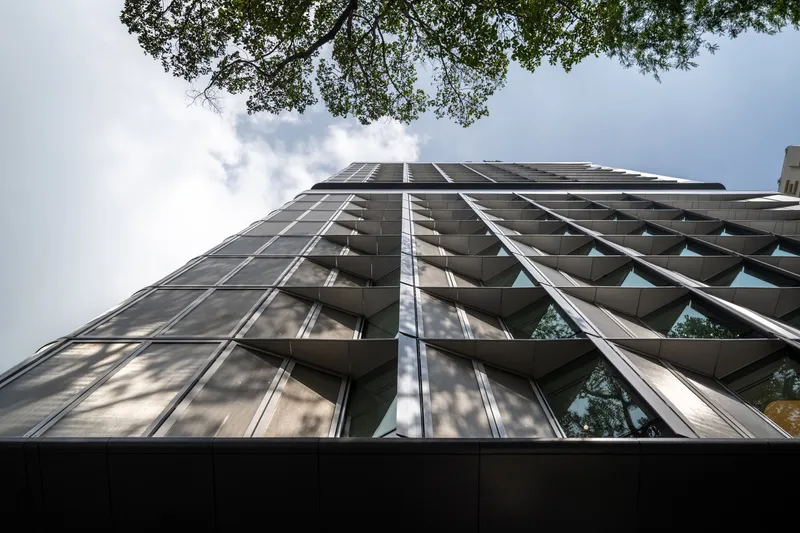
The sawtooth profile is not decorative. It is the result of solar analysis: each zigzag facet is calibrated to the angle at which sunlight hits the building in Ho Chi Minh City's latitude. Sun-facing surfaces are clad in metal mesh panels whose pattern is drawn from Vietnamese bamboo weaving, a detail that lets filtered light pass through while cutting direct heat gain. The opposite facets are fully glazed, giving occupants wide views of the city without thermal penalty.
Seen from street level, the translucent screens create a moiré effect as diagonal shading layers overlap behind the glass grid. The facade reads differently at every angle, shifting between opacity and transparency. It is one of the more successful examples of an environmental screen that also functions as genuine architectural expression rather than an afterthought stapled to the curtain wall.
The Sawtooth Meets the Street
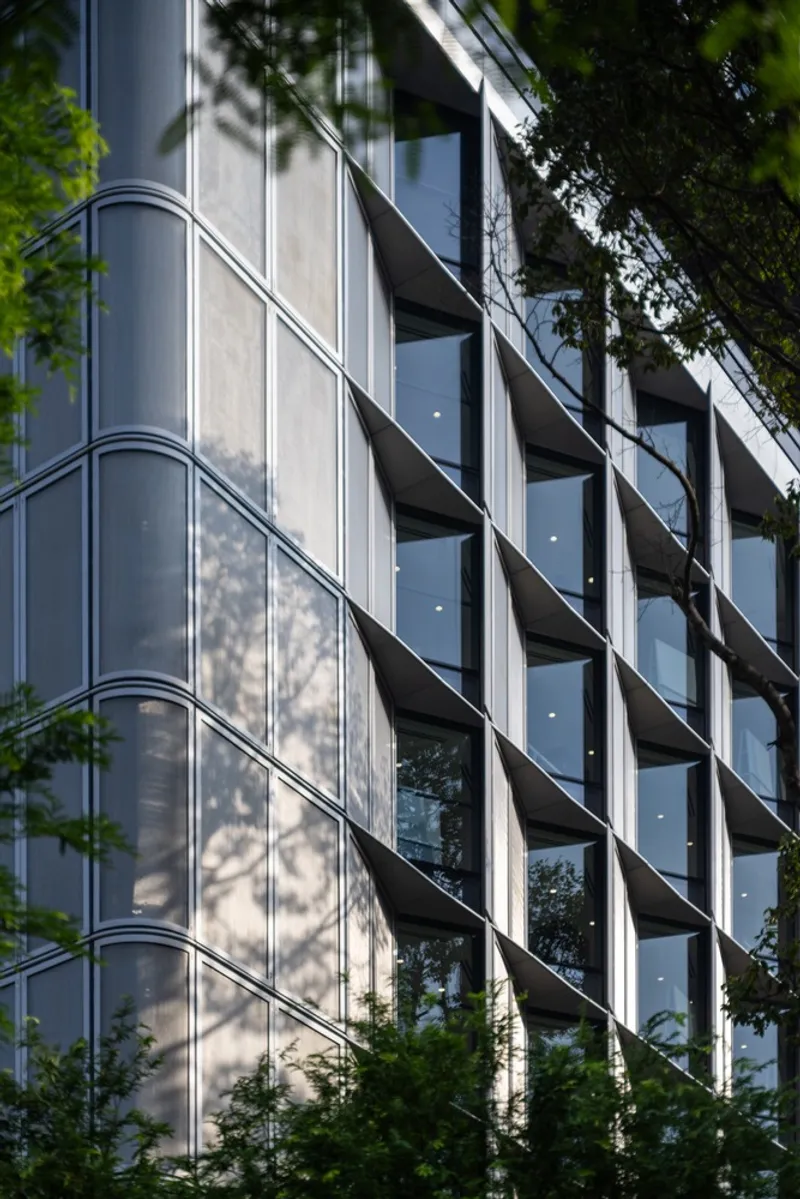
The tower sits on a double-fronted plot between Le Duan Boulevard and Nguyen Du Street, with entrances on both sides. At ground level the sawtooth geometry softens into curved balconies and a landscaped arrival sequence. Dappled tree shadows play across angled concrete and glass panels, a welcome break from the hard edges typical of HCMC's business district.
Inside the lobby, chevron-shaped balconies overhead echo the building's faceted logic while curved white seating and subtle purple accent lighting mark the transition from the dense tropical street to a controlled interior world. It is a generous public threshold for a private headquarters, and it signals the spatial ambition that continues upward through the atria.
Stacked Voids and Vertical Connectivity
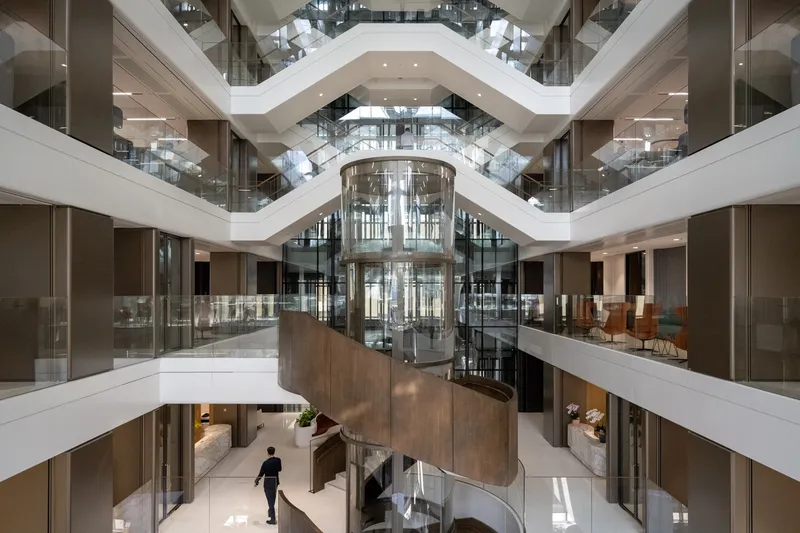
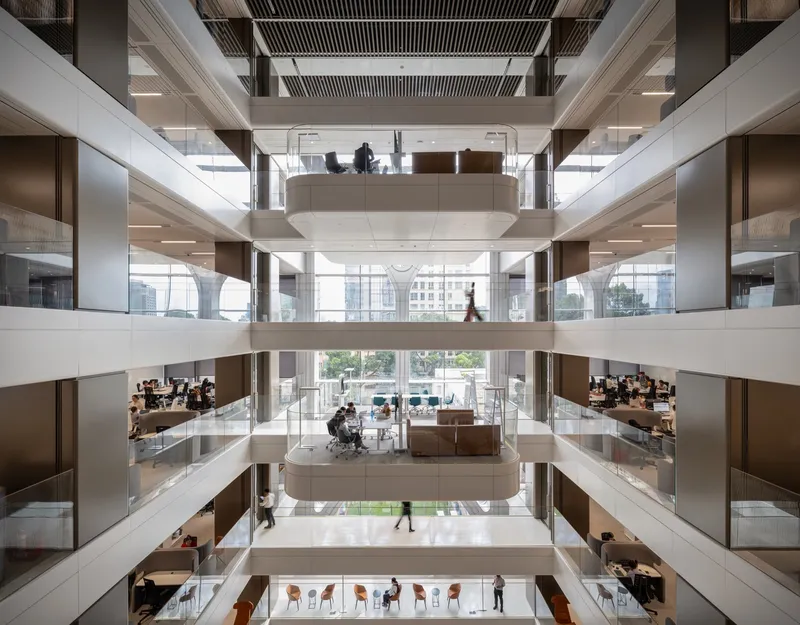
The three central atria are the organizational engine of the building. By starting at staggered levels, they create distinct vertical neighbourhoods: the lower atrium serves premier banking and meeting suites, while the upper two frame the office floors and executive level. Zigzag balconies ring each void, turning circulation into a social act. You see colleagues on other floors. You sense the scale of the organization. The cylindrical glass elevator shaft at the centre of the first atrium reinforces the transparency.
Meeting pods are suspended within the atria, offering semi-enclosed spaces that borrow light and air from the larger void. The staggered white floor plates in the upper atrium create a visual rhythm that makes a 21-storey office feel less like a stack of identical decks and more like a single interconnected space. Foster + Partners pushed the structural core to the rear of the plan, against the adjacent hotel, to keep these floorplates as open and uninterrupted as possible.
The Spiral Core
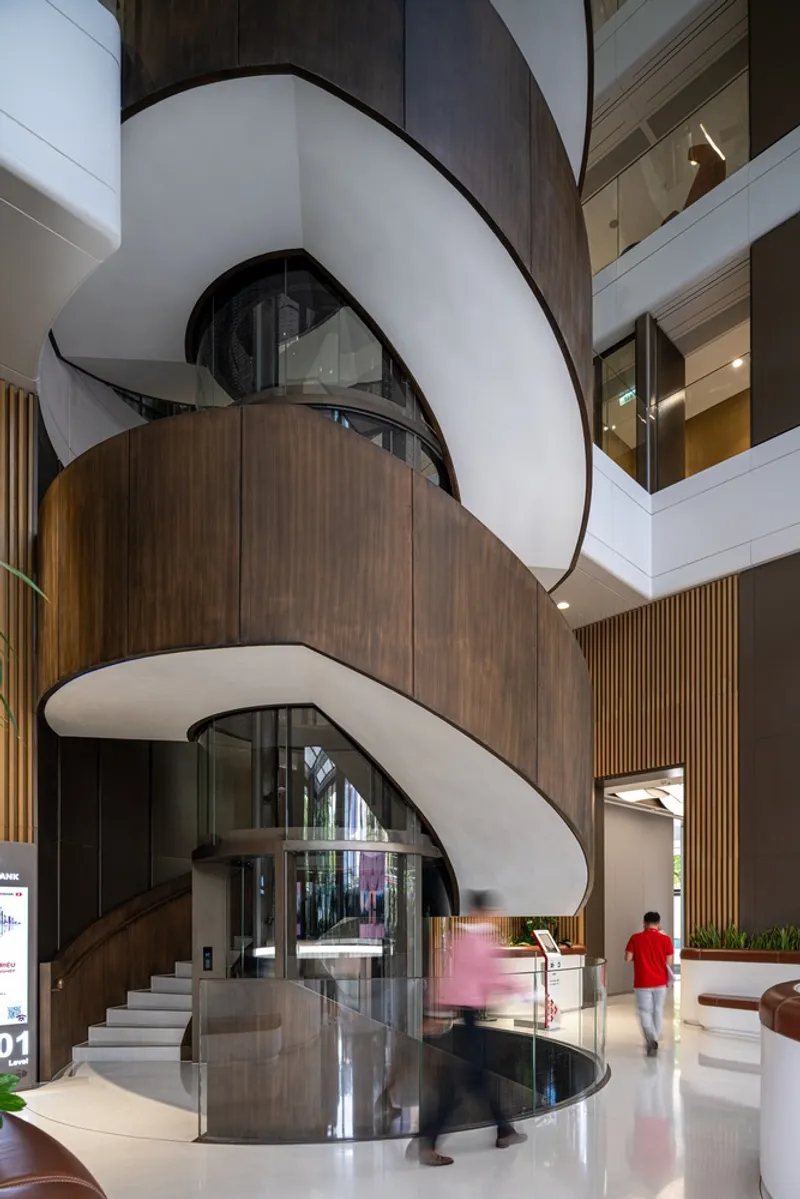
A sculptural spiral staircase wraps around a cylindrical timber volume, connecting amenity levels between the two expressed blocks. The curved soffits and the warm timber tone introduce a material warmth that counterbalances the white and glass palette elsewhere. It is a set piece, certainly, but it also solves a real problem: how do you get people to move between floors on foot in a 21-storey building? You make the stairs the most beautiful thing in the room.
The recessed amenity floor between the two vertical blocks, housing the canteen and gym, sits right at this hinge point. Placing shared social spaces at the seam between the tower's two halves ensures that employees from both zones converge there naturally. It is a simple organizational move with outsized impact on daily interaction.
Climate Logic as Design Driver
The pursuit of LEED Platinum certification is more than branding here. The entire massing, from sawtooth plan to atrium depths, is derived from environmental analysis. In a city where average temperatures sit above 27°C year-round, reducing solar heat gain is the single most effective lever for cutting energy use. By folding the facade into a self-shading geometry, the tower reduces cooling loads before mechanical systems even enter the equation.
The bamboo-weave metal screens deserve a closer look in this context. They are perforated enough to admit diffused daylight but dense enough to block the worst thermal radiation. The reference to local craft traditions is not arbitrary nostalgia; bamboo weaving is itself a technology for modulating light and air, developed over centuries in Vietnam's climate. Translating it into metal mesh at tower scale is a legitimate lineage, not a pastiche.
Why This Project Matters
Ho Chi Minh City is building at extraordinary speed, and much of its new commercial stock defaults to the generic glass box plus brute-force cooling. The Techcombank Headquarters demonstrates that climate-responsive design at a serious scale does not require formal austerity or technological exoticism. A sawtooth plan, woven screens, and well-placed voids are straightforward moves. The discipline lies in deriving them from rigorous analysis rather than aesthetic whim, and in following through from massing to detail.
More broadly, this is Foster + Partners working in a register that suits them well: performance-driven form, a clear structural idea, and meticulous execution. The three staggered atria give the project its spatial signature and prevent the interior from collapsing into the monotony that plagues most high-rise offices. If the LEED Platinum certification comes through, it will be earned by geometry as much as by systems, and that is a lesson worth exporting far beyond Vietnam.
Techcombank Headquarters, Ho Chi Minh City, Vietnam. Architect: Foster + Partners. 21 storeys. Completed 2023.
About the Studio
Share Your Own Work on uni.xyz
If projects like this are the kind of work you want to make, uni.xyz is a place to publish your own, find collaborators, and enter design competitions.


Popular Articles
Popular articles from the community


Architekt Andreas Gruber Scatters 23 Dark Timber Chalets Across a South Tyrolean Forest Edge
In Molini di Tures, Amonti Chalets breaks a resort into a hamlet of gabled timber houses, with parking, storage and services pushed into the slope.

David Ortega Stacks a Two-Story Mexico City Penthouse Around a Steel Stair and a Pergola-Shaded Roof Terrace
In Colonia Roma, a 300 m² penthouse uses oak joinery, a planted steel stair and a slatted roof pergola to make a new-build apartment feel like a house.

U.GA Architects Wraps an Oval Rooftop Pool in Curved Board-Formed Concrete on Busan's Jeollidan-gil
In Busan's Jeonpo-dong, a 454 m² mixed-use block stacks a neighborhood facility, guest rooms and an oval rooftop pool inside spiraling concrete walls.

Juan García Correa, John González and Claudia Rueda Sink a Circular Amphitheater into a Manizales Engineering Building
On the La Nubia campus in Manizales, Colombia, the S1 Building folds labs and offices into a hillside of ramped lawns that double as a campus route.

Similar Reads
You might also enjoy these articles


Hodi-Mandai Geram
Project Function: Preservation and revitalization of the Intangible heritage and socio-spatial identity of the Hodi by Housing, Cultural Memory Center, Sacred Grove, landscape, local tourism economy


Olio Towers: A Mid-Rise for Performers That Fuses Housing, Rehearsal, and Stage
Located blocks from Houston's Theater District, this modular tower stacks living units around a central performance atrium.

Oasis: Modular Green Housing Carved into Dhaka's Urban Fabric
A shortlisted Plugin Housing entry reclaims unauthorized settlements in Dhaka with stepped concrete volumes, green roofs, and ventilation-driven design.

Black Hole: A Floating Megastructure for the Post-Physical Era
Emiliano Mazzarotto envisions a spherical, self-scaling arena where e-sports, digital hotels, and holographic stadiums replace traditional public space.

Explore Office Building Competitions
Discover active competitions in this discipline

Challenge to reimagine the Iron Throne

Photograph architecture without architects

Illustrate the lost glory of Angkor Wat - Render Challenge

Design challenge to reuse E-waste
Comments (0)
Please login or sign up to add comments
No comments yet. Be the first to comment!