
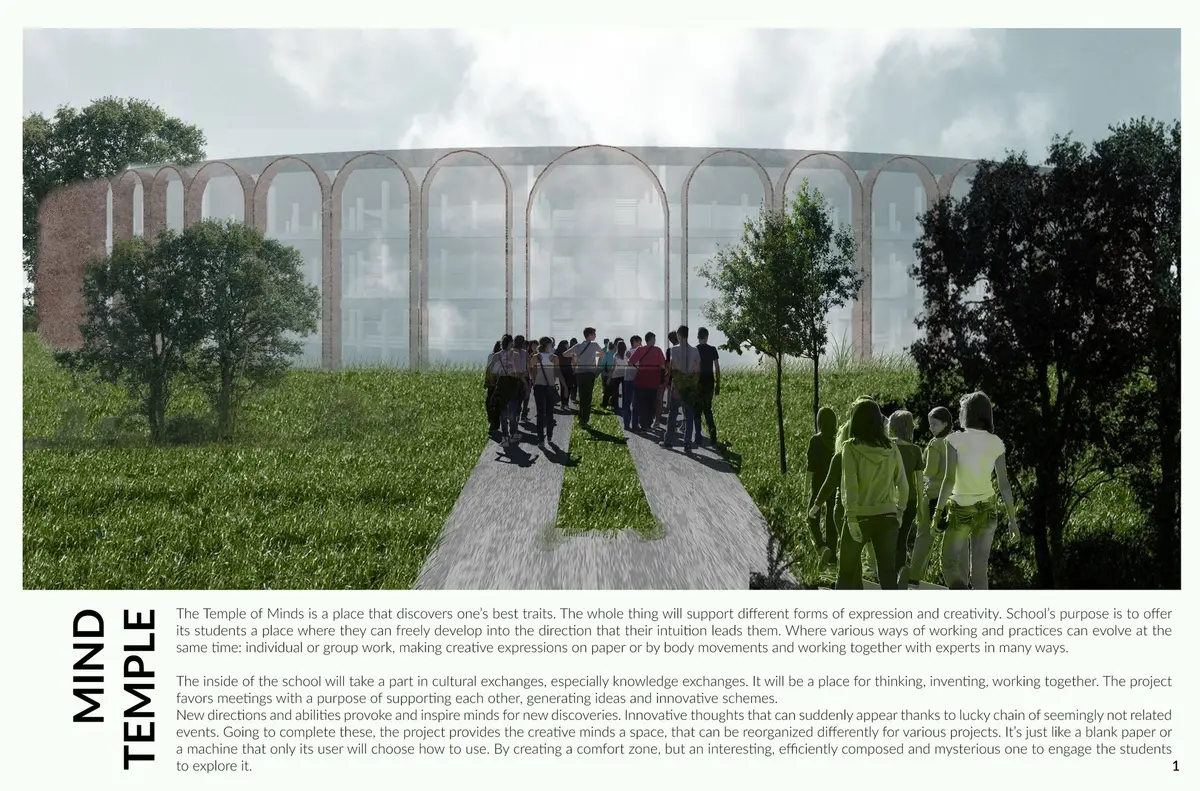
Temple of Minds: A Circular School That Puts a Planted Courtyard at the Heart of Learning
Aneta Góralska rings flexible learning zones and shared spaces around a green courtyard, recasting the school as an ecosystem, not an institution.


Most school buildings still answer to the logic of the corridor: a spine, a row of identical rooms, a bell that moves bodies from one box to the next. Temple of Minds starts by refusing that diagram. Its proposition is simple and far-reaching. Bend the school into a ring, put a garden in the middle, and let learning happen everywhere the building's circulation meets that landscape. The plan stops sorting students and starts gathering them.
The project, published on uni.xyz by Aneta Góralska, frames the school as a living ecosystem rather than an institution measured by academic output. Individual study, collaborative workshops, public discussion, artistic work and movement-based learning are meant to coexist within one connected environment. Góralska relies on a circular form, green internal courtyards, adaptive learning zones and collaborative public spaces to make architecture an active participant in education, not a neutral container for it.
Stacked Slabs Emerging From a Wooded Slope
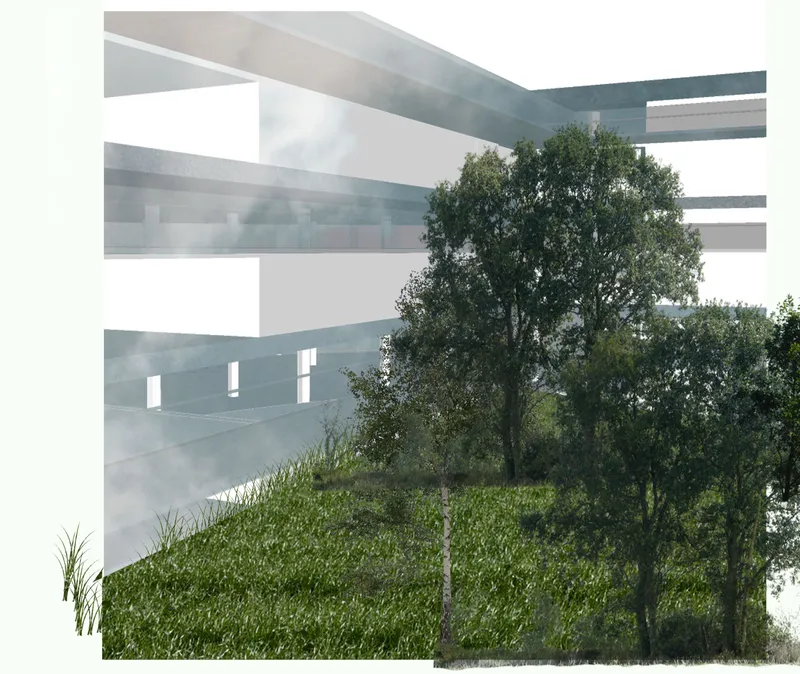
The opening rendering sets the mood before it explains the plan. Horizontal concrete slabs and white volumes rise behind a grassy slope, partly veiled by birch and oak trees and a drifting mist. The building reads less as an object placed on a site than as something the landscape gradually gives way to. That is a deliberate move against the institutional facade: there is no grand entrance or ceremonial front, only layered floor plates stepping out from behind the vegetation.
This matters for how the project positions itself in its district. Góralska describes the rounded geometry as a way to soften the building's scale and to strike a balance between architecture and nature while keeping a distinct presence. The rendering supports that claim. The slabs give the school a clear identity, while the planting and topography keep its bulk from overwhelming the approach.
An Arcade That Turns Circulation Into Shared Space
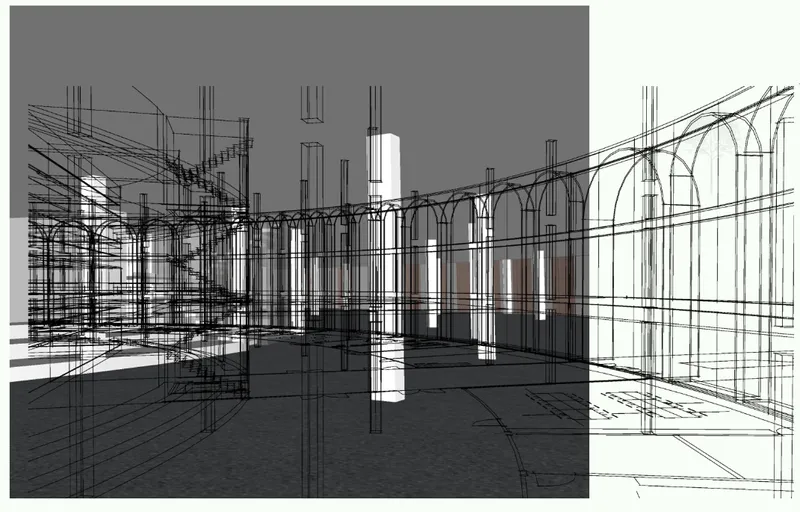
The wireframe perspective shows where the project's ideas about community become physical. A curved arcade of arched bays and columns sweeps around, with a stair breaking the rhythm and shading in grey and brown picking out depth and material. Because the plan curves, no stretch of this colonnade ends in a blind turn; each bay opens onto the next, and the line of sight continually bends back toward the centre.
This is the spatial argument behind Góralska's claim that the ring keeps students and teachers visually connected to shared spaces. In a conventional school the corridor is purely circulation. Here the arcade becomes a threshold where a conversation can pause, a group can spill out of a workshop, or someone can simply watch the courtyard. The arch, an old and almost civic motif, gives this everyday circulation a sense of occasion that suits a building calling itself a temple.
A Ring Plan Wrapped Around a Living Courtyard
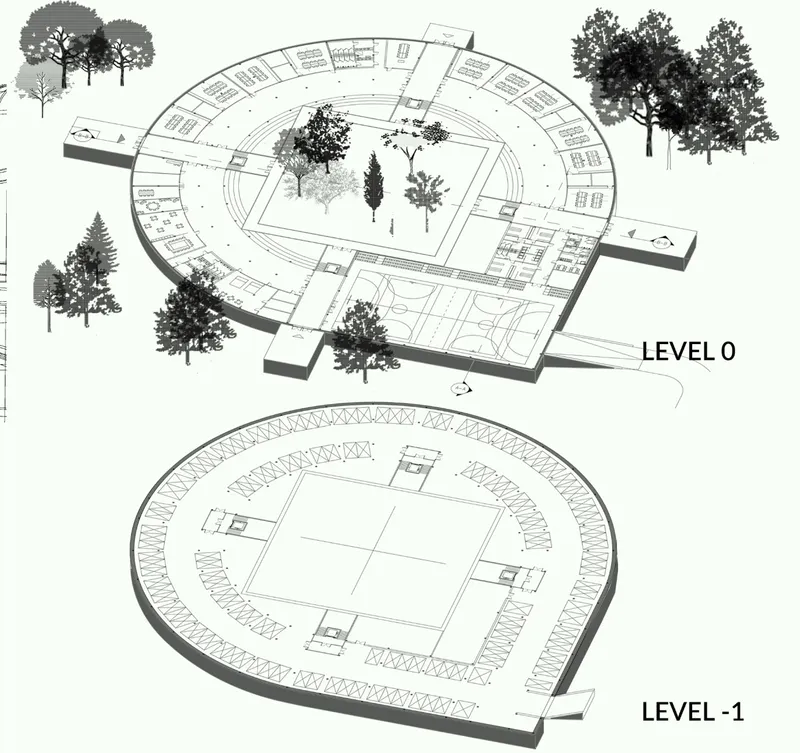
The axonometric reveals the full organisation in two stacked levels. At ground level, a ring of programme encloses a planted courtyard, which Góralska calls the emotional and spatial heart of the school. Below, a basement holds parking bays, keeping vehicles out of the landscape and leaving the ground plane free for people and planting. The split is clear: services go underground, and the life of the school wraps around the garden.
The courtyard is the project's most consequential decision. Placing greenery at the geometric centre means nature is not a view from a classroom window or an afterthought at the edge of the site; it is the thing every part of the building faces. Combined with learning zones intended to adapt as activities change, the ring offers a framework that can support a range of teaching approaches without requiring structural changes.
Why This Project Matters
Temple of Minds takes a well-rehearsed argument, that learning extends beyond the classroom, and gives it a legible architectural form. The circle is not merely a symbolic gesture toward unity; it does practical work, eliminating dead-end corridors, keeping the courtyard in constant view, and turning the arcade into a social space. That alignment between concept and plan is what separates a strong student proposal from a well-meaning manifesto.
The next step for the project would be to show how adaptive zones work in practice: how a room shifts from quiet study to group workshop, and how the courtyard functions across seasons and through a school day. Even so, Góralska's core proposition is persuasive. A school built around a garden, with circulation designed for lingering, treats students as participants in a shared environment rather than units moving through a system, and that is a good brief for any designer working on education buildings.
View the Full Project
About the Designers
Designer: Aneta Góralska
Enter a Design Competition on uni.xyz
uni.xyz runs architecture and design competitions year-round that reward proposals with spatial conviction and real site intelligence.
Project credits: Temple of Minds by Aneta Góralska.


Popular Articles
Popular articles from the community


U.GA Architects Wraps an Oval Rooftop Pool in Curved Board-Formed Concrete on Busan's Jeollidan-gil
In Busan's Jeonpo-dong, a 454 m² mixed-use block stacks a neighborhood facility, guest rooms and an oval rooftop pool inside spiraling concrete walls.

LT2A and OPEN Architectes Thread a Brick and Glass High School Through a Wooded Belgian Campus
In Braine-l'Alleud, a 3,000 m² wing for Collège Cardinal Mercier pairs pale brick with a glazed colonnade, deferring to a small chapel and a dense wood.

longwave studio Reorganizes a 112 m² Tainan Apartment Around the Daily Routines of a Family and Two Cats
In Tainan, Taiwan, birch plywood, rust-red furniture and a freestanding plaster wall link arrival, storage, work and family life in one apartment.

Cube Design Draws an Ecological Corridor Between Two Shenzhen Hills with the Nankai Building
Beside Shenzhen's container docks, the Nankai Building pairs stacked balconies with a climbing green screen to connect two hillsides across its height.

Similar Reads
You might also enjoy these articles
Healing Façade: A Modular Chapel System That Restores Ethiopia's Sacred Forests
Winner of the Eco-Chapel competition, this circular timber façade collects water from air to rebuild soil and reforest degraded Ethiopian landscapes.
Kaffeebühnen: Where Coffee Shop Architecture Becomes a Civic Stage in Vienna
A linear sequence of timber boxes, transparent shells, and open yards turns the Viennese café tradition into a public performance space.
Eco Chapel: A Modular Forest Pavilion That Grows Like the Landscape It Protects
Hexagonal timber modules weave through existing trees, turning a chapel into a living system for prayer, education, and reforestation.


Urban Forest: A Vertical Ecosystem for 5,000 Workers in Singapore's Changi Business Park
Radially stacked pods and layered green decks turn a 7-acre plot into 47 acres of ecological workspace projected for 2040.


Comments (0)
Please login or sign up to add comments
No comments yet. Be the first to comment!