
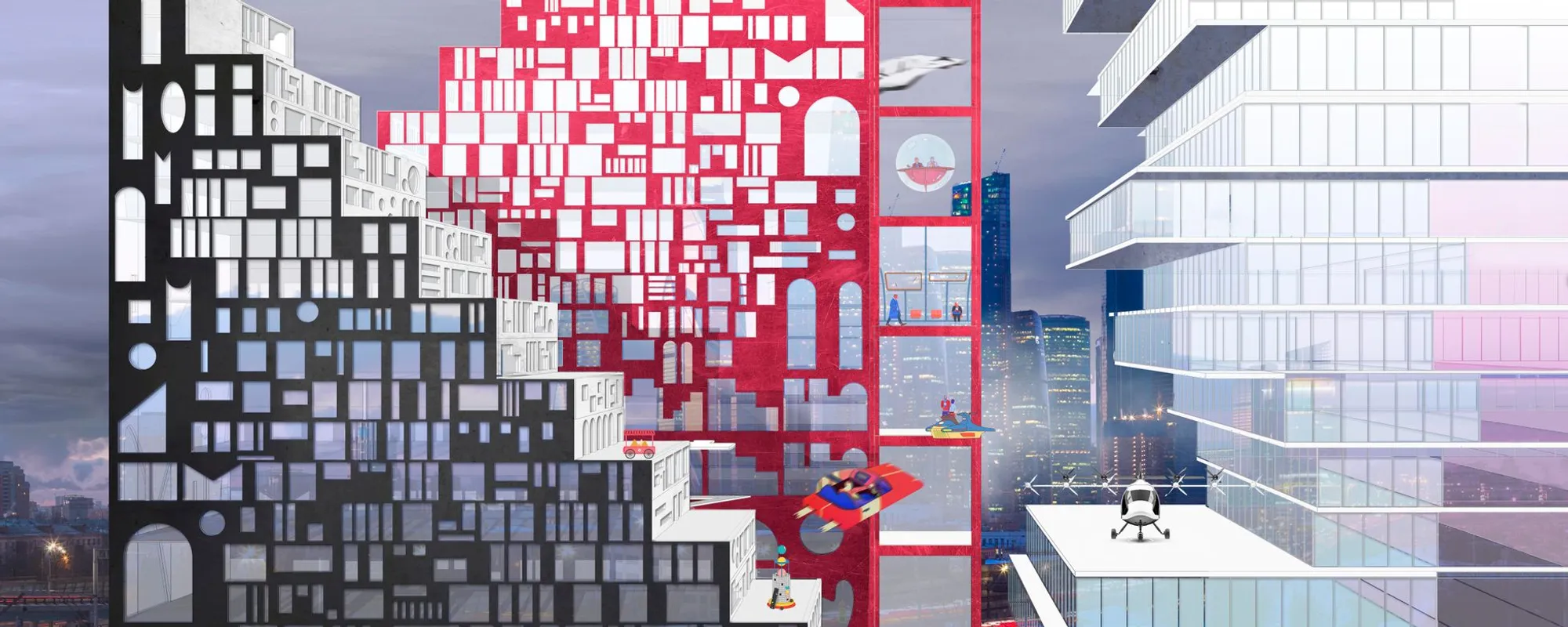
The CityGate: A Vertical City Above Moscow
A supertall hybrid tower stacking an airport, offices, shops, co-living, transit, and housing into a single structure on the Moscow River.


What happens when you stack an airport on top of an office district on top of a shopping centre on top of housing on top of a transport hub? You get The CityGate, a speculative supertall tower for Moscow that compresses an entire urban district into a single vertical structure. Designed by Darya Zakhvatova and Ekaterina Sorokina, the project won the People's Choice Award in the Hybrid Futures '19: Work x Fly competition on uni.xyz.
The competition asked designers to imagine how work and air travel could merge into a single architectural system. CityGate answers by merging everything: not just work and flight, but housing, retail, leisure, transport, and public space, all in one tower on the Moscow River.
The Programme Stack
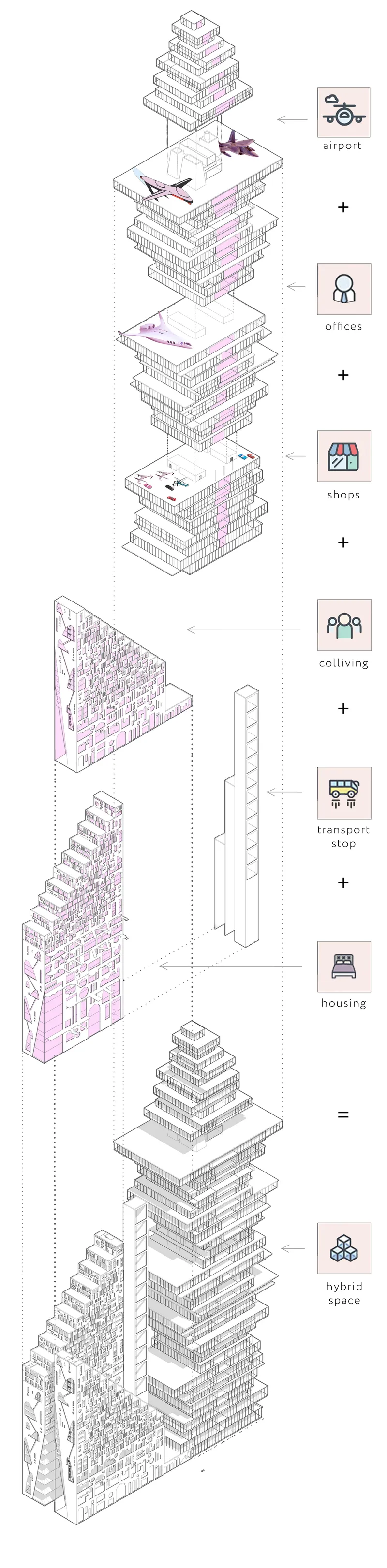
The exploded axonometric is the project's clearest drawing. It breaks the tower into six programme layers, each one a distinct urban function. Housing at the base. A transport hub above it. Then co-living, shops, offices, and an airport at the summit. Together they produce what the diagram labels a hybrid space: a building that contains an entire city's programme in a single vertical address.
This is not a new idea in principle. Mixed-use towers have existed for decades. But CityGate pushes the concept to its logical extreme. The airport at the top is not a helipad. It is a full docking infrastructure for drones, flying cars, and small aircraft. The transport hub is not a lobby. It connects to boats, hyperloop, and ground transit. Every layer is a real urban system, not a token gesture.
Moscow River: The Site
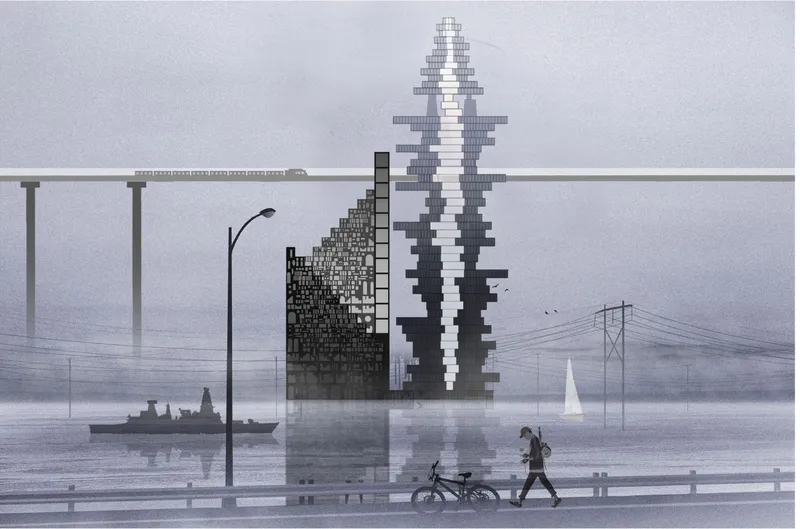
The site is on the Moscow River, near the existing Moscow City towers. The render shows the building emerging from fog on the embankment: a patterned residential slab on one side and the stacked programme tower on the other, connected by a vertical core. Boats pass on the river. A bridge carries a hyperloop line. A pedestrian pushes a bicycle in the foreground. The scale is extraordinary.
Placing a supertall on the Moscow River is a statement about where the city's centre of gravity should shift. The existing Moscow City cluster is a financial district. CityGate proposes something more ambitious: a node that is residential, commercial, logistical, and aerial, all at once.
The Section: A Vertical City at Night
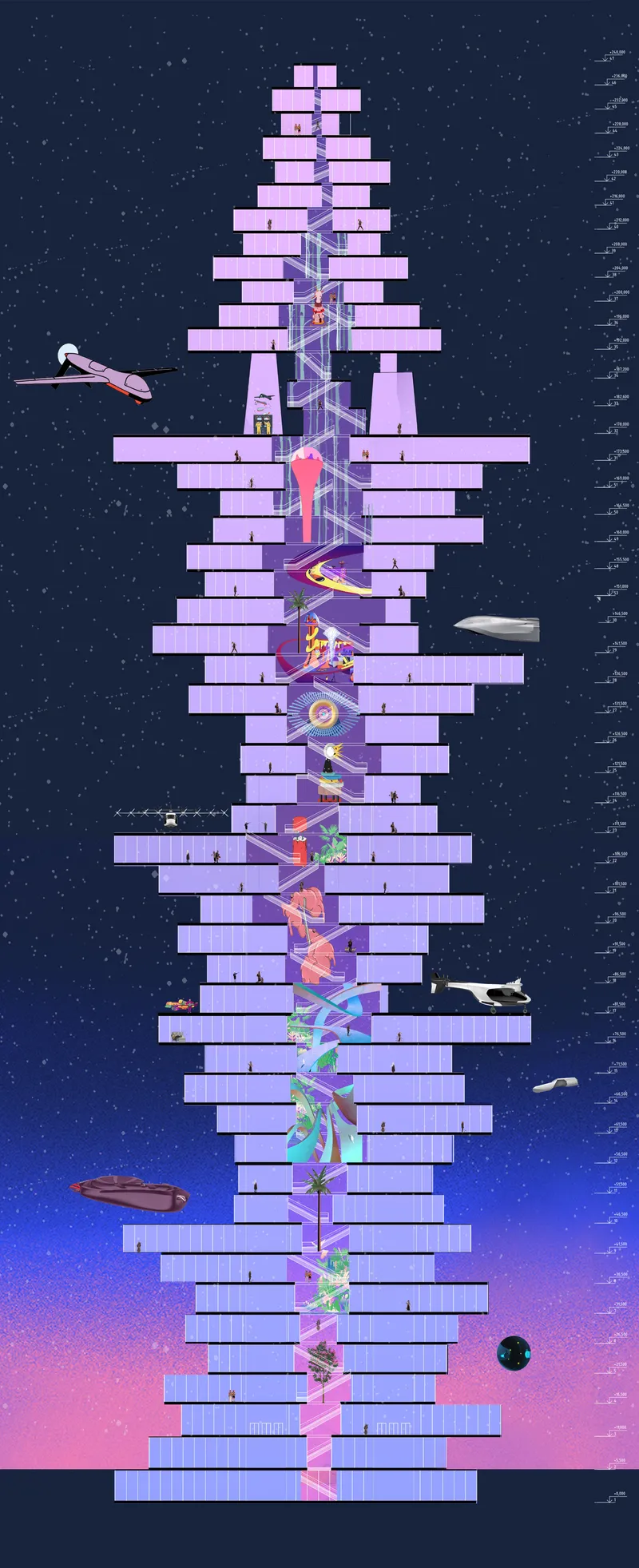
The full-height section drawing, rendered in purples and pinks against a night sky, reveals the internal logic. A spiralling central core connects all levels. Programme floors step outward as the tower rises, creating landing platforms at every level for different vehicle types. The widest floors are in the middle (offices and retail). The narrowest are at the top (airport) and bottom (housing base).
The section reads like a diagram of ambition. It is deliberately unrealistic about current technology and deliberately serious about future possibility. This is what speculative competition entries are for: to draw the diagram of a world that does not exist yet and ask whether it should.
Night Identity: The Tower as Beacon
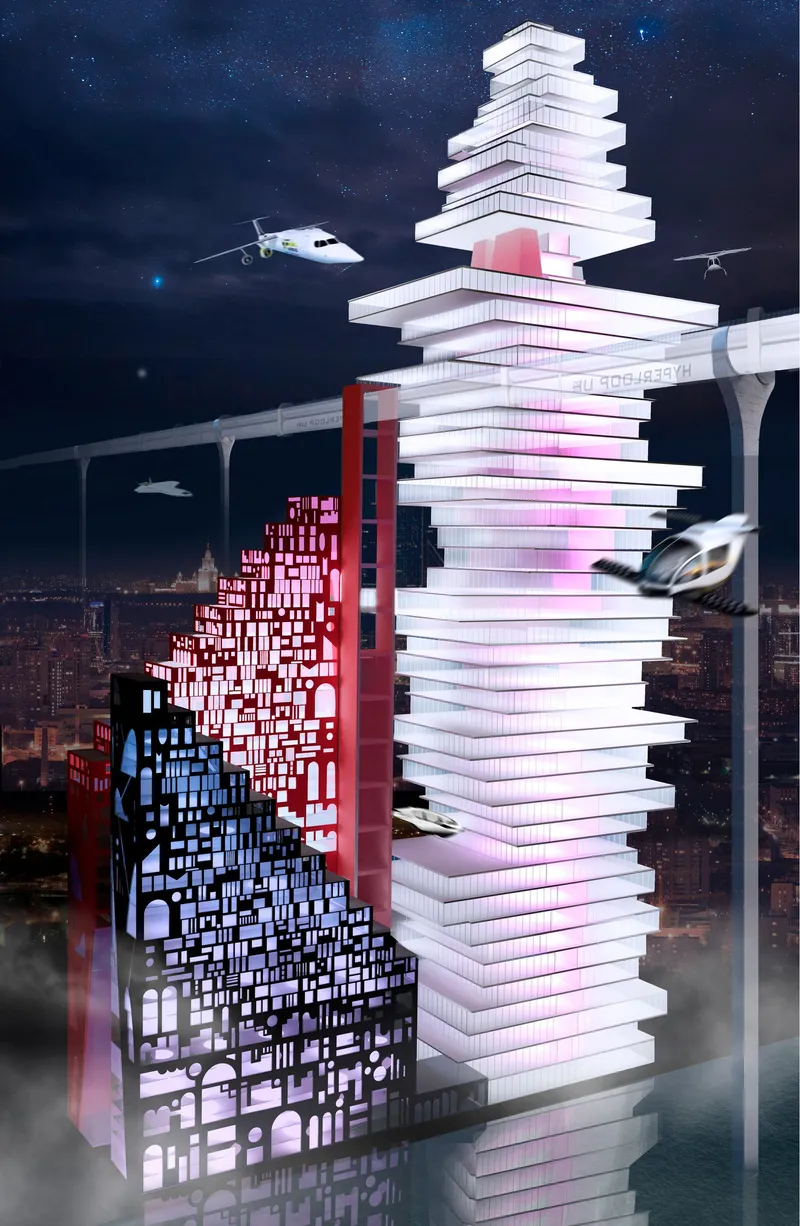
The night render is the project's most published image. The tower glows white and pink above Moscow's skyline. Drones circle. A flying vehicle docks at an upper platform. The hyperloop bridge enters the building mid-height. The patterned residential volume beside the tower is lit from within, revealing the density of its inhabitation.
This image works because it is honest about what the building wants to be: a landmark. CityGate does not try to blend in. It announces itself. In a competition about the future of flight and work, that confidence is appropriate. The building is a gate, and gates are meant to be seen.
Why This Project Won the People's Choice
The Hybrid Futures competition asked a question that most entries answered cautiously: add a landing pad, add some co-working. CityGate answered maximally: put everything in one building and make flight the organising principle. The People's Choice Award reflects the audience response to that ambition. It is the kind of project that makes you stop scrolling.
Is it buildable? Not with current technology. Is it useful? Absolutely. It demonstrates what happens when you take a brief seriously and push it to its limit. The result is a spatial diagram that any future discussion about vertical hybrid buildings will reference, whether they build it or not.
View the Full Project
About the Designers
Designers: Darya Zakhvatova, Ekaterina Sorokina
Enter a Design Competition on uni.xyz
If speculative supertall design, hybrid programme towers, or future mobility architecture is the kind of work that excites you, uni.xyz runs competitions year-round that reward maximum ambition.
Project credits: The CityGate by Darya Zakhvatova and Ekaterina Sorokina. People's Choice Award, Hybrid Futures '19: Work x Fly (uni.xyz).



Popular Articles
Popular articles from the community


Co-Life: Senior Housing Design That Reconnects Older Adults With the City
Co-Life reimagines senior housing design through healing gardens, shared streets, workshops, and a sustainable community across generations.

Riyadh For All: Intergenerational Urban Design for Active Aging in Rabat
Riyadh For All reimagines urban design in Rabat with intergenerational co-living, adaptive courtyards, and Moroccan cultural exchange today.

Lunar Spiral: Space Architecture Shaped by the Mathematics of the Universe
Lunar Spiral reimagines space architecture through Fibonacci geometry, lunar regolith, levitating habitats, and self-sustaining Moon living.

Conexión: Biophilic Design Reimagines High-Rise Living in Hong Kong
Conexión reimagines high-rise living in Hong Kong through biophilic design, green facades, shared spaces, daylight, water and nature within.


Similar Reads
You might also enjoy these articles

Day and Night Park: A Time-Based Urban Newsstand in Beijing
A temporary urban newsstand in Beijing blending travel, light, and reading through poetic colors, compact form, and community-focused design.

Modernist Patio Renovation in El Masnou, Barcelona by Oliver Segura Arquitectura + Cebrià Arquitectura
Modernist patio renovation blending tradition and innovation with a movable pool, leveled floors, and Catalan materials in El Masnou.

Alto Residencial Coop: Cooperative Housing Development in Santiago de Compostela by Carbajo Barrios Arquitectos
A linear cooperative housing complex blending white volumes and perforated metal façades, enhancing community living, natural light, privacy, and urban integration.
Vil Genis School by BPA ARCHITECTURE – Massy, France
Vil Genis School in Massy, France, features sustainable design, south-facing classrooms, community integration, accessible spaces, and modern educational architecture.

Explore Future City Competitions
Discover active competitions in this discipline


Deconstructivism - Illustration Design Challenge

Challenge to illustrate a Contemporary Castle


Illustrate the lost glory of Angkor Wat - Render Challenge
Comments (0)
Please login or sign up to add comments
No comments yet. Be the first to comment!