

The Niels Bohr Building: A Landmark for Scientific Innovation in Copenhagen
The Niels Bohr Building in Copenhagen combines state-of-the-art labs, collaborative spaces, and innovative design for interdisciplinary scientific research and education.


A Tribute to Scientific Heritage
The Niels Bohr Building stands as an iconic hub for the Faculty of Science at the University of Copenhagen. Designed by Christensen & Co. Architects, this cutting-edge facility honors the legacy of Niels Bohr, the legendary Danish physicist who transformed Copenhagen into a global center for scientific discovery during the 1920s and 1930s. The building bridges historical inspiration with modern research, fostering a dynamic, international scientific community.


State-of-the-Art Research Facilities
Spanning 55,000 square meters, the Niels Bohr Building accommodates a wide array of scientific disciplines including biology, chemistry, physics, geography, geology, computer science, mathematics, molecular biomedicine, nanotechnology, and e-science. Specialized laboratories support advanced research in astrophysics, nanophysics, quantum physics, and other cutting-edge fields.
Key technical facilities include:
- Technical laboratories and synthesis labs
- Ice labs and chemistry labs
- GMO and isotope laboratories
- Robotics labs
- Clean rooms and wet labs with classifications ISO 5–8
The building’s design ensures high precision for scientific experiments, including vibration-free basements that neutralize external disturbances from the adjacent Jagtvej traffic.


Designed for Social Connections and Interdisciplinary Collaboration
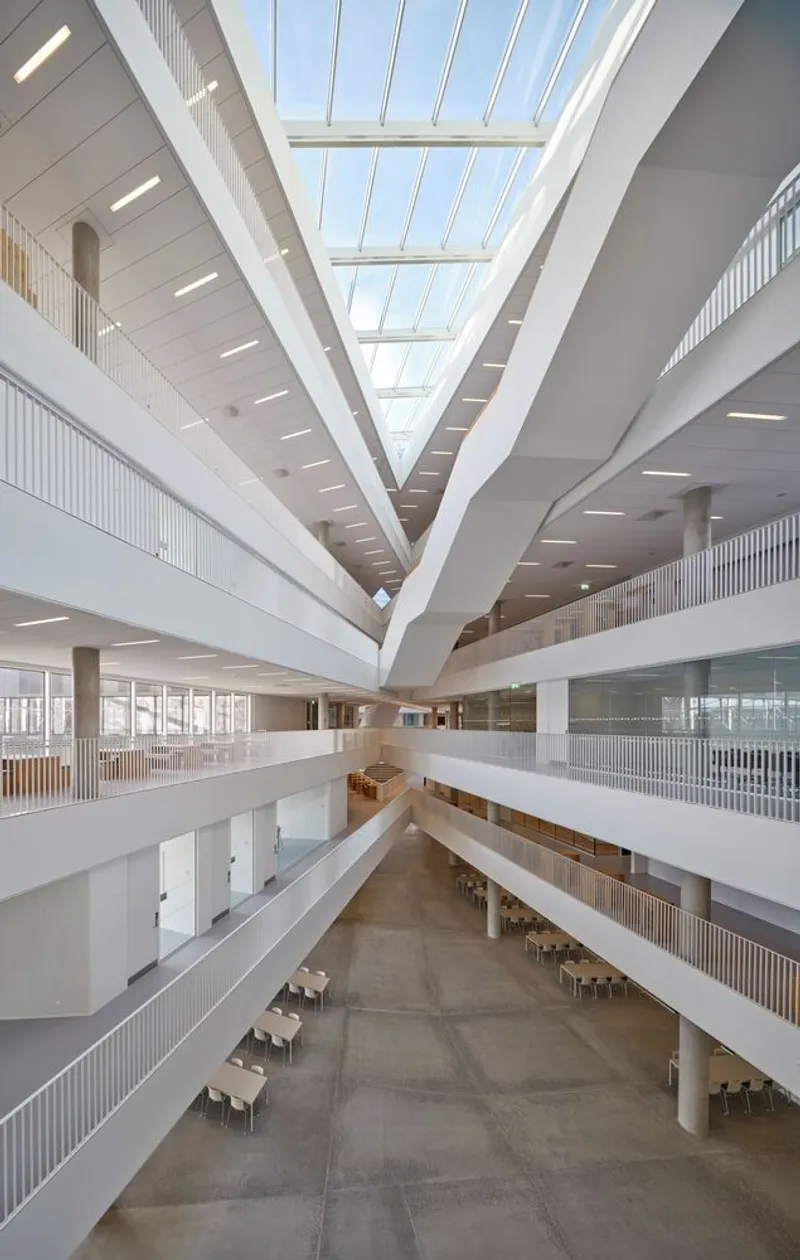
The Niels Bohr Building is not just a research facility—it’s a social and collaborative hub. At its core lies the Troposphere, an infinity-shaped atrium designed to encourage interaction among students, professors, and researchers.
The building promotes knowledge-sharing and community engagement through:
- Coffee spots and informal meeting areas
- Six courtyards for relaxation and group activities
- Open atriums encouraging cross-disciplinary exchange
This design philosophy ensures that no one works in isolation, reflecting a modern approach to collaborative science and education.


Innovative Architectural Solutions
The Niels Bohr Building is composed of two main structures connected by a skywalk, accommodating advanced research requirements while responding to urban challenges. Sensitive research equipment is safeguarded from vibrations through specialized basement construction, and flexible internal layouts allow the building to adapt to evolving scientific needs.
Materials like glass, wood, and modern lighting solutions enhance natural light and transparency, reinforcing the building’s ethos of openness and collaboration.


A Hub for Future Scientific Discoveries
Since its completion in 2024, the Niels Bohr Building has set new benchmarks in research infrastructure, interdisciplinary collaboration, and sustainable architectural design. By combining advanced laboratories with spaces for social interaction, Christensen & Co. Architects have created a building that continues Niels Bohr’s vision of a vibrant, connected scientific community.
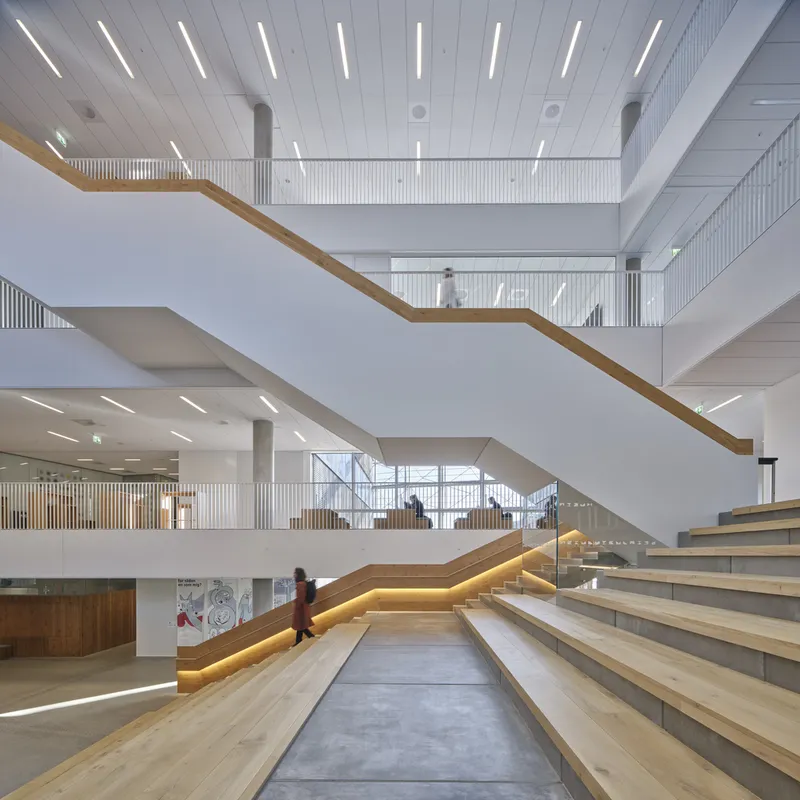
All Photographs are works of Adam Mørk


Popular Articles
Popular articles from the community


graciastudio Turns a Viewless Tijuana Lot Inward Around a Courtyard of Concrete, Timber and Trees
In Tijuana, Jorge Gracia's GA2 House stacks a timber-clad private floor over exposed concrete and replaces a missing view with a planted interior patio.


Singing Woman: An Opera House That Performs Before the Curtain Rises
Ovidiu Cristian Pavel's conceptual opera house translates Estonia's choral identity into a sculpted waterfront landmark facing the Baltic Sea.

FCC Arquitectura Expands a Portuguese Granite House with a Board-Marked Concrete Wing
In Portugal, JV House pairs a cleaned-up whitewashed and granite dwelling with a timber-shuttered concrete extension, courtyards and a garden pool.

David Ortega Stacks a Two-Story Mexico City Penthouse Around a Steel Stair and a Pergola-Shaded Roof Terrace
In Colonia Roma, a 300 m² penthouse uses oak joinery, a planted steel stair and a slatted roof pergola to make a new-build apartment feel like a house.

Similar Reads
You might also enjoy these articles


Hodi-Mandai Geram
Project Function: Preservation and revitalization of the Intangible heritage and socio-spatial identity of the Hodi by Housing, Cultural Memory Center, Sacred Grove, landscape, local tourism economy


Olio Towers: A Mid-Rise for Performers That Fuses Housing, Rehearsal, and Stage
Located blocks from Houston's Theater District, this modular tower stacks living units around a central performance atrium.

Oasis: Modular Green Housing Carved into Dhaka's Urban Fabric
A shortlisted Plugin Housing entry reclaims unauthorized settlements in Dhaka with stepped concrete volumes, green roofs, and ventilation-driven design.

Black Hole: A Floating Megastructure for the Post-Physical Era
Emiliano Mazzarotto envisions a spherical, self-scaling arena where e-sports, digital hotels, and holographic stadiums replace traditional public space.

Explore Copenhagen Competitions
Discover active competitions in this discipline

Challenge to design public laboratory

Challenge to reimagine the Iron Throne

Photograph architecture without architects

Illustrate the lost glory of Angkor Wat - Render Challenge
Comments (0)
Please login or sign up to add comments
No comments yet. Be the first to comment!