
The Push: A Bridge That Remembers Your First Bicycle Ride
A kinetic, openable bridge transforms the memory of learning to cycle into layered public space, retail, and urban spectacle.


What if a bridge could make you feel five years old again? The Push begins with a narrow, curved entrance designed to reproduce the anticipation of a first bicycle ride, then unfolds through five sequential spatial moments that mirror the emotional arc of learning to balance, fall, and finally fly. It is infrastructure built around a memory, a crossing that insists you arrive somewhere different from where you started, not just geographically but emotionally.
Designed by Mina Mohsen and Amany Attia, The Push is an Institutional Excellence Award entry for The City Link competition. The project reimagines the urban bridge as a living structure that celebrates cycling culture, parent-child relationships, and collective experience. Rather than treating the bridge as a neutral connector between two banks, Mohsen and Attia layer it with programme, kinetic architecture, and narrative sequence, making the crossing itself the destination.
Four Floors Stacked Over Water
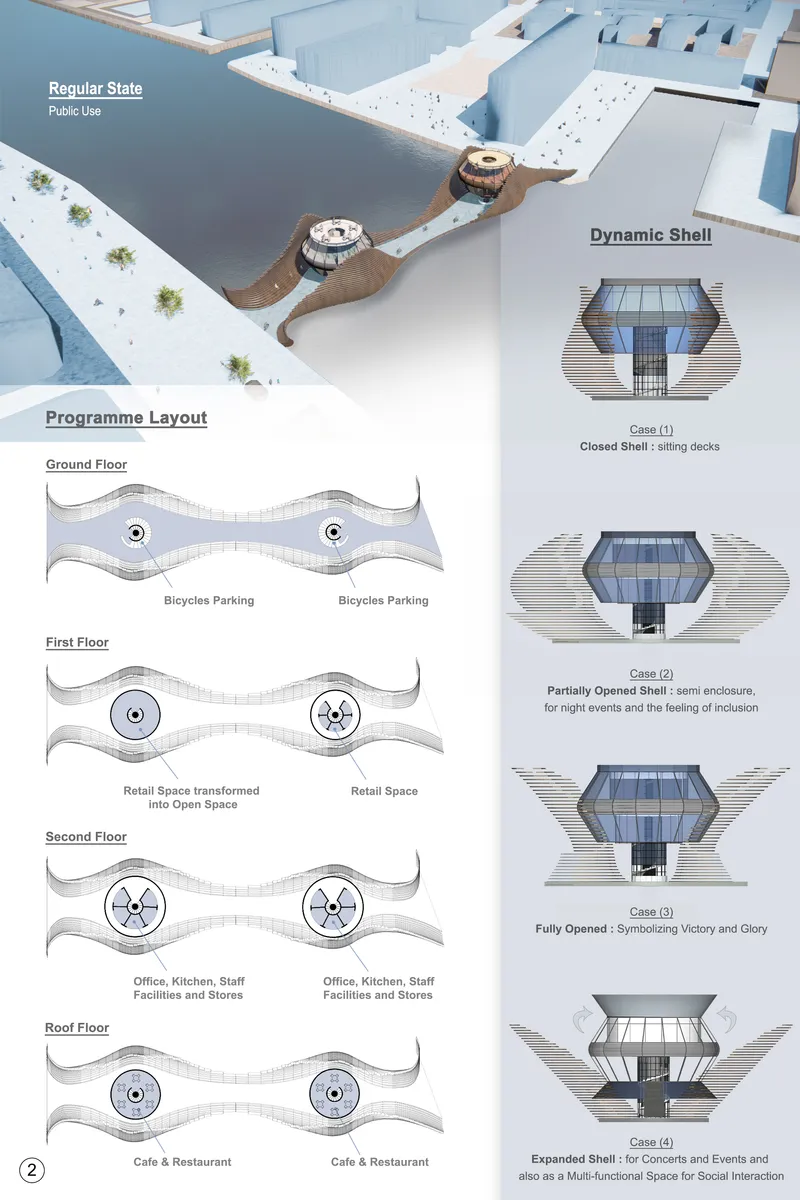
The floor plan and shell configuration diagram reveals how tightly the programme is packed into the bridge's cross-section. The ground floor is given entirely to circulation and bicycle movement, keeping flow uninterrupted. Above that, the first floor holds retail spaces engineered to transform into open public areas when needed. A second floor houses offices, kitchens, staff facilities, and service zones that keep the bridge operational day to day. At the roof level, cafés and restaurants activate what would otherwise be dead structural surface, turning the top of the bridge into a genuine urban destination.
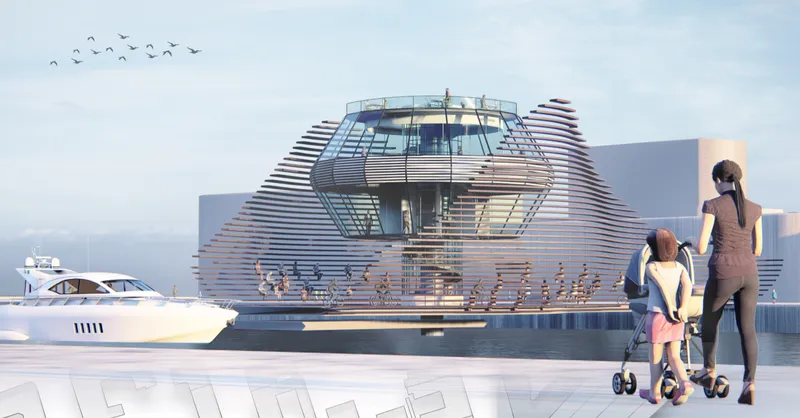
From the waterfront, horizontal louvers wrap the elevated central volume in a rhythmic screen that simultaneously filters light, frames views, and signals the bridge's identity from a distance. The family walking along the boardwalk in the rendering gives immediate scale: this is not a slender pedestrian span but a substantial inhabited structure that reads more like a neighbourhood suspended above water.
A Shell That Opens in Four Acts
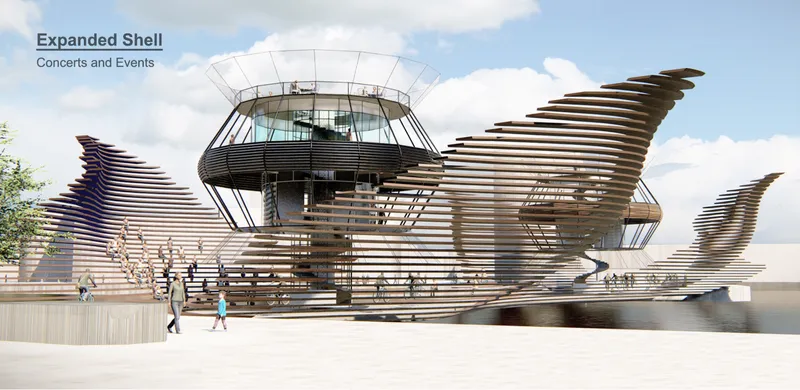
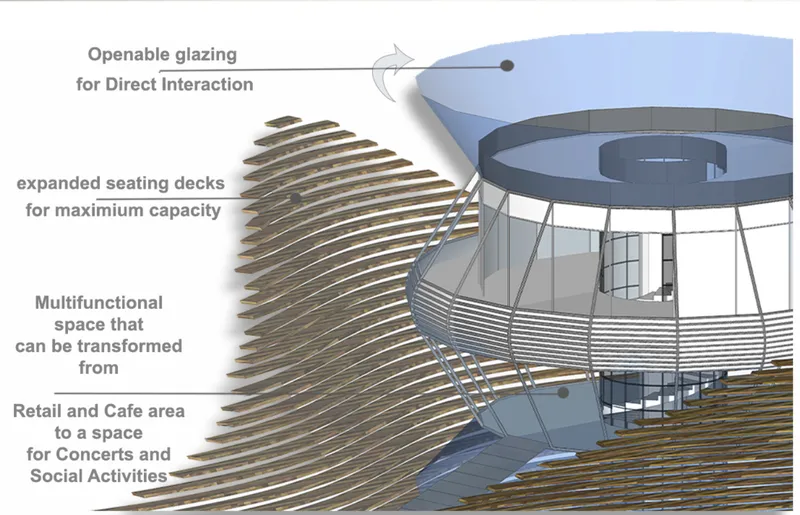
The most striking technical proposition in The Push is its dynamic shell system, an architectural skin that shifts configuration to match social and programmatic demands. In its closed state, the shell creates intimate sitting decks and enclosed resting zones. Partially opened, it produces semi-enclosed spaces suited to evening events. Fully opened, it transforms the bridge into an urban stage, symbolizing collective celebration. In its most extreme expanded state, the shell accommodates concerts and large-scale public gatherings, with extended seating decks cantilevering outward over the water.
The detail rendering shows how the retractable louver system connects to the circular glazed upper level, exposing the mechanical logic behind the transformation. These are not cosmetic gestures; the louvers physically reconfigure the enclosure ratio of the interior spaces, changing the bridge's relationship to wind, light, and crowd size in real time. Architecture that literally breathes is a familiar ambition, but here the mechanism serves a clear narrative purpose: each state of the shell corresponds to a stage in the emotional journey from enclosure to openness.
Five Moments from Anticipation to Independence
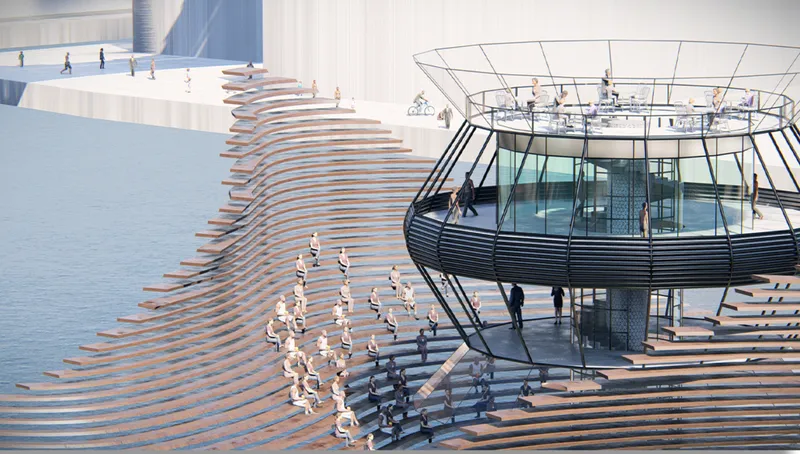
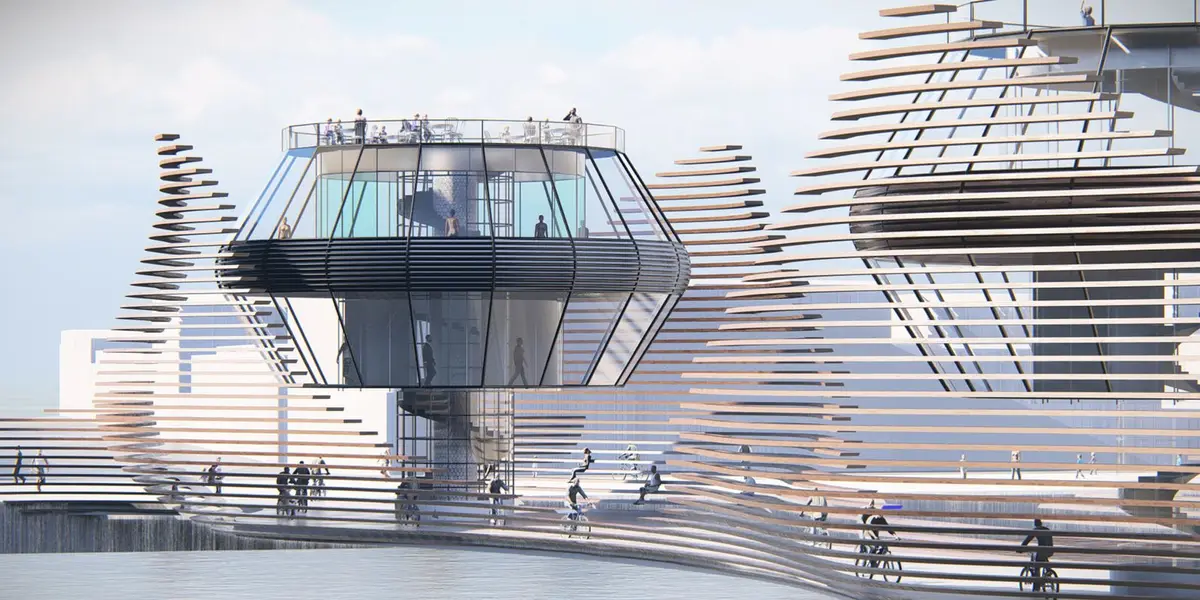
The experiential sequence is divided into five named components, each assigned a distinct spatial character. The Push, the entry, is narrow and curved to build anticipation. The Souls are two central hubs containing retail and services, providing safety and orientation. The Holding Hands are adjustable resting shells offering enclosure and comfort. The Fall is an openable section that introduces a sense of controlled risk. And The Flight is the final release: an open journey forward that symbolizes independence. The waterside view of horizontal timber louvers forming a wing extending from the circular viewing platform captures the spirit of that last moment, where structure dissolves into air and the crossing ends not with a wall but with a horizon.
Splitting the Deck for Ships Below
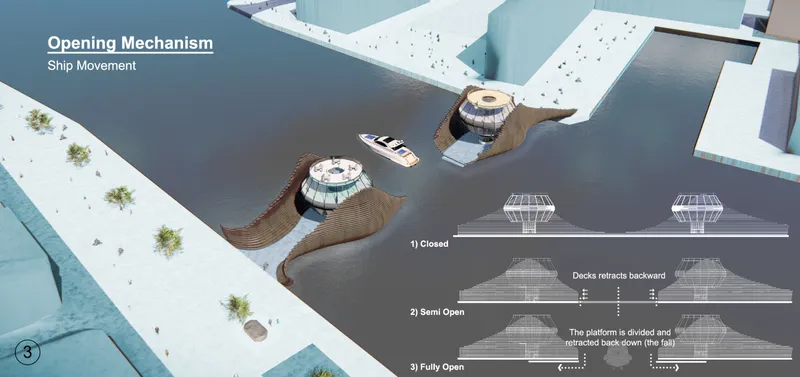
An aerial view of the two waterfront pavilions, paired with a diagram showing three opening mechanism positions, makes the engineering ambition explicit. The bridge must accommodate ship traffic beneath it without severing pedestrian and bicycle circulation above. Decks retract and platforms divide with precision, a kinetic choreography that allows the structure to fulfill its obligations as both infrastructure and inhabited space. The diagram's three states show how the openable section transitions cleanly, keeping disruption to surrounding movement minimal while creating a visual event for anyone watching from the banks.
This is where The Push moves beyond metaphor. A bridge that tells the story of learning to ride a bicycle is a compelling narrative device, but a bridge that also opens for maritime traffic while sustaining public life on its upper decks is an engineering proposition with real urban value. The two ambitions are not separate; they reinforce each other. The moment of "The Fall," the section that introduces controlled risk in the narrative, is also the section that physically opens, collapsing conceptual and structural logic into a single mechanism.
Why This Project Matters
Bridges tend to attract one of two design approaches: the minimal engineering gesture that treats the span as pure structure, or the maximalist icon that treats it as sculpture. The Push sidesteps both by treating the bridge as a programmed building that happens to cross water. Retail, offices, cafés, and event space are not bolted on as afterthoughts; they are organized floor by floor with the same care you would bring to a mixed-use building on solid ground. The result is a bridge that generates foot traffic rather than simply accommodating it.
What makes Mohsen and Attia's work genuinely interesting is their insistence that infrastructure can carry emotional content without sacrificing functional performance. The five-part narrative could easily have become decorative wallpaper over a conventional span. Instead, it is built into the spatial sequence, the shell states, and the opening mechanism itself. The Push argues that the best public spaces are the ones that make you feel something specific, not just comfortable, and that a bridge is uniquely positioned to do this because it already implies a beginning, a middle, and an end.
View the Full Project
About the Designers
Designers: Mina Mohsen, Amany Attia
Enter a Design Competition on uni.xyz
uni.xyz runs architecture and design competitions year-round that reward proposals with spatial conviction and real site intelligence.
Project credits: The Push by Mina Mohsen, Amany Attia The City Link (uni.xyz).


Popular Articles
Popular articles from the community


David Ortega Stacks a Two-Story Mexico City Penthouse Around a Steel Stair and a Pergola-Shaded Roof Terrace
In Colonia Roma, a 300 m² penthouse uses oak joinery, a planted steel stair and a slatted roof pergola to make a new-build apartment feel like a house.

Architekt Andreas Gruber Scatters 23 Dark Timber Chalets Across a South Tyrolean Forest Edge
In Molini di Tures, Amonti Chalets breaks a resort into a hamlet of gabled timber houses, with parking, storage and services pushed into the slope.

David Macias Steps a Doorless Stone and Plaster House Down a Tropical Colombian Hillside
In the humid hills of Colombia, Threshold House replaces the front door with an open void and terraces its 850 m² down the slope instead of fighting it.

Cube Design Draws an Ecological Corridor Between Two Shenzhen Hills with the Nankai Building
Beside Shenzhen's container docks, the Nankai Building pairs stacked balconies with a climbing green screen to connect two hillsides across its height.

Similar Reads
You might also enjoy these articles

Yenisei Monitoring Center: A Sun-and-Moon Sphere Anchors a Research Campus on Siberia's Great River
In Krasnoyarsk, shifting square blocks, a glazed central sphere and descending window rhythms turn river science into a public spectacle on the Yenisei.
Andretta Artist's Village: A Node-Based Masterplan That Lets the Hills Write the Plan
A cultural landscape strategy for Palampur's artist colony threads studios, residences and stages along a porous spine shaped by the Dhauladhar terrain.
Street Children Rehabilitation Center: A Brick Campus That Eases Children From Street to Safety
A low-rise courtyard campus where learning streets, uthans and shaded verandahs stage a gradual passage from street into protective, family-scale life.
The NEON Culture: A Field of Pavilions Built for the 24-Hour City
Smaran Alva spreads galleries, stages, clubs and markets across a varied site, treating light, sound and ramped movement as the real building materials.

Explore Cycling Bridge Competitions
Discover active competitions in this discipline

Challenge to reimagine the Iron Throne

Photograph architecture without architects

Illustrate the lost glory of Angkor Wat - Render Challenge

Design challenge to reuse E-waste
Comments (0)
Please login or sign up to add comments
No comments yet. Be the first to comment!