
The Urban Ensemble: Modular Micro-Housing That Breathes with Bengaluru's Lake District
A winning micro-housing prototype uses prefabricated modules, passive ventilation, and a staggered V-plan to deliver compact living near Halasuru Lake.


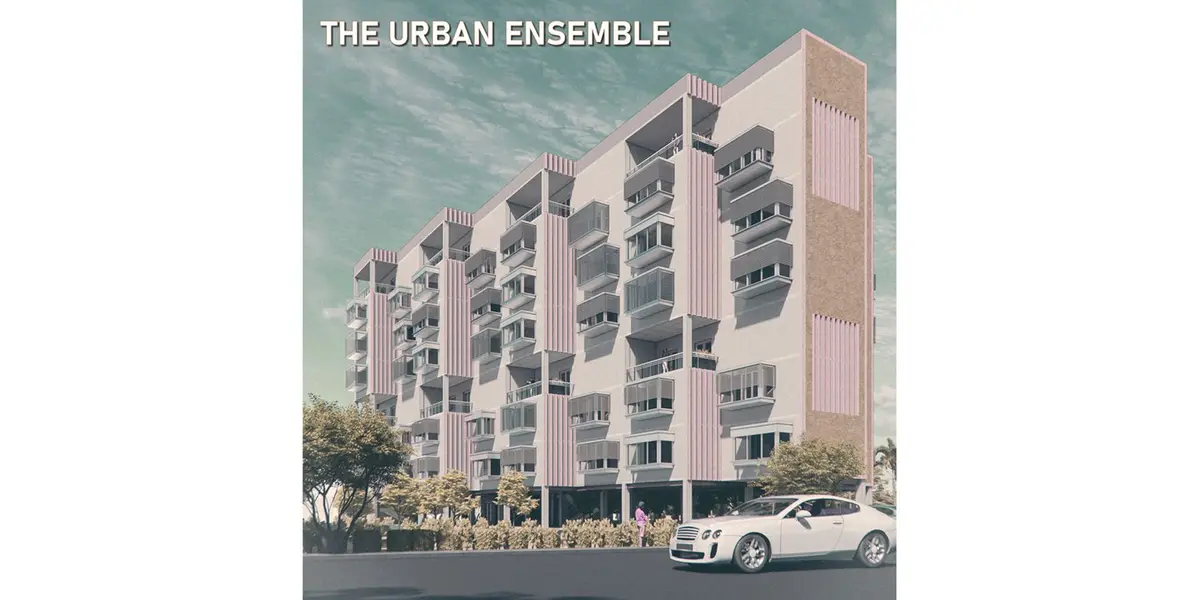
Eighty meters from Halasuru Lake, a cluster of staggered residential volumes steps back from the waterfront in a V-shaped plan calibrated to pull cool breezes through every corridor. The Urban Ensemble is not another generic apartment block dropped onto a vacant plot; it is a prefabricated micro-housing system designed to plug into one of Bengaluru's most transit-rich, ecologically sensitive neighborhoods, proving that density and livability can coexist when the architecture does the hard work of climate response.
Designed by Yamini Srivastava and Ashwin Dinesh, the project won the Plugin Housing Challenge. Sited along Kensington Main Road within walking distance of Halasuru Metro Station, the development leverages its adjacency to the lake for both environmental performance and visual amenity. The surrounding neighborhood supports diverse lifestyle needs, but the real design opportunity lies in the lake itself: its microclimate, its breezes, and its capacity to anchor a new model of context-sensitive residential planning in one of India's fastest-growing tech hubs.
A Waterfront Form Shaped by Airflow
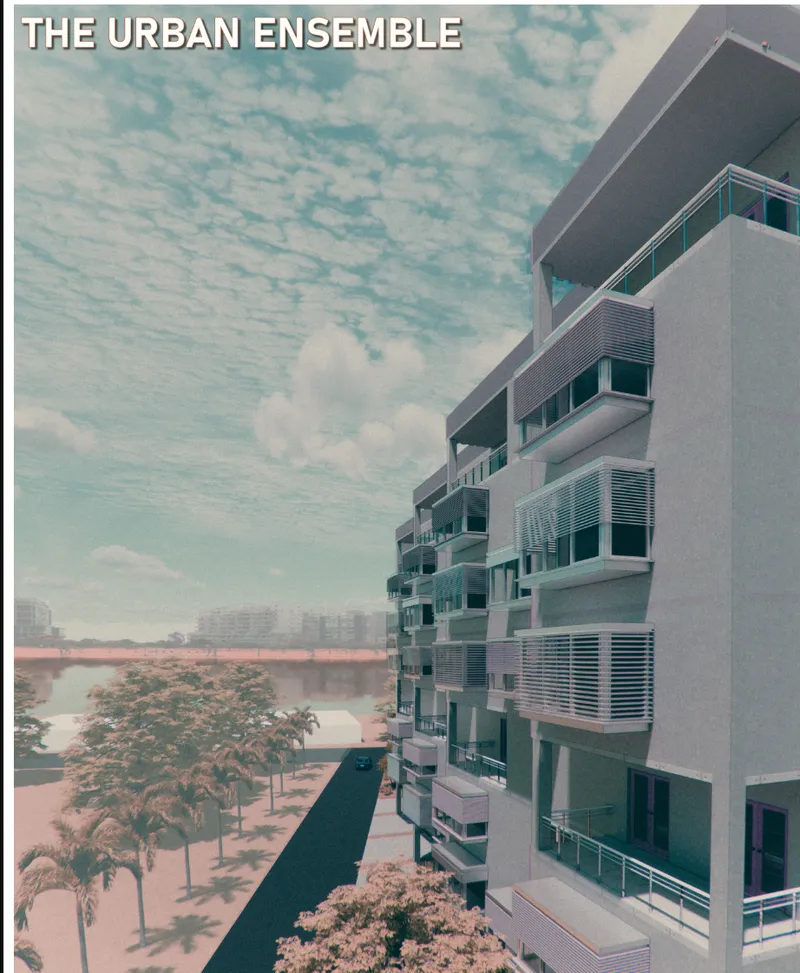
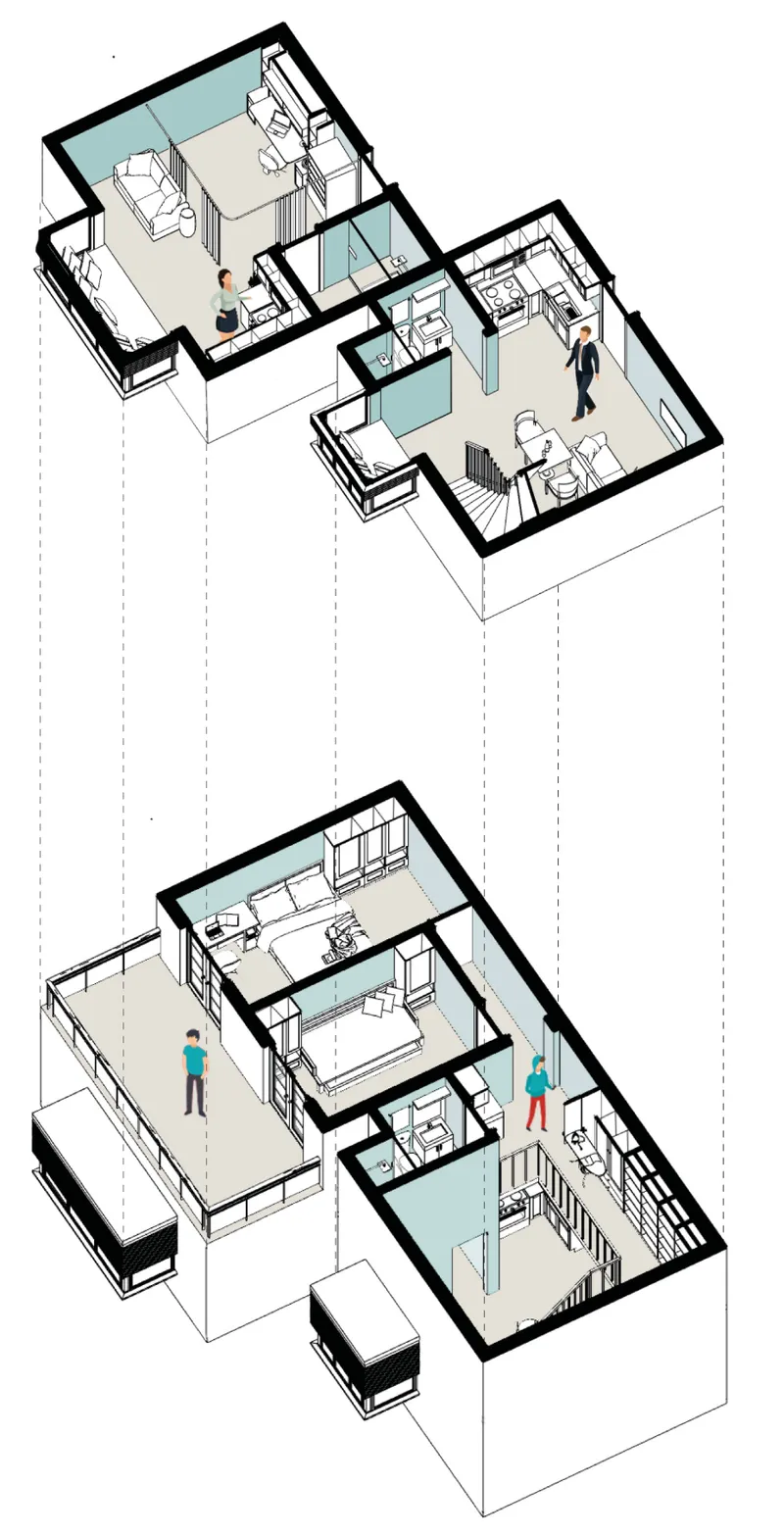
The rendered perspective from the lakefront reveals the logic of the staggered massing: residential blocks step outward at angles that open balconies and bay windows toward the water while creating gaps between volumes for cross-ventilation. The V-shaped site layout is not decorative; it generates a Venturi effect, accelerating air movement through the central courtyard and reducing reliance on mechanical cooling. The axonometric section drawing makes the split-level unit organization legible, showing staircases connecting duplex-style double occupancy units where recreational zones occupy the lower level and private quarters sit above.
Orienting buildings to maximize daylighting and panoramic lake views simultaneously is a common claim in housing proposals. Here, the staggered plan delivers on it structurally: each module rotates slightly relative to its neighbor, preventing one unit from blocking another's sightline. The courtyard between the volumes acts as both a microclimate moderator and a social catalyst, creating shared ground without eroding the privacy of individual dwellings.
Convertible Interiors That Work Harder Than Their Square Footage
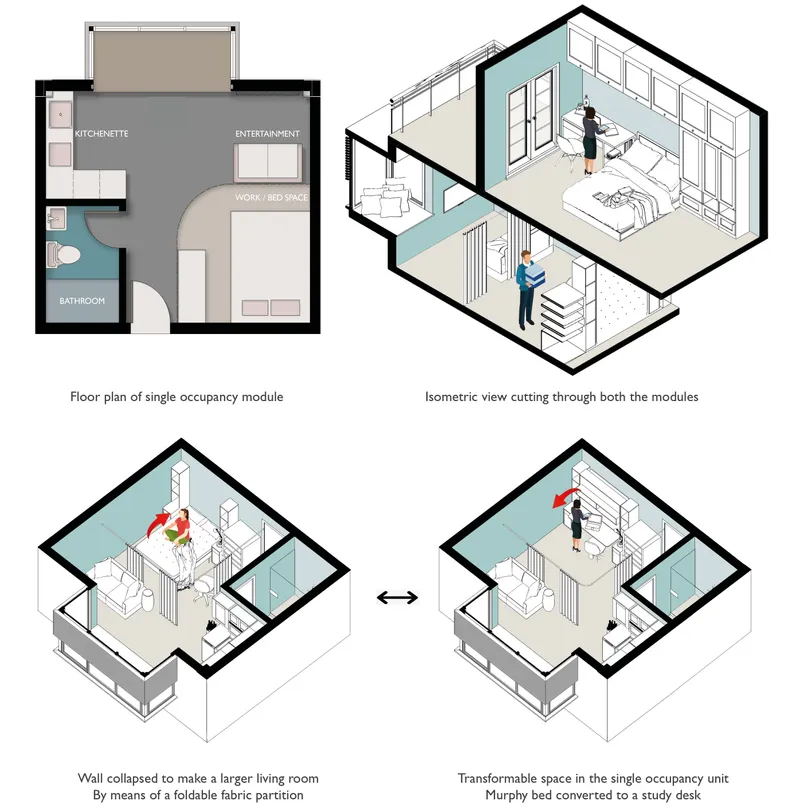
The floor plans and isometric unit drawings expose the real discipline of micro-housing: making a compact footprint feel generous through transformation. Single occupancy units feature lake-facing bay windows, foldable Murphy beds that convert into desks, and collapsible fabric partitions that allow residents to reconfigure their space throughout the day. Double occupancy units adopt a duplex strategy, separating communal living from sleeping quarters across two levels connected by an internal stair, with a shared balcony extending usable area outward.
Each module is designed to function independently or combine with adjacent units to form larger living arrangements, following a plug-in logic that gives the system its name. The prefabricated construction follows DFMA (Design for Manufacture and Assembly) guidelines, enabling precision off-site fabrication and streamlined onsite assembly. Multi-use furniture and convertible partitions are not afterthoughts but integral to the modular kit, reducing on-site waste while empowering residents to personalize their homes without structural intervention.
Green Roofs, Solar Panels, and a Passive Envelope Strategy
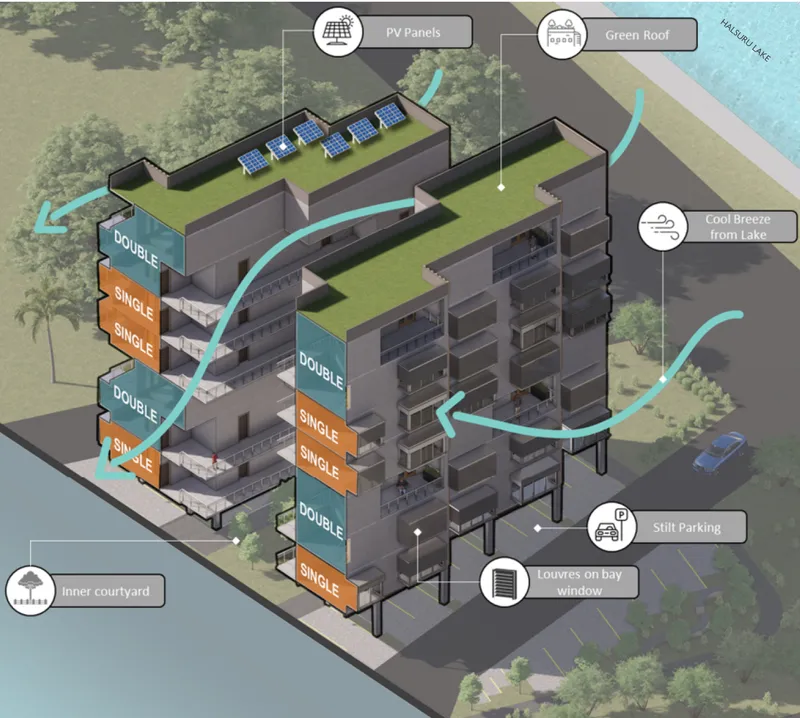
The axonometric environmental diagram lays out the project's sustainability infrastructure with unusual clarity. Green roofs cap each stepped volume, managing stormwater and reducing heat island effects. Solar PV panels occupy south-facing roof surfaces, contributing to reduced utility loads alongside WaterSense-labeled plumbing fixtures and energy-efficient appliances. Rainwater harvesting systems collect and redirect runoff, while the diagram traces natural ventilation flows through and between units, illustrating how the building form itself is the primary cooling strategy.
Additional envelope treatments include vertical timber louvers for solar shading and moss walls that promote biodiversity on building surfaces. Eco-friendly landscaping uses local, low-maintenance plant species to preserve ecological balance while minimizing irrigation demands. Smart building technologies, including automated systems in corridors and shared spaces, lower operational costs. Taken together, these are not isolated green gestures but a coordinated envelope and infrastructure strategy that reduces consumption without compromising comfort.
Ground-Level Commons Beneath Raised Volumes
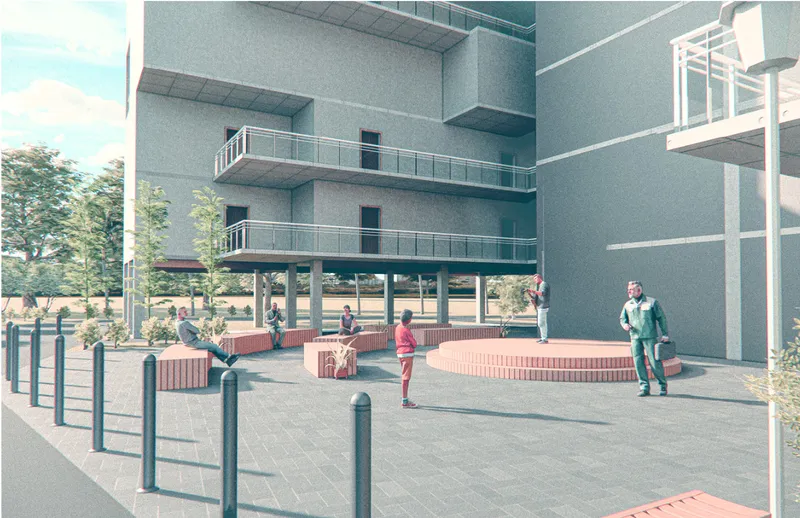
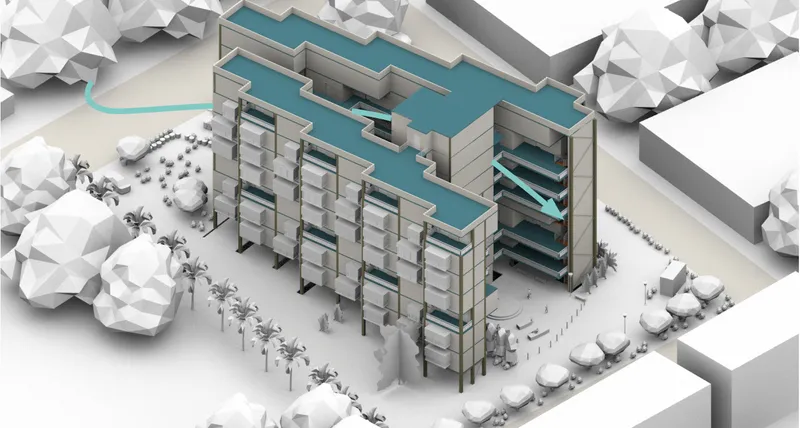
The courtyard rendering shows what happens at ground level: stepped brick seating elements and metal bollards define a shared social space beneath the raised residential volumes. The stilt-level design accomplishes three things at once. It creates open parking, establishes accessible pathways for users of all abilities, and lifts living spaces above the ground plane to improve ventilation and flood resilience near the lake. The isometric site view confirms the stepped massing in context, with green roofs reading as a continuous planted surface that terraces down toward the water.
Universal design is embedded in the circulation strategy rather than treated as a compliance afterthought. Accessible pathways connect the courtyard to the metro station route and the lakefront, making the development's proximity to transit a lived reality rather than a site plan statistic. The brick seating, the bollard-defined pedestrian zones, and the shaded underbelly of the residential volumes together create a ground plane that invites occupation, turning infrastructure into public life.
Why This Project Matters
Bengaluru's housing crisis is not a supply problem alone; it is a quality problem. The city builds plenty of apartments, but few of them respond to climate, context, or the actual lifestyles of young professionals and solo dwellers who make up its booming tech workforce. The Urban Ensemble takes the plugin housing brief seriously, delivering a modular system that can be fabricated off-site, assembled quickly, and adapted over time without demolition or waste. Its V-shaped plan, Venturi-driven ventilation, and convertible interiors are not speculative ideas but buildable strategies grounded in a real site 80 meters from a real lake.
What distinguishes Srivastava and Dinesh's winning entry is its refusal to treat sustainability and affordability as separate problems. The passive envelope, the DFMA construction logic, the green roofs, and the compact transformable units all serve both goals simultaneously. In a city where the average commute devours hours and where air conditioning loads strain an overtaxed grid, a micro-housing prototype that cools itself, generates its own power, and sits within walking distance of a metro station is not a utopian exercise. It is the minimum viable architecture for a livable Bengaluru.
View the Full Project
About the Designers
Designers: Yamini Srivastava, Ashwin Dinesh
Enter a Design Competition on uni.xyz
uni.xyz runs architecture and design competitions year-round that reward proposals with spatial conviction and real site intelligence.
Project credits: The Urban Ensemble by Yamini Srivastava, Ashwin Dinesh Plugin Housing Challenge (uni.xyz).


Popular Articles
Popular articles from the community


longwave studio Reorganizes a 112 m² Tainan Apartment Around the Daily Routines of a Family and Two Cats
In Tainan, Taiwan, birch plywood, rust-red furniture and a freestanding plaster wall link arrival, storage, work and family life in one apartment.

LT2A and OPEN Architectes Thread a Brick and Glass High School Through a Wooded Belgian Campus
In Braine-l'Alleud, a 3,000 m² wing for Collège Cardinal Mercier pairs pale brick with a glazed colonnade, deferring to a small chapel and a dense wood.

Jaramillo Van Sluys Arquitectura and Urbanismo Turn a Demolished Registry Lot in Quito into an Orchard Plaza
In Quito's Centro Histórico, a 2,800 m² plaza exposes the San Agustín convent wall and redraws its lost Augustinian orchard in volcanic stone.

U.GA Architects Wraps an Oval Rooftop Pool in Curved Board-Formed Concrete on Busan's Jeollidan-gil
In Busan's Jeonpo-dong, a 454 m² mixed-use block stacks a neighborhood facility, guest rooms and an oval rooftop pool inside spiraling concrete walls.

Similar Reads
You might also enjoy these articles


Vereda Arquitetos Renovates a 40-Square-Meter Apartment Inside Niemeyer's Copan Building
A compact unit in São Paulo's most iconic residential tower gets a material overhaul that pairs exposed concrete with bold blue Formica.

Shakur's House: Exposed Brick as an Interior Organiser in a 168 m² Mashhad Residence
Brick moves indoors in this Mashhad residence, where masonry walls, glass partitions and teal planes sequence a compact home without closing it off.

Day and Night Park: A Time-Based Urban Newsstand in Beijing
A temporary urban newsstand in Beijing blending travel, light, and reading through poetic colors, compact form, and community-focused design.

Modernist Patio Renovation in El Masnou, Barcelona by Oliver Segura Arquitectura + Cebrià Arquitectura
Modernist patio renovation blending tradition and innovation with a movable pool, leveled floors, and Catalan materials in El Masnou.

Comments (0)
Please login or sign up to add comments
No comments yet. Be the first to comment!