
The Wall
A Chance to Live

.The Concept
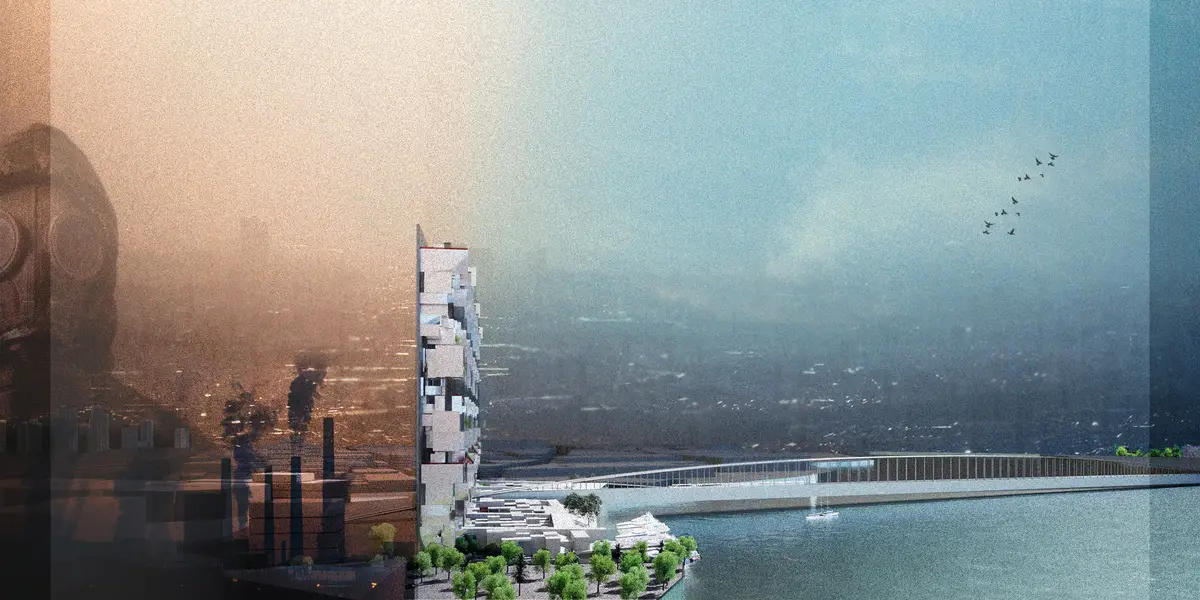
Our team was aware of the fact that a single building can only solve some of the problems an area has. Yet, we wished to design a building that would help improve the living situation for all the locals as much as possible, preferably being a modular and repeatable pattern that would inspire the officials and authorities to multiply it. Hence, the context choice became crucial, and finally, Ahvaz was chosen. Ahvaz used to be a glorious city in the south of Iran, but nowadays, with the dramatic increase in air pollutants (mainly consisting of larger particles like Pm2.5 to Pm 10, even microplastics) caused by deforestation and lack of proper management, this city has almost become unlivable. Addiontaly, the most eye-catching and iconic river in this city, the Karun, is constantly being contaminated by the people who have bought lands near it and turned this public beauty into a filthy private backyard. The housing crisis is becoming more severe daily; numerous low-quality “economic” housing projects have been left unfinished for decades. As a means to oppose the current situation and as a formal and artistic approach, we made the city's ground make a literal stand to the problems, forming a wall and a vertical neighborhood on it. This wall would divide and protect other parts of the town, plus the river. The upright part of the wall would filter the air passing through it, increasing the air quality, and the ending would blend into the edge of the Karun river creating a pleasant and reachable public city space for everyone. The whole neighborhood is transferred into a vertical one; thus, the accesses for vehicles and pedestrians, even the public spaces, should be redesigned accordingly. Furthermore, the skyline would be rotated as well, resulting in a facade with altering levels. Finally, the units would be hung from a heavy load-bearing steel grid that provides support for all the facilities. The wall would consist of some tubes merging to create a fine mesh that wouldn’t be visible from afar, resembling a solid white surface letting the air freely pass through it. These tubes have several filtration mechanisms to absorb microplastics so they can be harvested for recycling late on.
Context and Site plan
The area between the building and the river is covered by a grid-based cubic-designed module with altering levels; that encourage people to engage with the river and the building more. Following the organic forms of the bay of Karun, we created a multi-level pier with a vehicle tunnel running through it to alter the damaged image of the river and persuade people to hang around there more, creating a social hub. Engaging with people from every social class is a priority for a social hub.
Program
Like any other city, proximity, streets, and accesses form this skyscraper. This design's main concertation was to create equality in every neighborhood. So, the facilities and services have been scattered throughout the tower to make accessing them more manageable. The inspiration behind this is the 15-minute city concept, meaning you don’t have to travel more than 15 minutes to reach anything you desire. This way, not only will it increase the visual appeal of the project due to diversity but also, the toll on the vertical vehicle elevators would decrease drastically. Finally, the residents would have a chance to form a community with people they live near since they would have constant encounters; Overall, the neighborhood's safety would also increase. The units vary widely; each one is designed with a specific user in mind. Some are duplexes, some are tinier for single working people, and some even have their personal garden in front. The units all have openings facing the wall to take advantage of the purified air and one curtain wall facing Karun to acquire the maximum sun rays and get a stunning view of the river.
Structure
The structure is a steel grid that stands behind the housing units, with the elevators for vehicles acting as shear concrete walls, further straightening the system. The units would be bolted to this frame to maintain their stability. On the other hand, the surface has its own separate structure, just some joining to the base grid for better stability. Many tiny spaceframe modules run through the wall functioning as its structure.
Life Cycle
In order to take a sustainable approach towards maintaining a building, the tubes in the surface can be replaced individually with ease in case the filters face a problem. The units are prebuilt in different locations. If any issues happen to one of them, they are also changeable. The structure is exposed and made from steel which increases its repairability


Popular Articles
Popular articles from the community


Cloaked Colonization: A Mobile Underwater Habitat That Moves Like a Fish
Micah Abaya's shortlisted EHC Pacific entry reimagines ocean settlement as a dispersed network of self-sustaining architectural organisms.

Tsunami Convergenics: Turning Catastrophic Ocean Forces into Underwater Housing Infrastructure
A speculative underwater settlement off the coast of Onagawa, Japan, treats tsunamis and typhoons as energy sources rather than threats.

Singing Woman: An Opera House That Performs Before the Curtain Rises
Ovidiu Cristian Pavel's conceptual opera house translates Estonia's choral identity into a sculpted waterfront landmark facing the Baltic Sea.
Extended Shell: Retrofitting Kolkata's Balconies as Living Urban Thresholds
A modular retrofit system recovers the social and environmental intelligence of Kolkata's historic verandas for contemporary Park Street residents.

Similar Reads
You might also enjoy these articles

Shakur's House: Exposed Brick as an Interior Organiser in a 168 m² Mashhad Residence
Brick moves indoors in this Mashhad residence, where masonry walls, glass partitions and teal planes sequence a compact home without closing it off.

Day and Night Park: A Time-Based Urban Newsstand in Beijing
A temporary urban newsstand in Beijing blending travel, light, and reading through poetic colors, compact form, and community-focused design.

Modernist Patio Renovation in El Masnou, Barcelona by Oliver Segura Arquitectura + Cebrià Arquitectura
Modernist patio renovation blending tradition and innovation with a movable pool, leveled floors, and Catalan materials in El Masnou.

Alto Residencial Coop: Cooperative Housing Development in Santiago de Compostela by Carbajo Barrios Arquitectos
A linear cooperative housing complex blending white volumes and perforated metal façades, enhancing community living, natural light, privacy, and urban integration.

Comments (0)
Please login or sign up to add comments
No comments yet. Be the first to comment!