

TOYOTA Research and Development Center By Nikken Sekkei: Shanghai, China
TOYOTA R&D Center in Shanghai blends innovative architecture, sustainable design, and collaborative spaces, advancing autonomous driving, hydrogen technology, and future mobility research.


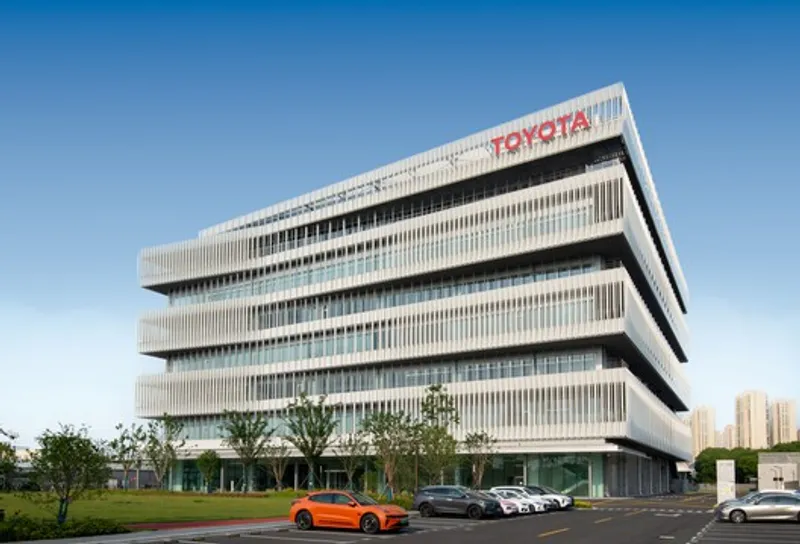
The TOYOTA Research and Development Center, designed by Nikken Sekkei, is a state-of-the-art R&D hub located in Jiading District, Shanghai, China. Covering an expansive 46,003 m², this seven-story facility was completed in 2023 to support Toyota’s mission of advancing autonomous driving, fuel cell technology, and hydrogen-based mobility in China. Conceptualized as an “Innovation Park,” the design integrates biophilic principles with cutting-edge workplace strategies, fostering collaboration, creativity, and environmental responsibility.

Integration of Nature and Technology
The center is strategically positioned in Shanghai’s automotive and technology corridor, adjacent to Tongji University, a leading institution in hydrogen fuel cell research. The facility embraces a park-like environment, with a vast green plaza in front, meeting stringent greening standards and offering spaces for recreation, gatherings, and emergency evacuation. The outdoor zones accommodate food trucks, sports events, and relaxation areas, promoting interaction among researchers while maintaining a strong connection to nature.
Flexible and Efficient Workspaces
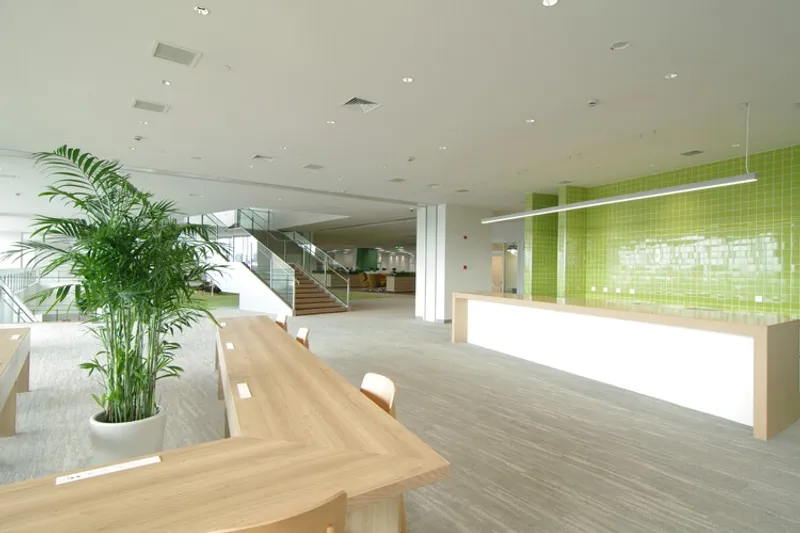
The building features a 60m x 60m universal space at the center of each floor, designed for flexible expansion and future research requirements. Vertical circulation and utility rooms are dispersed along a north-south axis, optimizing duct and piping layouts and ensuring efficient maintenance and safety. A 12m x 12m modular structural grid using precast concrete beams and floor slabs enhances economic efficiency and adaptability while meeting city-specific construction requirements. Service balconies surrounding each floor provide solar shading and accommodate future modifications.
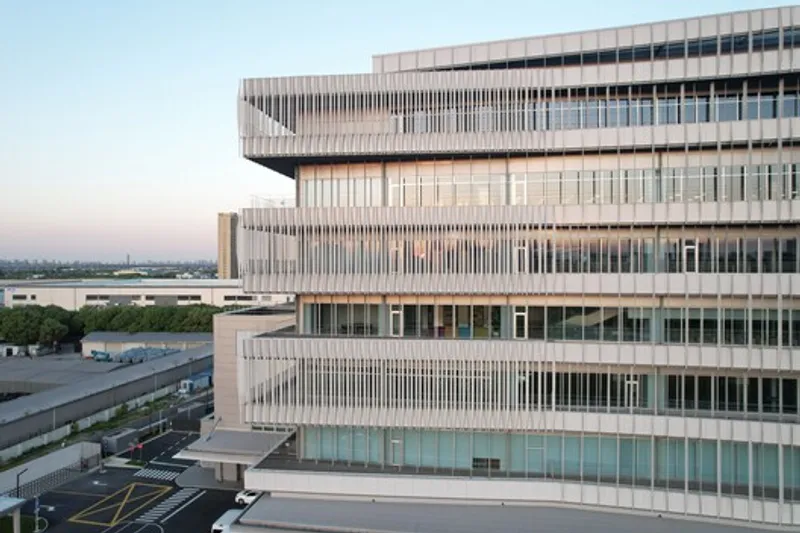
Iconic Light Wing Louvers
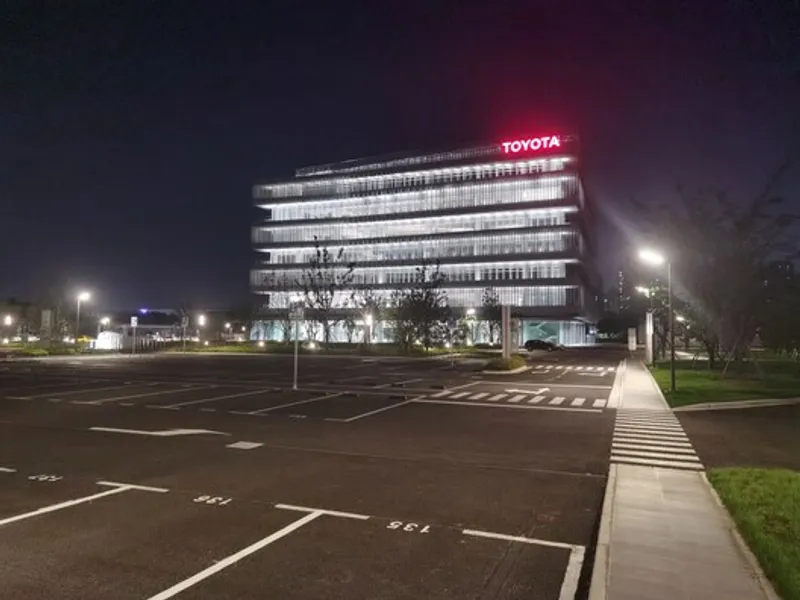
The building’s signature Light Wing louvers draw inspiration from automotive character lines, optimized using advanced simulation technology to reduce solar load. The west façade incorporates computationally designed louvers, balancing sunlight reduction with visual aesthetics. Perforated louvers diffuse natural light into interiors, minimizing glare and creating a visually dynamic, energy-efficient envelope.
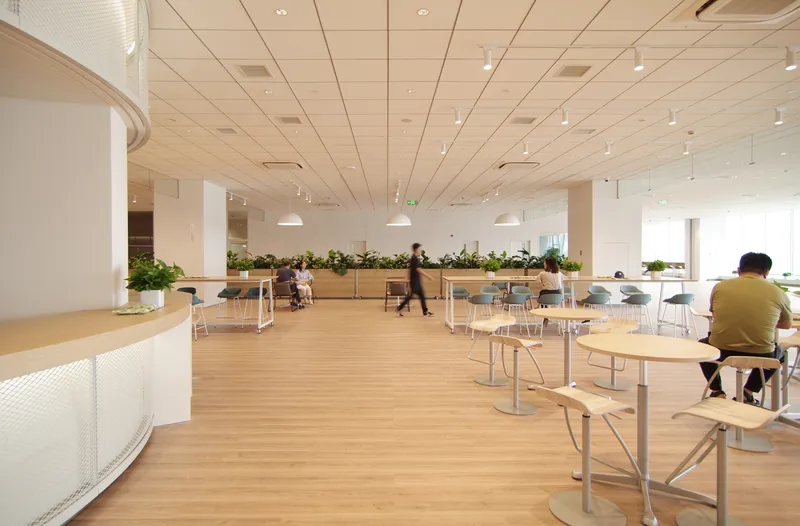

Innovation Void and Collaborative Spaces
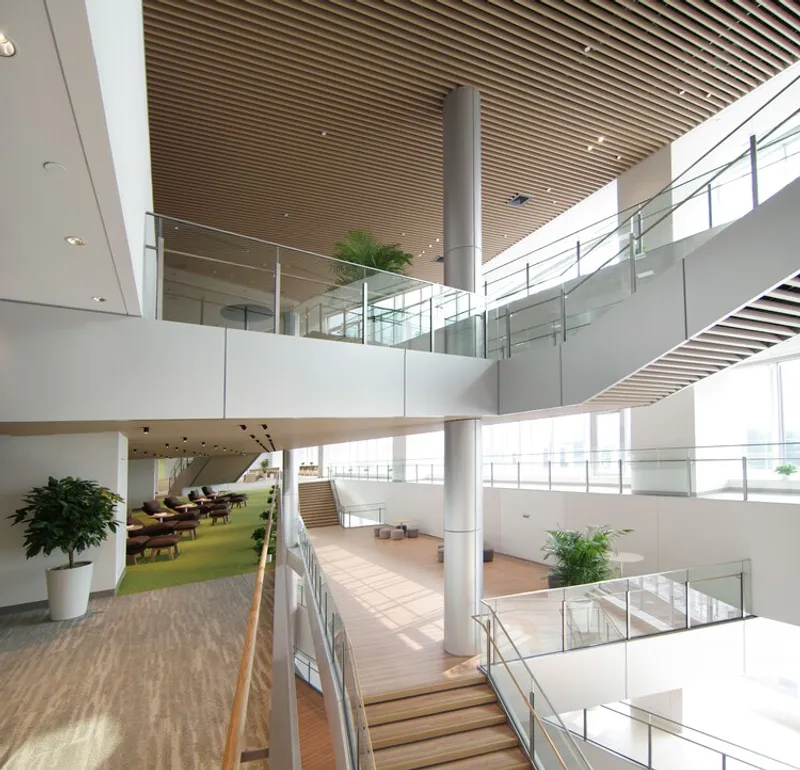
At the heart of the building, the Innovation Void atrium links floors vertically, promoting co-creation among researchers, engineers, and staff. Staggered floor plans and varying ceiling heights create diverse sightlines and seating zones, enabling spontaneous interactions while maintaining comfort. The design supports agile workflows, integrating hardware and software development and facilitating collaboration between Chinese and Japanese teams.
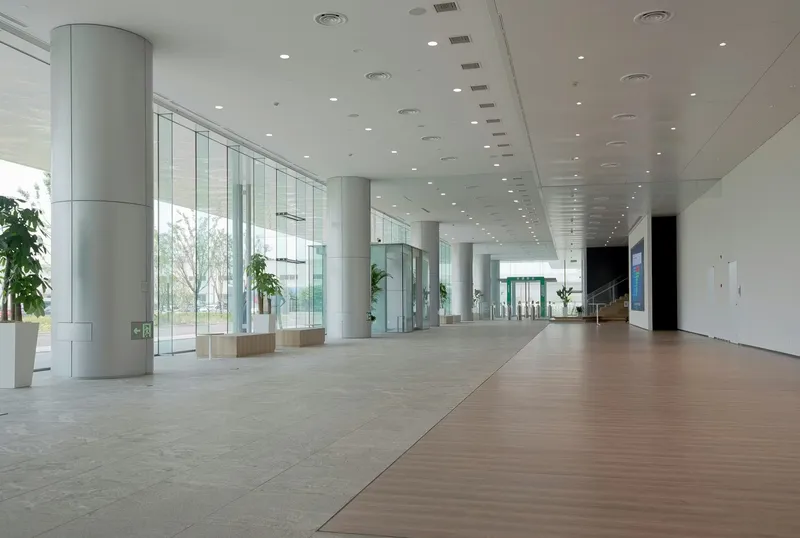

Commitment to Hydrogen and Sustainability
The facility embodies Toyota’s sustainability and decarbonization initiatives, featuring hydrogen-based power generation, solar energy utilization, and energy management systems. Hydrogen equipment provides power equivalent to one floor, supporting experiments in fuel cell (FC) technology and cogeneration. By partnering with universities, the center contributes to next-generation hydrogen mobility and environmental conservation, reflecting Toyota’s commitment to a carbon-free society.

A Vision for the Future
Designed to withstand global climate challenges, pandemics, and unexpected events, the center is a next-generation R&D hub emphasizing human-centered design, sustainable innovation, and mobility for happiness. By blending architectural innovation, green spaces, and advanced technology, the TOYOTA Research and Development Center sets a benchmark for future mobility research facilities worldwide.


Popular Articles
Popular articles from the community


Cube Design Draws an Ecological Corridor Between Two Shenzhen Hills with the Nankai Building
Beside Shenzhen's container docks, the Nankai Building pairs stacked balconies with a climbing green screen to connect two hillsides across its height.

Juan García Correa, John González and Claudia Rueda Sink a Circular Amphitheater into a Manizales Engineering Building
On the La Nubia campus in Manizales, Colombia, the S1 Building folds labs and offices into a hillside of ramped lawns that double as a campus route.

LT2A and OPEN Architectes Thread a Brick and Glass High School Through a Wooded Belgian Campus
In Braine-l'Alleud, a 3,000 m² wing for Collège Cardinal Mercier pairs pale brick with a glazed colonnade, deferring to a small chapel and a dense wood.

GROUP A Strips a 1969 Rotterdam Harbor Headquarters to Its Frame and Wraps It in Timber Louvers
In Rotterdam's M4H harbor district, Ferro Offices reuses a 1969 frame, adds one timber storey and reaches BREEAM-NL Outstanding.

Similar Reads
You might also enjoy these articles

Gil Mello Arquitetura Tilts a Single Roof Toward the Waterfalls on a Plateau Above Aiuruoca, Brazil
In Aiuruoca, Minas Gerais, a 200 m² house of local labor and reclaimed poles pairs a low valley veranda with a tall mountain one.

U.GA Architects Wraps an Oval Rooftop Pool in Curved Board-Formed Concrete on Busan's Jeollidan-gil
In Busan's Jeonpo-dong, a 454 m² mixed-use block stacks a neighborhood facility, guest rooms and an oval rooftop pool inside spiraling concrete walls.

Felipe Hess Arquitetos Turns a Blind Stone Wall to the Street and Opens a Brazilian House onto a Courtyard and Canal
A canal-front house in Brazil hides behind painted stone and planting, then opens to an olive-tree courtyard, a reed-ceilinged porch and a curving pool.

David Macias Steps a Doorless Stone and Plaster House Down a Tropical Colombian Hillside
In the humid hills of Colombia, Threshold House replaces the front door with an open void and terraces its 850 m² down the slope instead of fighting it.

Explore Architecture Competitions
Discover active competitions in this discipline

Challenge to reimagine the Iron Throne

Photograph architecture without architects

Illustrate the lost glory of Angkor Wat - Render Challenge

Design challenge to reuse E-waste
Comments (0)
Please login or sign up to add comments
No comments yet. Be the first to comment!