
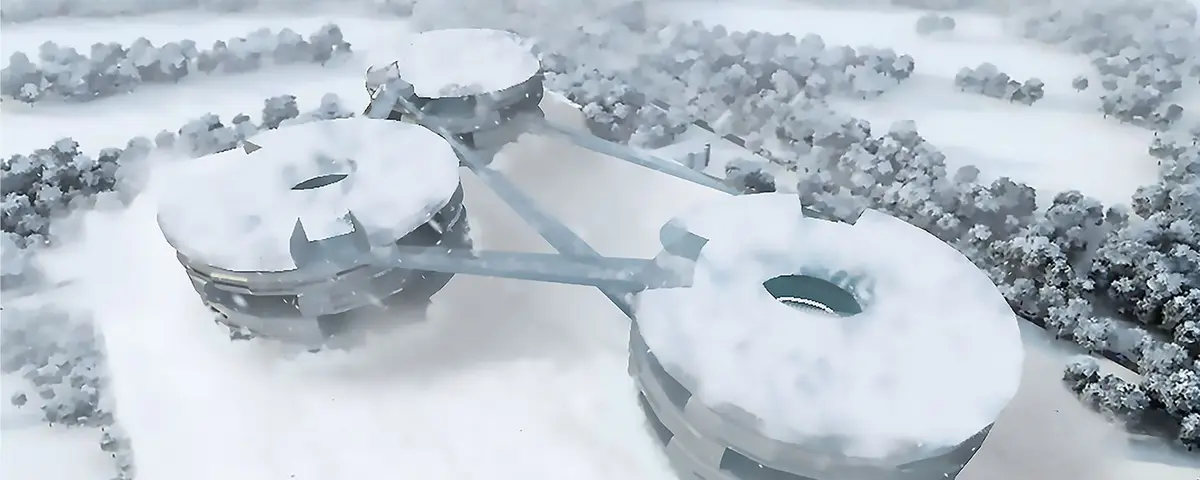
TRIO: Three Circular Towers That Reimagine Incarceration as Rehabilitation
A triadic ring-form prison replaces panopticon rigidity with layered transparency, communal movement, and spatial dignity for inmates.


What if the shape of a prison could change what happens inside it? TRIO answers that question with three interconnected circular towers that reject the punishing geometries of traditional incarceration. The ring form is both symbolic and operational: it replaces the rigid surveillance lines of panopticon-style plans with fluid circulation, layered transparency, and a spatial logic built around rehabilitation rather than confinement. Each tower is vertically stratified across six levels, from public reception at ground level to guard rooms and surveillance centers at the top, connected by transparent corridors that allow movement and oversight to coexist without one negating the other.
Designed by Jie Wu, Qinglin Liu, Shuhan Wu, and Lihua Feng, TRIO was shortlisted in the Switching Prisons competition. The brief asked designers to rethink prison typology for a future shaped by evolving forms of crime, particularly cybercrime, where inmates may be intellectually adept individuals better served by education and vocational training than by isolation. The team responded with a triadic spatial network that treats architecture as behavioral intervention, structuring every hour from 6:30 am wake-up to 10:00 pm lights-out around spaces designed to reduce psychological stress and promote engagement.
Three Towers, Six Levels, One Legible System

The elevation drawing reveals TRIO's vertical logic: stacked volumes with horizontal banding that distinguish each programmatic layer. The first floor handles reception, observation, and visitor areas. The second floor accommodates dining, sports, and leisure. Floors three and four house the living units and prison cells. The fifth floor is reserved for guard rooms and surveillance centers, while the roof provides interconnected corridors for external circulation. This stratification means different zones can operate simultaneously, each visible to the others through transparent connecting corridors, creating a prison environment where security is maintained through legibility rather than opacity.
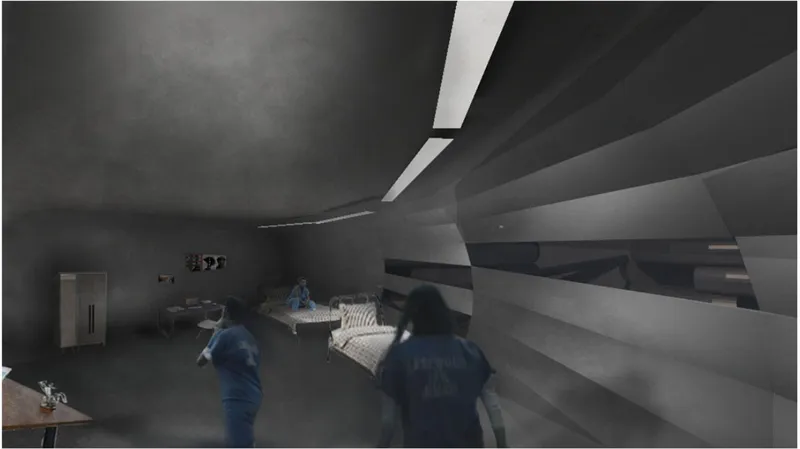
The interior rendering reinforces this idea. Angular wall planes channel light from a skylight above, illuminating figures in what reads as a transitional space between program zones. The darkness surrounding the lit figures is not punitive; it is controlled contrast, directing movement and attention. This is architecture as wayfinding, where spatial sequences guide inmates through their daily routines without the aggressive signaling of traditional correctional facilities.
Curved Volumes and the Courtyard as Social Core


TRIO's circular plan produces curved white volumes that open onto a central courtyard, visible in the rendering where a lone figure walks toward a grassed area. The courtyard is not leftover space. It is a centralized functional core, an outdoor activity zone that acts as the social heart of the triadic network. The curved walls enclosing it eliminate the hard corners and dead ends that characterize conventional prison blocks, replacing them with continuous sightlines and a sense of containment that feels less confrontational than panopticon surveillance.
At ground level, the exterior plaza reads more like a civic space than a correctional facility. Stacked concrete volumes create a layered facade that pedestrians move beneath, blurring the boundary between the institution and its surrounding context. The design team's commitment to transparency is evident here: rather than walls that isolate, TRIO employs spatial layers that integrate, treating the prison perimeter as a gradient rather than a hard edge. The implication is deliberate. Reform, the designers argue, is better served through inclusion than exclusion.
Night and Interior: Architecture That Sustains Dignity Around the Clock


The night rendering reveals how TRIO's transparency operates after dark. The illuminated complex glows across its stacked volumes, with figures gathered in a public square below. Light spills out horizontally, signaling activity and life within. The building does not shut down visually at night; it remains legible, its internal rhythms visible to both residents and the surrounding community. This is a pointed inversion of the typical prison aesthetic, which relies on opacity and the deliberate concealment of what happens inside.
The interior perspective completes the spatial narrative. A figure descends white terraced planes toward a hazy courtyard, moving through a sequence that feels open and directional without being coercive. The terracing creates informal social zones, places to pause or sit, breaking the corridor into something closer to a landscape. The design team's attention to daily routine is embedded in these details: the spatial sequence from cell to courtyard is not a march but a transition, calibrated to reduce the psychological friction that conventional prison architecture amplifies.
Why This Project Matters
TRIO makes a compelling case that prison architecture does not have to look or feel like punishment. By replacing linear cell blocks with a triadic ring network, the design dissolves the adversarial geometry that defines most correctional facilities. Every decision, from the vertical distribution of program to the curved plan that opens onto a shared courtyard, is oriented toward a single proposition: that well-considered spatial sequences can alter behavioral patterns over time. The project takes this seriously enough to map the full daily cycle, from wake-up to lights-out, against specific architectural conditions.
What gives TRIO additional relevance is its acknowledgment that the nature of crime is changing. Designing for a future population of digitally literate inmates who may benefit more from education and vocational training than from physical containment forces a fundamental rethink of what a prison needs to be. Wu, Liu, Wu, and Feng have proposed a facility that is less fortress and more campus, a place where transparency, communal activity, and spatial dignity are not idealistic extras but the structural logic of the building itself.
View the Full Project
About the Designers
Designers: Jie Wu, Qinglin Liu, Shuhan Wu, Lihua Feng
Enter a Design Competition on uni.xyz
uni.xyz runs architecture and design competitions year-round that reward proposals with spatial conviction and real site intelligence.
Project credits: TRIO by Jie Wu, Qinglin Liu, Shuhan Wu, Lihua Feng Switching Prisons (uni.xyz).


Popular Articles
Popular articles from the community


Lunar Spiral: Space Architecture Shaped by the Mathematics of the Universe
Lunar Spiral reimagines space architecture through Fibonacci geometry, lunar regolith, levitating habitats, and self-sustaining Moon living.

Little Red Riding Hood: Architectural Design as a Journey Through Fear, Light, and Storytelling
Little Red Riding Hood reimagines the fairy tale through architectural design shaped by fear, light, scale, memory, uncertainty, and choice.

Co-Life: Senior Housing Design That Reconnects Older Adults With the City
Co-Life reimagines senior housing design through healing gardens, shared streets, workshops, and a sustainable community across generations.

Co-life: Sustainable Architecture for Age-Friendly Community Living
Co-life reimagines sustainable architecture for seniors through courtyards, rammed earth, shared gardens, and spaces designed for belonging.

Similar Reads
You might also enjoy these articles

Day and Night Park: A Time-Based Urban Newsstand in Beijing
A temporary urban newsstand in Beijing blending travel, light, and reading through poetic colors, compact form, and community-focused design.

Modernist Patio Renovation in El Masnou, Barcelona by Oliver Segura Arquitectura + Cebrià Arquitectura
Modernist patio renovation blending tradition and innovation with a movable pool, leveled floors, and Catalan materials in El Masnou.
Alto Residencial Coop: Cooperative Housing Development in Santiago de Compostela by Carbajo Barrios Arquitectos
A linear cooperative housing complex blending white volumes and perforated metal façades, enhancing community living, natural light, privacy, and urban integration.
Vil Genis School by BPA ARCHITECTURE – Massy, France
Vil Genis School in Massy, France, features sustainable design, south-facing classrooms, community integration, accessible spaces, and modern educational architecture.

Explore Architecture Competitions
Discover active competitions in this discipline

Challenge to reimagine the Iron Throne

Photograph architecture without architects

Illustrate the lost glory of Angkor Wat - Render Challenge

Design challenge to reuse E-waste
Comments (0)
Please login or sign up to add comments
No comments yet. Be the first to comment!