
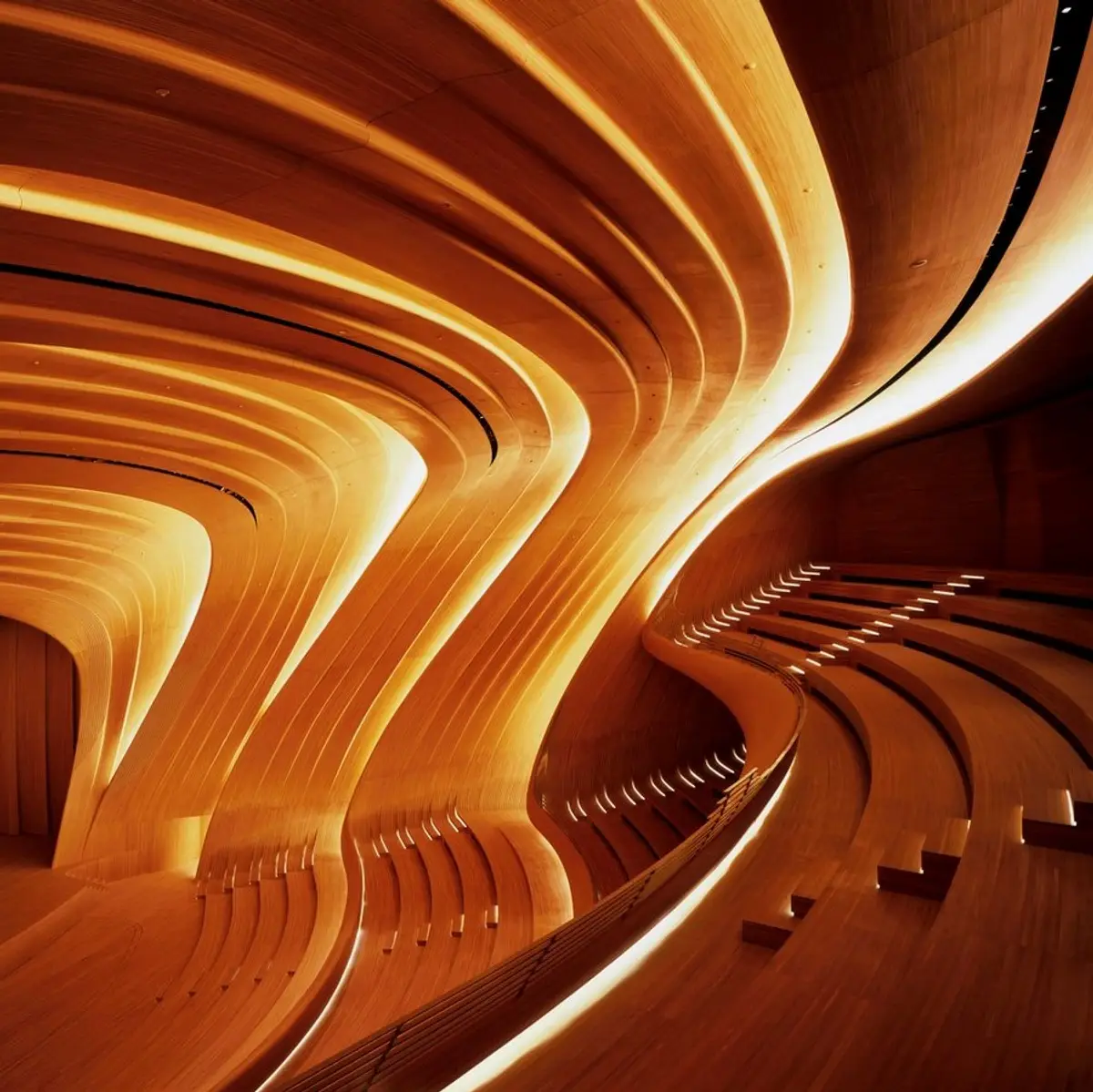
Uni Tectonic Design Contest for a Volcano Museum
Volcano Museum at the foot of Mount Ararat on the border between Turkey and Armenia
Prologue
The motive of the journey has accompanied man for centuries. The first people led a nomadic lifestyle to get the necessary resources. At some point, it was apparently possible to develop a sedentary mode. The passage of years has shown however, despite not having to travel, man is still looking for new reasons to do so change of place. After much of the land was discovered, the expeditions took over space. The concept of a nomad remains still valid in widespread use, while digital nomadism has become our new reality.
An inseparable element of the road is reaching the goal set at the end of the route. Reaching the top is related with various difficulties, however, it also abounds in extraordinary views and allows for in-depth contact with nature. In order to learn the history of a given place, it is not enough to acquire theoretical information about it. Only getting to know the atmosphere of a given space through your own experience, you can devote yourself to full-fledged reflection.
To discover the meaning of an extinct volcano, we climb to its top. We should know his past so go to the center of the earth.
The essence of the concept
The museum designed by me functions as a negative - a reflection of the actual object. Mount Ararat in itself it is the largest and most important exhibit. So the building works on the principle of contrast. The volcano's contours define the shape of an inverted cone, embedding the mass deeply in the context of the place, while the resulting crater makes it possible to travel underground.
The museum is open from June to September, at a temperature of 25-30˚C, and is partly connected to the outdoor area. Sightseeing takes place in organized groups. Interference with the space around the museum has been reduced to a minimum. A small parking lot is intended mainly for buses. Goats and sheep were allowed to graze in the vicinity of the complex.
Going deeper and deeper, the wanderer can literally plunge into the inner tissue of our planet, touching walls and structures made of basalt and other volcanic products obtained from excavation resulting from the location of the museum below level 0. The materials were combined with modern construction solutions, which gave the space a raw, organic character.
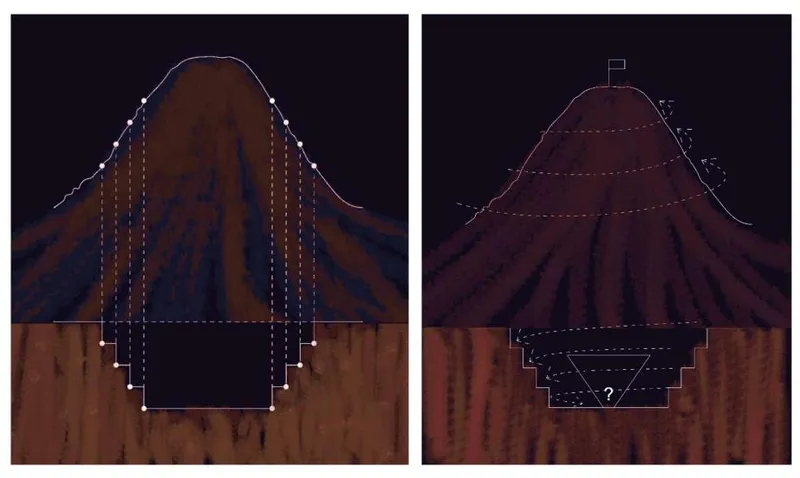
Moving on the ramp, you can see the considerable depth of the object from the top floor, which is it evokes both curiosity and feelings of insecurity. The mood of mystery remains in addition intensified by a monumental glass block located in the central part of the crater. When the wanderer gets inside, with the passage of time, it emerges more and more clearly from the hitherto transparent cone three-dimensional hologram. Total shading of the space enables large-format viewing a spectacle that allows us to recreate an explosion that we would never be able to do under natural conditions experience it up close. A breach in the ground evokes associations with a bunker or a safe hiding place surroundings. The hologram, on the other hand, shows the past, present and future of volcanology -is a synthesis of information usually presented on many information boards or exhibits in typical exhibition spaces. It shows the unquestionable power and superiority of the force of nature over human.
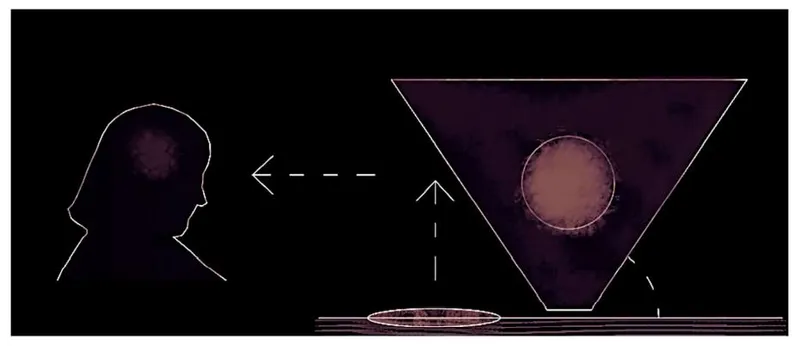
Floor projectors and glass panes inclined up to 55˚ create a 3D image based on four symmetrical flat images. The trick is called Pepper's Ghost and is commonly used in amusement parks, television, cinemas and concerts. The cone was mounted on steel poles and ropes. The structure also supports the diaphragm.
The structure, modeled on the Frei Otto stadiums and garden pavilions, has many advantages - it is light, economical, easy to assemble, modify and transport. It can also be reused, e.g. in commercial hangars. Local materials were used, e.g. sheep wool in the building insulation. Basalt and volcanic rocks obtained from the excavation cover the floors, walls, furniture, interactive panels and pavilions' facades. Lighting and projectors are energy efficient. Mechanical supply and exhaust ventilation with recuperation, a heat pump were used, and the entire facility was adapted to the needs of the disabled. Round shapes inside and out, combined with exhibits that affect the senses, allow the complex to be classified as a sensory one.
Both the history and the sightseeing route come full circle. On his way back, the wanderer chooses the direction consistent with the movement of lava during volcanic eruptions. As the traveler slowly emerges on surface, his eyes are shown in all its glory the panorama of Mount Ararat - monumental and awakening even more admiration than the underground spectacle. A real volcano, the prototype of a building, dominates the building and is the greatest visual attraction for visitors, even more valuable under the influence of the knowledge acquired during the show and the history of the place.
The external form of the museum - a tented roof spread over the hologram, refers to the traditional ones local Kurdish tents. From the ground level, only the membrane structure and small "bodies foreign" covered with earth, resembling emerging from sandy and rocky ground, scattered here and there stone fragments are visible. Round forms contain a pavilion with an entrance area and a shop, a cafe and two facilities for researchers and workers, while below level 0 smaller exhibitions and workshop space. The underground storeys are connected to the main exhibition by means of hollow tunnels. When viewed from the outside, the entire assumption appears to be temporary, just like Native camps set up seasonally. Roofing is almost as fleeting as holographic display. The formation of the complex resembling a nomadic settlement allows for the preservation of the original character of the existing one space and, despite the size of the site, it fits into the landscape.
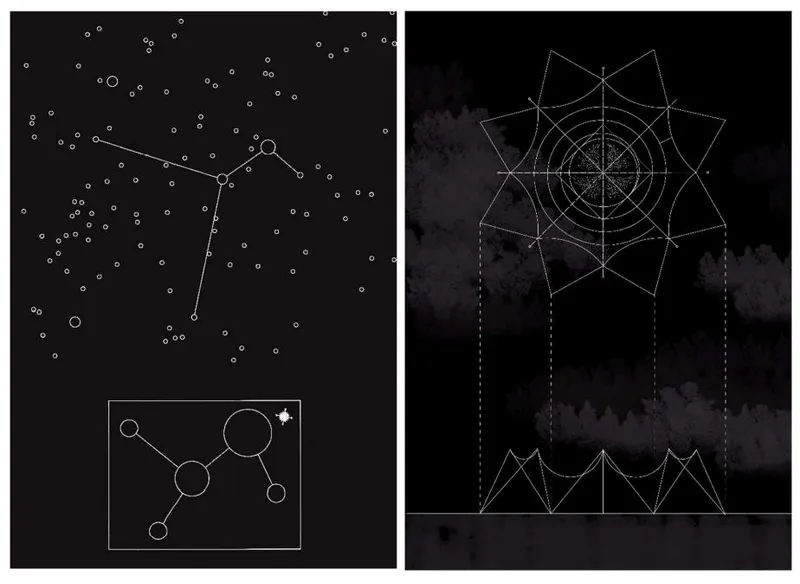
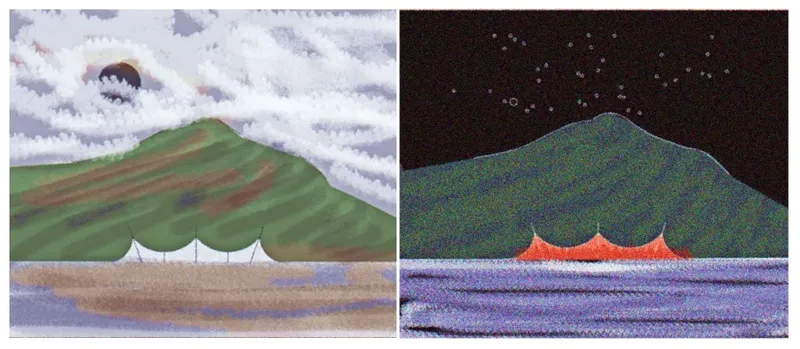
Illuminated under the cover of the night, the tent becomes an extraordinary installation thanks to the projection placed inside light, resembling a substitute for a real volcanic eruption. The design seen from above can also be associated with a kaleidoscope or an Asian ornamental mandala. Shining when viewed from the top of Ararat the form is a landmark for wanderers. When seen up close, small pavilions can be seen at first glance seem to be arbitrarily placed. In the bird's eye view, however, along with the main body, they arrange themselves into a geometric composition reminiscent of the constellation of Noah's Dove - formerly no less important in symbol beliefs than the volcano itself. The building is perceived from different perspectives, regardless of the chosen one frame tries to pay tribute to nature, organic, fleeting structures and selected specificity at all costs location, and establish a kind of dialogue with the traveler. During the day, you can see it from a distance of several hundred meters only the white sheets of the tent blowing in the wind. Or maybe it is the sails of the legendary ark?

Popular Articles
Popular articles from the community


The Amber Palace Opera: A Geological Fiction Surfaces on Tallinn's Baltic Waterfront
Pierre Brillard reimagines a Baltic legend as a public landscape, opera house, and waterfront promenade rooted in Tallinn's coastal identity.

Singing Woman: An Opera House That Performs Before the Curtain Rises
Ovidiu Cristian Pavel's conceptual opera house translates Estonia's choral identity into a sculpted waterfront landmark facing the Baltic Sea.
Cloaked Colonization: A Mobile Underwater Habitat That Moves Like a Fish
Micah Abaya's shortlisted EHC Pacific entry reimagines ocean settlement as a dispersed network of self-sustaining architectural organisms.
Tsunami Convergenics: Turning Catastrophic Ocean Forces into Underwater Housing Infrastructure
A speculative underwater settlement off the coast of Onagawa, Japan, treats tsunamis and typhoons as energy sources rather than threats.

Similar Reads
You might also enjoy these articles
The Rhythm of Seasons
A Farmers' Market Connecting Nature and the City

More Than a Building-Designing a Living System
More Than a Building-Designing a Living System
Base Beyond
DESERT COMPOUND ARID: TOURISM OF ABSENCE AND ABUNDANCE


Comments (0)
Please login or sign up to add comments
No comments yet. Be the first to comment!