
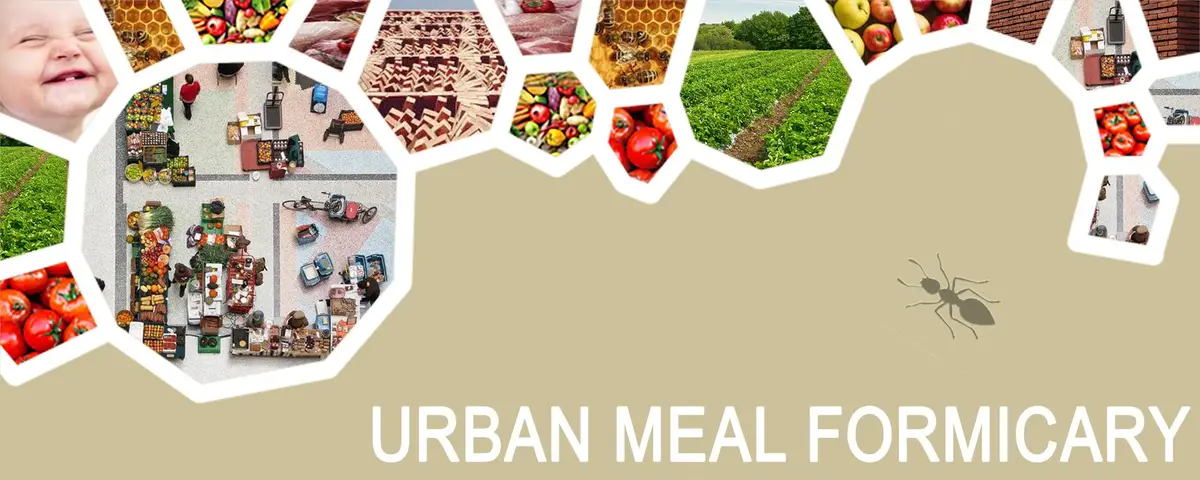
Urban Meal Formicary: Ant Colony Logic Applied to Urban Agriculture
A bio-inspired farming complex uses the organizational intelligence of ant colonies to restructure urban food production and community life.


Ant colonies solve problems that would overwhelm most engineered systems: resource distribution across thousands of nodes, adaptive responses to environmental disruption, and collaborative labor without centralized command. The Urban Meal Formicary borrows that logic and applies it to a question architecture rarely takes seriously enough: how cities feed themselves. Rather than treating urban farming as a rooftop afterthought, the project proposes a full architectural ecosystem where food production, education, commerce, and leisure occupy interconnected circular zones, each one functioning like a chamber in a living colony.
Designed by Ahmed Kaisi, Anastasia Semenova, and Anastasiia Orlova, the project received an Honorable Mention in the Urban Meal Mine competition. The brief asked designers to rethink sustainable farming infrastructure for cities, and the team responded with a scheme that treats architecture itself as an adaptive organism, one that is responsive to environmental shifts, economic demands, and the social dynamics of its community.
Perforated Brick and Open Fields: Where Cultivation Meets the Street
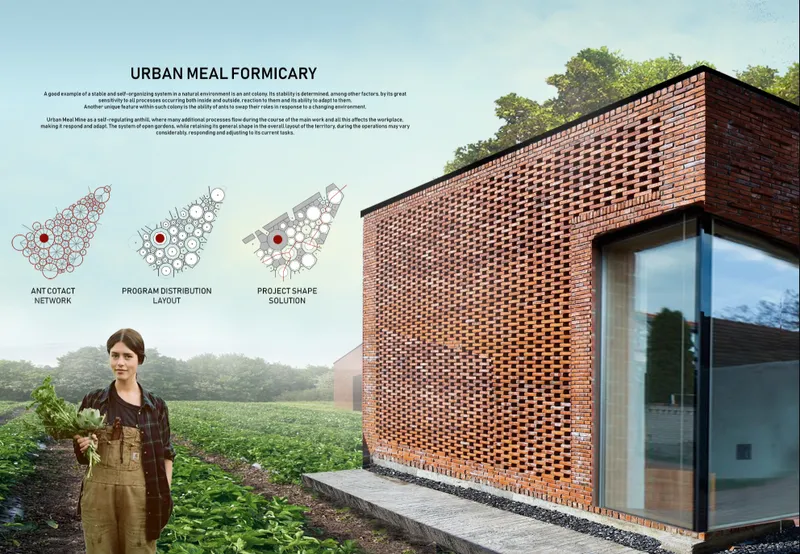
The facade strategy makes the project's agricultural mission legible from the outside. A perforated brick volume sits beside a large glazed opening that frames a working vegetable field, collapsing the boundary between enclosed architecture and productive landscape. The brick patterning is not decorative indulgence; it serves ventilation, filters light, and anchors the building in a material language that reads as both contextual and deliberately crafted. A farmer standing among the crops completes the image: this is architecture that expects to be inhabited by labor, not just leisure.
The choice of brick also speaks to the project's commitment to sustainable construction methods and reduced carbon footprint. Brick ages well, requires minimal maintenance, and can be sourced locally in most urban contexts. Paired with the green roofs visible across the complex, the material palette signals environmental stewardship without resorting to the glass-and-steel vocabulary that often dominates "sustainable" architecture.
Terraced Markets and Suspended Walkways: A Multi-Level Food Economy
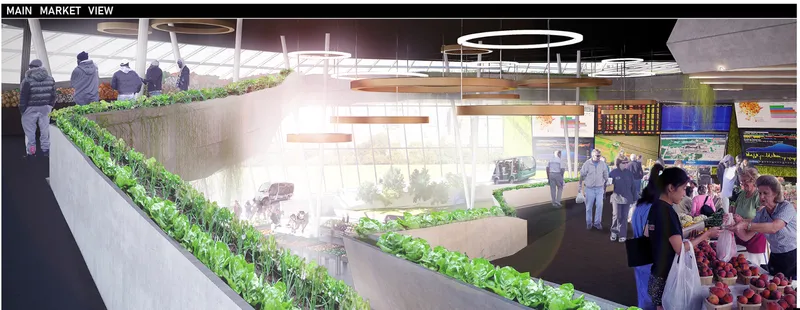
Step inside and the colony metaphor becomes spatial. The interior rendering reveals a multi-level market hall where terraced planters cascade between shopping zones, and suspended walkways connect upper levels. People move through the space at different elevations, browsing locally grown produce while surrounded by the very plants that generated it. The section eliminates the conventional separation between retail floor and growing space; here, they occupy the same volume.
This programmatic layering is where the ant colony analogy gains real traction. In a formicary, food storage, processing, and distribution happen in adjacent chambers connected by efficient pathways. The market space mirrors that arrangement: culinary workshops sit alongside open-air selling areas, and educational spaces promote awareness of ecological cycles. The community becomes both producer and consumer within a single architectural circuit, shortening the supply chain to a matter of steps rather than miles.
Circular Geometry in a Dense Urban Field

From above, the site plan reads as a series of concentric and overlapping circular zones carved into a dense urban fabric. Curved paths wind through planted areas, connecting community gardens, yoga centers, playgrounds, and exhibition spaces. The geometry is deliberate: circles distribute movement evenly, avoid dead-end corridors, and create soft boundaries between programmatic zones rather than hard walls. This is an urban park that also happens to be a food production facility, an education center, and a cultural venue.
The aerial view also reveals the scale of the intervention. Set within a tightly built neighborhood, the complex claims significant ground area for agriculture and recreation, a bold proposition in any city where land value pressures tend to squeeze out non-commercial uses. The designers treat this tension as an opportunity: by combining agricultural, social, and recreational functions into a single integrated landscape, the project justifies its footprint through sheer programmatic density.
Planted Roofs and Waterfront Presence at Dusk
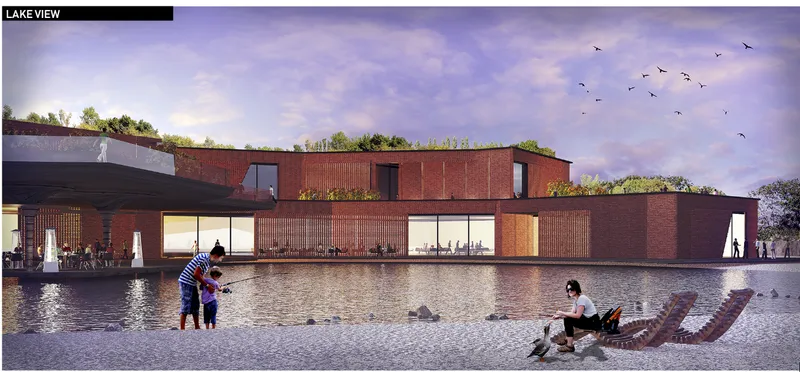
The lakeside elevation reveals the project's quieter ambition. Low horizontal brick volumes extend toward the water, their planted roofs softening the roofline into a series of green planes that regulate microclimates and promote biodiversity. Visitors gather at the water's edge as dusk settles in, a scene that suggests the complex operates not just as a daytime market or farm but as an evening social destination. The waterfront orientation supports ecological balance while offering the kind of public amenity that builds genuine community attachment to a place.
The horizontality of the massing matters. By staying low, the buildings defer to the landscape and the water rather than competing with the surrounding urban skyline. Green roofs become visible ground planes when seen from neighboring buildings, extending the perception of parkland beyond the site boundaries. It is a generous move, one that positions the Formicary as a piece of urban infrastructure rather than an isolated architectural object.
Why This Project Matters
Urban food systems are brittle. Global supply chains stretch thin, transportation costs inflate prices, and most city residents have no meaningful relationship with the food they eat. The Urban Meal Formicary does not propose a technological fix or a policy document; it proposes architecture. By organizing cultivation, commerce, education, and community gathering into a single bio-inspired complex, the project argues that the built environment itself can be restructured to make cities more self-sufficient.
What distinguishes Kaisi, Semenova, and Orlova's work is the coherence between metaphor and plan. The ant colony is not a branding exercise layered onto a conventional building; it is a structural principle that shapes the circular site geometry, the multi-level market section, the distributed program, and the collaborative ethos of the entire scheme. The result is a project that takes a familiar competition prompt and delivers a spatially rigorous, conceptually grounded response that deserves the attention it received.
View the Full Project
About the Designers
Designers: Ahmed Kaisi, Anastasia Semenova, Anastasiia Orlova
Enter a Design Competition on uni.xyz
uni.xyz runs architecture and design competitions year-round that reward proposals with spatial conviction and real site intelligence.
Project credits: Urban Meal Formicary by Ahmed Kaisi, Anastasia Semenova, Anastasiia Orlova Urban Meal Mine (uni.xyz).


Popular Articles
Popular articles from the community


Little Red Riding Hood: Architectural Design as a Journey Through Fear, Light, and Storytelling
Little Red Riding Hood reimagines the fairy tale through architectural design shaped by fear, light, scale, memory, uncertainty, and choice.

Conexión: Biophilic Design Reimagines High-Rise Living in Hong Kong
Conexión reimagines high-rise living in Hong Kong through biophilic design, green facades, shared spaces, daylight, water and nature within.

Hill & Cross Opera: Sculptural Opera House Architecture Shaped by Tallinn’s Landscape and Identity
Hill & Cross Opera reimagines opera house architecture in Tallinn through its sculptural hill, civic plaza, glass wave and a luminous cross.

ALGAL REALM: A Bio-Integrated Lunar Habitat Design for Life Beyond Earth
ALGAL REALM reimagines lunar habitat design with algae-powered life support, 3D-printed regolith, and vertical living for a lunar future.

Similar Reads
You might also enjoy these articles

Bao Huynh Watercolor Atelier: A Serene Art Retreat in Hội An
Bao Huynh Watercolor Atelier in Hội An blends multifunctional art spaces, sustainable design, local materials, and family-friendly living in a serene environment.

Atelier Macri Concept Store Interior Design by CASE-REAL
Atelier Macri store features a "ko" counter, walnut wood details, cork displays, blending retail, gallery, and seamless customer experiences.

Manuel Vargas Izquierdo Stadium and High-Performance Sports Center: Architectural Excellence in Jalpa de Méndez
The Manuel Vargas Izquierdo Stadium blends sustainable design, inclusive sports facilities, and cultural-inspired architecture, revitalizing Jalpa de Méndez’s public spaces.

KAKR Buluh Awar Hall: Revitalizing Community and Ecology Through Bamboo Architecture
Community built bamboo hall revitalizes Buluh Awar village, empowering youth, restoring ecology, celebrating vernacular craftsmanship through sustainable architecture and culture.

Explore Urban Meal Mine Competitions
Discover active competitions in this discipline

Challenge to reimagine the Iron Throne

Photograph architecture without architects

Illustrate the lost glory of Angkor Wat - Render Challenge

Design challenge to reuse E-waste
Comments (0)
Please login or sign up to add comments
No comments yet. Be the first to comment!