

Water slum
Beyond the normalized cities

Slums are said to be among the least understood places on the planet, largely because they are also among the most complex. The very impossibility of the category—of attempting to define them while simultaneously revealing a condition of incompleteness—brings to the fore the emergency under which thousands of people live day after day. The United Nations has defined them as “(…) informal settlements lacking access to improved drinking water, improved sanitation, sufficient living space, housing durability, and security (…)”. But what can they mean today? Who can live in no-man’s-land, in segregation, on the periphery, in the middle of nowhere, amid arid land or on the water? Slum is perhaps the most intimate definition of the notion of territory, even of the city itself; they, the displaced, pre-exist the city.
Although rapid urbanization drives economic growth and leads people to seek employment and investment opportunities in urban areas, UN-Habitat has presented a statistic showing that 78% of the population in “low-development” countries live in informal settlements—that is, in places marked by poverty and precariousness. Through a political lens, the inability of marginalized people to establish a foothold in society stems from the failure of states to manage the presence and proliferation of these settlements. At the same time, it is widely known that the increase in urbanization over recent years has brought about unprecedented problems of habitability and inequality. If, under a positivist outlook, the city is conceived as a material and political mechanism, a common framework for improving quality of life, it is now evident that data kills sound interpretation. If we reverse the question, we might understand that the city itself, as a complex entity beyond state control, is incapable of sustaining what it was originally conceived to provide.

What Slum City brings to the table is the very life of those who today live under the norm of invisibility. And this is no minor matter. What more than one government has proposed in such cases is destruction rather than understanding. Yet the agency of those who inhabit these places precedes the very authority of states; they pre-exist their homes made of wood and sheet metal, pre-exist and resist the city itself. To ask how one might live on the periphery in the year 2080 is, in itself, to understand our present time, while bringing to light the complexity of their lives: how can we intervene without replacing, without denying their memory and territory? And it is here that the question can—and must—shift its ground: how can we understand the periphery of slums as a possibility; as a question rather than a category?
How can we think about the plurality of peoples without reducing it to a single identity, a single history, or a single political will? M. Foucault challenges explanations that seek to understand all power relations from a single center and reclaims the importance of recovering historical and local forms of knowledge that have been disqualified, subordinated, or excluded by dominant discourses. His work allows us to formulate a fundamental question: How does a society come to define certain people, behaviors, or ways of life as abnormal, dangerous, or undesirable? Applied to so-called “slums,” this means that marginality can be examined not only as an economic condition, but also as a position within a system of social classification. However, identifying a community practice is not enough to consider it emancipatory; we must examine how power is distributed within it. The periphery, then, should not automatically be understood as a place of resistance. It can be a space of subordination, of reproduced hierarchies, of collective organization, or of coexistence among all these processes.

Lefebvre has taught us that space is socially produced within a collective order—both as an imposed norm and as an ordering principle that prevents chaos—and that the periphery is-not a matter of distance from the center, but also embodies and expresses economic, political, and social relations. For his part, AbdouMaliq Simone argues that people produce the city through social networks, everyday arrangements, and relationships that do not always coincide with formal structures of precision and planning. A people of potentialities that appears and disappears on the shoulders of a subject not yet politically constituted. It can emerge, despite everything, in the collective, in the unseen, in the mass. It is then that we are no longer speaking merely of an indefinable category, but of the collective that is, despite the city that surrounds it or keeps it at a distance. A society of multiplicity; a multiple people emerging in the unseen. The category of the marginalized neighborhood does not exhaust the lives of its inhabitants: a people that appears and disappears. Guattari understands the displaced—literally—as mutants; that which remains and changes:
“(...) I believe there exists a multiple people, a people of mutants, a people of potentialities that appears and disappears, that takes shape in social events, in literary events, in musical events. I am often accused of being exaggerated, beastly, stupidly optimistic, of failing to see the misery of peoples. I can see it, but… I don't know, perhaps I'm delirious (...). It is the molecular revolution (...)”. F. Guattari, Suely Rolnik, Micropolítica: cartografías del deseo, Traficantes de sueños, Madrid, 2006.
The Water Slum project poses the question from the standpoint of the present, looking toward a near future seventy years from now: how can we propose a way of life never before seen, starting precisely from that which cannot be seen? Across the globe, there are slums that inhabit the unthinkable, acknowledging that modernism's futurity has failed those others. Water, waste, or drought are commonplace. The vision of this project is directed toward the slums that live on the water. And here a distinction must be made: there is a difference between living “on the water” or “by the water” and living in it. The proposed context is Makoko, Lagos, Nigeria; a settlement on the water that lives in it, not on it. In 2013, despite government warnings seeking to evict entire islets—not individual plots—the inhabitants remained: nearly 3,000 people were left homeless. Despite this, they did not leave; they are still there. The Nigerian settlement is one among many across the Global South facing the same conditions of precariousness: lack of drinking water, inadequate sanitation, self-built housing, improvised transportation, virtually no access to cultural platforms, and informal employment.
Beyond Normalized Cities proposes a project of projects; a hybrid between the existing and the possible. The project does not deny the material reality of the peripheries; rather, it uses that reality as a starting point for configuring mechanisms that allow contemporary societies to inhabit their own territories without prompting emigration. Water Slum configures “submersible bodies” that sustain what their existing settlements are currently unable to sustain in terms of habitability: the postmodern structure can adopt different configurations and be submerged; it provides spaces for recreation, education, sports, culture, transportation, and work for those who live around it. It proposes a project archetype that, through elevated and submerged volumes, preserves the memory and collective life of what already exists, addressing what the periphery has been unable to provide for itself.


Popular Articles
Popular articles from the community


Some Thoughts Clamps Felt and Metal Together to Build a Modular Eyewear Store in Wuhan
A 98 m² MOLSION eyewear shop in Wuhan builds its displays from stacked red and grey felt modules held by custom triangular metal fasteners.

U.GA Architects Wraps an Oval Rooftop Pool in Curved Board-Formed Concrete on Busan's Jeollidan-gil
In Busan's Jeonpo-dong, a 454 m² mixed-use block stacks a neighborhood facility, guest rooms and an oval rooftop pool inside spiraling concrete walls.

Cambra Buró Sets a Kuwaiti Coastal Villa on a Sculpted Travertine Plinth and Lets the Upper House Float
In Abu Al Hasaniya, Kuwait, a 3,000 sqm seaside villa pairs a heavy stone base with clay, cork and walnut to work with the Gulf climate.

3XN, B+H and ZHUBO Design Shape the Shenzhen Natural History Museum as a Walkable Geological Landscape
Beside Yanzi Lake in Shenzhen's Pingshan District, a 105,300 m² museum folds its galleries under a public roof that behaves like a river-carved hillside.

Similar Reads
You might also enjoy these articles


Vereda Arquitetos Renovates a 40-Square-Meter Apartment Inside Niemeyer's Copan Building
A compact unit in São Paulo's most iconic residential tower gets a material overhaul that pairs exposed concrete with bold blue Formica.

Shakur's House: Exposed Brick as an Interior Organiser in a 168 m² Mashhad Residence
Brick moves indoors in this Mashhad residence, where masonry walls, glass partitions and teal planes sequence a compact home without closing it off.
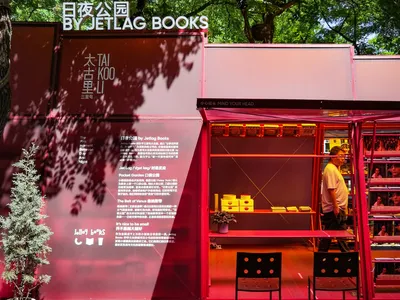
Day and Night Park: A Time-Based Urban Newsstand in Beijing
A temporary urban newsstand in Beijing blending travel, light, and reading through poetic colors, compact form, and community-focused design.

Modernist Patio Renovation in El Masnou, Barcelona by Oliver Segura Arquitectura + Cebrià Arquitectura
Modernist patio renovation blending tradition and innovation with a movable pool, leveled floors, and Catalan materials in El Masnou.

Explore Urban Layers Competitions
Discover active competitions in this discipline


The Global Benchmark for Architecture Dissertation Awards

Challenge to visualize slums of 2080
Comments (0)
Please login or sign up to add comments
No comments yet. Be the first to comment!