

What's Next?
Understanding the past to prepare for the future; a look into what Architecture can offer

When Peter Eisenmen first used the computer to generate drawings for Bio-center, a competition entry in 1987, many at the time imagined the repercussions of this change, but never truly fathomed how the industry would eventually revolutionize.
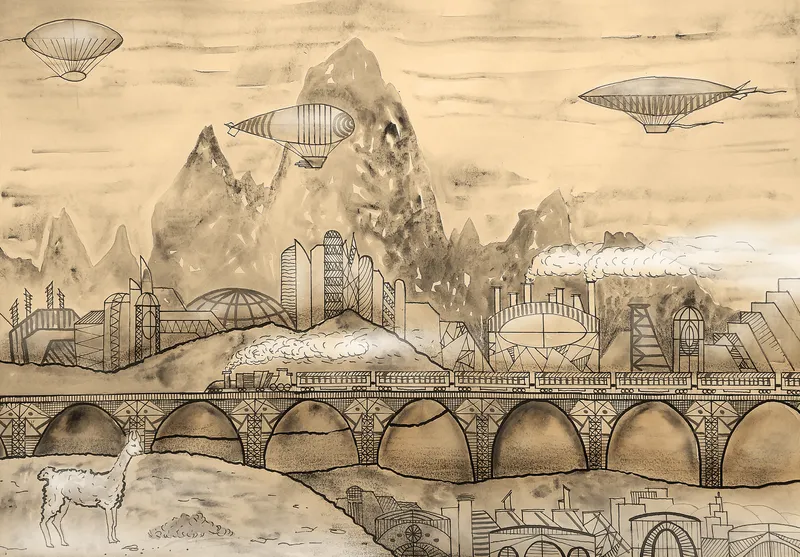
Watching sci-fi films like Blade Runner, Star Wars and Wall-E growing up, the dystopian concept of machines and AI taking over our planet has been seeded in our minds. As technology progressed, these questions became points of contention and research. Technology has changed everything we do. Our exercise, shopping, living, eating and even sleep patterns have been modified by the presence of technology. As many professions like accountants and drafters got replaced by machines or computers, it is predicted that by 2037, 47% of the work will be replaced by robots. The use of technology has changed architecture as its economics as well. It has made it easier to conceptualize structures, increase building efficiency and visualization of the project.
“Modernism was, in essence, an age of transition. Architecture needs to be well informed and restless, offering advanced personal environments,” said John Habraken, theoretician and former head of architecture at MIT. Standing between the trends and ornamentation of the past decade, and the evolution of technology for architecture, this is a turning point for architects to collectively discover and design a path for the field.
The most evident change in the field of architecture is due to the ever-evolving software and machines. But at the same time, the changes in the habits of the consumers are also noteworthy. For example, the once flourishing tailoring sector has now been gleefully replaced by the mass fast production industry. The users themselves have traded fit, quality, and uniqueness for ease of buying, brand identity and trends. As users, we have lost the understanding of the complexity of making any product. The process of constructing a ‘one-off’ house, is often overwhelming for the users. This is then often traded by mass-produced units. Unique structures increase the aspirational costs and thus increase the prices of the structure but limit the consumer base. Keeping in mind the importance of contextual architectural processes, the question of whether to continue a ‘one-off’ building types to make variations of the same model need to be addressed by the community. As we move into a mass-produced society, does architecture need an ‘iPhone’ type model system of its own?
Despite being a product-infatuated society, the past decade has shown that consumers are looking for a new alternative to architecture. To increase market shares, architects must look deeper into the needs of the users. Most of us might be accustomed to a certain level of comfort that comes with mass production, but we all are unique and want our spaces, homes and public spaces to reflect that uniqueness and individuality. We might all buy the same iPhone every year, but the cover we put on it is unique to us.
Architects now have the opportunity to collaborate with technology to come up with innovative design solutions to modern issues and problems. As architectural projects become more complex, jobs like computational designer, structural engineer, sustainability consultants and furniture design consultants become pivotal, diminishing the role of architects and making them obsolete.
Looking at the job market today, the kind of jobs available are drastically different from those available a mere 75 years back. The folks who lost their jobs in metallurgy and agriculture did not become data researchers and social media managers overnight. This transition is a slow and painful one that forces everyone to evolve and grow. The change in jobs and technologies have numerous upsides as well.
the use of exciting new technologies in architecture is not foreign to the field. Digital tools have allowed us to collaborate and communicate our work to larger audiences.
Italian architect, Luigi Moretti, argued that a building can be described by a set of parameters that could be described by mathematical equations. This gave rise to the usage of the word ‘parametric’ concerning architectural spaces. Antoni Gaudi worked computationally as well by creating models throughout the design of Sagrada Familia. Another revolutionary architect Buckminster ‘Bucky’ Fuller, developed prefabricated architectural projects arising from this love of atoms making up every element. Designing geodesic domes to modular housing, he understood that by using less of the earth’s resources, we can build a more equal society. While the recession of the mid-1970s and 80s saw the development of computer-aided drawings (CAD), the 1990s and early 200s saw the projects make on digital platforms come to life. Then came the information revolution. The advent of the internet made communication exponentially faster. It was no more necessary to fax or FedEx sheets. This further instilled the importance of collaborative work and common intelligence. This age is being used by architects to take leverage of software like BIM. The early 200s saw the innovation of Grasshopper and Rhino, which became monumental in the field of machine simulations and design.
As the world now revolves around data, understanding his long history helps us understand the fast pace at which technology is evolving. This helps us understand the future of the field.
One of the major strides taken in architecture that affects our near future is parametric modelling software. While mostly used for coding, using the same for architecture can open up countless possibilities. It presents to us countless design options and shows us the viable ones. This in turn makes the work faster. Not just for fancy facades anymore, parametric modelling also gives real-life practical solutions. Another major stride in building technology is fabrication and prototyping. Fabrication reduces the time of construction and the cost. Prototyping reduces the time loop between user feedback and design thus encouraging designers to innovate and use more advanced techniques. The BIM software has well as been instrumental in changing the field as we know it. exciting technologies like VR ring our ideas to reality, often making the users and developers believe in the concepts which would otherwise be deemed as too ambitious.
Many believe the automation of architecture is unlikely. While machines can quantify and compute, we are given the gift of ideas, thoughts are innovation. Presently, technology does not possess that power. The Telegraph reported architecture at 1.8%, to be one of the lowest professions out of 700 others for automation probabilities. While presently the art of an architect remains solemn, change is the only constant as It challenges us to always move ahead. As all of humanity navigates this information revolution, we as architects will come up with creative solutions.

References (10)


Popular Articles
Popular articles from the community


Singing Woman: Contemporary Architecture Inspired by Estonia’s Voice and the Sea
Singing Woman turns Estonia’s song culture into flowing opera house architecture, blending public life, landscape, sea, and national memory.

Cloaked Colonization: A Mobile Underwater Habitat That Moves Like a Fish
Micah Abaya's shortlisted EHC Pacific entry reimagines ocean settlement as a dispersed network of self-sustaining architectural organisms.

Manzana Morphosis: Stretching Barcelona's Grid into a Living Landscape for 2050
A radical reworking of the Eixample manzana turns density into a tool for generous public space, vertical ecology, and environmental performance.
Faces of the Soviet Avant-Garde: Turning Moscow's Street Names into an Open-Air Museum
A network of sculptural installations across a Moscow residential district transforms forgotten architect names into spatial encounters with cultural memor

Similar Reads
You might also enjoy these articles

Day and Night Park: A Time-Based Urban Newsstand in Beijing
A temporary urban newsstand in Beijing blending travel, light, and reading through poetic colors, compact form, and community-focused design.

Modernist Patio Renovation in El Masnou, Barcelona by Oliver Segura Arquitectura + Cebrià Arquitectura
Modernist patio renovation blending tradition and innovation with a movable pool, leveled floors, and Catalan materials in El Masnou.

Alto Residencial Coop: Cooperative Housing Development in Santiago de Compostela by Carbajo Barrios Arquitectos
A linear cooperative housing complex blending white volumes and perforated metal façades, enhancing community living, natural light, privacy, and urban integration.
Vil Genis School by BPA ARCHITECTURE – Massy, France
Vil Genis School in Massy, France, features sustainable design, south-facing classrooms, community integration, accessible spaces, and modern educational architecture.


Comments (0)
Please login or sign up to add comments
No comments yet. Be the first to comment!