

TAEP/AAP Builds a Walled Oasis on Kuwait's Coast That Revives the Courtyard House
The White Fortress House in Al Khiran reimagines Northern Gulf traditions of privacy and climate resilience through concrete, patios, and a solitary tower.


Kuwait's construction boom after the mid-twentieth century replaced the courtyard house, the country's default domestic typology for centuries, with imported models that sealed residents away from the landscape rather than mediating it. TAEP/AAP answers that loss directly. Their White Fortress House, completed in 2023 on a private beach in Al Khiran Pearl City, is a 1,045 square meter single-level compound that restores the courtyard as the organizing device of domestic life while refusing any nostalgic costume. The result is a concrete enclave that reads from the air like an excavated ruin and from the ground like a sequence of outdoor rooms, each tuned to a specific register of social life.
What makes the project genuinely interesting is its willingness to treat walls not as enclosure but as infrastructure. Towering, thick concrete barriers do the heavy thermal lifting, blocking the fierce desert sun while creating shaded microclimates in the patios they frame. Rather than relying on mechanical systems alone, the house deploys passive cooling through mass, shade, and ventilation, turning structure into climate strategy. Every patio has a program: one greets, one rests, one celebrates. A tall cylindrical tower punctuates the horizontal plan like a minaret without a mosque, offering solitude and panoramic views of the Gulf. The architecture is legible, purposeful, and unafraid of silence.
A Fortress in the Sand
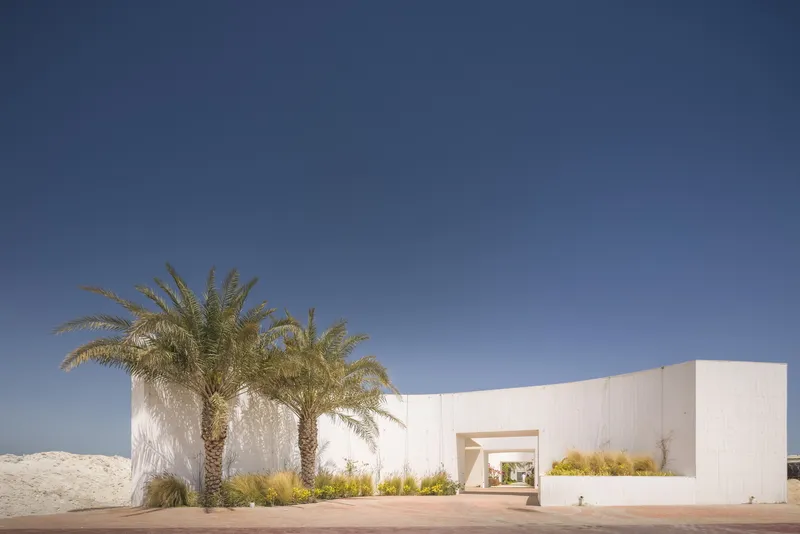
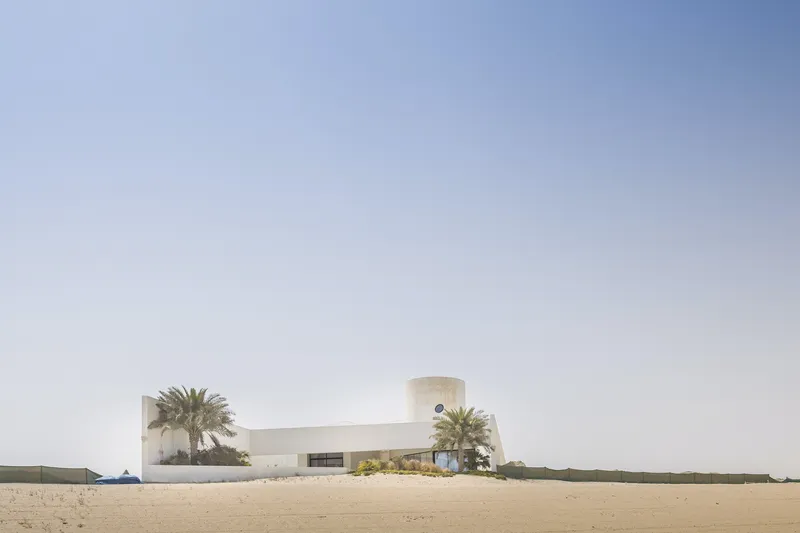
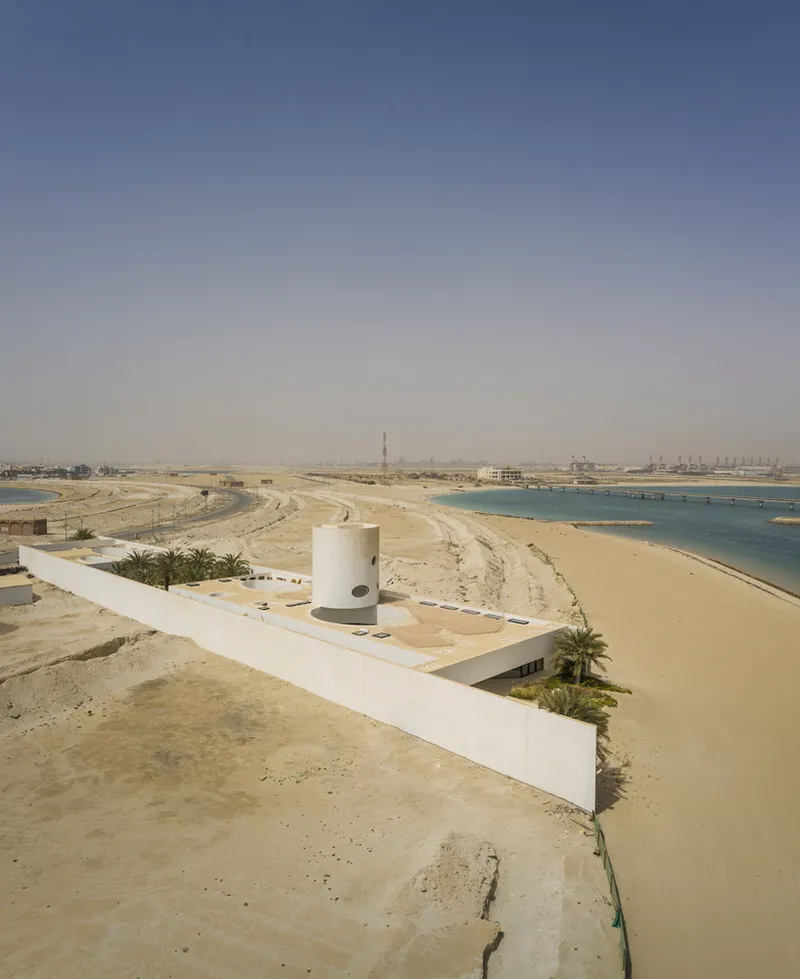
From a distance the house barely announces itself. Long white walls run parallel to the coastline, their creamy concrete surfaces absorbing sunlight without glare. The compound sits low in the sand, deferring to the flat horizon rather than competing with it. Palm trees, grasses, and native vegetation soften the perimeter, making the boundary between architecture and landscape deliberately ambiguous.
The fortress metaphor is not decorative. Those thick walls do real work: they insulate interior spaces against temperature swings that can exceed 50°C in summer, and they create privacy in a development that will eventually house 100,000 homes. TAEP/AAP treats the wall as the project's primary architectural element, giving it texture, height, and curvature so that it becomes space rather than simply bounding it.
Courtyards as Program
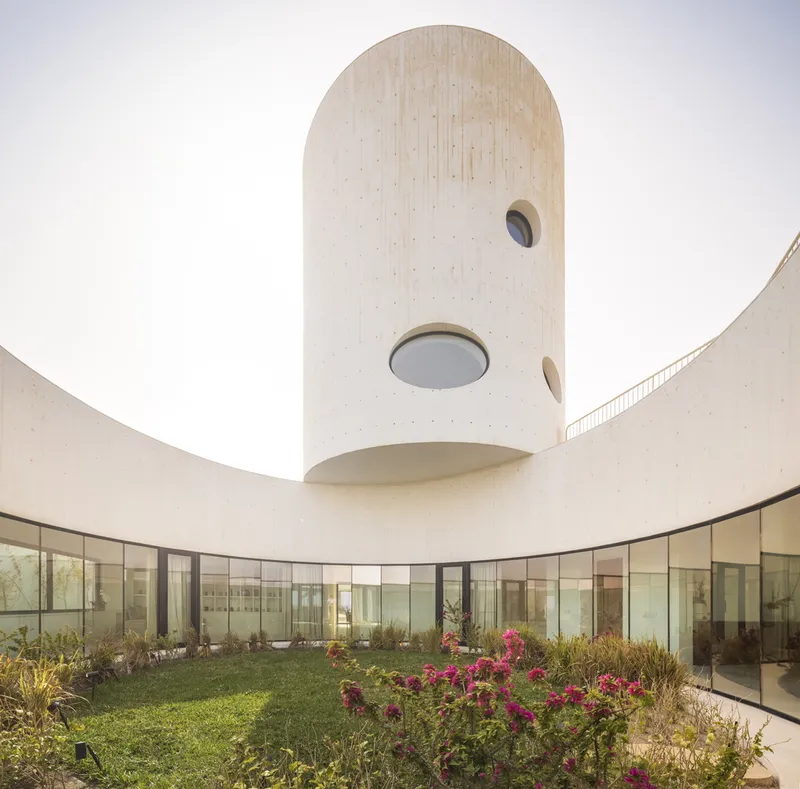
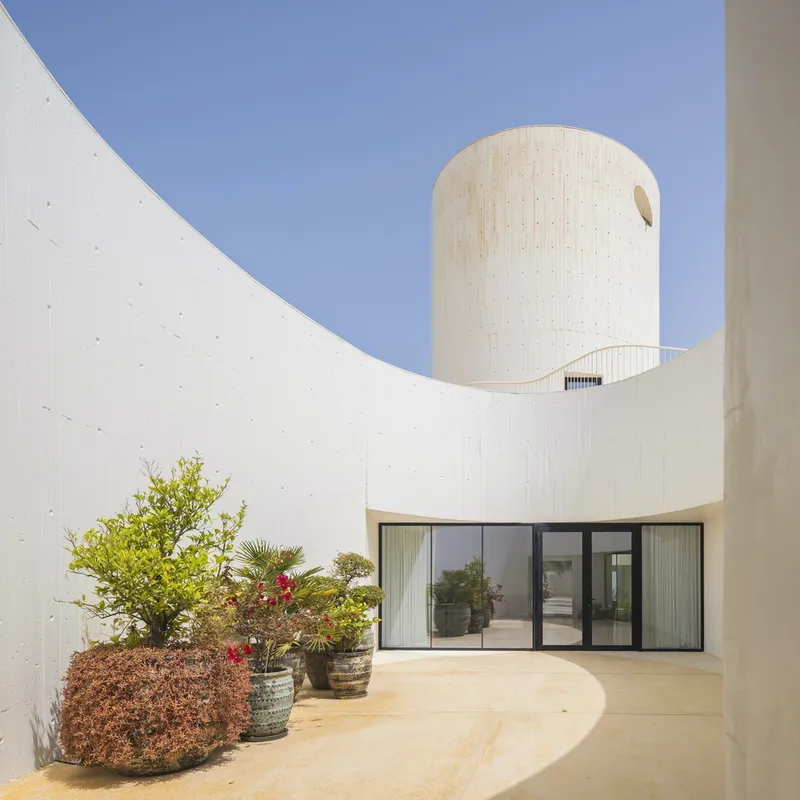

The plan distributes domestic life across a series of oval and rectangular courtyards rather than concentrating it in a single open plan. Each patio has a specific social charge. The arrival courtyard frames the approach with potted ceramics and curved walls. A deeper garden courtyard, ringed by glazed facades, serves the main social spaces: the diwania, the dining room, the library. A more intimate patio adjoins private quarters. This differentiation turns the courtyard from a passive void into an active participant in how the house is used.
The oval geometry of many patios is worth noting. Curves eliminate corners where hot air stagnates and direct breezes across planting beds. They also resist the orthogonal grid of the surrounding development, giving the interior landscape a softness that the stern perimeter walls deliberately withhold.
Thresholds and Passages
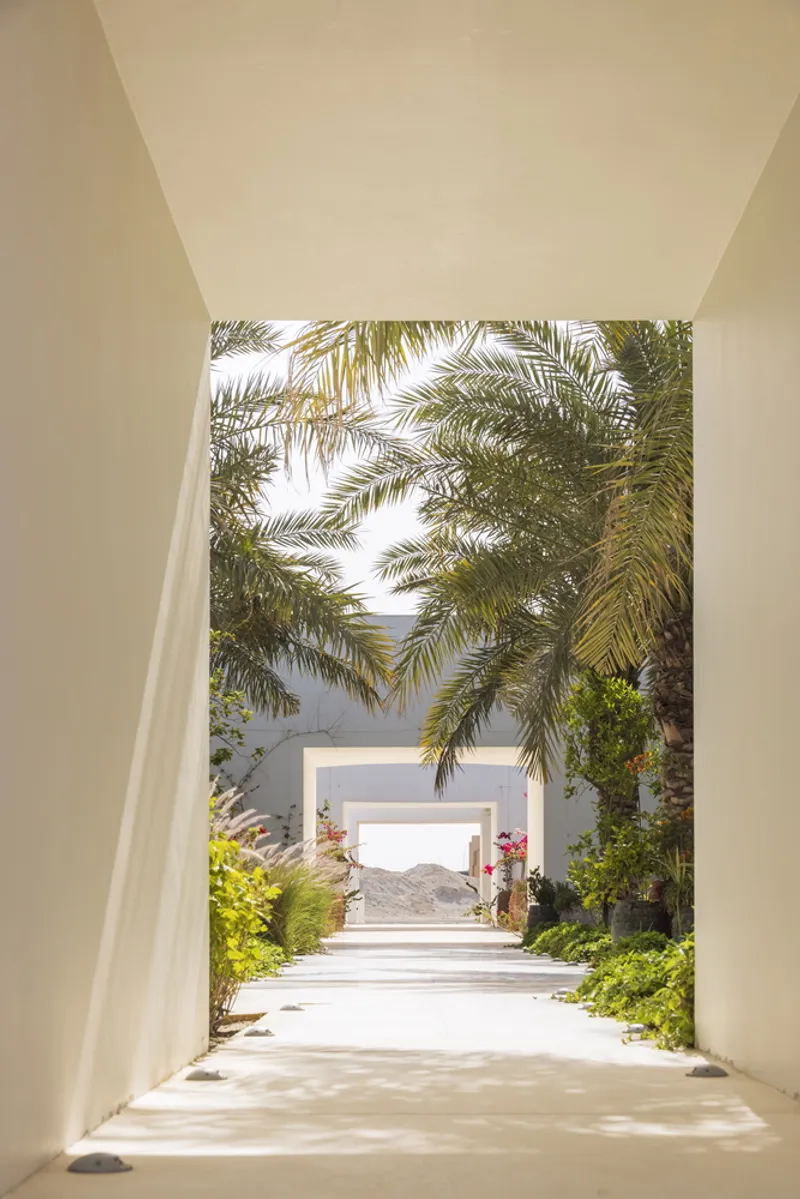
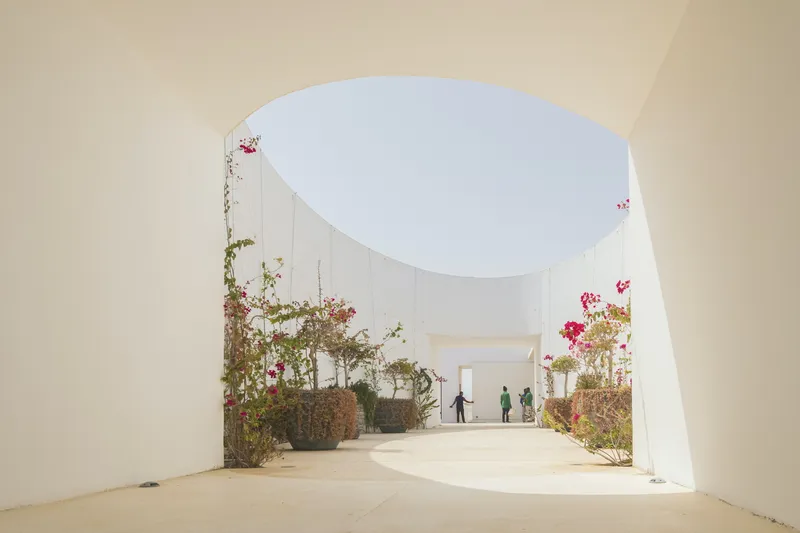
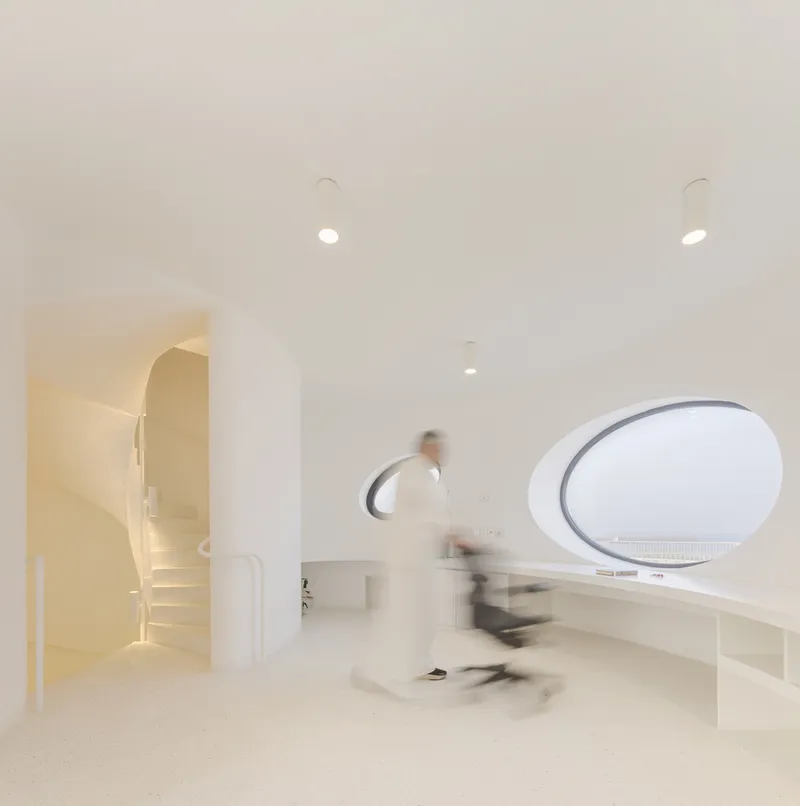
Movement through the house is never direct. A central axial corridor runs from the main entrance to the private family quarters, but it is crossed and interrupted by garden views, arched passageways, and shifts in ceiling height that slow you down and reorient your attention. Vaulted openings frame palm gardens. Oval windows punch through thick walls to create layered sightlines. The architects understand that in a hot climate, the journey between rooms is as important as the rooms themselves, because shade and breeze are experienced in transit.
Terrazzo floors, a traditional Kuwaiti finish, give the corridors a continuous material identity. The blurred figures captured moving through these spaces convey the intended pace: unhurried, contemplative, attuned to light and shadow rather than efficient circulation.
The Tower and the Horizon
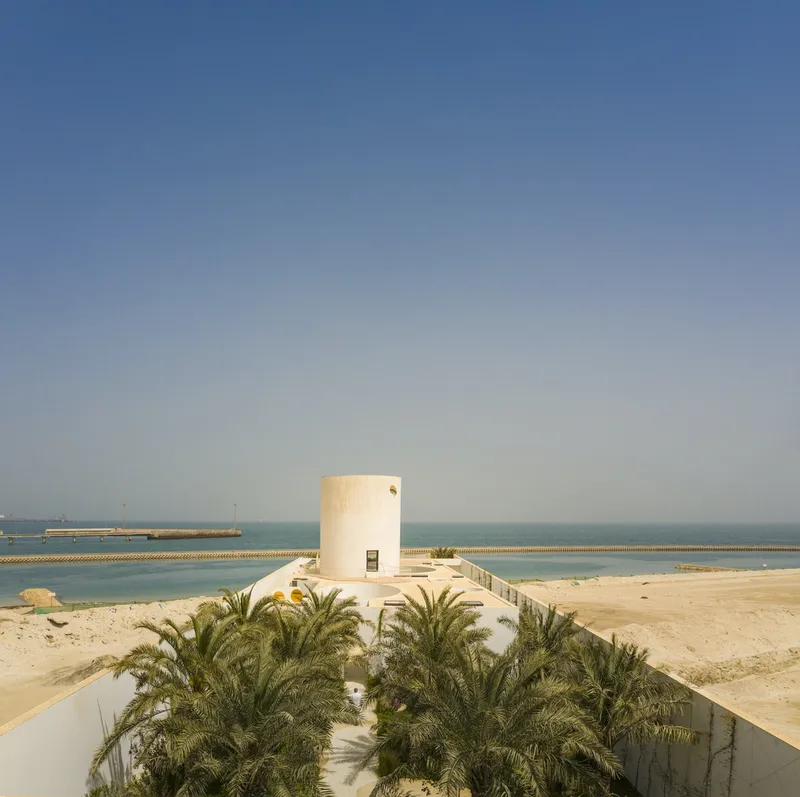
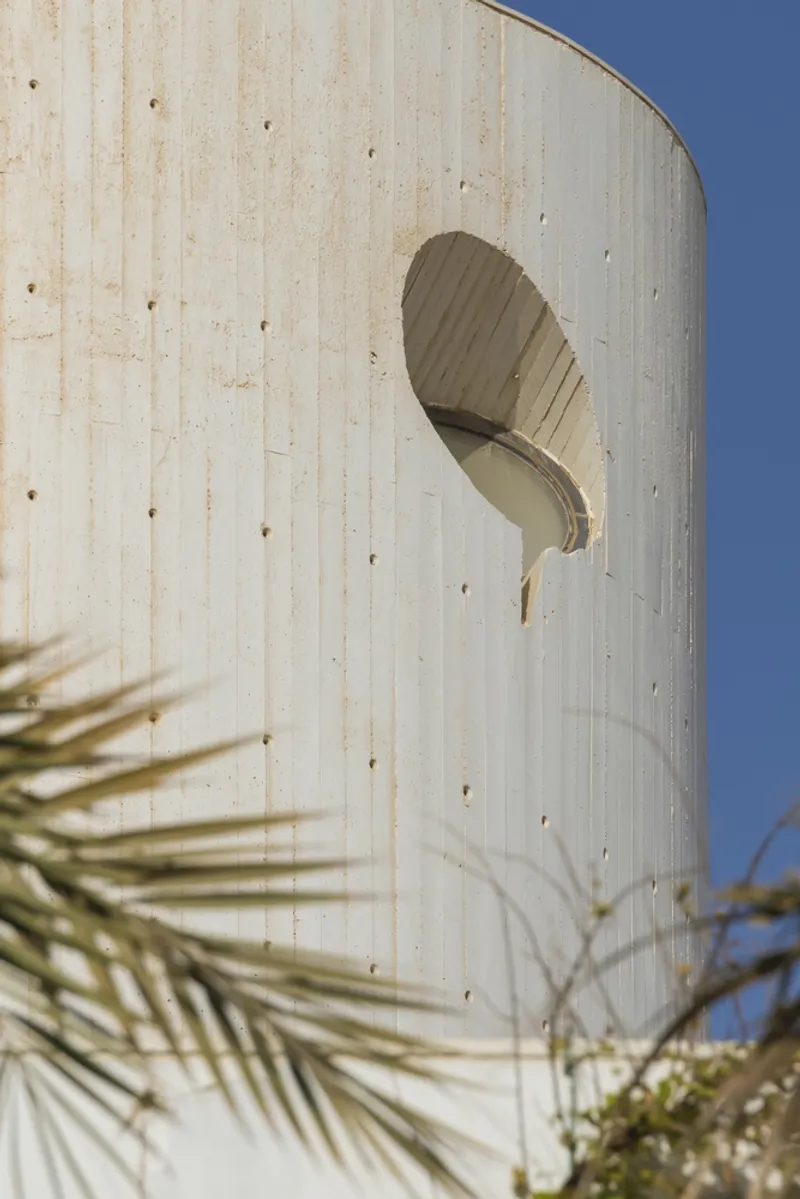
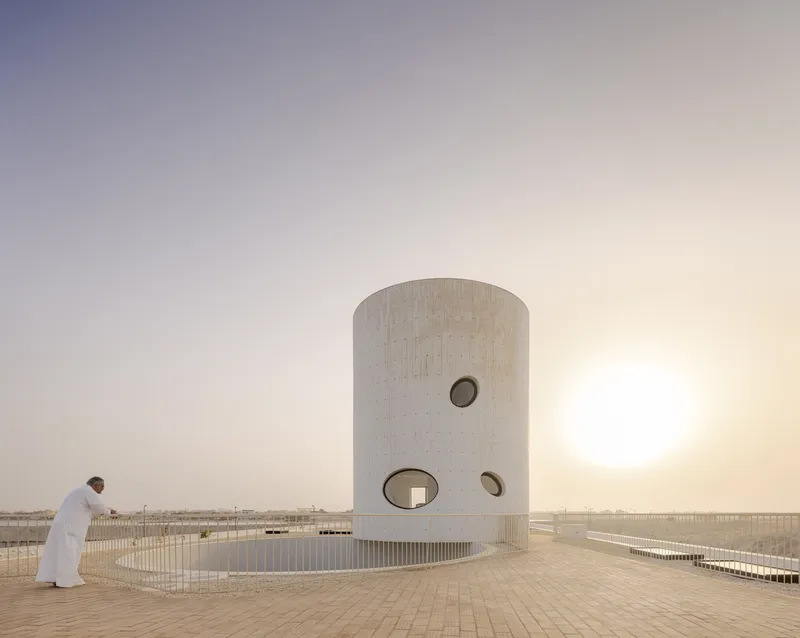
The cylindrical tower is the house's most assertive gesture, a vertical element in an otherwise emphatically horizontal composition. Its boardmarked concrete surface records the formwork in undulating horizontal lines, giving the tower a tactile roughness that contrasts with the smooth rendered walls below. Circular openings of varying sizes puncture its shell, controlling light and framing specific views of the Gulf, the gardens, and the dunes.
Functionally, TAEP/AAP designate the tower as a space for solitude and meditation, a private counterpoint to the social courtyards at ground level. Its rooftop is a contemplative walking terrace with panoramic views. The reference to a lighthouse is hard to miss: the tower marks the house from the sea and, at dusk, becomes a lantern visible across the flat coastal landscape.
Interior Atmospheres


Inside, the material palette is restrained but specific. An interior pool room sits beneath a circular skylight that washes the space in diffused light, turning the act of swimming into something closer to bathing in a hammam. The library features a full-height shelving wall and a black-framed window that frames the courtyard planting like a painting. In the bathroom, green subway tile wainscoting, marble countertops, and brass-framed circular mirrors introduce a deliberate note of craft and color.
These interiors, developed with interior designers Leonor Barata Feyo and Carolina Grave, avoid the all-white minimalism that so many desert houses default to. Handcrafted finishes and material contrasts give each room a distinct character while maintaining the overall atmosphere of calm and weight that the architecture demands.
Where Land Meets Sea

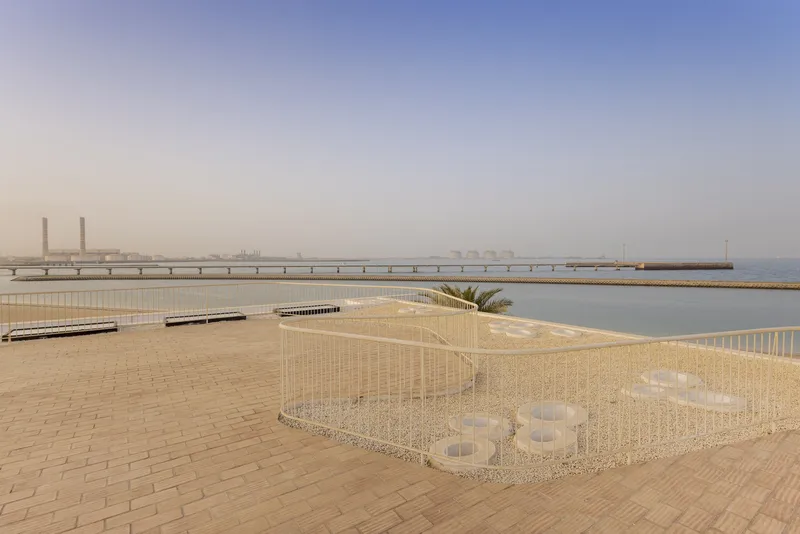

The house occupies a sandy peninsula between turquoise water and desert shoreline. A covered passageway with a timber-clad ceiling punctured by circular skylights frames the approach to the sea, creating a controlled transition from the interiority of the compound to the openness of the Gulf. At dusk, illuminated palm trees line the entry pathway, and the white facades glow against the darkening sand.
A waterfront promenade extends the domestic realm to the beach, reinforcing the idea that the house is not a sealed object but a sequence of spaces that gradually unfolds toward the horizon. The landscape strategy, developed by Susana Pinheiro, integrates native vegetation, sand dunes, and flowering bougainvillea to blur the line between designed garden and coastal terrain.
Material and Climate Logic
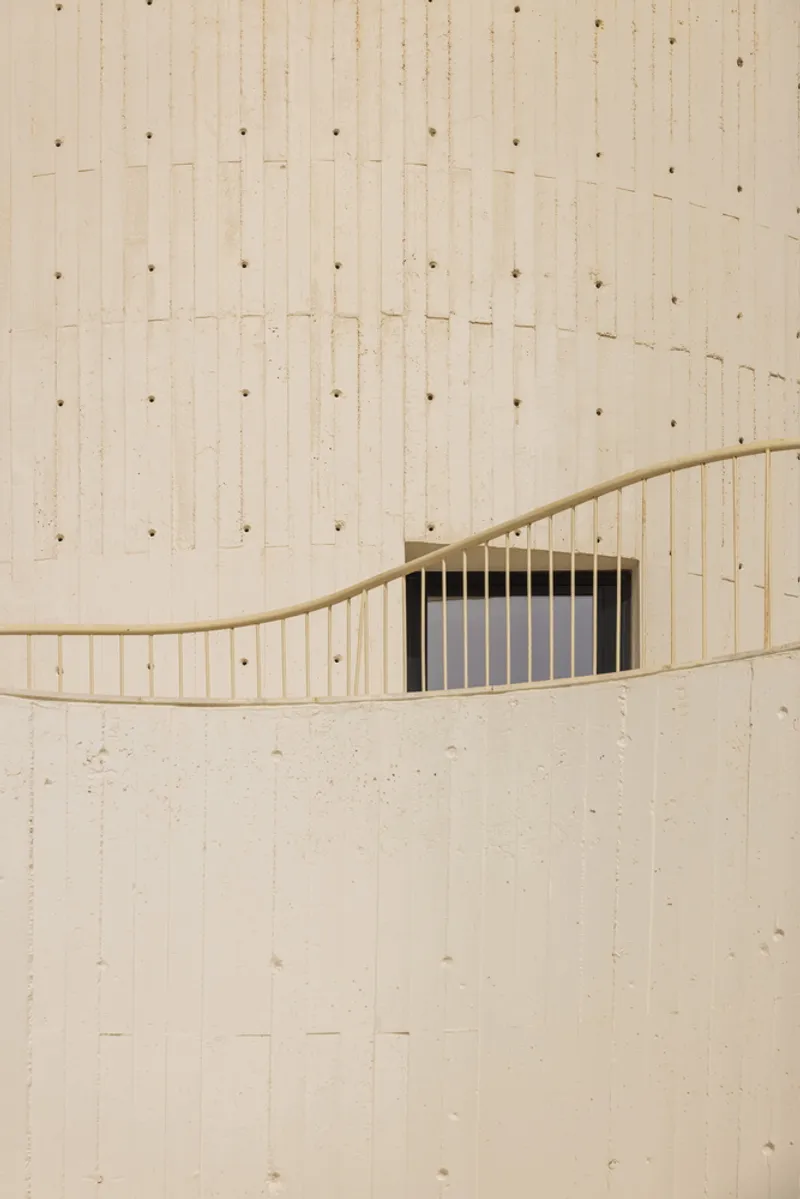
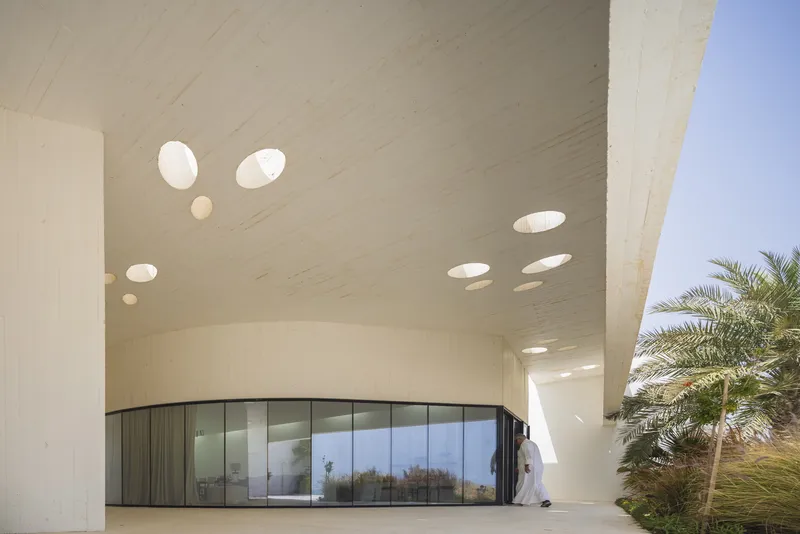
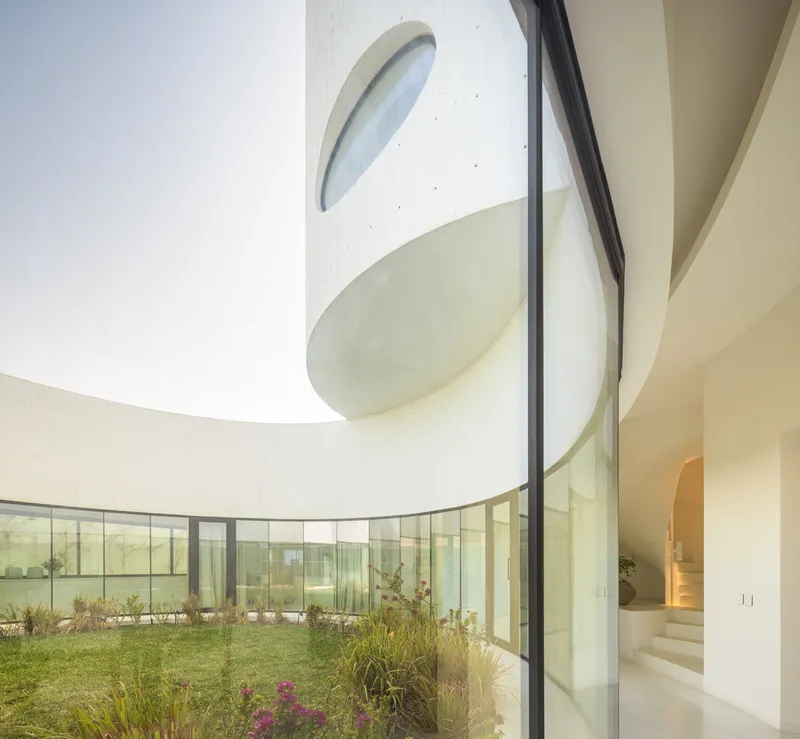
The concrete and brick framework is chosen for structural resilience and cost-effectiveness, not spectacle. Up close, the walls reveal their making: boardmarked relief patterns, recessed bronze-framed glazing, and undulating surface textures that catch raking light. Architectural overhangs shade the glazed social areas, and the deep reveals around windows create additional shadow lines that reduce solar gain.
This is passive design executed through form rather than technology. The thick walls store thermal mass, the courtyards promote stack-effect ventilation, and the shaded patios function as buffer zones between the brutal exterior climate and the cooled interior. TAEP/AAP prove that in extreme heat, the plan itself is the first line of defense.
Plans and Drawings
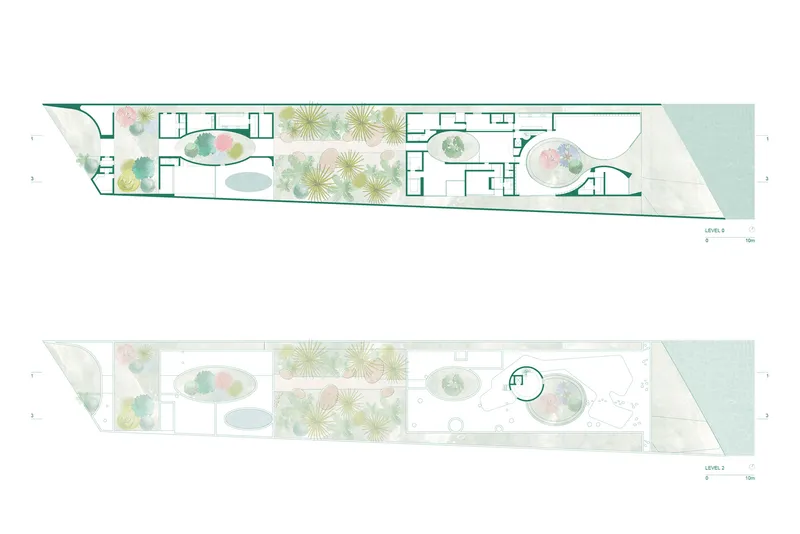
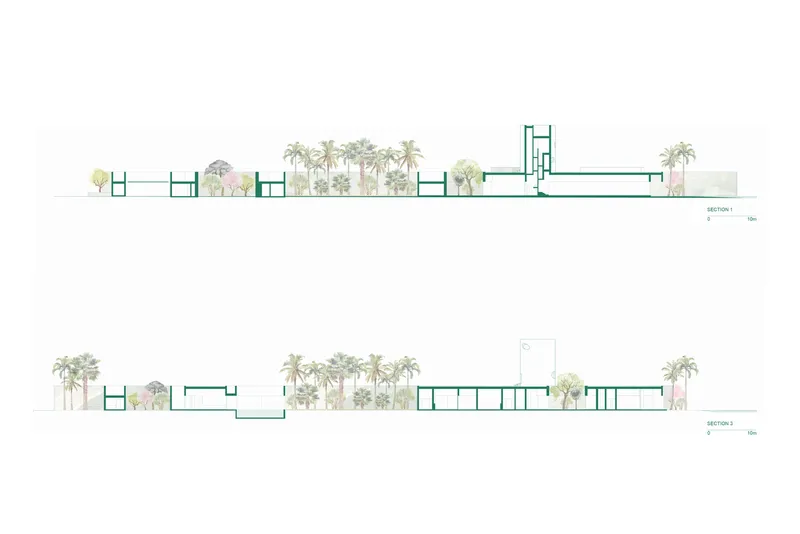
The floor plans reveal the compound's organizational clarity: a rectangular perimeter containing a linear sequence of low-slung volumes interspersed with oval patios, courtyards, and the central palm oasis. The section drawings confirm just how low the house sits in its landscape: palms tower over the roofline, and the cylindrical tower is the only element that breaks the horizon. Dense landscape planting fills the spaces between buildings, making vegetation not an afterthought but a structural component of the plan.
Why This Project Matters
The courtyard house is one of the oldest architectural ideas in the Gulf, and one of the most ecologically intelligent. By reviving it with contemporary construction and a rigorous spatial program, TAEP/AAP demonstrate that tradition and modernity are not opposites but collaborators. The White Fortress House does not mimic historic forms. It extracts principles (thick walls, shaded outdoor rooms, non-linear circulation, passive cooling) and applies them with the precision and material vocabulary available today. The 2025 International Architecture Award from The Chicago Athenaeum recognizes exactly this: the project's refusal to choose between cultural continuity and architectural ambition.
In a region where residential architecture often defaults to either imported luxury brands or government-issue repetition, this house charts a third path. It is specific to its climate, its culture, and its coastline. It uses accessible materials. It treats landscape as architecture and architecture as landscape. For a development of 100,000 homes, it offers a model of what domestic life in the Gulf could be if architects took the courtyard seriously again.
White Fortress House by TAEP/AAP. Al Khiran, Kuwait. 1,045 m². Completed 2023. Interior design by Leonor Barata Feyo and Carolina Grave. Landscape by Susana Pinheiro. Structural engineering by R5 Engineers. Photography by Fernando Guerra | FG+SG.
About the Studio
Share Your Own Work on uni.xyz
If projects like this are the kind of work you want to make, uni.xyz is a place to publish your own, find collaborators, and enter design competitions.


Popular Articles
Popular articles from the community


Juan García Correa, John González and Claudia Rueda Sink a Circular Amphitheater into a Manizales Engineering Building
On the La Nubia campus in Manizales, Colombia, the S1 Building folds labs and offices into a hillside of ramped lawns that double as a campus route.

Architekt Andreas Gruber Scatters 23 Dark Timber Chalets Across a South Tyrolean Forest Edge
In Molini di Tures, Amonti Chalets breaks a resort into a hamlet of gabled timber houses, with parking, storage and services pushed into the slope.

U.GA Architects Wraps an Oval Rooftop Pool in Curved Board-Formed Concrete on Busan's Jeollidan-gil
In Busan's Jeonpo-dong, a 454 m² mixed-use block stacks a neighborhood facility, guest rooms and an oval rooftop pool inside spiraling concrete walls.

David Macias Steps a Doorless Stone and Plaster House Down a Tropical Colombian Hillside
In the humid hills of Colombia, Threshold House replaces the front door with an open void and terraces its 850 m² down the slope instead of fighting it.

Similar Reads
You might also enjoy these articles


Hodi-Mandai Geram
Project Function: Preservation and revitalization of the Intangible heritage and socio-spatial identity of the Hodi by Housing, Cultural Memory Center, Sacred Grove, landscape, local tourism economy


Olio Towers: A Mid-Rise for Performers That Fuses Housing, Rehearsal, and Stage
Located blocks from Houston's Theater District, this modular tower stacks living units around a central performance atrium.

Oasis: Modular Green Housing Carved into Dhaka's Urban Fabric
A shortlisted Plugin Housing entry reclaims unauthorized settlements in Dhaka with stepped concrete volumes, green roofs, and ventilation-driven design.

Black Hole: A Floating Megastructure for the Post-Physical Era
Emiliano Mazzarotto envisions a spherical, self-scaling arena where e-sports, digital hotels, and holographic stadiums replace traditional public space.
Explore Desert Architecture Competitions
Discover active competitions in this discipline

Challenge to illustrate the ruins of Petra

Challenge to reimagine the Iron Throne

Photograph architecture without architects

Illustrate the lost glory of Angkor Wat - Render Challenge
Comments (0)
Please login or sign up to add comments
No comments yet. Be the first to comment!