

Worcester Blackstone Visitor Center by designLAB architects: Reviving Industrial Heritage Through Sustainable Architectu
Sustainable visitor center transforms industrial brownfield into cultural hub, blending heritage storytelling, community space, and ecological restoration through innovative architecture.


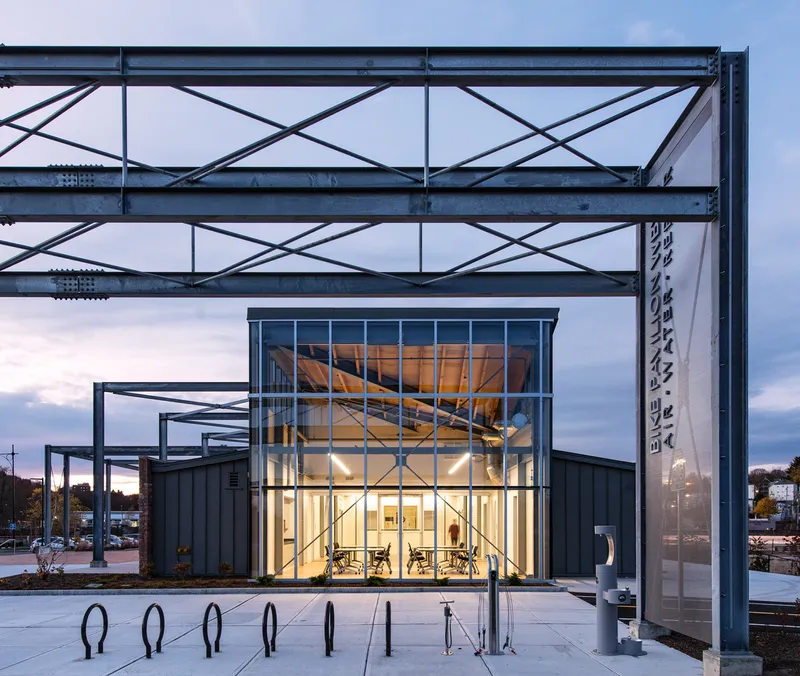
The Worcester Blackstone Visitor Center, designed by designLAB architects, stands as a powerful example of adaptive storytelling in contemporary architecture. Located in Worcester, United States, this 11,000-square-foot visitor and exhibition center transforms a former industrial brownfield into a vibrant public destination that reconnects community, history, and landscape.

Reimagining a Lost Industrial Legacy
Built on the site of a former steel mill, once home to the historic Washburn & Moen Manufacturing Company (later American Wire & Steel), the project addresses a unique challenge: how to narrate a rich industrial past when no physical remnants remain. Following a devastating fire that destroyed the last standing structure, the site was cleared, leaving behind only memory and cultural significance.
designLAB architects responded with an innovative architectural strategy that uses form, materiality, and spatial sequencing to reconstruct history without relying on artifacts. The project becomes a living narrative, embedding industrial references into every layer of design.

A Multi-Layered Site Strategy
The masterplan is organized around five key architectural and landscape elements that collectively shape the visitor experience:
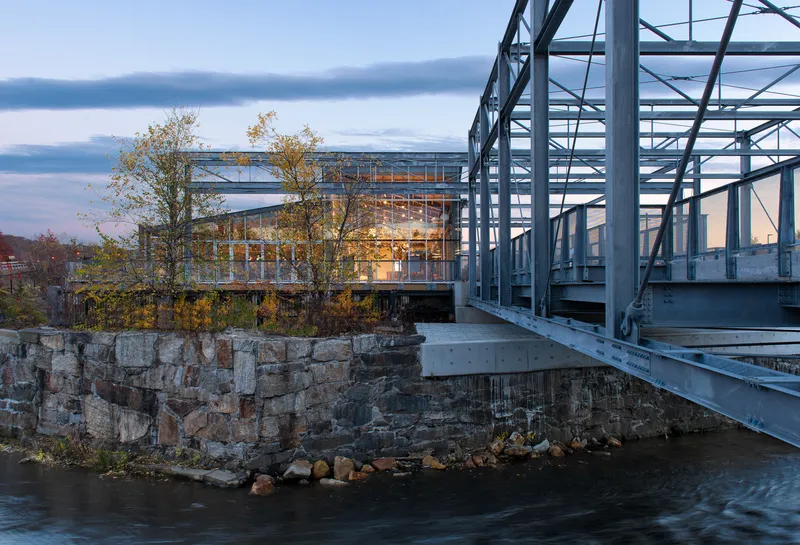
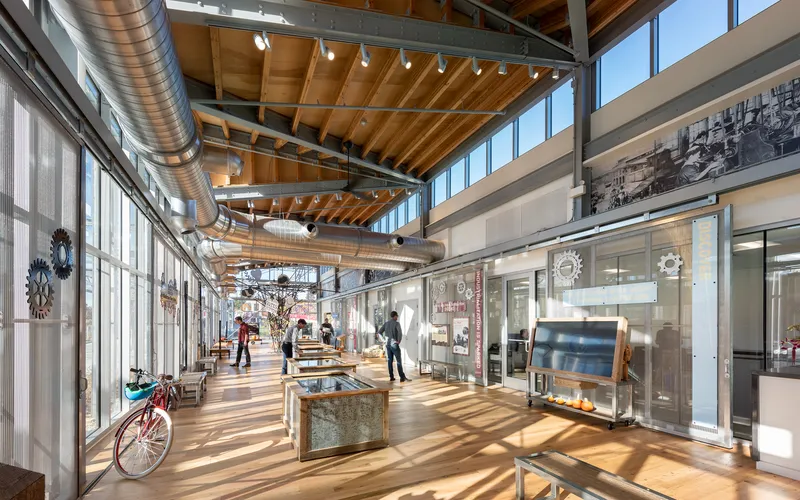
- Visitor Center Building: A flexible structure housing exhibition spaces, classrooms, and offices
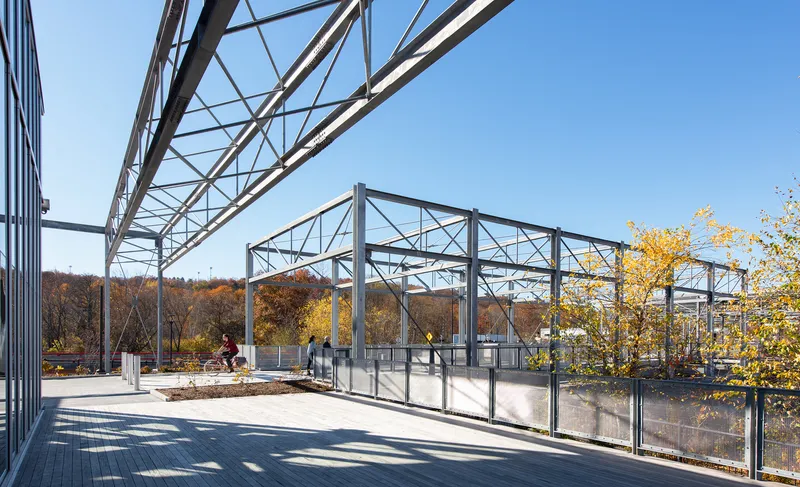
- Festival Lawn: An open green space for public gatherings and events
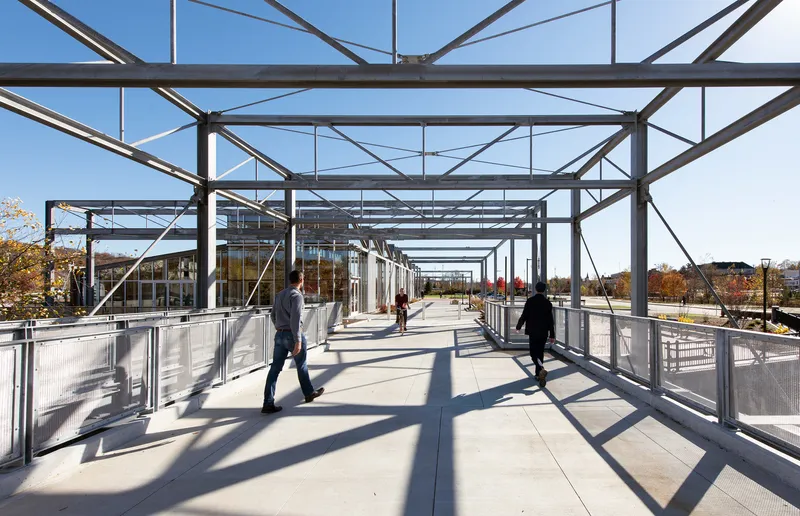
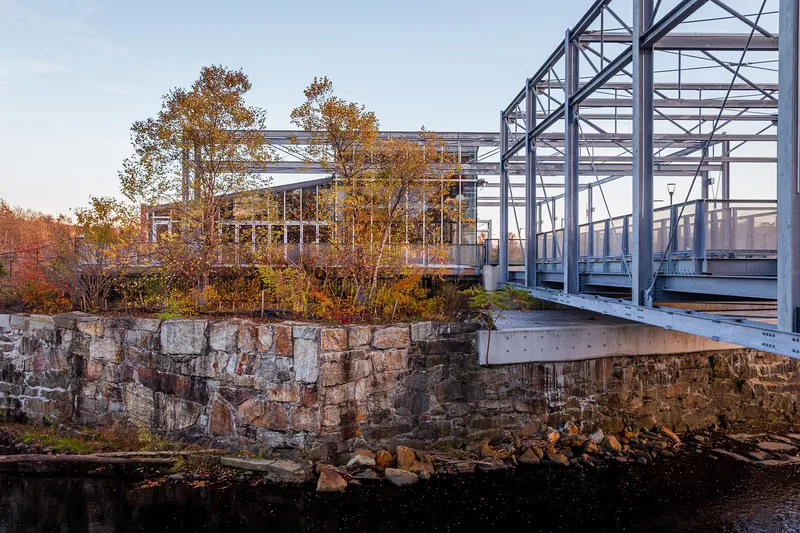
- Pedestrian Bridge: A connective element spanning the Blackstone River
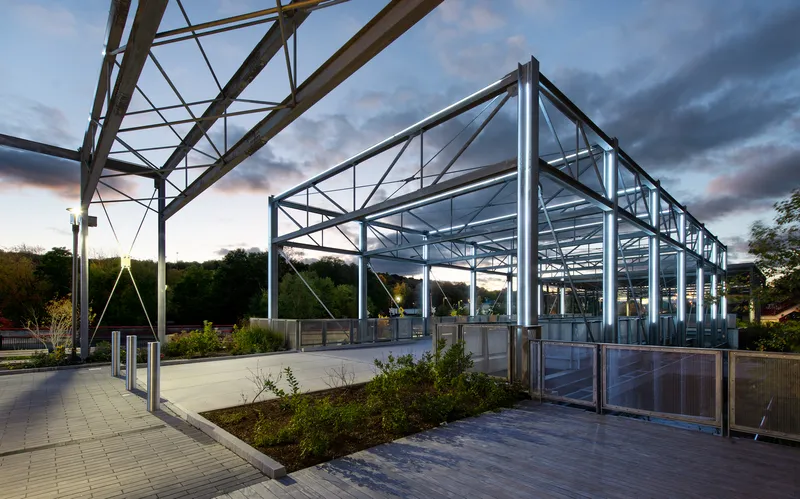
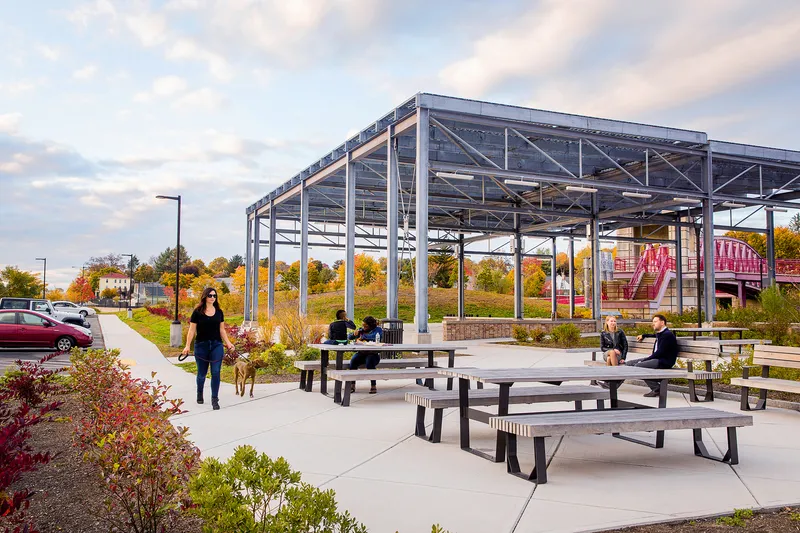
- Events Pavilion: A multifunctional plaza defined by a solar canopy
- Heritage Walk: A curated pedestrian and cycling path with interpretive installations
Together, these elements create a cohesive cultural landscape that encourages exploration, movement, and engagement.

Industrial Language Through Form and Materials
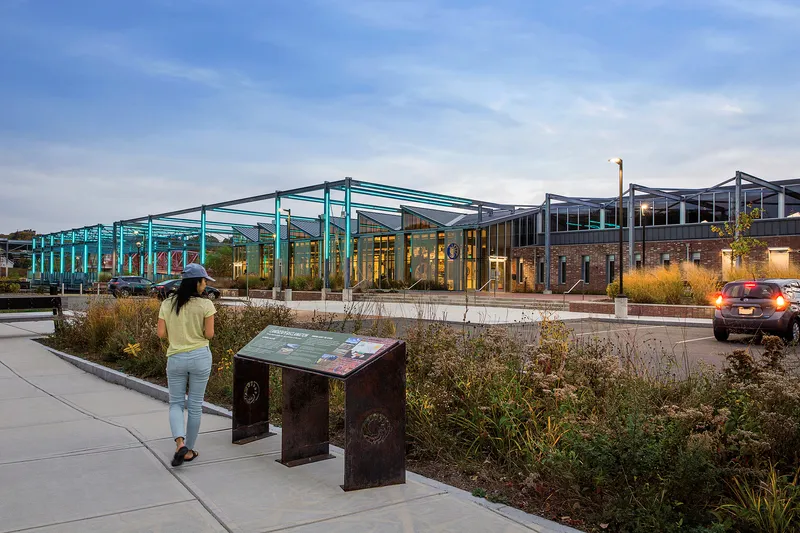
The architectural expression draws heavily from the site’s industrial past. Steel frames and wire-inspired detailing echo the legacy of wire manufacturing, while a series of large steel site frames visually reconstruct the scale of the former factory complex.
The visitor center’s folded roof is inspired by traditional sawtooth industrial roofs, referencing the original mill structures that once dominated the site. Reclaimed wood and brick, sourced from nearby industrial demolitions, further reinforce the narrative of reuse and continuity.
This careful layering of materials and forms creates a powerful sense of memory, transforming absence into presence through design.

Sustainable Design and Brownfield Remediation
A key aspect of the project is its commitment to sustainability and ecological restoration. The site, previously damaged by decades of industrial use, has been rehabilitated through thoughtful landscape strategies and environmentally responsible building systems.
Native plantings, permeable surfaces, and sustainable construction methods work together to repair the land while reducing environmental impact. The integration of a solar array within the events pavilion highlights the project’s forward-thinking approach to renewable energy.
This transformation from industrial brownfield to sustainable public space reflects a broader shift in contemporary architecture, one that prioritizes regeneration over extraction.

Community-Centered Architecture
Beyond its architectural and environmental achievements, the Worcester Blackstone Visitor Center plays a crucial social role. It reconnects the surrounding Quinsigamond Village community with its heritage, offering a place for reflection, gathering, and storytelling.
The project fosters a renewed relationship between people and place, allowing visitors to engage with both the past and the evolving identity of the community. It is not just a building, but a platform for collective memory and future narratives.

Architecture as Healing
Ultimately, the Worcester Blackstone Visitor Center represents architecture’s capacity to heal, both land and community. By transforming a site marked by industrial decline into a sustainable and inclusive public space, the project bridges history and modernity.
It stands as a compelling model for how architecture can preserve cultural identity, promote sustainability, and create meaningful civic spaces in post-industrial contexts.
All photographs are works of
Chuck Choi, Raj Das


Popular Articles
Popular articles from the community


The Amber Palace Opera: A Geological Fiction Surfaces on Tallinn's Baltic Waterfront
Pierre Brillard reimagines a Baltic legend as a public landscape, opera house, and waterfront promenade rooted in Tallinn's coastal identity.


graciastudio Turns a Viewless Tijuana Lot Inward Around a Courtyard of Concrete, Timber and Trees
In Tijuana, Jorge Gracia's GA2 House stacks a timber-clad private floor over exposed concrete and replaces a missing view with a planted interior patio.

Cube Design Draws an Ecological Corridor Between Two Shenzhen Hills with the Nankai Building
Beside Shenzhen's container docks, the Nankai Building pairs stacked balconies with a climbing green screen to connect two hillsides across its height.

Singing Woman: An Opera House That Performs Before the Curtain Rises
Ovidiu Cristian Pavel's conceptual opera house translates Estonia's choral identity into a sculpted waterfront landmark facing the Baltic Sea.

Similar Reads
You might also enjoy these articles
Cube Design Draws an Ecological Corridor Between Two Shenzhen Hills with the Nankai Building
Beside Shenzhen's container docks, the Nankai Building pairs stacked balconies with a climbing green screen to connect two hillsides across its height.

Praksis A and Studio Sted Bend a Red Timber Cabin Across the Granite of Norway's Southern Coast
On the southern Norwegian coast, a 105 m² cabin follows the rock on slender posts, pairing red cladding outside with pine, brick and plywood within.

David Ortega Stacks a Two-Story Mexico City Penthouse Around a Steel Stair and a Pergola-Shaded Roof Terrace
In Colonia Roma, a 300 m² penthouse uses oak joinery, a planted steel stair and a slatted roof pergola to make a new-build apartment feel like a house.

PARALELA and LB2 Thread a Public Walkway Through the Base of a Las Condes Residential Tower
In Las Condes, Santiago, the Hamlet Building gives its fenceless ground floor to a 70-metre wooded passage linking two streets and the metro.

Explore Architecture Competitions
Discover active competitions in this discipline

Challenge to reimagine the Iron Throne

Photograph architecture without architects

Illustrate the lost glory of Angkor Wat - Render Challenge

Design challenge to reuse E-waste
Comments (0)
Please login or sign up to add comments
No comments yet. Be the first to comment!