
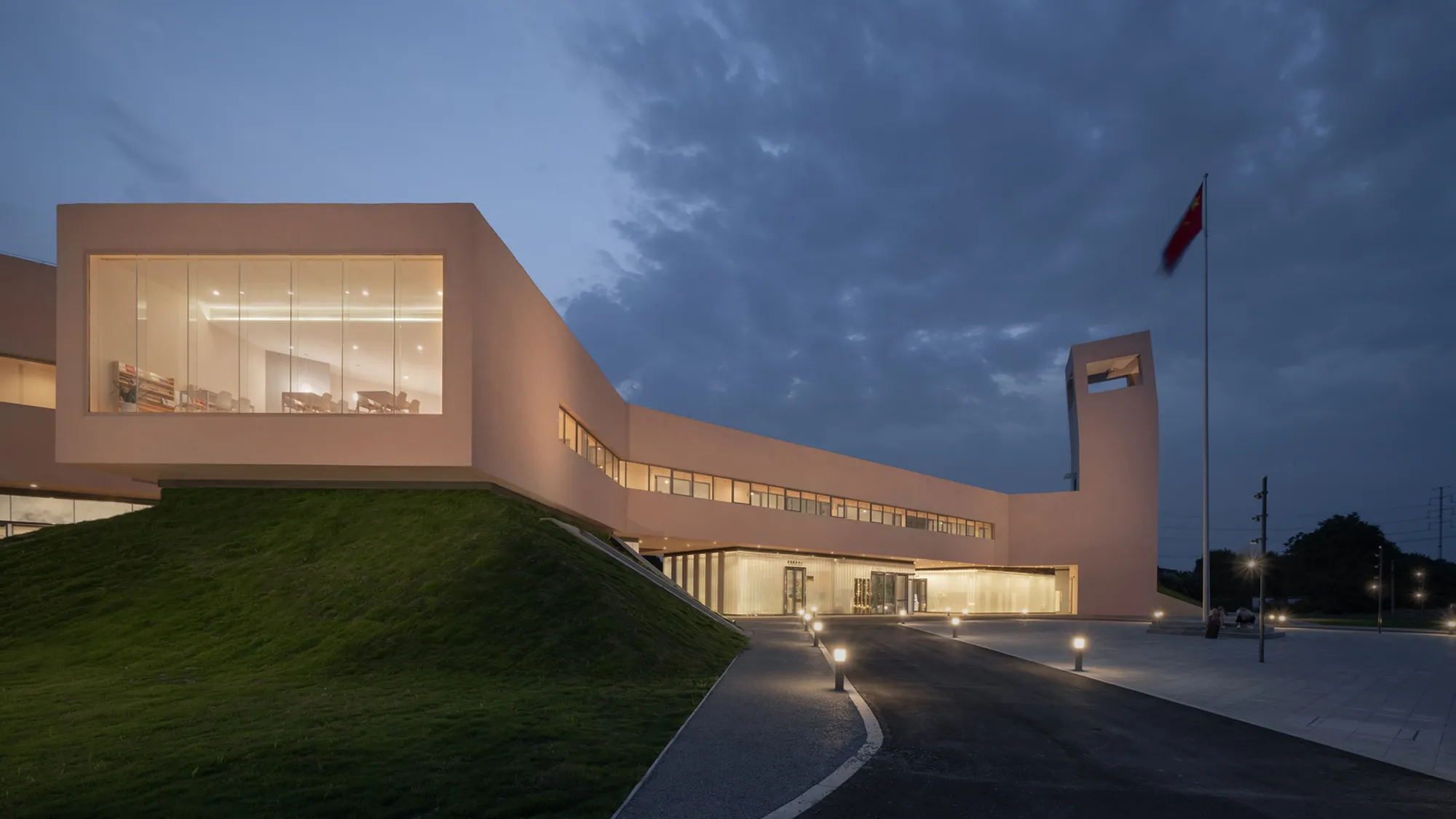
Xue Village Community and Tourist Service Center by Studio 10 – A Landmark of Rural Revitalization and Cultural Tourism
A transparent, landscape-integrated community and tourist center blending public services, cherry blossom views, and landmark architecture with floating volumes and an observation tower.


The Xue Village Community and Tourist Service Center, designed by Studio 10, stands on a triangular site in Xue Village, Wangcun Town, Xingyang City, Henan Province. Covering 2,500 m², the project sits near the central section of the South-to-North Water Diversion Project, one of China’s most influential water infrastructure systems. This unique location shapes both its architectural identity and its social purpose.
To the southwest, diverted water from the Danjiangkou Reservoir flows northward through an engineered channel and tunnels beneath the Yellow River. Emerging several kilometers away, it continues its journey to support surrounding regions. Positioned between this massive water system and the scenic cherry blossom forest on the southern bank of the Yellow River, the center becomes a vital gateway for both residents and seasonal tourists.


A Dual-Purpose Hub for Residents and Visitors
Each April and May, the cherry blossom forest draws thousands of visitors, transforming the quiet village into a vibrant seasonal destination. To meet this growing demand, Studio 10 designed the center as a hybrid community hub—combining essential resident services with tourist amenities. The building integrates administrative spaces, senior care facilities, community rooms, a library café, and public restrooms, creating a shared civic nucleus.
The site’s narrow north–south orientation, commonly used by villagers as a marketplace, inspired a design strategy prioritizing public accessibility, open circulation, and landscape continuity. Flanked by a green ecological belt to the west and farmlands to the east, the project maintains the natural, undulating terrain while enhancing the public character of the space.

Floating Volumes and Light-Filled “Boxes”
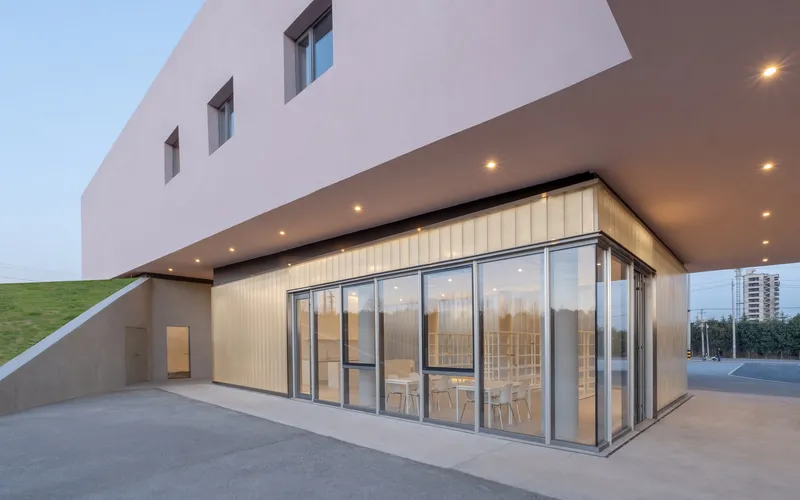
To soften the elongated site and avoid visual heaviness, the architects distributed key public programs within a series of semi-translucent and semi-reflective “boxes” on the ground floor. These lightly scaled volumes create a green, porous, and fluid environment supporting both community life and visitor flow.

Above them, a long floating volume houses offices, staff areas, and the village history exhibition hall. The northern end lifts gently to form a multi-purpose auditorium with stepped seating. A full-height glazed wall frames views toward the landscape, while an exterior staircase leads down to a stepped plaza and garden berm.
Observation Tower as a New Village Landmark
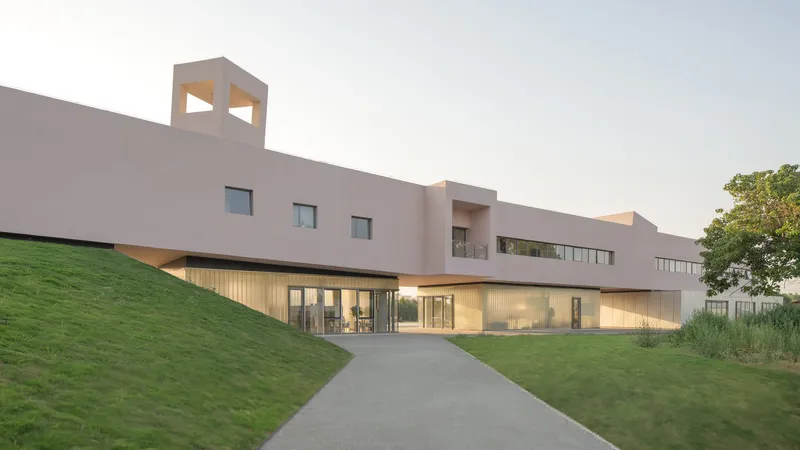
Xue Village consists of seven dispersed hamlets, and the site is separated from the main community and the blossom forest by Cherry Blossom Avenue and the Yellow River Expressway. To overcome this separation and strengthen its presence, Studio 10 transformed the stairwell beside the history exhibition hall into a striking observation tower.
This tower acts as:
- A visual landmark recognizable from a distance
- A wayfinding beacon for visitors
- A community identity marker
- A viewing platform overlooking both the water diversion project and the cherry blossom landscape
From the tower, visitors witness both human engineering achievement and natural beauty—an architectural narrative that blends nature and infrastructure.
A Roof Terrace for Daily Life and Emergency Use
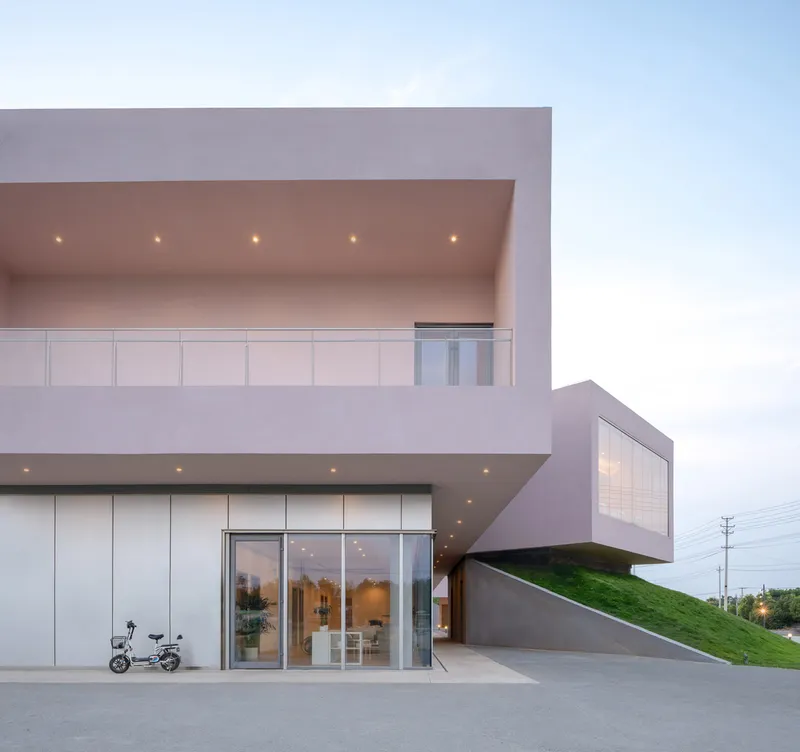
The roof of the upper massing doubles as a public accessible terrace. Villagers and tourists reach it via the observation tower staircase. In addition to serving as a daily leisure platform, the terrace is also designed as an emergency refuge area during extreme weather or natural disasters, reinforcing the building’s civic responsibility.
Materiality: Transparency, Reflection, and Concrete Craft
The project’s material palette strengthens its identity as a community landmark:
Ground Floor “Boxes”
- Made of semi-transparent channel glass to blur boundaries between interior and surrounding farmland
- Enhanced public accessibility and openness
- Southern senior-care areas use semi-reflective aluminum panels to maintain privacy while reflecting sky and greenery
Upper Volume and Tower
- Clad in colored cast-in-place concrete, echoing the industrial scale of the nearby water conservancy project
- Concrete walls feature petal-shaped punched openings and bas-relief textures
- Light filtering through skylights creates a poetic effect reminiscent of falling cherry blossoms


All photographs are works of Chao Zhang




Popular Articles
Popular articles from the community


The Ocean Hive: Sustainable Architecture for a Self-Sufficient Civilization at Sea
The Ocean Hive imagines sustainable architecture at sea, where modular habitats, algae, wave power and ocean waste sustain a growing colony.

The Earth Pod: 3D Printed Homes for Resilient Refugee Communities
The Earth Pod reimagines refugee housing through 3D printed homes made from clay, combining resilience, self-sufficiency, and rapid shelter.

Riyadh For All: Intergenerational Urban Design for Active Aging in Rabat
Riyadh For All reimagines urban design in Rabat with intergenerational co-living, adaptive courtyards, and Moroccan cultural exchange today.

Co-life: Sustainable Architecture for Age-Friendly Community Living
Co-life reimagines sustainable architecture for seniors through courtyards, rammed earth, shared gardens, and spaces designed for belonging.
Similar Reads
You might also enjoy these articles


Hodi-Mandai Geram
Project Function: Preservation and revitalization of the Intangible heritage and socio-spatial identity of the Hodi by Housing, Cultural Memory Center, Sacred Grove, landscape, local tourism economy


Olio Towers: A Mid-Rise for Performers That Fuses Housing, Rehearsal, and Stage
Located blocks from Houston's Theater District, this modular tower stacks living units around a central performance atrium.

Oasis: Modular Green Housing Carved into Dhaka's Urban Fabric
A shortlisted Plugin Housing entry reclaims unauthorized settlements in Dhaka with stepped concrete volumes, green roofs, and ventilation-driven design.

Black Hole: A Floating Megastructure for the Post-Physical Era
Emiliano Mazzarotto envisions a spherical, self-scaling arena where e-sports, digital hotels, and holographic stadiums replace traditional public space.


Explore Sustainable Design Competitions
Discover active competitions in this discipline



Challenge to reimagine the Iron Throne


Photograph architecture without architects


Illustrate the lost glory of Angkor Wat - Render Challenge


Design challenge to reuse E-waste
Comments (0)
Please login or sign up to add comments
No comments yet. Be the first to comment!