
BEYOND INDIGO:CARRYING THE LEGACY INTO THE FUTURE
This thesis explores the integration of industrial production with the rhythms and principles of nature, focusing on a denim manufacturing facility in Bangladesh. “Working in the Echoes of Nature” reimagines the conventional factory as a responsive, environmentally conscious space where architecture mediates between heavy industry and ecological balance.
Project Media
PROJECT INTRODUCTION
The study explores the socio-economic impact of the industry, emphasizing employment generation, women’s empowerment, technological advancement, and export growth. At the same time, it addresses existing challenges related to worker safety, health, environmental concerns, and workplace quality. An approach to carrying the reputation of denim producers on global stages with a highly efficient human-centric working environment is given to the workers.
DESIGN PROCESS
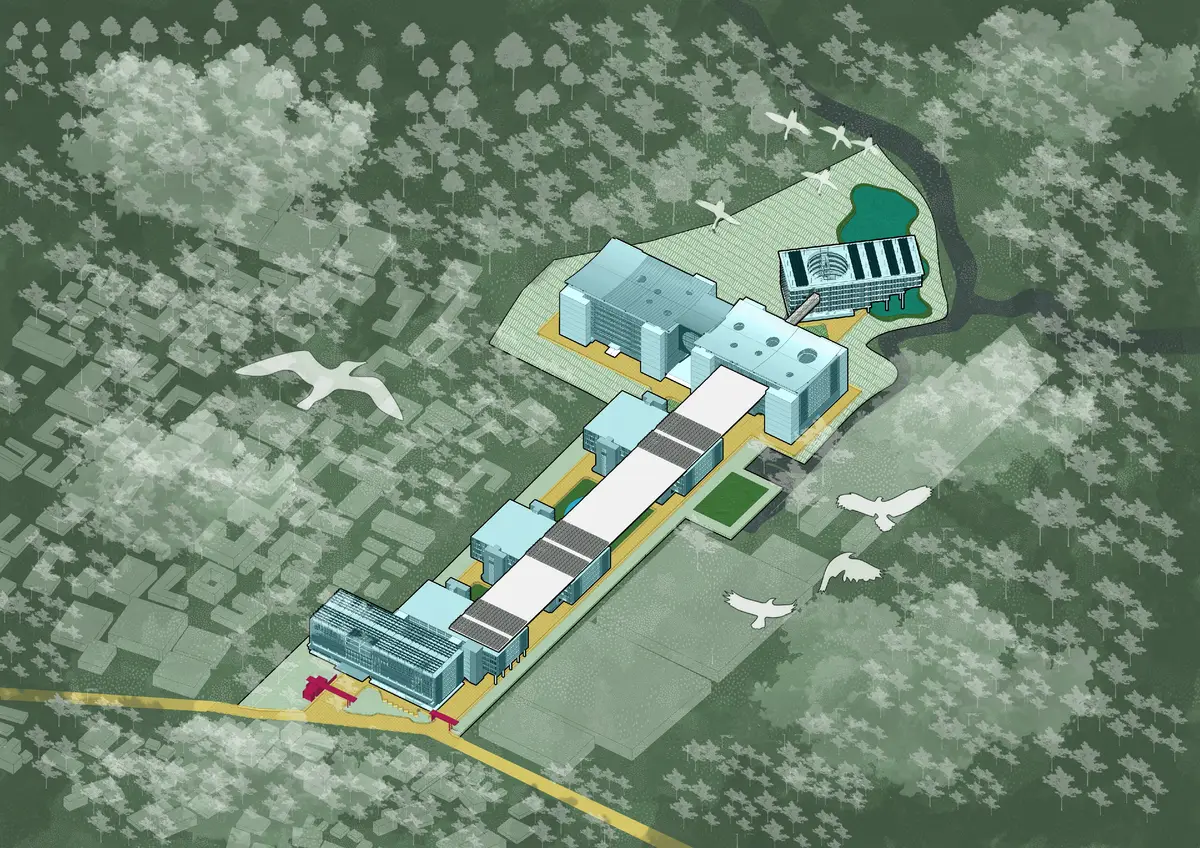
The masterplan responds to critical industrial and environmental parameters by ensuring fire-safe massing, efficient worker movement, optimized production flow, and streamlined distribution networks. A continuous industrial loop, reinforced through an integrated bridge system, enhances operational connectivity. North–south building orientation reduces heat gain, while an artificial water body between the masses provides evaporative cooling, stormwater retention, ecological landscape regeneration
GROUND FLOOR PLAN
The massing strategy prioritizes fire safety, clear entry–exit routes, and the management of high worker density. A central open courtyard and landscaped pockets introduce daylight, ventilation, and visual relief within the industrial environment. The buildings are oriented along the north–south axis to minimize heat gain and improve environmental performance.
EXPLODED DIAGRAM
The design integrates natural ventilation, daylighting, green façades, and rooftop gardens to create a healthier and more comfortable working environment. Sustainable features such as solar panels, steel mesh shading systems, and energy-efficient building materials help reduce heat gain, lower energy consumption, and minimize the factory’s environmental impact. Material variation in facade making has great impact in energy efficiency.
LONGITUDINAL SECTION
A worker can comfortably work in 25-27 degree celcius, which mostly depends on building orientation and facade. All buildings designed with north-south orientation, a smart facade system cuts the sun glare, green integration in the facade also adds a special feature like quality views, and air. Ventilation is one of the most concerning issues in production, which has been solved by smooth airflow among the masses.
AMINITIES BUILDING
A central circulation core, highlighted by the prominent spiral ramp and stair system, encourages movement, visual connectivity, and social interaction among workers across different levels.The roof structure incorporates solar panels and a sawtooth profile that optimizes daylight harvesting and renewable energy generation.Community-focused amenities such as training facilities, recreation spaces, medical services, daycare, and dining areas are strategically integrated within the building.
ILLUSTRATION's
Some stories are illustrated with spaces, facades, and many more, carrying a historic footprint of Bengal clothing. Indigo Revolution, muslin, and many historical footprints are illustrated within the page. in this illustration, an approach to not feeling the industrial heaviness, where nature merges with architecture, some fairy feelings are animated in the architect's mind.

Project Score
Project Team (1)


Project Owner
PUBLISHED ON 12th June 2026

Explore Sustainable Design Competitions
Discover active competitions in this discipline


Challenge to reimagine the Iron Throne

Photograph architecture without architects

Illustrate the lost glory of Angkor Wat - Render Challenge

Design challenge to reuse E-waste
Similar Projects
Discover related projects you might like


![Factory[n]Certainty](https://img.uni.xyz/eyJidWNrZXQiOiJ1bmktcHJvamVjdHMiLCJrZXkiOiIxMy8yNDE2ZGY4Ny0zOWE4LTQxNGQtYTkyMS03YmMyMDdlN2M3ODYvc2lhbTIyMDI2LTA2LTMwVDIwLTI4LTE4LTQyNzgyMC5wbmciLCJlZGl0cyI6eyJyZXNpemUiOnsid2lkdGgiOjUwLCJmaXQiOiJjb3ZlciJ9LCJqcGVnIjp7InF1YWxpdHkiOjEwfSwid2VicCI6eyJxdWFsaXR5IjoxMH0sImZsYXR0ZW4iOmZhbHNlLCJub3JtYWxpc2UiOmZhbHNlfX0=)


Comments (4)
Please login or sign up to add comments
One of the illustrations is particularly memorable, with a very distinctive and engaging visual style.
Thank you so much mam, it’s so much inspirational to see this complement.
A strong and well-researched thesis that thoughtfully connects industrial production with environmental and human wellbeing. Further integration of the many sustainable strategies into a clearer architectural language could make the proposal even stronger.
Appreciate sir, feeling honoured, Your complement trully demonstrated my hardwork clearly.