
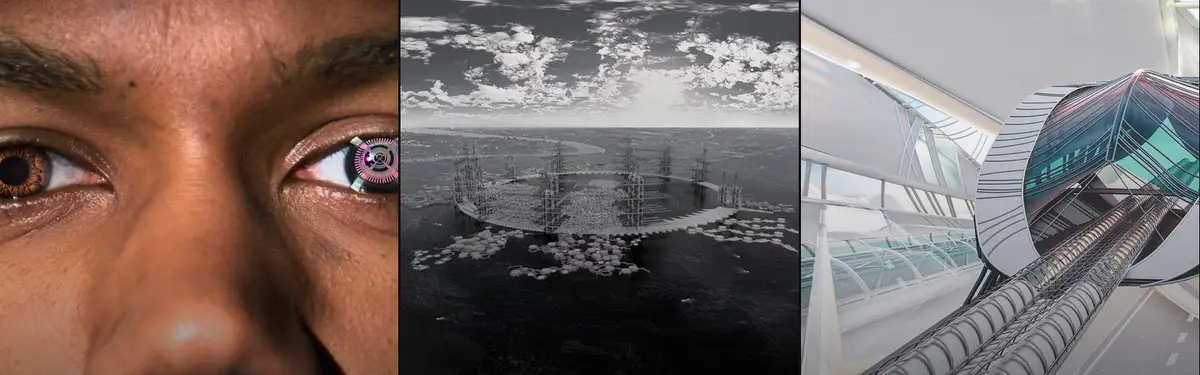


Neo Futurism
Design and architecture exploring speculative futures through technological innovation, sustainability, and reimagined social systems.
Neo-futurism is a late 20th and early 21st century movement in architecture and design that treats advanced technology, engineering and new materials as the starting point for expressive, dynamic form. It takes the optimism of the early Italian Futurists, filters it through the high-tech and space age architecture of the 1960s, and arrives at the sweeping curves, sculpted structures and computer-generated geometries associated with architects such as Zaha Hadid and Santiago Calatrava.
What is neo-futurism?
Neo-futurism is a named style with a lineage, not a general label for anything that looks new. The Wikipedia entry on neo-futurism describes it as a movement in the arts, design and architecture with roots in the mid-century structural expressionism of Alvar Aalto and Buckminster Fuller, and as partly an evolution out of high-tech architecture. Where high-tech buildings put their structure and services on display as a kit of parts, neo-futurist buildings tend to fold structure, skin and space into one continuous gesture: a roof that becomes a wall, a column that branches like a tree, a floor that rises into a ramp.
Three ideas hold the style together. Technology is a source of form rather than a finish. Movement, whether of people, vehicles or the eye, is expressed directly in the building's lines. And the future is approached with confidence: neo-futurist projects assume that engineering and design can make cities better places to live.
It also helps to say what neo-futurism is not. It is not the same as the Italian Futurism of 1909 to the First World War, which was bound up with a glorification of war and speed. It is not a synonym for speculative or science fiction design in general, which uni.xyz covers under futuristic design. And although it overlaps with parametric design, parametric tools are a method, while neo-futurism is an attitude to form and to the future.

A short history of neo-futurism
The story starts with Futurism itself. Filippo Tommaso Marinetti published the Manifesto of Futurism in 1909, and the young architect Antonio Sant'Elia translated its cult of the machine into drawings of a new city: stepped housing blocks, external lifts and traffic on several levels. The history of Futurist architecture records that Sant'Elia built very little and was killed in the First World War, but his Città Nuova drawings of 1914 translated the Futurist vision into urban form.

After the Second World War the futurist impulse returned in a different key, fed by the space age, car culture and new materials. Eero Saarinen's TWA Flight Center in New York, completed in 1962, wrapped an airport terminal in a thin concrete shell shaped like a pair of wings on four Y-shaped piers. In London the Archigram group (Peter Cook, Warren Chalk, Ron Herron, Dennis Crompton, Michael Webb and David Greene) produced paper projects for plug-in, walking and instant cities, and Cedric Price's unbuilt Fun Palace of 1961 fed into Richard Rogers and Renzo Piano's Centre Pompidou. Neo-futurism grew directly out of this high-tech generation.
The style regained momentum around the turn of the millennium, when computer modelling made complex curved geometry buildable. Zaha Hadid, whose Vitra Fire Station in Weil am Rhein was completed in 1993, received the Pritzker Architecture Prize in 2004, and Calatrava won the 1991 competition that grew into the City of Arts and Sciences in Valencia. In 2007 the designer Vito Di Bari wrote a Neo-Futuristic City Manifesto for Milan's Expo 2015 bid, describing the approach as a cross-pollination of art, technology and ethical values.
"At the same time as a restless society pushes architecture by posing a new set of characteristic problems, the new digital design tools pull architecture into an uncharted territory of opportunity."
Key principles of neo-futurism
No manifesto binds every neo-futurist designer, but the built work and the strongest student projects share a recognisable set of moves. The examples below come from members' work on uni.xyz and from landmark buildings.
Form that expresses movement
Futurism celebrated speed, and neo-futurism still draws buildings as if they were in motion. Long unbroken lines, tapering ends and aerodynamic sections suggest flow even in a static structure. Transport buildings are the natural testing ground, because the movement is real. HYPERSTEM by Tiffany Nguyen and Dallal Thibian argues that hyperloop technology calls for a redefined building type, and gives its station a streamlined shell that reads like the vehicle it serves.

Structure as sculpture
Neo-futurist engineering is meant to be seen. At Valencia, Calatrava's own project description explains that five concrete "trees" branch out to carry the roof of the science museum, and that the planetarium is shaped like a human eye set in a pool, with an "eyelid" of movable metal slats. The structure does the work and carries the image at the same time.
Technology as the generator of form
Digital modelling, simulation and fabrication let designers draw and build surfaces that could not be set out by hand. In Hadid's work this produced folding concrete landscapes such as the Phæno science centre in Wolfsburg. In student work the same tools produce shapes that are closer to living matter. Parallel Universe by Rowan Elselmy, a winning entry in the Visualization '22 competition, explores how humans and robots might share a designed world, and renders it as smooth, organic archways and reflective water.

Continuity of ground, wall and roof
Hadid spoke of opening up the ground plane and treating it as an artificial landscape. Many neo-futurist buildings lift their mass off the ground on a few supports, or let the floor rise into ramps and terraces, so the city flows underneath and through them.

Optimism with an ethical brief
Di Bari's manifesto tied the style to quality of life and sustainability, and recent work tends to pair technology with ecology. Projects now ask who the technology serves: residents, the climate, or only the image of progress.
Neo-futurism on uni.xyz
Members on uni.xyz rarely design a neo-futurist building for a client brief. More often they use the style's tools, curved structure, modular systems and visible technology, to test what architecture could be when work, transport or disaster changes the rules. The projects and journals below show the range.
URGENCYCLE by Ekin erdogan, the most liked project in this topic and a winning entry in the Re-Shelter competition, starts from the uncomfortable interval between a disaster and reconstruction, when people struggle to meet basic needs. It uses futurist imagery for a humane purpose: shelter for the period when life freezes.
Synchronicity by Roger Chanin, a winning entry in the Breaking Work - Singularity competition, explores an efficient future where humans and artificial intelligence work together to create utopia, and places its skyscraper in Seoul. Its images stack timber-framed modules, terraces and planting into a single vertical city.

Liberty Utopian Network (LUN) by Alessandro Cece, Dina Muneer Nemer Alhasan and Alaa Moustapha El-Khatib received the Institutional Excellence Award in the Hybrid Futures '19 - Work x Fly competition. The team worries that freedom might become scarce in an age of AI, and answers with a community that is fluid in form and in how its functions are distributed. The uni.xyz journal on LUN describes spherical modular hubs that connect, disconnect and reconfigure along a tri-core vertical spine.
made of water. by Zé Pedro, recognised as Best in Region at UnIATA '20, responds to wildfires that burn vast areas and cost human and animal lives. Its monumental concrete towers and suspended spheres show the darker, more monumental side of the style.

NEW HOUSTON by Congyue Zhou, an Organizer's Choice Award winner in the Origyn competition, imagines the first self-dependent space settlement, planned for 2040, as a step toward humans becoming an interstellar species. The journal Curved-Living covers another Origyn entry, by Yakup Cesur, which takes cues from the Neolithic settlement of Çatalhöyük for a rotating habitat built from 3D-printed recycled debris.
Some of the clearest neo-futurist thinking appears in the journals. One journal opens with a question that sums up the style's biological turn:
"What if a skyscraper behaved less like a building and more like a tree?"
uni.xyz journal, Parallax of Time & Space
The project it describes, Parallax of Time & Space by Ahmad Wasi, sets a cluster of tree-shaped towers in Bangkok, with circular platforms cantilevering from central cores, elevated roadways and VTOL pods docking at altitude, while the ground is given back to forests and water systems. It is a direct descendant of Sant'Elia's multi-level city, redrawn for a hotter, wetter century.
Trails by Debarpan Dey, an Editor's Choice in the Superimpose competition, takes the opposite view: a near future of flying cars, oxygen crisis and isolated people, told as a story in neon-lit corridors.
Challenges and future directions
Neo-futurism's critics raise three recurring problems. The first is cost and buildability. Unique curved structures demand custom formwork, complex steel and long engineering programmes, and the gap between the competition render and the built building can be wide. The second is energy. Large glazed shells and sculptural concrete carry a heavy carbon load, which sits awkwardly with the movement's claims about a better future. The third is context: a sculptural object can ignore the street around it.
The most interesting current work answers these points rather than ignoring them. Timber, recycled and lighter materials, robotic fabrication that makes repetition cheaper, and a stronger focus on public ground are all pulling the style toward responsibility. Members are also questioning the clichés of the future itself.
"This is a retro futuristic project that aims to avoid the usual representation of post-human architecture, typically associated with the image of eerie dystopian world."
Rowan Elselmy, project statement for Parallel Universe on uni.xyz
Another direction treats the building as a responsive system. Fluid Spaces by Hoda Ghoreyshi, an Honorable Mention in the CityScraper competition, imagines space formed by a self-optimising fluid shaped in a magnetic field according to layers of transport, work and living.

Neo-futurism for students and designers
Neo-futurism suits thesis projects that need a strong idea about technology and a building type under pressure from change: transport hubs, research stations, flood-proof housing, workplaces reshaped by AI, or habitats in orbit. The test of a good project is whether the form comes from the problem. Show the structural logic, explain how the geometry is built, and be honest about energy and cost. Study the lineage too: Sant'Elia's drawings, Archigram's collages and Calatrava's structural sketches are still the best teachers for the style's drawing language.
Ideas competitions are where most of the projects above began; browse open briefs on uni.xyz competitions. For related work, see space architecture and cyberpunk, the darker counterpoint to neo-futurist optimism.
Frequently asked questions
What is neo-futurism in architecture?
Neo-futurism is a late 20th and early 21st century architectural movement that uses advanced engineering, new materials and digital design to create dynamic, expressive forms. It developed out of high-tech architecture and the space age designs of the 1960s, and it is associated with an optimistic view of technology's role in city life.
What is the difference between futurism and neo-futurism?
Futurism was an Italian avant-garde movement founded in 1909 that celebrated speed and the machine; in architecture it produced mostly drawings, notably Sant'Elia's Città Nuova. Neo-futurism is the later, built movement that took up those themes with modern technology, without Futurism's political baggage.
Who are the main neo-futurist architects?
Zaha Hadid and Santiago Calatrava are the names most often linked to the 21st century revival. Eero Saarinen, Buckminster Fuller and the Archigram group are usually counted among the precursors, and Norman Foster, Renzo Piano and Richard Rogers share many of the high-tech themes the style absorbed.
Is neo-futurism the same as high-tech architecture?
No. High-tech architecture expresses technology by exposing structure and services as visible components. Neo-futurism grew out of it but tends toward continuous, sculpted surfaces where structure, skin and space merge into a single flowing form.
What are examples of neo-futurist buildings?
Well-known examples include Calatrava's City of Arts and Sciences in Valencia, Hadid's Phæno science centre in Wolfsburg, and, as an earlier precursor, Saarinen's TWA Flight Center in New York.
References and further reading
- Neo-futurism, Wikipedia
- Futurist architecture, Wikipedia
- Archigram, Wikipedia
- TWA Flight Center, Wikipedia
- Zaha Hadid, 2004 Laureate and her ceremony acceptance speech, The Pritzker Architecture Prize
- Ciudad de las Artes y de las Ciencias, Valencia, Santiago Calatrava Architects and Engineers


Popular projects
View all 25 projects


Latest journals
View all 57 journals
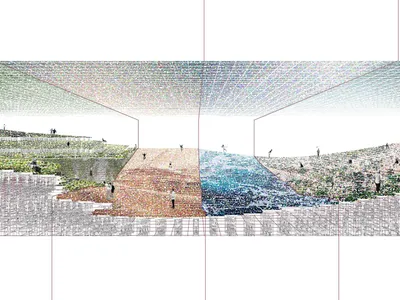
Retail in 2077: Architecture as Interface for a Dematerialized Economy
Junqiao Li imagines a modular grid of VR portals and advertising surfaces where commerce dissolves into spatial experience.
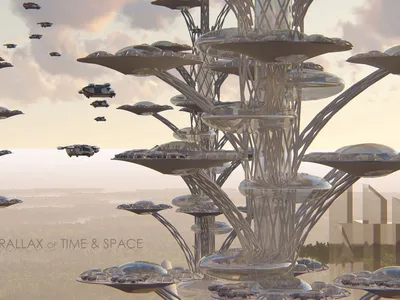
Parallax of Time & Space: Skyscrapers as Living Vertical Ecosystems
A biomorphic tower system in Bangkok lifts urban programs into the sky, freeing the ground for forests, flood resilience, and renewable energy.

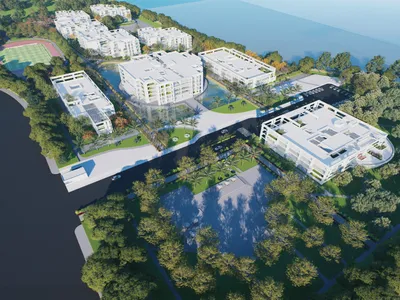
GAME-UTOPIA:
ENVISIONING IT INSTITUTE IN PHY-GITAL WORLD
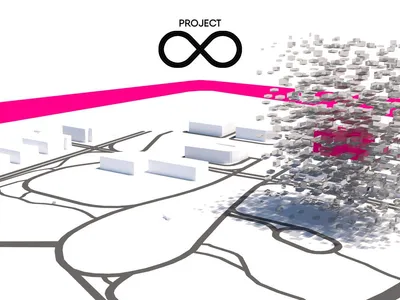
Project Infinity: Floating Architecture That Shields Archaeology While Building 2040
A People's Choice winning concept layers cantilevered canopies, AI-driven urban planning, and hybrid public spaces above ancient heritage sites.


